

Automotive
The Best Polishing Compounds: 4 Compared (and One to Skip)
We compared four cutting compounds and found three that state their cut as a sanding grit they can remove, and one that describes it with adjectives instead.
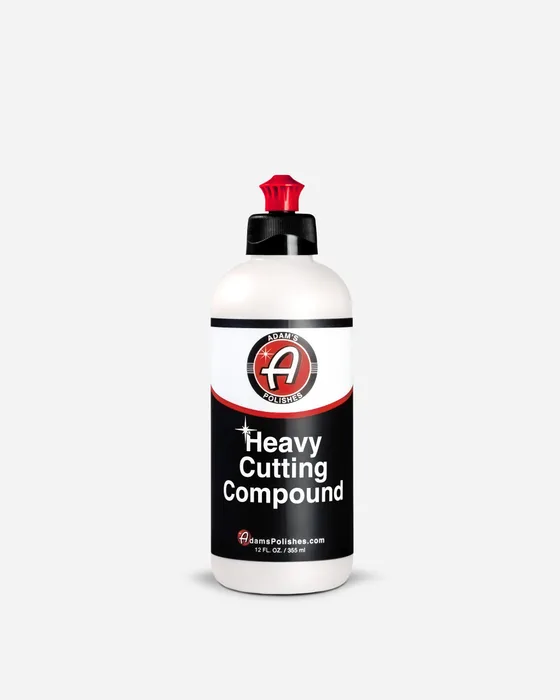
The short version
Adam's Heavy Cutting Compound is the pick: it removes 1000 to 1200 grit sanding marks, uses diminishing abrasives with no fillers or silicones so it is body shop safe, and the page gives an actual working procedure with times. P&S Ballistic Max Cut is the runner-up and the trade choice, removing 1000 grit sanding scratches or finer, cleared for rotary and DA with wool or foam, and sold by the quart. Meguiar's D300 is the depends pick: it is a fine correction compound aimed at light to moderate defects and it is designed around Meguiar's own DA Microfiber Cutting Disc, so it is half a system rather than a standalone bottle. Skip Chemical Guys C4. Its page calls it heavy-cut and moderately abrasive at once, ranks it below the brand's own V32, and its 1200 grit claim is a lighter cut than the two picks. Best for: anyone about to correct paint who has realised the compound and the pad are one decision.
Our picks at a glance
- Adam's Polishes Heavy Cutting Compound - Buy. States the sanding grit it removes, says the abrasives diminish, and tells you there are no fillers hiding the result.
- P&S Detail Products Ballistic Max Cut Compound - Buy. Removes 1000 grit sanding scratches, works on rotary or DA with wool or foam, and comes by the quart.
- Meguiar's DA Microfiber Correction Compound D300 - It depends. A fine correction compound built around one specific pad, which makes it half a system rather than a bottle.
- Chemical Guys C4 Clear Cut Correction Compound - Skip. Called heavy-cut in one line and moderately abrasive in the next, and Chemical Guys rates it below its own V32 for cut.
The verdict in 30 seconds
What mattered most
- Cut, stated as sanding grit
- Cut described as
- Abrasive type
- Fillers or silicones
- Machine cleared
- Pad pairing
A compound is abrasive in a bottle, and the only useful question about it is how much material it removes. Three of these four answer that in a checkable way, by naming the sanding scratch grade they will erase. The fourth describes its cut as super-micro, which is an adjective rather than a measurement. There is no industry cut scale, so where a brand does not name a grit you are left comparing marketing language across bottles.
States the sanding grit it removes, says the abrasives diminish, and tells you there are no fillers hiding the result.
Best for: Serious defect removal on hard clear coat, and anyone who wants to know that the gloss they see afterwards is corrected paint rather than filler.
- Removes up to 1000 to 1200 grit sanding marks, a checkable statement of cut rather than an adjective.
- Diminishing abrasive technology, so the compound breaks down as you work it and finishes finer than it starts.
- No fillers or silicones, stated explicitly, which is what makes it body shop safe and means the finish you see is real.
- The page gives a working method: two to three cross-hatch passes over 40 to 60 seconds, then stop with the pad still in contact.
- Sold in 4 and 12 ounce sizes, so a full car correction goes through it quickly.
- Designed around the brand's own Heavy Cutting Wool Pad, though the instructions also list foam and microfiber cutting pads.
- Diminishing abrasives need to be worked for the full time to finish properly, which is slower than a non-diminishing product.
- The page claims an ultra-fine finish in as little as one step, but on deeper defects plan on a refining pass afterwards.
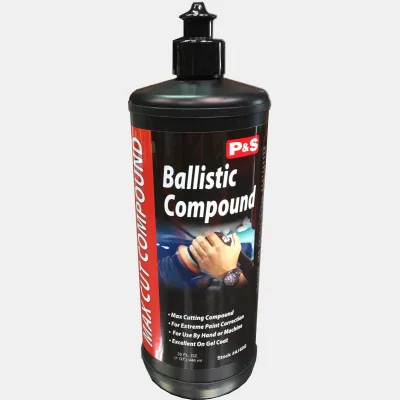
Removes 1000 grit sanding scratches, works on rotary or DA with wool or foam, and comes by the quart.
Best for: Professional and high volume correction, hard clear coats, and gel coat work where the extra aggression is the reason you are buying.
- Developed to remove 1000 grit sanding scratches or finer, alongside oxidation, fallout and water spots.
- Cleared for rotary as well as high action DA polishers, with either wool or foam cutting pads.
- Stated as suitable for harder paint finishes and gel coat, which widens it to boats as well as cars.
- Sold by the quart, which is the right quantity for anyone correcting more than one vehicle.
- No statement of whether the abrasives are diminishing or non-diminishing.
- Nothing said about fillers or silicones, which matters when you are judging your own work.
- Quart minimum, which is a lot of compound for a single correction.
- Max cut on gel coat and hard paint means it is more aggressive than a soft modern clear coat needs.
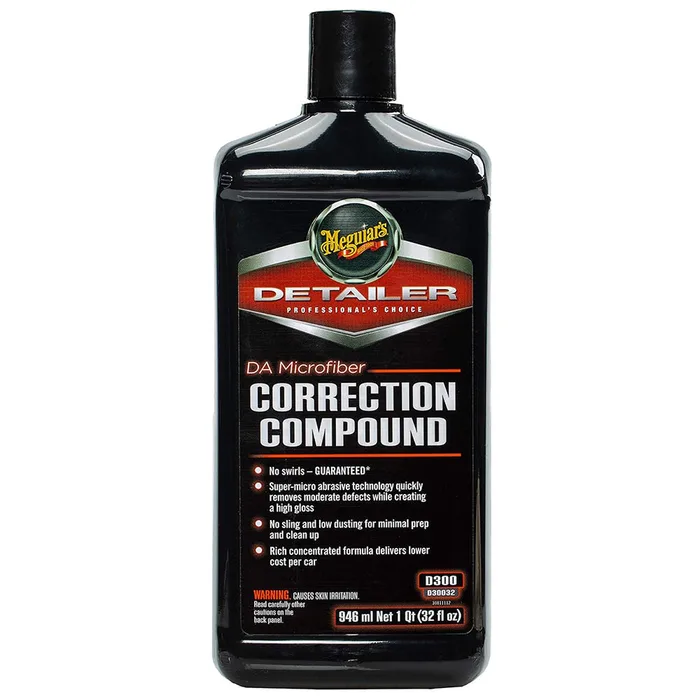
A fine correction compound built around one specific pad, which makes it half a system rather than a bottle.
Best for: Swirls and light scratches on a normal daily driver, especially if you are already running Meguiar's DA microfibre discs.
- Super-micro abrasive technology aimed at scratches, acid rain, swirls and holograms.
- No sling and low dusting, which is a real quality-of-life difference over a long session.
- Targeted at light to moderate defects, which is where most daily-driver paint actually sits.
- Part of an established DA system, so the pad and product pairing is settled for you.
- Designed for use with Meguiar's own DA Microfiber Cutting Disc, so buying the compound alone is buying half of it.
- No sanding grit reference, so its cut cannot be compared against the two compounds here that give one.
- Light to moderate defects means it is the least aggressive product in this comparison.
- Microfibre pads cut hard for their softness and tend to leave a haze that needs a foam refining pass.
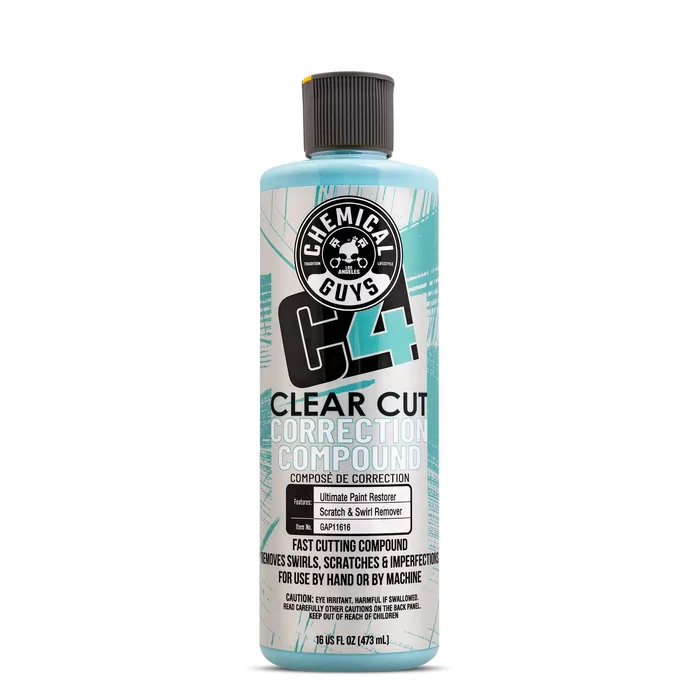
Called heavy-cut in one line and moderately abrasive in the next, and Chemical Guys rates it below its own V32 for cut.
Best for: Moderate correction followed by the brand's P4 polish, for buyers who want low dust more than maximum cut.
- Described as tackling scratches, acid rain marks, etching, swirls and holograms, which is the full defect list.
- Removes 1200 grit and finer sanding marks, works by DA, rotary or hand, and keeps a consistent cut from start to finish.
- Chemical Guys says it produces virtually zero dust, leaves minimal micro-marring and lets a coating bond properly afterwards.
- Sixteen ounce bottle, a sensible size for one car.
- The description calls it heavy-cut while the features call it moderately abrasive and less abrasive than the brand's V32.
- Its 1200 grit claim is a finer scratch than the 1000 grit marks the two picks quote, so it cuts less than its heavy-cut label suggests.
- Chemical Guys itself places it below its V32 compound, so a buyer who needs real heavy cut is pointed to a different bottle.
- No specific pad pairing suggested, on a product where the pad contributes as much cut as the compound.
| Criteria | Heavy Cutting Compound Top pick Buy it Buy | Ballistic Max Cut Compound Buy it Buy | DA Microfiber Correction Compound D300 It depends Buy | C4 Clear Cut Correction Compound Skip it Buy |
|---|---|---|---|---|
| Best for | Serious defect removal on hard clear coat, and anyone who wants to know that the gloss they see afterwards is corrected paint rather than filler. | Professional and high volume correction, hard clear coats, and gel coat work where the extra aggression is the reason you are buying. | Swirls and light scratches on a normal daily driver, especially if you are already running Meguiar's DA microfibre discs. | Moderate correction followed by the brand's P4 polish, for buyers who want low dust more than maximum cut. |
| Price tier | $$ · mid-range | $$ · mid-range | $$ · mid-range | $$ · mid-range |
| Cut, stated as sanding grit | 1000 to 1200 grit marks | 1000 grit scratches or finer | Not stated | 1200 grit and finer marks |
| Cut described as | Hyper cutting, with a grit figure | Max cut, with a grit figure | Super-micro abrasive, light to moderate defects | Heavy-cut, and moderately abrasive |
| Abrasive type | Diminishing | Not stated | Not stated | Consistent cut from start to finish |
| Fillers or silicones | None, stated, body shop safe | Not stated | Not stated | Not stated |
| Machine cleared | Not restricted | Rotary and high action DA | DA, with the brand's microfibre disc | DA, rotary or by hand |
| Pad pairing | The brand's Heavy Cutting Wool Pad | Wool or foam cutting pads | Meguiar's DA Microfiber Cutting Discs specifically | Not stated; follow with P4 Polish |
| Working method published | Yes, passes and timing given | No | No | Yes, drops and pressure given |
| Sizes | 4 oz, 12 oz | Quart | 32 oz | 16 oz |
Which one is right for you?
- Serious defect removal on hard clear coat, and anyone who wants to know that the gloss they see afterwards is corrected paint rather than filler. Buy it Adam's Polishes Heavy Cutting Compound
- Professional and high volume correction, hard clear coats, and gel coat work where the extra aggression is the reason you are buying. Buy it P&S Detail Products Ballistic Max Cut Compound
- Swirls and light scratches on a normal daily driver, especially if you are already running Meguiar's DA microfibre discs. It depends Meguiar's DA Microfiber Correction Compound D300
- Moderate correction followed by the brand's P4 polish, for buyers who want low dust more than maximum cut. Skip it Chemical Guys C4 Clear Cut Correction Compound
How we judged the field
Five things decide a compound. Cut comes first, and the only checkable form of it is a sanding grit the product will remove, which three of these four provide and one replaces with adjectives. Abrasive type comes second, because diminishing and non-diminishing abrasives are worked differently and finish differently, and knowing which you have changes your technique. Third is whether the product contains fillers or silicones, since those hide uncorrected defects for a few weeks and then let them reappear. Fourth is machine and pad clearance, because the pad contributes as much cut as the bottle does. Fifth is size, since correction uses far more compound than people expect.
The field splits by how aggressive the product is and by who wrote the page. Heavy cutting compounds sit at the top, aimed at sanding marks and deep defects, and three here quote grit grades to place themselves. Correction compounds sit below that for swirls and light scratches on daily drivers. Underneath the marketing, the real division we found was between brands that describe their abrasives and brands that describe their results, and that division turned out to predict how useful each page was.
Adam’s Polishes Heavy Cutting Compound
Buy itAdam’s Heavy Cutting Compound is the pick because its page reads like it was written by someone who uses it. The cut is stated as removing up to 1000 to 1200 grit sanding marks, which places it against any other compound that quotes a grade. The abrasives are described as diminishing, so they break down through the pass and the product finishes finer than it starts, which is why the page also gives a working method: two to three full cross-hatch passes over 40 to 60 seconds, then switch off while leaving the pad in contact with the surface. That last detail prevents sling and is exactly the kind of thing most pages leave you to learn by ruining a panel. Best of all it states no fillers and no silicones, and calls itself body shop safe, which means the gloss you see when you wipe the residue off is corrected paint rather than a temporary cosmetic. The costs are size, at 4 and 12 ounces, and the likelihood that deeper defects still need a refining pass after it, despite the page’s one-step claim.
P&S Detail Products Ballistic Max Cut Compound
Buy itP&S Ballistic Max Cut is the same claim aimed at people doing this for a living. It is described as a max cutting heavy duty compound developed to remove 1000 grit sanding scratches or finer, along with oxidation, fallout and water spots, and stated as suitable for harder paint finishes and gel coat. Gel coat is the tell: this is a product that also goes on boats, which means it is built for surfaces considerably harder than a modern soft clear coat. It is cleared for rotary as well as high action DA polishers with either wool or foam cutting pads, which is unusually specific and useful, since a compound that will not behave on a rotary is a real limitation in a body shop. It comes by the quart. What the page does not say is whether the abrasives diminish, or whether there are fillers or silicones in it, and on a professional product aimed at people who resell the finish, the silicone question is the one that matters.
Meguiar’s DA Microfiber Correction Compound D300
It dependsThe Meguiar’s D300 is the one to think about, because it is good and it is not really sold as a standalone product. It uses super-micro abrasive technology to remove scratches, acid rain, swirls, holograms and other light to moderate defects, and it is explicitly designed for use with Meguiar’s DA Microfiber Cutting Disc, delivering no sling and low dusting for minimal prep and clean up. Low dusting is worth more than it sounds over a full car, because compound dust settles into every panel gap and then has to be blown out. The catch is in that word designed. This compound was developed as one half of a pad and product system, and buying the bottle without the disc means using it outside the pairing it was tested in. It is also the least aggressive product here, aimed at light to moderate defects, and there is no grit reference, so its cut cannot be placed against the two compounds that give one.
Chemical Guys C4 Clear Cut Correction Compound
Skip itChemical Guys C4 is the one to leave, and it is a clean illustration of the category’s problem. The page describes a go-to heavy-cut compound for fast, effective paint correction that tackles scratches, acid rain marks, etching, swirls and holograms. The features list further down is more specific: it removes 1200 grit and finer sanding marks, works by DA, rotary or hand, keeps a consistent cut from start to finish, and comes with a short method of 4 to 5 drops worked until the product turns clear, followed by the brand’s P4 Polish. Chemical Guys also says it produces virtually zero dust, leaves minimal micro-marring and lets a coating bond properly afterwards, which is useful. The problem is that the page disagrees with itself about what it is. The headline calls it heavy-cut while the features call it moderately abrasive for medium scratches and less abrasive than the brand’s own V32, and its 1200 grit claim is a finer scratch than the 1000 grit marks both picks quote. No specific pad is suggested either, on a product where the pad supplies as much cut as the bottle. If you are buying a heavy-cut compound, the maker is telling you this is not its heaviest.
Sources
Specs in this review come from these pages.
- Adam's Heavy Cutting Compound product page (adamspolishes.com)
- P&S Ballistic Max Cut Compound product page (psdetailproducts.com)
- Meguiar's DA Microfiber Correction Compound D300 product page (meguiarsdirect.com)
- Chemical Guys C4 Clear Cut Correction Compound product page (chemicalguys.com)
- OSHA, Personal Protective Equipment (osha.gov)
Adam’s Polishes Heavy Cutting Compound vs P&S Detail Products Ballistic Max Cut Compound: which should you buy?
Adam’s Heavy Cutting Compound and P&S Ballistic Max Cut make almost the same cut claim and are built for different people. Both remove around 1000 grit sanding marks, which puts them in the same class and above the 1200 grit claim of the C4. Adam’s tells you more about the chemistry: diminishing abrasives, no fillers, no silicones, body shop safe, with a published working method that tells you how long a pass should take.
Ballistic answers with reach. It is cleared for rotary as well as DA and for wool as well as foam, it handles gel coat and harder paint than a modern car carries, and it comes by the quart. If you correct one car a year, the Adam’s 12 ounce bottle and its more detailed instructions are the better purchase, and the absence of fillers means you can trust what you see. If you correct cars regularly, or you have a rotary, or you work on boats, Ballistic covers ground the Adam’s page does not claim. On deeper defects, budget for a refining polish either way.
What to look for
- A sanding grit reference: removing 1000 grit marks is checkable, where heavy-cut and super-micro are adjectives with no scale behind them, and a lower grit number means a deeper scratch removed.
- Diminishing or non-diminishing, stated: it determines whether you work the product for a full cycle or stop when the defect clears.
- No fillers or silicones: fillers hide uncorrected defects for weeks and then let them reappear, and body shop safe is the phrase to look for.
- Machine and pad clearance: rotary compatibility is a real limitation for professionals, and the pad supplies as much cut as the compound.
- Whether it is tied to a specific pad: one product here is half of a system, and buying it alone means using it outside its tested pairing.
- Enough of it: correction uses far more compound than expected, and a 4 ounce bottle is a panel or two rather than a car.
Our final take
There is no industry scale for how much a compound cuts, so the useful brands invent one by quoting the sanding grit they can erase. Adam’s Heavy Cutting Compound is the pick because it does that at 1000 to 1200 grit, then adds what the others leave out: the abrasives diminish, and there are no fillers or silicones hiding the result. P&S Ballistic makes the same grit claim for professional volume and is the one to buy if you own a rotary or work on gel coat. Meguiar’s D300 is a capable fine compound sold as half of a pad and product system. C4 quotes a lighter 1200 grit cut while calling itself heavy-cut and moderately abrasive on the same page, and says nothing about fillers.
Questions, answered
What does removes 1000 grit sanding marks actually mean?
It is the clearest statement of cut available in this category. If a compound can erase the scratch pattern left by 1000 grit sandpaper, you know roughly how deep it works, and you can compare it directly against another compound making the same kind of claim. Three products here do that. The fourth describes its cut as super-micro, which sounds like a grade and is not, because no scale exists behind it. Where a grit figure is absent, you are comparing adjectives.
What is the difference between diminishing and non-diminishing abrasives?
Diminishing abrasives break down as you work them, starting coarse and finishing fine, so one product both cuts and refines if you work it for the full cycle. Non-diminishing abrasives stay the same size throughout, cutting consistently and finishing exactly as coarse as they started. Diminishing products reward the longer working time that Adam's publishes as 40 to 60 seconds; non-diminishing ones let you stop when the defect is gone. Only two pages in this comparison say which they are: Adam's is diminishing, and C4 states a consistent cut from start to finish.
Why does it matter whether a compound contains fillers?
Because fillers and silicones temporarily hide the defects you have not removed. The paint looks corrected while you are standing there, and then the fillers wash out over the following weeks and the swirls reappear. Body shop safe means the product contains none, which matters both for professionals, because silicone contamination ruins a respray, and for anyone judging their own work. Adam's states no fillers or silicones. The other three say nothing either way.
Do I need a separate polish after compounding?
Usually, yes, although Adam's claims a fine finish in as little as one step. A cutting compound removes defects and leaves its own finer scratch pattern behind, which reads as haze in direct light. The refining step uses a softer pad and a finer abrasive to remove that haze and bring up the gloss. Diminishing compounds narrow the gap because they finish finer than they start, and microfibre pads widen it because they tend to haze. Plan on two stages unless the paint was only lightly marked.
Can I use any compound with any pad?
Mostly, but the pairing changes the result more than people expect, since the pad contributes as much cut as the abrasive does. A heavy compound on a soft finishing pad will cut less and finish better; a fine polish on a wool pad will cut more than the bottle suggests. One product here is designed specifically around the manufacturer's own microfibre disc, which means buying it without that pad is buying half the system it was tested as.
Deciding between the top two? See our head-to-head: Adam's Polishes Heavy Cutting Compound vs P&S Detail Products Ballistic Max Cut Compound.
More in Automotive
Polishing Compounds, Explained Plain-English guide → Adam's Polishes Heavy Cutting Compound vs P&S Detail Products Ballistic Max Cut Compound Head-to-head →  The Best Polishing Pads: 4 Compared (and One to Skip)
  The Best Quick Detailers: 4 Compared (and One to Skip)
  The Best Radar Detectors: 4 Compared (and One to Skip)
  The Best Rinseless Washes: 4 Compared (and One to Skip)