Explained
Iron Removers, Explained
After reading, you'll understand what embedded iron is, why a wash cannot remove it, and how to use this chemistry without staining anything.
In this guide
If your paint still feels rough after a wash, the roughness is usually contamination sitting in the clear coat rather than dirt on top of it. A good share of that is iron: brake dust from your own car and everyone else's, and rail dust picked up on transport. It embeds, it rusts, and no soap has a mechanism to touch it. Iron removers dissolve it chemically, announce themselves by turning purple, and are sold with almost none of the specifications you would want.
The 30-second version
- The purple is dissolved iron, a real indicator of the reaction rather than a marketing dye.
- pH wording is the whole safety claim, and neutral is a narrower promise than balanced.
- Almost nobody publishes a dwell time, so work panel by panel and rinse before the product dries.
- Iron removal is not claying, because clay lifts the non-metallic contamination this chemistry leaves behind.
- Ventilation matters, since the thiol chemistry these products use smells strongly and is unpleasant in a closed garage.
The products this guide is about
Our verdict on each, with the full reasoning on the companion review.
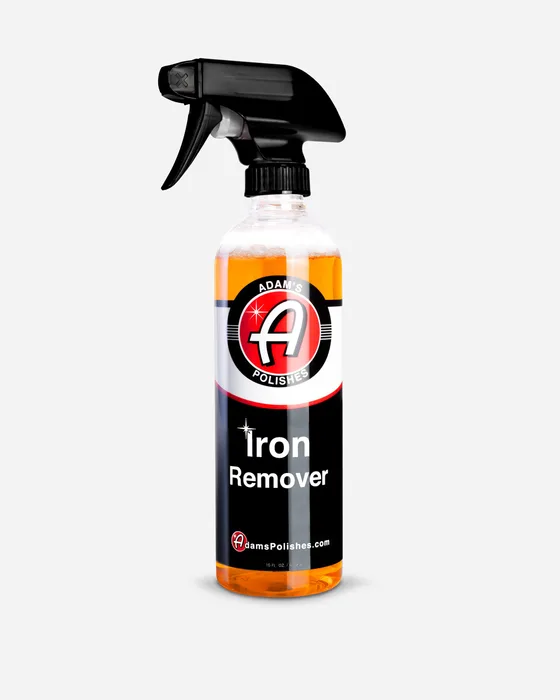
- Buy Adam's Polishes Iron Remover The most specific label in the category, and it points you at a different product for wheels. Amazon
- Buy P&S Detail Products Iron Buster Wheel & Paint Decon Remover One pH balanced product for wheels and paint, in sizes that assume you decontaminate more than one car. Amazon
- It depends Turtle Wax Hybrid Solutions Rapid-Decon Iron Remover, 23 fl oz A pH-neutral bottle sized for exactly one car, which is either the right amount or not enough. Amazon
- Skip Chemical Guys Decon Pro Iron & Fallout Remover Sold as an iron remover and a wheel cleaner in one 16 ounce bottle, with a pH balanced claim but no dwell time or guidance on either job. Amazon
What actually matters
- pH claim - whether the label says neutral, balanced, or nothing. It is the evidence that the product will not attack coatings, polished alloy or bare metal the way acidic wheel cleaners do.
- Acid-free - a separate and stronger statement than pH language, telling you the formulation avoids the acids that older wheel cleaners used. Worth looking for on wheels especially.
- Ready to use or concentrate - a ready-to-use product removes the most common user error. A concentrate is cheaper per use and needs a ratio, which these products rarely publish.
- Surface list - which materials the brand has cleared. Clear coat, single stage paint, glass, chrome and wheels are all different exposures, and single stage in particular is often unaddressed.
- Viscosity - thicker products cling to vertical wheel faces and dwell longer; thinner ones cover paint evenly and rinse faster. Brands rarely state it, but wheel-first products are usually thicker.
- Size - decontamination uses more product than people expect. Four wheels and a whole car will empty a small bottle, so the smallest size is often a single-use purchase.
- Odour - this chemistry smells strongly of sulphur. A low-odour claim is a genuine quality-of-life feature if you work in a garage.
The specs, in plain English
Green flags vs red flags
Green flags
- A pH claim stated in words, with acid-free as a separate line if the product is for wheels.
- Ready to use spelled out, or a dilution ratio if it is a concentrate.
- A surface list that names paint type rather than just saying paint.
- More than one size, so the product can scale to how much decontamination you actually do.
- A low-odour claim, which is a real benefit with this chemistry.
Red flags
- No pH language anywhere on a product whose competitors all make the claim.
- One small size on a product marketed for both wheels and a full car.
- A safety claim framed against unnamed competing products.
- No mention of what to do about dwell or drying.
- Marketing that leads on the colour change and says nothing about chemistry.
Who's who: the brands
- Adam's Polishes - Consumer line with unusually explicit labelling on paint type and dilution, and willing to point buyers at a different product for wheels.
- P&S Detail Products - Professional supply brand selling in trade sizes, with one product covering both wheels and paint.
- Turtle Wax - Mass-market brand using the narrower pH-neutral wording, in single retail bottle sizes.
- Chemical Guys - The broadest consumer range, with decontamination products often marketed for several jobs at once.
- CarPro - The brand whose Iron X popularised the category, and still the reference point most people compare other iron removers to.
How to read a listing without getting fooled
Read the pH line first and read it literally, because it is the only safety evidence on the page. Neutral is narrower than balanced, and no claim at all should give you pause when every competitor makes one. Then look for acid-free as a separate statement, which matters most if wheels are the job. Check the surface list for the words single stage if you own an older car, since that is where the risk sits and most pages are silent. Note the sizes, because decontamination is thirsty work and a 16 ounce bottle rarely covers wheels and a whole car. Finally, accept that most pages will not tell you a dwell time and plan around that: one panel at a time, in shade, rinsed before it can dry.
How much should you spend?
The budget tier here is a single retail bottle sized for one decontamination, which is honest value if you do this once a year and expensive if you do it twice. The mid-range covers both consumer bottles with better labelling and professional pints, and that is where most people should shop. Trade sizes are dramatically cheaper per ounce and only make sense if you have several vehicles, because this chemistry does not improve with age once opened. Since none of these products publishes coverage, the practical way to budget is to assume a full car with wheels uses considerably more than you expect and buy the next size up.
Questions, answered
How often should I use an iron remover?
Once or twice a year for most cars, and always before polishing or applying a coating. It is a decontamination step rather than a maintenance one, and using it every wash is unnecessary. Cars parked near rail lines, in industrial areas, or driven hard enough to generate a lot of brake dust benefit from the higher end of that range. The test is simple: wash the car, then feel the paint through a plastic bag. If it is rough, it needs decontaminating.
Why does it smell so bad?
The chemistry that dissolves iron in these products is sulphur-based, and sulphur compounds smell strongly and unpleasantly at very low concentrations. That is inherent to how they work rather than a formulation flaw. Work outdoors or with the garage open, and take a low-odour claim seriously if you have no choice about ventilation. It is unpleasant rather than acutely hazardous, but the usual eye protection and gloves apply.
Will it damage my ceramic coating?
A pH neutral or acid-free product used as directed and rinsed before drying should not. That is the entire design intent of the category and the reason it displaced acidic wheel cleaners. Where damage happens is from letting the product dry on the surface, from repeated aggressive use, or from products with no pH claim at all. If you have paid for a coating, use a product that makes the claim in writing and do not leave it sitting.
Can I use a wheel iron remover on my paint?
Sometimes, and the brands themselves are the best guide. Wheel-focused products are usually thicker and more concentrated because brake dust is a heavier load than rail dust, and one brand on this page explicitly says to use its wheel cleaner on wheels and its iron remover on paint. If a product is sold for both, it will be a compromise between the two. Where a page does not distinguish, treat the paint as the more delicate surface and test first.
Or jump to the head-to-head: Adam's Polishes Iron Remover vs P&S Detail Products Iron Buster Wheel & Paint Decon Remover.