Explained
Foam Cannons, Explained
After reading, you'll know whether you need a cannon or a gun, how to match one to your pressure washer, and why the thickest foam isn't the goal.
In this guide
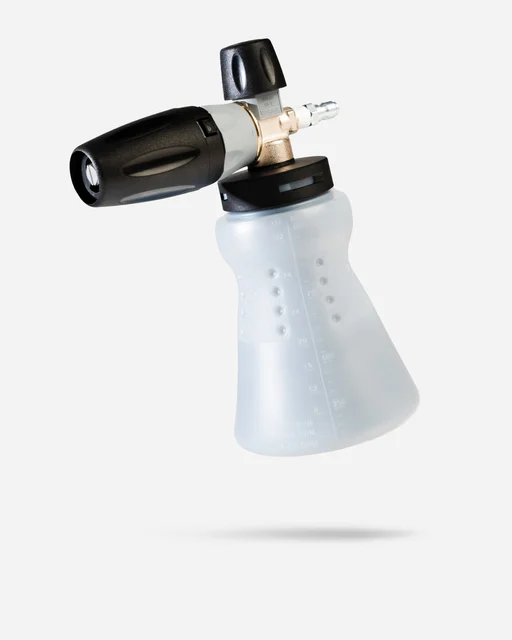
A foam cannon screws onto a pressure washer and turns car soap into thick, clinging suds you rinse off before you ever touch the paint with a mitt. The category is full of confusion: half the products sold as "cannons" are actually weaker garden-hose foam guns, and most listings sell you on foam thickness when the thing that actually protects your paint is something else entirely. This guide untangles it so you buy the right tool for the equipment you already own.
The 30-second version
- Cannon needs a pressure washer, gun runs off a hose. A foam cannon uses a pressure washer's high pressure and flow to whip soap into thick foam; a foam gun connects to a regular garden hose and can only make thin, drippy suds - match the tool to what you own.
- Thick foam is mostly for the photos. The shaving-cream look is cosmetic; what actually lifts grit safely is dwell time plus soap chemistry, so the soap has minutes to soften dirt and you drag less of it across the clearcoat during the wash.
- Build quality is where cannons live or die. A brass neck and quick-connect shrug off repeated attaching and pressure, while all-plastic threads cross-thread and leak - and a cannon that cross-threads once tends to leak forever.
- It has to fit your washer's flow, not just its fitting. Beyond the 1/4-inch quick-connect, the cannon's orifice needs to suit your washer's GPM and PSI, or the foam comes out thin and starved.
- The soap matters as much as the cannon. A high-foaming, pH-neutral car shampoo is what makes a cannon shine; dish soap and weak suds waste even a great cannon.
The products this guide is about
Our verdict on each, with the full reasoning on the companion review.
- Buy MTM Hydro PF22.2 Foam Cannon The enthusiast default: a brass-bodied cannon with independent foam and fan control that just works across almost any washer.
- Buy Adam's Polishes Adam's Standard Foam Cannon A well-built brass-fitting cannon that delivers thick, even foam for less than the premium picks.
- It depends Sun Joe SPX-FC34 Foam Cannon A budget cannon that shines if you already run a Sun Joe electric washer, and is fussier if you don't.
- Skip Chemical Guys TORQ Foam Blaster 6 Foam Wash Gun A capable garden-hose foam gun, but it is not a pressure-washer cannon and the thin foam shows it.
What actually matters
- Cannon vs gun - This is the single biggest decision. A pressure-washer cannon aerates soap with real force and makes thick foam; a garden-hose foam gun physically can't, so it tops out at thin suds. Buy the one that matches your equipment, not the one with the better marketing.
- Fitting and compatibility - Nearly all consumer cannons and washers use a 1/4-inch quick-connect that snaps into a standard washer gun, but a few brands use proprietary bayonet fittings that need an adapter. Confirm the connection before you buy so you're not stuck.
- Neck and thread material - Brass necks and quick-connects tolerate the repeated connect-disconnect cycles and pressure that slowly destroy all-plastic ones. Plastic threads cross-thread and leak; brass is the durability upgrade that actually pays off.
- Orifice matched to your washer's GPM/PSI - The cannon's orifice (the opening that meters water and soap draw) needs to suit your washer's flow. Too big or too small and the soap draw is either starved or overwhelmed, and the foam suffers.
- Foam and fan adjustment - Better cannons give you a foam-density dial plus an adjustable spray fan, ideally on separate controls. That lets you lay a wide clinging blanket for dwell time, then tighten the stream for wheel wells - instead of fighting one compromise knob.
- Tank size - A larger bottle means fewer refills mid-wash. It's a convenience factor, not a performance one, but a bigger tank is genuinely nicer on a full-size vehicle.
- The soap you pair it with - A cannon is only as good as the shampoo you feed it. A high-foaming, pH-neutral car wash soap is what produces clinging suds safely; household dish soap strips protection and foams poorly.
The specs, in plain English
Green flags vs red flags
Green flags
- A **brass body, neck, or quick-connect** - the fittings that resist cross-threading and leaks over seasons of use
- A standard **1/4-inch quick-connect** that mates with common pressure-washer guns, or a clearly stated adapter if your washer is proprietary
- **Separate controls** for foam density and spray fan, giving you real adjustment instead of one do-everything knob
- A stated **minimum GPM/PSI** or orifice guidance, which shows the maker expects you to match it to your washer
- A generous **bottle size** so you're not refilling halfway through a single vehicle
- Listing language that talks about **pre-wash and dwell time**, a sign the product is built and described around safe washing, not just foam theater
Red flags
- **All-plastic neck and threads** with no brass anywhere - the classic recipe for cross-threading and leaks
- A product sold as a "cannon" that actually connects to a **garden hose** - that's a foam gun, and it will never make cannon-grade foam
- Marketing that leads entirely on **thick, shaving-cream foam** and never mentions dwell time, soap, or flow matching
- **No mention of GPM/PSI requirements or orifice**, so you can't tell whether it will foam on your washer
- A **proprietary fitting** with no included adapter and no compatibility notes for your washer brand
- Reviews clustering around **stripped threads, leaks, or 'wouldn't foam on my washer'** - the tells of poor build or a flow mismatch
Who's who: the brands
- MTM Hydro - Enthusiast favorite known for brass-bodied cannons with independent foam and fan control that fit almost any washer.
- Adam's Polishes - Detailing brand offering brass-core cannons that deliver thick, even foam at a friendlier mid-range position.
- Sun Joe - Budget-focused maker whose cannons are a natural match for their own electric pressure washers.
- Chemical Guys - Widely sold detailing brand; makes both true cannons and hose-end foam guns, so read the listing carefully to know which you're buying.
- Kärcher - Major pressure-washer maker whose units often use proprietary bayonet fittings, so cannons may need a brand-specific adapter.
How to read a listing without getting fooled
Start by proving it's actually a cannon: look for the words "pressure washer" and a 1/4-inch quick-connect, not "garden hose" or a hose-thread inlet - that one distinction separates a real cannon from a foam gun dressed up like one. Next, hunt for the word brass in the neck, body, or quick-connect; if everything is plastic, expect cross-threading and leaks over time. Then find the flow requirement - a minimum GPM or PSI, or any note about matching the orifice to your washer - because a cannon that won't foam on your machine is useless no matter how it's built. Treat photos of towering shaving-cream foam as marketing, not proof: they say nothing about build quality, fit, or how safely the thing actually washes. Finally, if your washer is a brand like Kärcher or Ryobi that uses a proprietary fitting, confirm the listing includes the right adapter rather than assuming a universal 1/4-inch plug will snap in.
How much should you spend?
The truth is that the cannon itself is a small part of a good wash - the soap and your patience do most of the work - so you don't need to buy the most expensive one to wash safely. That said, the money is best spent on build. Stepping up from an all-plastic cannon to one with a brass neck and quick-connect is where extra dollars actually earn their keep, because plastic threads are the part that cross-threads, leaks, and forces a repurchase. Mid-range brass-core cannons capture most of that durability for meaningfully less than the premium enthusiast picks, and they're the value sweet spot for most weekend washers. The rock-bottom budget cannons are a fair call in one specific case: when they match a washer you already own (a budget maker's own electric unit, for instance) and you don't mind babying the plastic threads. Spend up only if you'll use it often, keep it for years, or swap it between different washers - situations where the buy-once-cry-once brass build pays off. Whatever you save on the cannon, put toward a quality high-foaming, pH-neutral car shampoo; that's the purchase that changes your results.
Questions, answered
What's the difference between a foam cannon and a foam gun?
A foam cannon attaches to a pressure washer and uses its high pressure and flow to whip soap into thick, clinging suds. A foam gun connects to a regular garden hose, which has far less pressure, so it can only make thinner, drippier foam. If you own a pressure washer, buy a cannon. If you only have a hose, a foam gun is your ceiling - don't expect cannon-grade foam from it, and don't buy a hose gun that's marketed as a cannon.
Do I need a specific pressure washer to run a foam cannon?
You need enough flow and pressure. Many cannons want a certain minimum GPM and a few hundred PSI to foam well, and small electric washers often sit right at the edge. Check that your washer meets the cannon's minimum flow, and match the cannon's orifice to your washer's GPM so the soap draw isn't starved or overwhelmed. Nearly all consumer washers and cannons use a 1/4-inch quick-connect, though a few brands need a proprietary adapter.
Does thicker foam actually clean better?
Not by itself. The photogenic shaving-cream look is mostly for show. What lifts grit safely is dwell time - letting the soap sit for minutes to soften and loosen dirt - plus the soap's own chemistry. Foam simply helps the soap cling to vertical panels longer so it can do that work. A medium foam with good soap and patience protects your paint better than a thick foam you rinse off in ten seconds.
Brass or plastic fittings - does it really matter?
Yes, more than almost anything else. Brass necks and quick-connects tolerate repeated attaching and pressure far better than all-plastic ones, which is why brass-based cannons see fewer leaks and stripped threads over time. If you do buy a plastic-threaded cannon, hand-tighten gently and stop at snug - never crank it. A cannon that cross-threads once tends to leak forever, so build quality here genuinely pays off.
What soap should I use in a foam cannon?
Use a dedicated high-foaming, pH-neutral car wash shampoo - it's formulated to produce clinging suds and to lift grit without stripping wax or sealant. Avoid household dish soap: it foams poorly in a cannon, can strip protection off your paint, and isn't gentle on the finish. The right soap does more for your results than any single spec on the cannon.
Will any foam cannon fit my pressure washer?
Usually, but confirm two things. First, the connection: most cannons ship with a 1/4-inch quick-connect that snaps into a standard washer gun, though some brands use proprietary bayonet fittings that need an adapter. Second, the flow: the orifice should suit your washer's GPM so it foams properly. Buy the correct adapter up front rather than forcing a mismatched fitting, which is exactly how leaks and cross-threading start.
Or jump to the head-to-head: MTM Hydro PF22.2 Foam Cannon vs Adam's Polishes Adam's Standard Foam Cannon.