Explained
Fuel Injector Cleaners, Explained
After reading, you'll understand which detergent chemistry has real evidence behind it, how to check whether a bottle contains it, what the TOP TIER gasoline standard actually requires, and which deposits an in-tank additive can never touch.
In this guide
First-time buyers of fuel additives get tripped up in three places. They assume every bottle on the shelf contains a detergent, when many contain a solvent or a base oil. They assume a fuel additive can clean anywhere carbon appears in an engine, when it can only reach surfaces the fuel itself touches. And they assume the gasoline they already buy is a blank slate that additives improve, when in fact federal rules set a detergent minimum and the TOP TIER standard sets a much higher one on top of it. Sort those three out and the whole aisle becomes readable.
The 30-second version
- PEA is the chemistry to look for, and a maker that names polyetheramine on the product page has given you something you can actually check.
- The safety data sheet is the tell, because a section 3 listing only base oil or a hydrocarbon-and-alcohol blend is describing a lubricant or a solvent, not a deposit control package.
- A direct injection engine's intake valves are unreachable from the tank, because fuel is sprayed into the cylinder and never washes across the back of the valve.
- TOP TIER gasoline already does this job, since a licensed marketer must run an approved additive at the correct treat rate in every grade of gasoline it sells.
- No additive fixes broken hardware, so a persistent cylinder-specific misfire code is a diagnostic job rather than a reason to buy a second bottle.
The products this guide is about
Our verdict on each, with the full reasoning on the companion review.
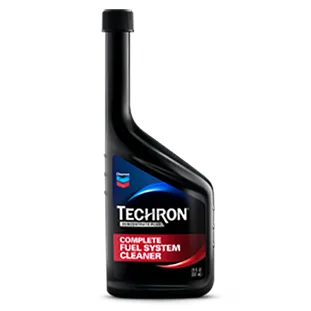
- Buy Chevron Techron Complete Fuel System Cleaner The most disciplined product here: a published 1 ounce per gallon treat rate, a stated ceiling on how often to use it, and direct injected engines named on the maker's own comparison chart.
- Buy Gumout Regane Complete Fuel System Cleaner The only product in this group whose maker names the detergent chemistry on the product page, and it is the one chemistry with the strongest published record: P.E.A. (polyetheramine). Amazon
- It depends Sea Foam Motor Treatment A genuinely useful can of petroleum solvent and alcohol for stored fuel, carburetors and small engines, and the wrong tool if your goal is stripping deposits off a modern injector. Amazon
- Skip Lucas Oil Fuel Treatment (Upper Cylinder Lubricant and Injector Cleaner) The broadest claims of the four sitting on top of the thinnest disclosure: the safety data sheet lists a single component, a hydrotreated heavy paraffinic petroleum distillate at 80 to 100 percent. Amazon
What actually matters
- Polyetheramine (PEA) - the detergent family that deposit control work in this category is built around, because it stays effective at the high temperatures found at the intake valve and injector tip. If a maker names it, you can compare like with like; if a maker will not, you are buying on brand trust alone.
- Treat rate - the ounces of product per gallon of fuel the maker specifies, which decides the actual concentration in your tank. A one-tank clean-up claim only means something when the dose is high, so compare bottle size against the number of gallons the label says it treats.
- Carrier fluid - the petroleum distillate that makes up most of the bottle and carries the active into the fuel. It is why a safety data sheet showing 80 percent distillates is normal, and why a sheet showing nothing but distillates is a red flag.
- Intake valve deposits (IVD) - the carbon that builds on the back of the intake valve, measured in milligrams in the standardized ASTM D6201 engine test. This is the deposit that fuel detergents were originally designed to remove, and the one a direct injected engine's fuel never reaches.
- Combustion chamber deposits (CCD) - carbon on the piston crown and chamber walls, which raises effective compression and can cause knock. Standards care about additives not making CCD worse, which is why TOP TIER caps the additized fuel at 140 percent of the base fuel's deposit weight.
- Injector deposits - buildup inside the injector and around its spray holes that distorts the fuel spray and shifts fuelling. On direct injected engines this is the deposit an in-tank additive genuinely can reach, since the injector tip sits in the fuel path.
- Lowest additive concentration (LAC) - the EPA-certified minimum treat rate at which a detergent package is approved for use in gasoline. It is a floor, not a target, and the whole point of a program like TOP TIER is to require performance well above it.
The specs, in plain English
Green flags vs red flags
Green flags
- The product page names the detergent chemistry outright, for example P.E.A. or polyetheramine, rather than describing it as an advanced or proprietary formula.
- The maker publishes a treat rate in ounces per gallon rather than only a vague one bottle per tank instruction.
- The safety data sheet is linked from the product page and is specific to the bottle size you are buying.
- The label gives a maximum frequency or a limit between oil changes, which indicates the maker expects the product to be used occasionally rather than continuously.
- The claims are about deposits and spray patterns rather than about octane, horsepower figures or passing an emissions test.
Red flags
- Big performance claims paired with a safety data sheet that lists only a petroleum distillate or base oil in section 3.
- Instructions to use it at every fill up, which converts a maintenance item into a recurring cost with no defined end point.
- Claims that a fuel additive will clean intake valves on a direct injection engine, since fuel never contacts that surface in those engines.
- An 'EPA registered' badge used as though it were a performance endorsement rather than a filing requirement.
- Language promising premium performance from low octane fuel or to replace the benefits of leaded gasoline, neither of which you can verify from any published document.
Who's who: the brands
- Chevron (Techron) - Chevron is both a licensed TOP TIER gasoline brand and the maker of the Techron bottled additives, and it publishes clearer dosing and use limits than most of the category while keeping the chemistry itself a trade secret.
- Gumout - The most transparent of the mass-market brands about chemistry, naming P.E.A. (polyetheramine) on its Regane and Multi-System Tune-Up lines.
- Red Line - Sells SI-1 Complete Fuel System Cleaner as a single high-concentration bottle per tank, with claims covering GDI injectors, carburetors, valves and combustion chamber deposits, though it describes its actives only as a blend of high-temp and low-temp detergents.
- Sea Foam - A petroleum solvent and isopropanol product with a long following among small engine, marine and classic car owners, and unusually plain about its own composition in its safety data sheet.
- STP - A very widely stocked line spanning injector cleaners, GDI intake valve cleaners and gas treatments, whose consumer pages describe concentrated detergents without naming the chemistry.
How to read a listing without getting fooled
Start with the two numbers that let you compare bottles honestly: the volume of the bottle and the number of gallons the label says it treats. Divide one by the other and you have the treat rate, which is the only way to see that one product is asking for a full ounce per gallon while another spreads six ounces across twenty-one gallons. Next, look for a chemistry name. Polyetheramine or P.E.A. printed on the page is a real disclosure; advanced formula, proprietary blend and premium ingredients are not. Then open the safety data sheet, which most makers link from the product page, and read section 3. You are looking for whether anything other than a carrier distillate is listed, and whether components are withheld as trade secret, which is common and not by itself damning. Finally, read the frequency instruction. A product that tells you when to stop is usually engineered as a periodic clean-up; one that tells you to use it at every fill is being sold as a habit. Ignore the horsepower and economy language entirely, because no listing in this category supports it in a way you can check.
How much should you spend?
This is a category where spending more does not reliably buy more, and where the cheapest option and the most expensive option can contain very different things. Budget bottles cover both the best value in the aisle and the worst: a named PEA detergent from a mass-market brand sits at the same tier as a bottle of base oil with expansive claims, so the tier tells you nothing on its own and the label has to do the work. Mid-range is where the well-dosed one-tank clean-up products land, and the extra money mostly buys concentration and a maker that publishes a proper treat rate. Premium bottles generally sell a single high-strength tank treatment, which can be worth it for a one-off deep clean but is poor economics as a routine. The most cost-effective move in the whole category is not a bottle at all: consistently buying licensed TOP TIER gasoline puts an approved detergent in every tank at no extra product cost, and for many drivers that removes the reason to buy anything else.
Questions, answered
Does premium gasoline contain more detergent than regular?
Not necessarily, and octane is a separate property from detergency. Under the TOP TIER standard a licensed marketer must use an approved additive at the correct treat rate in all grades of gasoline sold at the station, so regular from a licensed brand carries the same detergent treatment as premium from that brand. If your engine does not require premium, paying for it will not get you a cleaner fuel system. Buy the octane your manufacturer specifies and choose the station on whether it is licensed.
Is a fuel additive safe for my catalytic converter and oxygen sensors?
Mainstream products are generally formulated to be, and several makers state it explicitly on the product page. Gumout says Regane Complete is oxygen sensor safe and safe for turbocharged and supercharged vehicles, and Chevron publishes its own compatibility guidance for Techron. The genuine risk is overdosing rather than the product itself: Chevron warns that adding too much may cause oil thickening and fuel dilution. Follow the stated treat rate rather than emptying a large bottle into a small tank.
What actually cleans carbon off direct injection intake valves?
Mechanical or intake-side chemical service, done at the engine rather than through the tank. Walnut shell blasting through the intake ports is the thorough option and is a workshop job. Aerosol induction cleaners sprayed into the intake tract are a lighter-touch alternative that works on the same surface. Some manufacturers sidestep the problem in the design by fitting both port and direct injectors, so the port injectors wash the valves under some operating conditions. What will not work is any product poured into the fuel tank.
Do I need a fuel additive for a car I only drive occasionally?
The additive you probably want is a stabilizer rather than an injector cleaner. Gasoline degrades in storage, forming gum and varnish, and ethanol blends can pick up moisture. Products built around petroleum solvent and isopropanol are aimed squarely at that job, and Sea Foam directs 1 ounce per gallon for stabilizing stored fuel. The deposit-removal case is much weaker for a car that is barely driven, because deposits form with heat cycles and mileage, so treat storage and deposits as two separate problems with two different products.
Or jump to the head-to-head: Chevron Techron Complete Fuel System Cleaner vs Gumout Regane Complete Fuel System Cleaner.