

Automotive
The Best Fuel Injector Cleaners: 4 Compared (and One to Skip)
We compared four widely sold fuel additives on the only things you can actually check: what chemistry the maker discloses, what the safety data sheet lists, the stated treat rate, and whether the product can physically reach the deposits you are worried about.
The short version
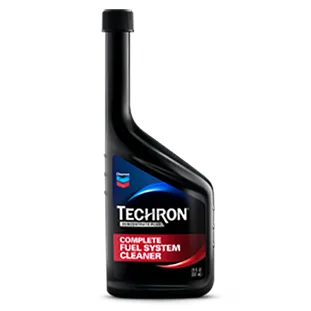
Chevron Techron Complete Fuel System Cleaner is our overall pick, mostly because Chevron publishes a real treat rate (1 ounce per gallon), names direct injection engines specifically, and puts hard limits on how often to use it. Gumout Regane Complete Fuel System Cleaner is the value pick and the only one of the four that names its detergent chemistry in plain sight: P.E.A. (polyetheramine). Sea Foam Motor Treatment is the depends pick, and it genuinely earns that: its safety data sheet lists a hydrocarbon blend and isopropanol, which is a good fit for stabilizing stored fuel or freeing up a gummed carburetor, and a poor fit if your actual goal is stripping injector deposits. Skip Lucas Fuel Treatment, whose safety data sheet lists one component, a hydrotreated heavy paraffinic petroleum distillate at 80 to 100 percent, while the maker's page promises premium performance from low octane, lower quality fuel. And the honest answer for a lot of drivers is that none of this is necessary, because consistently buying TOP TIER licensed gasoline puts an approved detergent additive in every grade you pump. Best for: drivers with a specific deposit symptom, or with a long history of cheap non-TOP-TIER fuel, who want one targeted clean-up rather than a bottle in every tank.
Our picks at a glance
- Chevron Techron Complete Fuel System Cleaner - Buy. The most disciplined product here: a published 1 ounce per gallon treat rate, a stated ceiling on how often to use it, and direct injected engines named on the maker's own comparison chart.
- Gumout Regane Complete Fuel System Cleaner - Buy. The only product in this group whose maker names the detergent chemistry on the product page, and it is the one chemistry with the strongest published record: P.E.A. (polyetheramine).
- Sea Foam Motor Treatment - It depends. A genuinely useful can of petroleum solvent and alcohol for stored fuel, carburetors and small engines, and the wrong tool if your goal is stripping deposits off a modern injector.
- Lucas Oil Fuel Treatment (Upper Cylinder Lubricant and Injector Cleaner) - Skip. The broadest claims of the four sitting on top of the thinnest disclosure: the safety data sheet lists a single component, a hydrotreated heavy paraffinic petroleum distillate at 80 to 100 percent.
The verdict in 30 seconds
What mattered most
- Detergent chemistry named by maker
- What the safety data sheet lists
- Stated treat rate
- Stated use interval
- Direct injection named on maker's page
- Sizes listed by maker
Fuel additives are one of the few categories where the marketing claim and the published document are easy to put side by side, and where they often disagree. The detergent chemistry with the strongest published record against injector and intake valve deposits is polyetheramine, usually written PEA, and most makers simply do not say whether they use it. So we did the boring work: we read each maker's own product page, treat rate, and safety data sheet, and we read the TOP TIER gasoline performance standard that sits behind the fuel you already buy. Four products, one of which we think most drivers should walk past.
The most disciplined product here: a published 1 ounce per gallon treat rate, a stated ceiling on how often to use it, and direct injected engines named on the maker's own comparison chart.
Best for: A driver who wants one properly dosed clean-up on a modern port or direct injected engine and is willing to follow the label rather than improvise.
- Chevron's product comparison chart states a treat rate of 1 ounce per 1 gallon, so a 12 ounce bottle treats 12 gallons and a 20 ounce bottle treats 20 gallons, which is a far higher dose per gallon than most rivals ask for.
- The comparison chart lists it as best for cars, SUVs and pickup trucks including GDI and PFI modern engines, so the direct injection recommendation is written down rather than implied.
- Chevron publishes a use ceiling rather than encouraging continuous use: every 3,000 miles, and no more than two treatments between oil changes.
- Chevron does not disclose the detergent chemistry. The safety data sheet lists hydrotreated light petroleum distillates at 80 to 85 percent plus trade secret components, so you cannot verify what the active is.
- Chevron's own FAQ says 'Unlike some competitors' PEA-based fuel additives formula, our technology will not cause sludge in engine oil', which distances Techron from the PEA family without telling you what it uses instead.
- Chevron's FAQ also states that a bottle is up to 10 times the additive concentration of Chevron fuel with Techron, which is another way of saying you are buying a stronger dose of something you already get at a Chevron pump.
- The same FAQ warns that adding too much may cause oil thickening and fuel dilution, so this is not a pour-it-in-every-tank product.
Amazon had no buyable listing for this when we last checked. The link still works if it returns.
Check price on Amazon Read our detailed assessment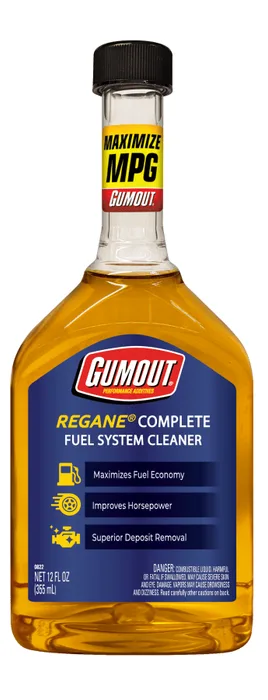
The only product in this group whose maker names the detergent chemistry on the product page, and it is the one chemistry with the strongest published record: P.E.A. (polyetheramine).
Best for: Someone who wants a named PEA detergent at a low price and is happy to treat a full tank rather than chase a maximum-strength one-tank dose.
- Gumout's product page states the product uses 'P.E.A. (polyetheramine) to effectively remove deposits other products can't', which is a chemistry you can look up rather than a marketing adjective.
- The 'what it does' list is specific about hardware: GDI/direct and port/indirect fuel injectors, intake valves and ports, piston tops, cylinder heads and combustion chamber.
- Gumout states it is oxygen sensor safe, safe for turbocharged and supercharged vehicles, and will not void the manufacturer's warranty, which covers the three questions most owners actually have.
- The dose per gallon is much lower than Techron's. Gumout directs both the 6 ounce and the 12 ounce bottle into a tank filled with up to 21 gallons, so a 6 ounce bottle works out under a third of an ounce per gallon.
- Naming PEA is not the same as publishing how much of it is in the bottle, and Gumout does not state a concentration.
- The intake valve claim can only apply where fuel actually touches the valve, which on a direct injected engine it does not, so half the listed hardware is out of reach in a DI car.
- The product carries a California Proposition 65 warning for naphthalene, which is worth knowing if you handle it without gloves.
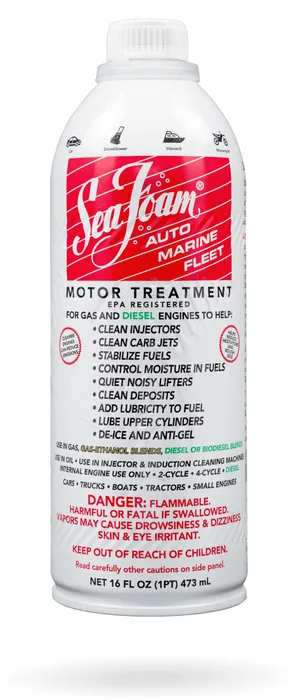
A genuinely useful can of petroleum solvent and alcohol for stored fuel, carburetors and small engines, and the wrong tool if your goal is stripping deposits off a modern injector.
Best for: Someone winterizing a boat, mower, generator or seasonal vehicle, or working on an older carbureted engine where a solvent soak is the right idea.
- Sea Foam publishes an unusually plain composition. The safety data sheet lists a hydrocarbon blend at under 95 percent and isopropanol at under 25 percent, so you know roughly what you are pouring in.
- It is one can for several jobs: 1 ounce per gallon of fuel, 1 ounce per quart of oil 100 to 300 miles before an oil change, and 1 ounce per gallon to stabilize fuel for storage.
- The isopropanol content is the part that earns its keep for stored fuel, and Sea Foam's own claim list leads with helping fuel resist evaporation and preventing gum and varnish rather than promising horsepower.
- No detergent chemistry is named anywhere. The maker describes it as '100% petroleum cleaning and lubricating ingredients', which describes a solvent, not a deposit control additive package.
- Solvent action and detergent action are different mechanisms. A solvent can dissolve soft gum and varnish; the baked carbon on a hot intake valve is what PEA-type detergents are formulated for.
- The label carries an 'EPA REGISTERED' line, which under 40 CFR Part 79 is a registration requirement for fuel additives and not an endorsement of performance.
- At 1 ounce per gallon, treating a full tank takes most of a 16 ounce can, so the per-treatment cost is not as low as the sticker suggests.
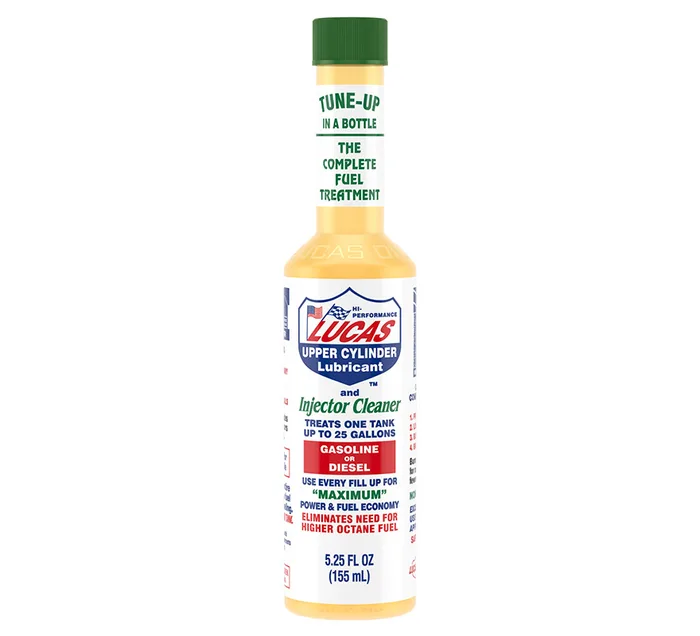
The broadest claims of the four sitting on top of the thinnest disclosure: the safety data sheet lists a single component, a hydrotreated heavy paraffinic petroleum distillate at 80 to 100 percent.
Best for: Owners of genuinely old, leaded-fuel-era engines who specifically want an upper cylinder lubricant and are not buying it as an injector cleaner.
- It is cheap per gallon treated, at 2 to 3 ounces per 10 gallons, and the quart and gallon sizes bring that down further.
- Lucas is upfront that exceeding the recommended dosage is not harmful to your vehicle, and it is one of the few products sold in bulk sizes for fleet or equipment use.
- As an upper cylinder lubricant in an old engine that was designed around leaded fuel, a paraffinic oil in the fuel is at least a coherent idea.
- The safety data sheet for the 5.25 ounce bottle lists exactly one entry in section 3: 'Distillates (petroleum), hydrotreated heavy paraffinic', CAS 64742-54-7, at 80 to 100 percent. No detergent is identified at all.
- Lucas describes it as 'a powerful blend of oils and additives that contain no SOLVENTS' with 'a high detergent action', but never names the detergent, so there is nothing to check.
- The claim list is very wide for a bottle of base oil: improved power and fuel mileage, cleaner exhaust emissions, and, per the maker's page, premium performance out of low octane, lower quality fuel.
- The maker's page directs you to use it at every fill-up, which turns a one-off maintenance item into a permanent line on your fuel bill.
| Criteria | Techron Complete Fuel System Cleaner Top pick | Regane Complete Fuel System Cleaner | Sea Foam Motor Treatment | Fuel Treatment (Upper Cylinder Lubricant and Injector Cleaner) |
|---|---|---|---|---|
| Verdict | Buy it | Buy it | It depends | Skip it |
| Best for | A driver who wants one properly dosed clean-up on a modern port or direct injected engine and is willing to follow the label rather than improvise. | Someone who wants a named PEA detergent at a low price and is happy to treat a full tank rather than chase a maximum-strength one-tank dose. | Someone winterizing a boat, mower, generator or seasonal vehicle, or working on an older carbureted engine where a solvent soak is the right idea. | Owners of genuinely old, leaded-fuel-era engines who specifically want an upper cylinder lubricant and are not buying it as an injector cleaner. |
| Price tier | $$ · mid-range | $ · budget | $ · budget | $ · budget |
| Detergent chemistry named by maker | No, undisclosed | Yes, P.E.A. (polyetheramine) | No, 'petroleum cleaning and lubricating ingredients' | No, 'oils and additives' |
| What the safety data sheet lists | Light petroleum distillates 80-85%, trade secret components 15-20% | SDS published per size; Prop 65 naphthalene warning | Hydrocarbon blend under 95%, isopropanol under 25% | One entry: hydrotreated heavy paraffinic distillate 80-100% |
| Stated treat rate | 1 oz per 1 gallon | One bottle per tank of up to 21 gallons | 1 oz per 1 gallon of fuel | 2-3 oz per 10 gallons |
| Stated use interval | Every 3,000 miles, max two treatments between oil changes | Every 3,000 miles | Every 3,000 miles or every 3 months | Every fill-up |
| Direct injection named on maker's page | Yes, DISI and GDI listed | Yes, GDI/direct injectors listed | Not named | Not named |
| Sizes listed by maker | 12, 20 and 32 oz | 6 oz and 12 oz | 16 fl oz on the label shown | 5.25 oz, 1 quart, 1 gallon, 330 gallon tote |
| Also directed for use in engine oil | No, fuel only | No, fuel only | Yes, 1 oz per quart of oil | No, fuel only |
| Headline claim to weigh carefully | One-tank clean-up solution | Maximized performance and fuel economy | Clean injectors, stabilize fuels, control moisture | Premium performance from low octane, lower quality fuel |
Which one is right for you?
- A driver who wants one properly dosed clean-up on a modern port or direct injected engine and is willing to follow the label rather than improvise. Buy it Chevron Techron Complete Fuel System Cleaner
- Someone who wants a named PEA detergent at a low price and is happy to treat a full tank rather than chase a maximum-strength one-tank dose. Buy it Gumout Regane Complete Fuel System Cleaner
- Someone winterizing a boat, mower, generator or seasonal vehicle, or working on an older carbureted engine where a solvent soak is the right idea. It depends Sea Foam Motor Treatment
- Owners of genuinely old, leaded-fuel-era engines who specifically want an upper cylinder lubricant and are not buying it as an injector cleaner. Skip it Lucas Oil Fuel Treatment (Upper Cylinder Lubricant and Injector Cleaner)
How we judged the field
Five things decide whether a bottle of fuel additive is worth buying. First, disclosed chemistry: polyetheramine, written PEA, is the detergent family with the strongest published record against injector and intake valve deposits, and a maker who names it has given you something checkable. Second, treat rate, because a detergent that is correctly dosed at one ounce per gallon and a detergent that is spread thinly across twenty-one gallons are not doing the same job. Third, what the safety data sheet actually lists, which is where the difference between a detergent package, a solvent and a base oil becomes visible. Fourth, whether the maker states a use ceiling, since a product that tells you to stop is behaving more like maintenance and less like a subscription. Fifth, physical reach: an in-tank additive can only touch surfaces that fuel touches, and on a direct injected engine the intake valves are not one of them.
The field splits cleanly once you apply those tests. On one side are products built around a deposit control additive package, where the maker either names PEA outright or publishes a dose and a limit that only make sense for a real detergent. On the other are petroleum solvent and base oil products, which have honest uses in stored fuel, carburetors and old engines, but which get sold with injector-cleaning language they cannot support. We picked one from each end and two from the middle: Chevron Techron Complete Fuel System Cleaner for its published dose and discipline, Gumout Regane Complete Fuel System Cleaner as the cheapest product that names its chemistry, Sea Foam Motor Treatment as the solvent that is upfront about being one, and Lucas Fuel Treatment as the case where the claims and the safety data sheet are furthest apart.
Chevron Techron Complete Fuel System Cleaner
Buy itChevron’s Techron Complete Fuel System Cleaner wins on the two things that are easiest to verify and hardest to fake. Its published product comparison chart gives a treat rate of 1 ounce to 1 gallon, so the 12 ounce bottle treats 12 gallons and the 32 ounce bottle treats 32, and it names GDI and PFI modern engines as the intended application rather than leaving you to guess. It also tells you to stop: every 3,000 miles, and no more than two treatments between oil changes, with a FAQ warning that overtreating may cause oil thickening and fuel dilution. That is a maker managing your expectations, which is rare here. The catch is that Chevron will not say what the detergent is. The safety data sheet lists hydrotreated light petroleum distillates at 80 to 85 percent alongside trade secret components, and Chevron’s FAQ actively distances Techron from competitors’ PEA-based formulas without naming an alternative. You are trusting the brand rather than the chemistry. For a driver who wants one properly dosed clean-up done right, that trade is defensible.
Gumout Regane Complete Fuel System Cleaner
Buy itGumout Regane Complete Fuel System Cleaner is the only product in this comparison whose maker puts the chemistry on the page: P.E.A. (polyetheramine), stated plainly, alongside a specific list of what it is meant to clean, from GDI and port injectors through intake valves and ports to piston tops and the combustion chamber. Gumout also answers the three practical questions owners ask, confirming it is oxygen sensor safe, safe in turbocharged and supercharged engines, and will not void the manufacturer’s warranty. The trade-off is dose. Gumout directs both the 6 ounce and the 12 ounce bottle into a tank of up to 21 gallons, which is a far thinner concentration than Techron’s ounce per gallon, and naming PEA does not tell you how much PEA. There is also a California Proposition 65 naphthalene warning, so wear gloves. Treat this as the sensible periodic maintenance bottle rather than a maximum-strength rescue, and it is very good value.
Sea Foam Motor Treatment
It dependsSea Foam Motor Treatment is the most honest product here about what it is, which is why it lands as a depends rather than a skip. The safety data sheet lists a hydrocarbon blend at under 95 percent and isopropanol at under 25 percent, and the maker describes the can as 100 percent petroleum cleaning and lubricating ingredients. That is a solvent with alcohol in it, and solvents are genuinely good at some things: dissolving soft gum and varnish, keeping stored fuel from going off, controlling moisture, freeing a carburetor that has sat all winter. Sea Foam’s own lead claims sit in that territory rather than promising horsepower. What it is not is a deposit control additive package, and no detergent chemistry is named anywhere. If you buy it hoping to strip baked carbon off a modern injector, you have bought the wrong tool. The ‘EPA REGISTERED’ line on the can is a registration requirement under 40 CFR Part 79, not a performance verdict.
Lucas Oil Fuel Treatment (Upper Cylinder Lubricant and Injector Cleaner)
Skip itLucas Fuel Treatment is the skip, and not because it is a bad oil. It is because the gap between what the label promises and what the document lists is the widest in this group. Section 3 of the safety data sheet for the 5.25 ounce bottle contains one entry: hydrotreated heavy paraffinic petroleum distillate, CAS 64742-54-7, at 80 to 100 percent. That is base oil. Lucas describes the product as a blend of oils and additives with no solvents and a high detergent action, but never names the detergent, so there is nothing to look up. Meanwhile the claim list runs to improved power and fuel mileage, cleaner exhaust emissions and, per the maker’s page, premium performance out of low octane, lower quality fuel. The maker also tells you to use it at every fill-up. A product with the least disclosure and the broadest promises, sold on a recurring basis, is the wrong end of this category. If you specifically want an upper cylinder lubricant for a leaded-fuel-era engine, buy it for that and only that.
Sources
Specs in this review come from these pages.
- TOP TIER Detergent Gasoline Deposit Control Performance Standard, Revision F (December 2019) (toptiergas.com)
- TOP TIER Approved Gasoline Deposit Control Performance Standard, Revision G (January 2025), including the GDI Fuel Injector Cleanliness test (toptiergas.com)
- TOP TIER Licensed Gasoline Brands (toptiergas.com)
- US Department of Energy and EPA, fueleconomy.gov: Engine Technologies (port injection versus direct injection) (fueleconomy.gov)
- Chevron Techron Complete Fuel System Cleaner Safety Data Sheet (cglapps.chevron.com)
- Sea Foam Motor Treatment Safety Data Sheet (seafoamworks.com)
Chevron Techron Complete Fuel System Cleaner vs Gumout Regane Complete Fuel System Cleaner: which should you buy?
Techron and Gumout Regane Complete are trying to do the same job from opposite directions. Techron sells you a heavy dose of something it will not identify, at a full ounce per gallon, with a hard limit on frequency. Gumout sells you a named detergent, polyetheramine, at a much lighter concentration, with a routine 3,000 mile interval. Neither approach is wrong. If you want the chemistry on the label so you can check it against the published literature, Gumout is the only one of the four that gives you that. If you want the strongest single treatment and you are willing to take Chevron’s word for the formulation, Techron is dosed for it and its comparison chart names direct injected engines explicitly.
Choose on your situation, not on the marketing. If your car has a specific symptom, a rough idle or a small drop in economy after years of cheap fuel, and you want one decisive clean-up before an oil change, buy Techron and follow the ounce-per-gallon rate exactly. If you drive a modern engine on licensed TOP TIER gasoline and simply want to add a detergent top-up once or twice a year without thinking about it, buy Gumout and put a bottle in a full tank. And if your car is direct injected and your actual complaint is carbon on the intake valves, neither bottle will help, because in-tank fuel never reaches that surface. That is a workshop job, and the honest recommendation is to spend the money there instead.
What to look for
- Named chemistry beats named benefits: a page that says P.E.A. or polyetheramine has told you something you can verify, while a page promising restored power and maximized economy has told you nothing.
- Read the treat rate, not the bottle size: an ounce per gallon and a bottle stretched across twenty-one gallons are two different products even if the label language is identical.
- Open the safety data sheet: it is usually linked from the same product page, and section 3 will often show you a base oil or a solvent where you expected a detergent package.
- A stated use ceiling is a good sign: Chevron’s instruction to stop after two treatments between oil changes reads as engineering, while an instruction to use it at every fill up reads as merchandising.
- Check whether direct injection is named: if a maker recommends the product for direct injected engines it should also be clear that in-tank chemistry cannot reach intake valves on those engines.
- Treat regulatory language carefully: EPA registration under 40 CFR Part 79 and meeting the minimum deposit control requirement in federal fuel rules are baseline compliance, not evidence that one bottle outperforms another.
Our final take
Buy Chevron Techron Complete Fuel System Cleaner if you want one properly dosed clean-up and you will follow the ounce-per-gallon rate and the two-treatments limit. Buy Gumout Regane Complete Fuel System Cleaner if you would rather know the detergent is polyetheramine and treat a full tank periodically for less money. Sea Foam Motor Treatment is worth owning for stored fuel, small engines and old carburetors, and is the wrong purchase for a modern injector problem. Skip Lucas Fuel Treatment as an injector cleaner, because its safety data sheet lists base oil and its maker promises premium performance from low octane fuel. And accept the least profitable answer in the category: if you consistently buy licensed TOP TIER gasoline, you may not need any of them.
Questions, answered
Is a bottle of injector cleaner actually better than just buying TOP TIER gasoline?
For a lot of drivers, no. The TOP TIER Detergent Gasoline Deposit Control Performance Standard requires a licensed marketer to put an approved additive at the correct treat rate into every grade of gasoline at the station, and the additive has to pass an ASTM D6201 engine test in which a base fuel producing at least 500 mg of intake valve deposits must come down to no more than 50 mg once the additive is in it. Licensed brands in the United States include Chevron, Shell, Exxon, Mobil, BP, Amoco, Costco and Kirkland Signature, Marathon, Phillips 66, Sunoco, Texaco, Valero, CITGO, QuikTrip and others. If you have used those consistently for years, a bottle is unlikely to find much to remove. Chevron's own FAQ frames the bottle as roughly up to ten times the additive concentration of its pump fuel, which is useful for a fast clean-up and redundant as a routine. The stronger case for a bottle is a car with a history of cheap non-licensed fuel, or one showing a specific deposit symptom.
Will any of these clean the carbon off my direct injection engine's intake valves?
No, and this is the single most useful thing to understand about the category. The US Department of Energy and EPA fuel economy site describes port injection as fuel injected into the intake port and mixed with air as it is drawn into the cylinder, while direct injection puts fuel straight into the cylinder. An SAE technical paper on intake valve deposit clean-up puts the port injection case even more plainly: the fuel is injected onto the intake valves and then pulled into the combustion chamber. That washing action is the entire mechanism by which a fuel-borne detergent reaches the back of an intake valve. On a direct injected engine there is no fuel on that surface, which is exactly why carbon accumulates there, and no amount of anything poured into the tank can reach it. Cleaning DI intake valves is a mechanical or chemical service done at the intake, such as walnut blasting or an induction-side foam, not a fuel treatment.
Can an additive fix an injector that is actually failing?
It cannot. A fuel additive works on deposits, which are a layer of gum, varnish or carbon that restricts flow or spoils the spray pattern. If the injector's coil is open, the pintle is stuck, the seal is leaking or the driver circuit in the ECU has failed, no chemistry in the tank changes any of that. The tell is usually behaviour: deposits tend to produce a gradual, drivable degradation such as a slightly rough idle or a small economy loss, while a failed injector tends to produce a hard misfire, a specific cylinder misfire code, or a fuel smell. If you have a persistent cylinder-specific code, get it diagnosed rather than buying a second bottle. Additives are cheap enough that trying one first is reasonable, but two rounds with no change is your answer.
How do I tell whether a product uses PEA or just solvent?
Read the maker's own product page and then the safety data sheet, which is usually linked from the same page. Gumout states P.E.A. (polyetheramine) directly on the Regane Complete page, which is the clearest case here. Sea Foam's safety data sheet lists a hydrocarbon blend and isopropanol and nothing else, which tells you it is a solvent-and-alcohol product. The Lucas Fuel Treatment safety data sheet for the small bottle lists a single component, a hydrotreated heavy paraffinic petroleum distillate at 80 to 100 percent, which is a base oil. Chevron's Techron sheet lists light petroleum distillates plus trade secret components, so the answer there is that Chevron simply does not tell you. Note that a safety data sheet only has to list hazardous components, so absence is not proof, but a sheet with no detergent listed and a page that never names one is a fair signal.
How often should I actually use one of these?
Less often than most labels suggest, and the labels themselves disagree. Chevron is the most conservative and the most credible on this point: every 3,000 miles, and explicitly no more than two treatments between oil changes, with a warning that overtreating may cause oil thickening and fuel dilution. Gumout says every 3,000 miles. Sea Foam says every 3,000 miles or at least every three months for equipment in regular use. Lucas suggests using it at every fill-up, which is the outlier and the one to be most sceptical of. A sensible default for a modern car on licensed TOP TIER fuel is one properly dosed treatment before an oil change once a year, or none at all until you have a symptom.
Deciding between the top two? See our head-to-head: Chevron Techron Complete Fuel System Cleaner vs Gumout Regane Complete Fuel System Cleaner.
More Automotive reviews
 The Best Garage Floor Mats: 4 Compared (and One to Skip)
  The Best Glass Towels: 4 Compared (and One to Skip)
  The Best Headlight Restoration Kits: 4 Compared (and One to Skip)
  The Best Ice Scrapers and Snow Brushes: 4 Compared (and One to Skip)
  The Best Interior Detailers: 4 Compared (and One to Skip)
  The Best Iron Removers: 4 Compared (and One to Skip)