Explained
Garage Floor Mats, Explained
After reading this you will know whether you need a containment tray or a rolled floor covering, and which specs on the listing actually predict whether the mat keeps water off your concrete.
In this guide
Garage floor mats get sold on how they look and bought because a car comes home in winter dripping slush, brine and grit onto bare concrete. Those are two different products. A containment mat with a raised edge is a shallow tray that holds liquid until you squeegee it out, while a rolled vinyl mat is a floor covering whose surface pattern decides whether it holds anything at all. The trip-up is buying the good-looking smooth mat and expecting tray behaviour from it.
The 30-second version
- Containment means a raised edge, not a printed border. If the mat has no berm around the perimeter, water runs off the side and onto the slab you were trying to protect.
- Surface pattern is the whole spec on a flat mat. Ribbed or channelled textures hold meltwater in the grooves, while nearly smooth pebbled patterns let it sheet straight to the edge.
- Length matters more than width. A mat shorter than your vehicle leaves the wheels carrying the most brine parked on bare concrete, which defeats the exercise.
- Cold changes how every one of these behaves. PVC and vinyl stiffen as temperatures drop, and a shipping crease that runs across a containment edge is exactly where water escapes.
- Cleanup is the feature people underrate. A full containment mat after a snowy week holds real volume, so a squeegee and a floor that slopes toward the door decide whether you actually maintain it.
The products this guide is about
Our verdict on each, with the full reasoning on the companion review.
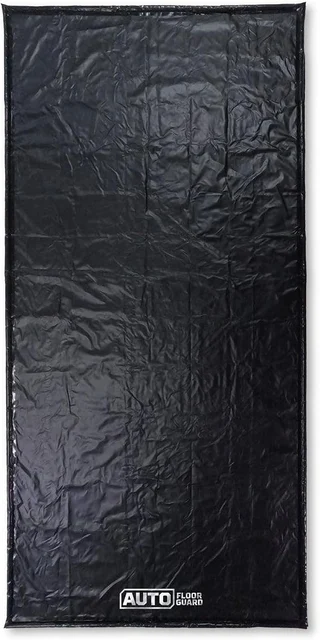
- Buy AutoFloorGuard SUV/Truck Containment Mat (8.5 ft x 20 ft) A genuine watertight tray with a built in berm, rated to hold up to 64 gallons of snowmelt. Amazon
- Buy G-Floor Ribbed Channel Vinyl Garage Floor Protector Mat (7.5 ft x 17 ft) Solid polyvinyl whose parallel channels hold liquid in the grooves instead of letting it sheet off the side. Amazon
- It depends WELKIN Containment Mat (8.5 ft x 20 ft) Budget PVC containment with a sponge filled edge that works well once you get it lying genuinely flat. Amazon
- Skip G-Floor Levant Pattern Vinyl Garage Floor Protector Mat (7.5 ft x 17 ft) The best looking mat here and the least useful in the wet: no berm, no channels, so everything runs to the edge and off. Amazon
What actually matters
- Containment edge (berm) height and construction. A welded or heat-sealed structural berm holds standing water reliably. A foam or sponge-filled edge column does the same job for less money but depends entirely on the mat lying perfectly flat, so a crease across it becomes a leak path.
- Seam type. Thermal-welded or heat-sealed seams are watertight. Glued or stitched seams are the first thing to fail once a tray is holding several gallons for months.
- Surface pattern on flat mats. Ribbed and channelled patterns break up surface tension and trap liquid in the grooves. Levant and other near-smooth pebbled textures have no channels and hold essentially nothing.
- Thickness, quoted in mils. Thicker solid vinyl resists punctures, tool drops and jack stands better, and solid single-layer material has nothing to delaminate. Very thin rolled goods telegraph every crack in the slab and tear at the trim edges.
- Cold-weather flexibility. Vinyl and PVC harden below freezing. Fabric-based containment mats stay more pliable, which matters if the mat has to be laid out or moved in an unheated garage in midwinter.
- Hot-tire behaviour. Solid polyvinyl is chemically resistant but not stain proof, and vinyl makers themselves acknowledge that some tire compounds mark it. Fabric containment mats are far less prone to tire marking or curling at the leading edge.
- Coverage and sizing model. Containment mats come in fixed sizes tied to vehicle class. Rolled vinyl trims with a utility knife and joins for wall-to-wall coverage, which is the reason to pick it when you want a whole bay finished.
The specs, in plain English
Green flags vs red flags
Green flags
- A stated raised-edge height and a gallon capacity rating, which means the maker is treating containment as a measurable spec rather than a marketing word
- Heat-sealed or thermal-welded seams described explicitly in the listing
- Solid single-layer polyvinyl with the thickness quoted in mils, and no mention of laminated layers
- A ribbed or channelled surface if the mat has no berm, ideally described by the seller as suited to wet or northern climates
- A squeegee included in the box, which tells you the maker understands the mat will actually be holding liquid
- Sizes offered by vehicle class, plus custom lengths or joinable widths on rolled products
Red flags
- Photos that show only a decorative pattern with no visible edge, paired with the word containment in the title
- No thickness figure anywhere in the specs on a rolled vinyl mat
- A foam edge column on a mat you plan to leave folded or install in a freezing garage, since it needs to lie perfectly flat to seal
- Nothing said about cold-weather behaviour on a product sold for snow and salt
- Vague material descriptions such as heavy duty rubber compound with no polymer named and no layer count
- A length that is shorter than your vehicle, no matter how attractive the width and price look
Who's who: the brands
- AutoFloorGuard - The name most associated with true containment trays, built from coated polyester fabric with welded seams and a built-in berm sized by vehicle class.
- G-Floor - US-made solid polyvinyl roll goods sold in several surface patterns, from ribbed channels to near-smooth Levant, usually with long warranty terms.
- WELKIN - Budget containment mats in textured PVC fabric built around a sponge-filled edge column, sold in several vehicle-class sizes with squeegee and anchors included.
- TrimaxMats and similar containment specialists - Mid-market containment trays that compete on edge height and included accessories rather than on fabric construction.
- RaceDeck and interlocking tile makers - Not mats at all but rigid modular tiles, worth knowing about because they solve the appearance problem while letting liquid drain through to the slab.
How to read a listing without getting fooled
Start by working out which of the two products you are looking at, because listings blur the line deliberately. Search the description for a stated edge height or a gallon capacity. If neither is there, treat it as a flat mat regardless of what the title says, and go straight to the surface pattern instead: ribbed or channelled holds liquid, near-smooth does not. On rolled vinyl, find the thickness in mils and check whether the material is described as solid rather than layered, since a laminate can separate where a single-layer sheet cannot. Read the dimensions against your own tape measure, not against the vehicle in the photo, and compare the length to your bumper-to-bumper measurement plus room to open a door. Then look at what the seller admits to in the fine print. Specialist flooring retailers are often more candid than the brand copy, and the useful disclosures are the ones about tire staining, movement over large areas, sliding on coated floors, and mats arriving folded with wrinkles that need time to relax. Finally, check the warranty. Rolled vinyl commonly carries limited lifetime terms while fabric containment mats carry much shorter ones, and that difference is a fair reflection of what each product is being asked to survive.
How much should you spend?
Cost in this category tracks construction, not size. The expensive end is welded fabric containment: a structural berm, watertight seams and enough capacity to sit under a slush-covered truck for a season. That premium is worth paying if you live with snow and road salt for months, because the cheaper alternatives all depend on something going right. The middle of the market is solid vinyl roll goods, where you are paying for thickness, single-layer construction and a long warranty, and where the ribbed and near-smooth versions of the same mat typically cost about the same, which makes choosing the pattern that holds liquid a free upgrade. The budget end is PVC-fabric containment with a foam edge column, and it genuinely works for one car in a milder climate if you can lay it out somewhere warm and let it flatten first. Where spending more stops paying is coverage: buying a bay-wide rolled mat when your problem is one wet vehicle gets you a bigger area of unprotected surface, not better protection. Buy the construction that matches your climate first, then size to the vehicle, and treat looks as the tiebreaker rather than the criterion.
Questions, answered
Do I actually need a raised edge, or will a flat mat do?
It depends on how wet your vehicle arrives. A raised edge turns the mat into a shallow tray, so several gallons of snowmelt sit there until you squeegee them out. A flat mat has nothing stopping that water reaching the perimeter and running onto the slab. If your car comes home covered in slush and brine, the edge is the whole point. If the climate is dry and you are mostly hiding a stained floor, a flat rolled mat is fine, and a ribbed or channelled pattern is a sensible middle ground because the grooves hold liquid where it lands.
Will hot tires stain the mat or curl the edges?
Vinyl is the material to watch. Solid polyvinyl resists garage chemicals, but the retailers who sell it state plainly that some tire compounds will stain the surface, and that large fully adhered areas can move with expansion and contraction. Fabric-based containment mats are much less prone to tire marking. Whatever you buy, let the mat and the floor reach room temperature before parking on it, and drive on straight rather than pivoting the wheels while stationary, since that is what bunches a mat or lifts an edge.
How do these behave in an unheated garage in winter?
PVC and vinyl both stiffen as temperatures drop, and nearly every mat ships either folded or rolled. In a cold garage the fold lines can take days rather than hours to relax, and a crease running across a containment edge is precisely where water escapes. The practical fix is to unroll the mat somewhere warm, or on a mild day, and let it settle under its own weight before relying on it. Coated fabric containment mats stay more pliable in the cold than thin PVC sheet does.
How thick should a rolled vinyl mat be?
Thickness is quoted in mils, and thicker material resists punctures, hides slab imperfections better and lies flatter. Thin rolled goods telegraph every crack underneath, curl at trimmed edges and tear where a jack or a dropped tool lands. More useful than the number alone is whether the material is solid all the way through rather than a laminate with a backing layer, because solid vinyl wears evenly and has nothing to delaminate.
Can a mat trap moisture and damage my concrete or epoxy coating?
It can if the floor is not dry when you lay it down, so let a damp or freshly washed slab dry fully first. There is a separate caution around coatings: mat makers warn that waterproof backings can react with some epoxies, paints and sealers, leaving residue or bonding the mat to the finish. Allow a new coating to cure completely before covering it, check your coating manufacturer's guidance, and lift a corner every few months to see how the floor underneath is doing.
What size should I buy?
Measure your vehicle bumper to bumper and add a couple of feet, then check that the width leaves room to open a door and stand on the mat. Length is where people under-buy, because a mat shorter than the vehicle leaves the wheels carrying the most brine on bare concrete. Containment mats come in fixed sizes tied to vehicle class, so size up if you are between classes. Rolled vinyl is more forgiving since it trims with a utility knife and joins for wall-to-wall coverage.
Or jump to the head-to-head: AutoFloorGuard SUV/Truck Containment Mat (8.5 ft x 20 ft) vs G-Floor Ribbed Channel Vinyl Garage Floor Protector Mat (7.5 ft x 17 ft).