

Automotive
The Best Floor Jacks: 4 Compared (and One to Skip)
We compared four hydraulic trolley jacks on capacity, lift height, weight and seal quality — the things that decide whether a jack is safe to trust.
The short version
For most home garages the Daytona 3 Ton Professional is the jack to buy: a steel, low-profile, long-reach frame with a dual-piston rapid pump that reaches the car in a couple of strokes and holds its load. If weight matters more than dollars, the Arcan ALJ3T gives you the same 3-ton rating in a light aluminum body you will actually move around. The Powerbuilt UniJack is a smart lift-and-support combo but only for higher-clearance trucks and trailers, not low cars. Skip the generic Torin Big Red bargain trolley jack — the seepage and bleed-down reports make it a false economy for regular work. And whichever you buy, the jack only lifts; always drop the car onto jack stands before you go under it. Best for: home mechanics who want a fast, high-capacity jack they can trust — paired, always, with stands.
Our picks at a glance
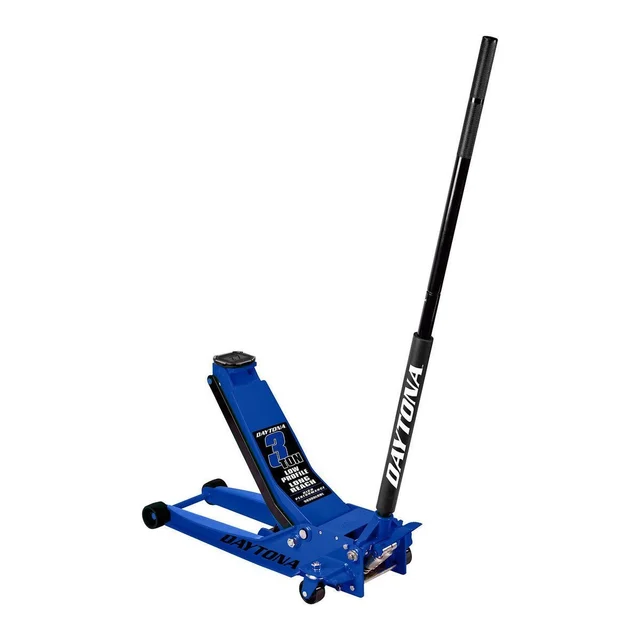
- Daytona 3 Ton Professional Rapid Pump Floor Jack - Buy. A steel, low-profile, long-reach jack with a dual-piston rapid pump that reaches the car in a couple of strokes — the value benchmark of the group.
- Arcan ALJ3T 3 Ton Aluminum Floor Jack - Buy. A genuinely light 3-ton aluminum jack with a quick-rise dual pump — the one you will actually move around and take to the track.
- Powerbuilt 640912 All-in-One 3 Ton UniJack - It depends. A bottle jack that raises itself on its own built-in stand — a lift and a support in one unit, but a narrow tool with a slow pump.
- Torin Big Red 3 Ton Hydraulic Trolley Jack - Skip. The ubiquitous bargain trolley jack — cheap and fine when it works, but the seal-and-QC lottery is not worth it under a car.
The verdict in 30 seconds
What mattered most
- Material
- Rated capacity
- Lift range (min–max)
- Weight
- Pump speed
- Seal / build quality
A floor jack lifts your car so you can change a tire, swap brake pads or reach the drain plug — but it is only ever a lift, never a support. The single most important rule in this whole review: once the car is up, put it on jack stands before any part of you goes underneath. A jack can seep, drift or let go; a stand is what keeps the car off you. With that settled, the picks below split cleanly by material and build quality — two jacks worth buying, one clever integrated-safety option that suits a narrow use, and one bargain-bin jack we would leave on the shelf.
A steel, low-profile, long-reach jack with a dual-piston rapid pump that reaches the car in a couple of strokes — the value benchmark of the group.
Best for: A home mechanic who wants a proven, fast, high-capacity jack for a permanent garage and does not need to carry it anywhere.
- Dual-piston rapid pump lifts the saddle to the car in roughly two to three strokes, then switches to a slow, controlled lift under load
- Low-profile nose slides under lowered cars, and the long-reach frame gets to center jacking points on bigger vehicles
- Owners consistently praise the seal quality and how long it holds a load without drifting
- Heavy steel build — comfortably the heaviest jack here, which makes it a chore to move around the garage or into a trunk
- Long-reach frame needs floor space and is overkill for a small car in a tight bay
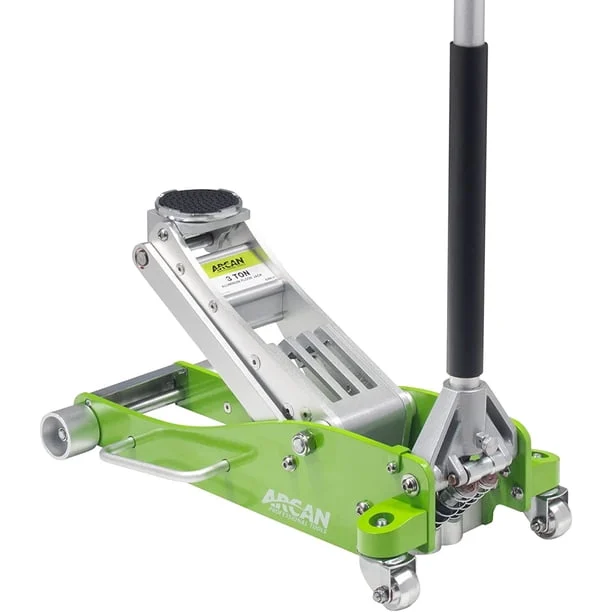
A genuinely light 3-ton aluminum jack with a quick-rise dual pump — the one you will actually move around and take to the track.
Best for: Anyone who values a jack they can carry — track-day drivers, apartment garages, or anyone tired of wrestling a steel tank.
- Aluminum frame keeps a 3-ton-rated jack far lighter than a comparable steel one, so it is easy to lift, roll and store
- Dual-piston quick-rise pump closes the gap to the car fast; low-profile nose fits under sports cars
- Wide saddle pad and a reputation for solid seals; carries a long limited warranty
- Costs noticeably more than a steel jack of the same rating — you pay a premium for the light weight
- Max lift height is a touch lower than the long-reach steel pick, so very tall trucks can out-reach it
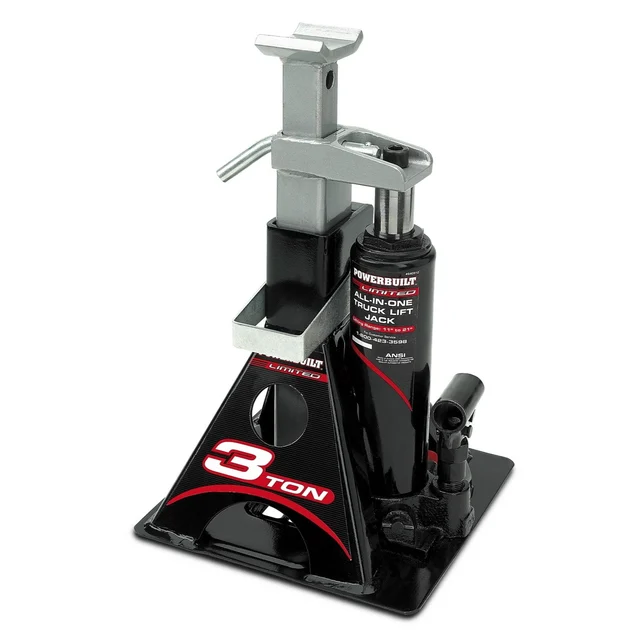
A bottle jack that raises itself on its own built-in stand — a lift and a support in one unit, but a narrow tool with a slow pump.
Best for: Truck, SUV and trailer owners who want a lift-and-support combo for higher-clearance vehicles — not low cars.
- The jack is its own stand: it lifts on the internal bottle, then the load rests on a fixed steel cradle — an inherent safety advantage
- Compact, tall lift range makes it useful for trucks, trailers and off-road recovery where clearance matters
- Inexpensive relative to a good trolley jack plus a separate pair of stands
- Bottle-jack action is slow and stroke-heavy compared with a rapid-pump trolley jack; there are no wheels to reposition it under load
- Tall minimum height means it will not fit under a low car, and it lifts one corner at a time rather than rolling to a jacking point
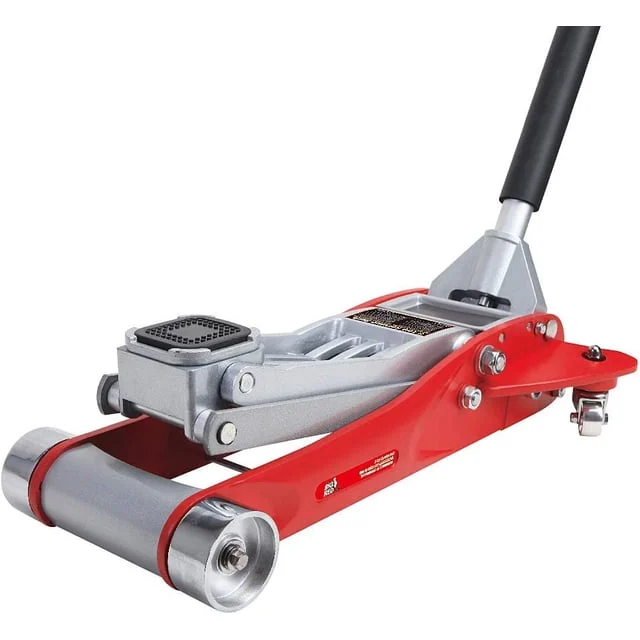
The ubiquitous bargain trolley jack — cheap and fine when it works, but the seal-and-QC lottery is not worth it under a car.
Best for: A bare-bones spare-tire backup for the trunk — not the jack you want for regular work in the garage.
- Very cheap and widely available; light enough to keep in a trunk for roadside tire changes
- 3-ton rating on paper covers most cars and small trucks
- Fine as an occasional emergency jack when paired with stands and treated with suspicion
- Owner reports of hydraulic seepage and rams that slowly bleed down under load are common — the exact failure you do not want in a jack
- Build and seal quality vary unit to unit; the saddle and lift feel are cruder than the picks above
- Short warranty and thin support if a seal goes
| Criteria | Daytona 3 Ton Professional Rapid Pump Floor Jack Top pick | Arcan ALJ3T 3 Ton Aluminum Floor Jack | Powerbuilt 640912 All-in-One 3 Ton UniJack | Torin Big Red 3 Ton Hydraulic Trolley Jack |
|---|---|---|---|---|
| Verdict | Buy it | Buy it | It depends | Skip it |
| Best for | A home mechanic who wants a proven, fast, high-capacity jack for a permanent garage and does not need to carry it anywhere. | Anyone who values a jack they can carry — track-day drivers, apartment garages, or anyone tired of wrestling a steel tank. | Truck, SUV and trailer owners who want a lift-and-support combo for higher-clearance vehicles — not low cars. | A bare-bones spare-tire backup for the trunk — not the jack you want for regular work in the garage. |
| Price tier | $$ · mid-range | $$$ · premium | $$ · mid-range | $ · budget |
| Material | Steel | Aluminum | Steel (bottle + stand) | Steel |
| Rated capacity | 3 tons | 3 tons | 3 tons | 3 tons |
| Lift range (min–max) | Low ~3.5 in to tall long-reach | Low ~3.6 in to mid-high | High ~11 in to ~21 in | Low ~3.9 in to mid |
| Weight | Heaviest (steel tank) | Light for the rating | Moderate, compact | Light |
| Pump speed | Dual-piston rapid pump | Dual-piston quick rise | Slow single bottle ram | Standard single pump |
| Seal / build quality | Praised, holds load well | Praised, holds load well | Simple and rugged | Inconsistent, seepage reports |
| Warranty | Limited | Long limited | Limited | Short |
| Price tier | $$ · mid-range | $$$ · premium | $$ · mid-range | $ · budget |
Which one is right for you?
- A home mechanic who wants a proven, fast, high-capacity jack for a permanent garage and does not need to carry it anywhere. Buy it Daytona 3 Ton Professional Rapid Pump Floor Jack
- Anyone who values a jack they can carry — track-day drivers, apartment garages, or anyone tired of wrestling a steel tank. Buy it Arcan ALJ3T 3 Ton Aluminum Floor Jack
- Truck, SUV and trailer owners who want a lift-and-support combo for higher-clearance vehicles — not low cars. It depends Powerbuilt 640912 All-in-One 3 Ton UniJack
- A bare-bones spare-tire backup for the trunk — not the jack you want for regular work in the garage. Skip it Torin Big Red 3 Ton Hydraulic Trolley Jack
How we judged the field
We don’t run our own lab, and we won’t pretend to. What we do is read the independent testing that measures the things that actually matter under a car — lift speed, how low and how high a jack reaches, how steadily it holds a load — and weigh that against what owners report after months and years of real use. For a tool whose failure mode is a car coming down, we cared about a short, honest list: rated capacity matched to real vehicles, the lift range from minimum to maximum height, weight and material, saddle size and build, pump speed, and above all the seal quality that decides whether a jack holds or slowly bleeds down. Warranty and price broke the ties.
One rule frames everything below, and it is not optional: a floor jack lifts a car but never supports it. Hydraulics seep and drift; a raised car on a jack alone is a car waiting to fall. Every recommendation here assumes that the moment the wheel clears the ground you lower the car onto rated jack stands on solid jacking points, chock the remaining wheels, and only then reach underneath. No jack in this review — or any review — changes that.
Daytona 3 Ton Professional Rapid Pump Floor Jack - buy
This is the jack that best balances the fundamentals. It is steel, so it is built cheaply per ton of capacity and feels solid, and its standout feature is a dual-piston rapid pump: the empty saddle rises to meet the car in roughly two or three strokes, then the pump automatically slows to a controlled lift once it is under load. That combination of a low-profile nose that slides beneath lowered cars and a long-reach frame that gets to the center jacking points of bigger vehicles is exactly what a versatile garage jack needs. Owners repeatedly single out the seal quality — it lifts smoothly and, crucially, holds its height without the slow sink that plagues cheaper jacks.
The honest trade-off is weight. This is comfortably the heaviest jack in the group; it is a steel tank that you position once and leave in place, not something you cheerfully carry to a friend’s driveway. The long-reach frame also wants floor space and is more jack than a small hatchback in a tight bay really needs. But if you have a permanent spot for it, nothing here matches its blend of speed, capacity and trustworthy seals for the money.
Arcan ALJ3T 3 Ton Aluminum Floor Jack - buy
The Arcan is the jack you will actually move. Aluminum construction keeps a full 3-ton-rated jack dramatically lighter than a comparable steel one, which sounds like a minor spec until you have hauled a steel jack out of a trunk. It shares the good ideas that make the Daytona work — a dual-piston quick-rise pump that closes the gap to the car fast, a low-profile nose for sports cars, and a wide saddle pad — and owners give it the same praise for solid, load-holding seals. It carries a long limited warranty, which signals the maker’s own confidence in the build.
Why runner-up and not the pick? Two reasons, both about what you give up for the light weight. It costs noticeably more than a steel jack of the same rating; aluminum is simply a premium material here. And its maximum lift height is a touch lower than the long-reach steel pick, so a very tall truck can out-reach it. For a huge number of buyers — anyone in an apartment garage, anyone doing track days, anyone tired of wrestling a heavy jack — those are trades well worth making.
Powerbuilt 640912 All-in-One 3 Ton UniJack - it depends
The UniJack is the most interesting design in this comparison because it addresses the review’s central safety rule in hardware. It is a bottle jack built into a fixed steel stand: you pump it up on the internal ram, and the load then rests on the rigid cradle rather than on the hydraulics alone. In other words, it is a lift and a support in one unit — a genuine, built-in safety advantage, and it is inexpensive next to buying a good trolley jack plus a separate pair of stands. Its tall lift range makes it a natural fit for trucks, SUVs, trailers and off-road recovery, where ground clearance is generous and you need to reach high.
But it is a specialist, not an all-rounder, which is why it lands at “it depends.” The bottle-jack action is slow and stroke-heavy compared with a rapid-pump trolley jack, and there are no wheels — it does not roll to a jacking point or reposition under load. Its tall minimum height means it simply will not fit under a low car. Buy it if you run higher-clearance vehicles and value the integrated lift-and-support concept; look elsewhere if your car sits low or you want speed and maneuverability.
Torin Big Red 3 Ton Hydraulic Trolley Jack - skip
The Big Red is the jack almost everyone has seen: cheap, red, and stacked on a pallet at every big-box store. On paper its 3-ton rating covers most cars, and it is light enough to toss in a trunk. As a bare-bones emergency backup for a roadside tire change — used briefly, paired with a stand — it is defensible. The problem is trusting it for regular work.
Owner reports of hydraulic seepage and rams that slowly bleed down under load are common enough to matter, and build quality varies noticeably from one unit to the next. A slow sink while holding a load is precisely the behavior you never want in a jack, and the short warranty and thin support mean a failed seal is often just a dead jack. This is the heart of the honest angle for the whole category: a bargain jack that seeps fluid or won’t hold under load is not a deal, it is a hazard. When a proven jack with trustworthy seals costs only a little more, the savings here are not worth what they buy.
Daytona 3 Ton Professional vs Arcan ALJ3T: which should you buy?
This is the real decision, and it comes down to one question: will you move the jack, or does it live in one place? Both are fast dual-piston jacks with low-profile noses, 3-ton ratings and the load-holding seals that separate a good jack from a scary one. The difference is the metal. The Daytona is heavier steel with a longer reach and a lower price — the better buy if it sits in a fixed garage bay and you want maximum reach for the money. The Arcan trades some weight savings for a higher price and slightly less maximum lift, but it is light enough to carry, roll and store without a fight.
Buy the Daytona if you have a dedicated spot and want the most jack per dollar. Buy the Arcan if portability is worth a premium — track days, shared garages, or simply not wanting to deadlift a steel jack every time. Both are honest recommendations; they just suit different garages.
What to look for
- Capacity matched to your car: Aim for a jack rated for at least about three-quarters of the vehicle’s weight, since you lift one corner at a time. A 3-ton jack suits most cars and light trucks. Bigger is not automatically better.
- Lift range, both ends: Check the minimum height (low-profile if your car sits low) and the maximum (tall enough for trucks and SUVs to clear the ground with a stand under them).
- Material vs weight: Steel is cheaper and robust but heavy; aluminum is light and easy to move but costs more and often lifts a bit lower. Pick for how you’ll use it.
- Pump speed: A dual-piston “rapid” or “quick-rise” pump reaches the car in a couple of strokes and saves real effort over a single-piston jack.
- Saddle and seals: A wide, padded saddle spreads load on the jacking point; trustworthy seals that hold height without drifting are the single most important quality marker. Seepage is a dealbreaker.
- And always, jack stands: Budget for a rated pair. The jack lifts; the stands hold. Never substitute one for the other.
Our final take
For most home garages, buy the Daytona 3 Ton Professional — it is fast, reaches low and high, holds its load, and costs a fair mid-range price. Choose the Arcan ALJ3T instead if you would rather carry a light aluminum jack than heave a steel one, and you don’t mind paying for the privilege. The Powerbuilt UniJack is a clever lift-and-support combo worth a look if you run higher-clearance trucks and trailers, but it is the wrong tool for a low car. Skip the generic Big Red bargain jack for anything more than an occasional trunk spare — the seal lottery is not worth it. Whatever you pick, the rule that outranks every spec in this review is the simplest one: the jack only lifts the car. Put it on stands before you trust it with your body.
Questions, answered
Is it ever safe to work under a car held up by only the floor jack?
No. Treat this as the one non-negotiable rule of jacking. A floor jack is a hydraulic lift, and any hydraulic ram can seep, drift or fail — slowly or suddenly. Once the car is at height, lower it onto a pair of rated jack stands placed on solid jacking points, and only then put yourself underneath. The jack raises the car; the stands are what hold it. Chock the wheels that stay on the ground, too.
How much capacity do I need, and does a bigger number mean safer?
Match the rating to your vehicle, not to bravado. A common guideline is to pick a jack rated for at least three-quarters of the vehicle's weight, since you are usually lifting one corner at a time — a 3-ton jack covers most cars and many light trucks with margin. A higher rating is not automatically safer if it means a taller, heavier jack that will not fit your car; the right capacity plus the right lift height beats the biggest number on the box.
Why does maximum lift height matter as much as capacity?
Because a jack that cannot reach your jacking point is useless no matter how much it can lift. Low, wide cars need a low minimum (a low-profile nose that slides under the pinch weld); tall trucks and SUVs need a high maximum so the wheel clears the ground with room for a stand. Always check both the minimum and maximum height against your specific vehicle before buying.
Steel or aluminum — which should I choose?
It is a trade-off between weight and cost. Steel is heavier but cheaper for a given capacity and generally cheaper to build robustly, which suits a jack that lives in one spot. Aluminum is markedly lighter for the same rating, so it is far easier to move, carry to a track or lift into a trunk — but you pay a premium and often accept a slightly lower maximum lift. Neither is inherently safer; seal and build quality matter more than the metal.
What does a bad or failing jack actually look like?
Watch for hydraulic fluid seeping around the ram, a saddle that slowly sinks or bleeds down while holding a load, a pump that feels spongy, or a lift that stutters instead of rising smoothly. Any of these means the jack cannot be trusted to hold — which is exactly why a bargain jack with seal problems is dangerous rather than a deal. Retire a jack that seeps or drifts, and never rely on it to hold weight even briefly.
Deciding between the top two? See our head-to-head: Daytona 3 Ton Professional Rapid Pump Floor Jack vs Arcan ALJ3T 3 Ton Aluminum Floor Jack.
More Automotive reviews
 The Best All-Weather Car Floor Mats: 4 Compared (and One to Skip)
  The Best Foam Cannons: 4 Compared (and One to Skip)
  The Best Fuel Injector Cleaners: 4 Compared (and One to Skip)
  The Best Garage Floor Mats: 4 Compared (and One to Skip)
  The Best Glass Towels: 4 Compared (and One to Skip)
  The Best Headlight Restoration Kits: 4 Compared (and One to Skip)