Explained
Engine Degreasers, Explained
After reading, you'll understand which chemical family a degreaser belongs to, what its pH and dilution ratio mean in practice, and how to find the two or three facts on a safety data sheet that decide whether it belongs near your engine.
In this guide
Almost every engine degreaser makes the same three claims on the front of the bottle: powerful, fast, safe on surfaces. None of those words is defined. What separates a product that will strip years of baked oil from one that will dull your aluminium intake is the chemical family it belongs to, and that information lives on the safety data sheet rather than the label. First-time buyers also tend to underestimate two things: how much of the work is done by dwell time rather than strength, and how much a concentrate changes the value calculation.
The 30-second version
- There are three families, solvent, caustic and water-based, and knowing which one you are holding predicts almost everything else.
- The safety data sheet is public, and its pH, composition and GHS classification sections settle arguments that the label leaves open.
- Aluminium is the material to worry about, because it is soft and alkaline solutions can accelerate its corrosion if you let them sit.
- Dwell time does the work, so a water-based cleaner given five minutes usually beats the same cleaner rushed.
- Runoff is regulated, and rinsing an engine bay onto a driveway that drains to the street is exactly what stormwater rules target.
The products this guide is about
Our verdict on each, with the full reasoning on the companion review.
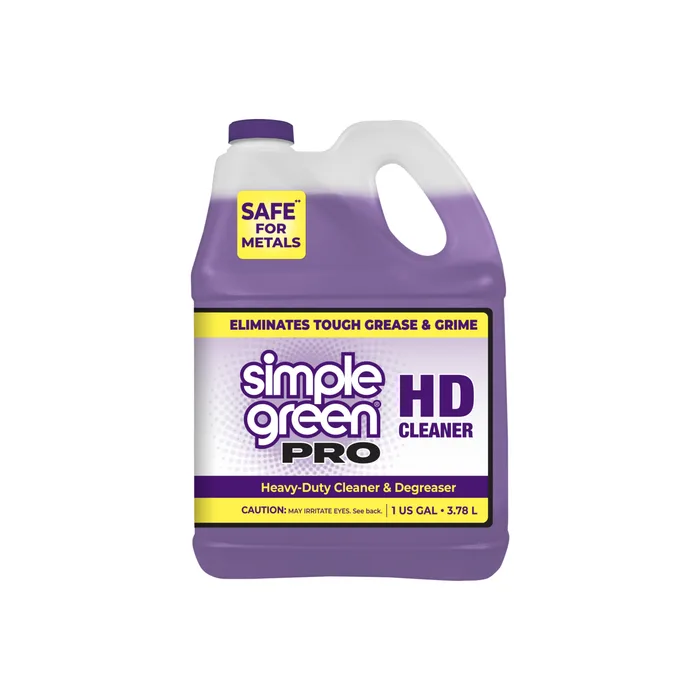
- Buy Simple Green Pro HD Heavy-Duty Cleaner A water-based alkaline concentrate built around silicate and phosphate builders rather than caustic soda, which is why the maker will say it works on aluminium. Amazon
- Buy Oil Eater Cleaner & Degreaser Original Formula A silicate-built water-based concentrate that dilutes hard, cleans hard, and is strongly alkaline enough that you should treat the undiluted jug with respect. Amazon
- It depends Simple Green All-Purpose Cleaner The green bottle half the garages in the country already own, genuinely fine for light engine bay upkeep and genuinely outgunned by heavy grease. Amazon
- Skip Gunk Original Engine Degreaser A kerosene and petroleum distillate aerosol that absolutely dissolves old grease, and carries the hazard profile you would expect from that description. Amazon
What actually matters
- Chemistry family - Solvent, caustic and water-based degreasers attack grease by completely different mechanisms and have completely different side effects on rubber, plastic and bare metal. Identify the family first and every other spec makes sense.
- pH - Printed in section 9 of any safety data sheet, it tells you how aggressive the alkalinity is. Anything above about 12 is strong enough that gloves and a fast, thorough rinse stop being optional.
- Dilution ratio - A concentrate that the maker dilutes 1:10 is a fundamentally different purchase from a ready-to-use spray, both in how far it goes and in how much control you have over strength.
- Dwell time - The minutes the product is allowed to sit before rinsing. Water-based cleaners depend on it, and every maker warns against letting the solution dry on the surface, which concentrates it exactly where you do not want it.
- Aluminium compatibility - The one material claim worth hunting for, because engine bays are full of soft, often unpainted aluminium and because manufacturers who have tested it will say so specifically.
- Rinsability - Whether the product is designed to be flushed off with water. Safety data sheets sometimes state restrictions on non-rinseable surfaces, which quietly tells you the product is not a wipe-and-leave cleaner.
- GHS classification - The hazard categories on the safety data sheet, covering flammability, aspiration, irritation and carcinogenicity. This is where solvent aerosols look very different from water-based concentrates.
The specs, in plain English
Green flags vs red flags
Green flags
- The maker publishes a safety data sheet you can find in two clicks from the product page.
- The label or product page names specific metals the product has been tested on rather than saying 'safe on all surfaces'.
- There is a printed dilution ladder with more than one ratio, showing the product was designed as a concentrate.
- The directions give an actual dwell time in minutes and tell you not to let the solution dry.
- The ingredient list is disclosed by name and CAS number rather than hidden behind 'proprietary blend' for everything.
Red flags
- The phrase 'safe on everything' with no named material and no stated contact time limit.
- No safety data sheet available, or one that is several versions out of date.
- A ready-to-use spray sold at a concentrate's strength claim, with no dilution guidance at all.
- Marketing that emphasises how fast it works while the sheet lists an extremely flammable aerosol classification.
- No mention anywhere of rinsing, covering electrical components, or what to do with the runoff.
Who's who: the brands
- Simple Green - Sunshine Makers' consumer and professional line, notable for publishing detailed safety data sheets for its products.
- Oil Eater - Kafko International's water-based concentrate line, built around replacing solvent cleaners in shops and industrial settings, and a page that describes the original formula as a highly concentrated cleaner.
- Gunk - A Blaster LLC brand with a long history in the aerosol solvent degreaser aisle, including the Engine Brite formulations most people picture when they hear 'engine degreaser'.
- Purple Power - A widely stocked industrial-strength cleaner and degreaser concentrate, and a good example of a product where reading the label's own metal guidance before use is worth the minute.
- Meguiar's - A car care and detailing brand, so its degreasers are pitched at owners keeping a presentable engine bay rather than at heavy equipment restoration.
How to read a listing without getting fooled
Start on the maker's own product page and find two things: the dilution instructions and any named material claim. If the page says a ratio like 1:3 or 1:10, you are looking at a concentrate and can work out real-world value. If it names metals, such as aluminum, stainless steel and chrome, that is a claim the manufacturer has to stand behind, and it is worth far more than the word 'safe'. Then open the safety data sheet, which every manufacturer publishes, and read three sections: composition, which tells you the family; section 9, which gives pH and flash point; and section 2, which lists the GHS hazard categories. A water-based concentrate will typically show pH somewhere between 9 and 13, a flash point above 212F and an irritation classification. A solvent aerosol will show petroleum distillates near the top of the composition table, a flash point well under 200F and a flammability classification. That comparison takes about a minute and settles most of the decision.
How much should you spend?
This is an inexpensive category and the spread between tiers is narrow, so buying the cheapest option rarely saves much and occasionally costs you a dulled intake manifold. Budget tier covers most solvent aerosols and the large water-based concentrate jugs, and at this end the concentrates are the better value because they dilute several times over. Mid-range buys professional-grade water-based concentrates with published metal compatibility and a proper dilution ladder, which is where we would spend. Premium tier in this category mostly means specialist formulations developed for aerospace or precision equipment, and unless you are cleaning something genuinely delicate you are paying for testing you do not need. The most useful way to compare is not the sticker on the shelf but how many usable litres of working solution the container makes at the dilution the maker specifies for engines.
Questions, answered
Is a citrus degreaser actually gentler?
Usually yes, but 'citrus' describes a fragrance and a d-limonene solvent, not a safety guarantee. Citrus and surfactant blends tend to be milder on paint and rubber than petroleum distillates and need more dwell time in exchange. Check the pH and the composition list rather than the scent, because some citrus-scented products are also strongly alkaline.
Can I use engine degreaser on my driveway afterwards?
Most water-based degreasers list concrete as a suitable surface, often at a heavier dilution than they use on engines. The bigger issue is where the runoff goes. If your driveway drains to a street gutter, that gutter almost certainly leads to a storm drain and then to a waterway with no treatment in between.
What temperature should the engine be?
Cool enough to touch. Manufacturers warn that spraying water onto a hot engine can cause thermal shock and crack or warp components, and hot metal also makes the cleaner evaporate and dry on the surface, which is the one thing every label tells you to avoid. Work in shade if you can.
Do I need a separate degreaser for a motorcycle or bicycle chain?
Often yes, because chain lubricants and o-ring seals have their own compatibility rules that a general engine degreaser is not formulated around. Several manufacturers sell a dedicated bike or motorsports formulation for exactly this reason. If you only own one bottle, check the maker's guidance on rubber and elastomers before using it near seals.
Or jump to the head-to-head: Simple Green Pro HD Heavy-Duty Cleaner vs Oil Eater Cleaner & Degreaser Original Formula.