Explained
Car Drying Towels, Explained
After reading, you'll understand how to compare towels of different sizes and densities, and how to keep microfibre absorbent.
In this guide
Microfibre drying towels are sold almost entirely on one number, GSM, and it is a number most buyers read as if it meant capacity. It does not. GSM is grams per square metre, a measure of how tightly packed the fibre is, so it describes the fabric rather than the towel. To know how much water a towel can hold you need the density and the area, and the second is frequently published while the first sometimes is not.
The 30-second version
- GSM is a density, so it needs multiplying by the towel's area before it means anything about capacity.
- Twist loop out-absorbs plush, because twisted strands draw water in by capillary action instead of trapping it.
- The blend ratio drives absorbency, with polyamide the softer, thirstier and more expensive half of the fibre.
- Fabric softener destroys microfibre, coating the fibres and killing the capillary action permanently.
- One towel rarely finishes a car, and at least one manufacturer says so on its own product page.
The products this guide is about
Our verdict on each, with the full reasoning on the companion review.
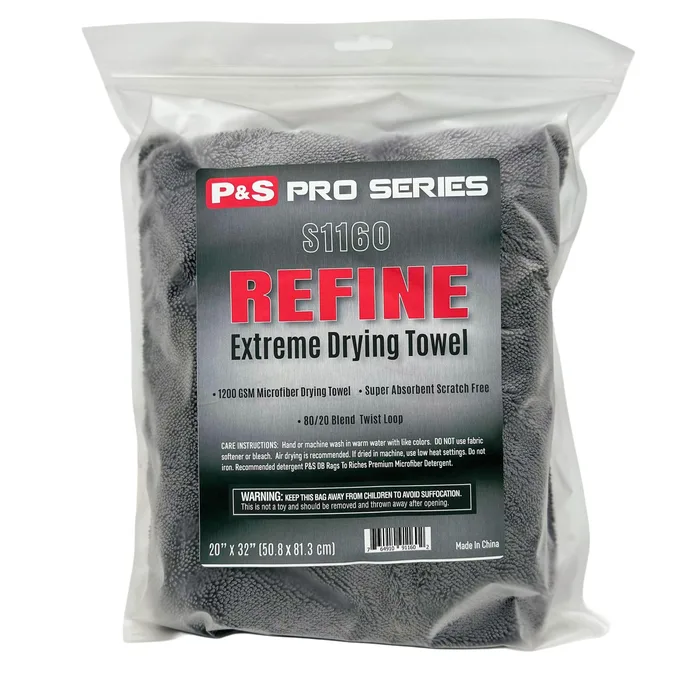
- Buy P&S Detail Products Refine Extreme Drying Towel 1,200 GSM twist loop in an 80/20 blend, and the only towel here that publishes every number you would want.
- Buy Adam's Polishes Hybrid Drying Towel 1,020 GSM at 20 by 30 inches, which lands close to the P&S on total fibre in a size that is easier to handle. Amazon
- It depends Chemical Guys Cloud 9 Extra Large Microfiber Drying Towel, 52 x 36 in. Roughly twice the area of the next largest towel here, with no published GSM to say how much it holds.
- Skip Adam's Polishes Great White Microfiber Drying Towel 370 GSM, and the brand's own page recommends buying two because one will not finish the car. Amazon
What actually matters
- GSM - grams per square metre of fabric. It describes how dense the pile is, not how big the towel is. The towels in the comparison run from 370 to 1,200, and the top of that range only helps if the towel is also a useful size.
- Area - the towel's actual dimensions. Multiply the area in square metres by the GSM and you get grams of fibre, which is the closest thing to a capacity figure the category offers.
- Weave - twist loop uses long twisted strands with capillary channels; plush pile is cut and soft; waffle weave uses a grid that holds water in pockets and is common on glass towels.
- Blend ratio - polyester to polyamide, usually written 80/20 or 70/30. More polyamide means softer and more absorbent, and it costs more, which is why cheap towels skew heavily to polyester.
- Edging - how the towel is finished. Sewn polyester edges can scratch if they drag; edgeless and silk-banded towels remove that risk and are worth having on paint.
- Size and foldability - a towel you can fold into eighths gives you eight dry faces. A huge towel gives you one enormous wet one, and it will find the ground.
- Pack quantity - drying uses more towels than people expect, and buying in packs is both cheaper and closer to how the job actually goes.
The specs, in plain English
Green flags vs red flags
Green flags
- GSM and dimensions both published, so total fibre mass can be worked out.
- Weave type named rather than described with a brand word.
- A blend ratio such as 80/20 stated on the page.
- Edgeless or silk-banded construction on a towel intended for paint.
- Multipack options, which match how the job actually consumes towels.
Red flags
- No GSM published on a towel sold at a premium price.
- A construction described only by a brand name such as hybrid, with no weave stated.
- A very low GSM presented alongside a large size as if the two cancelled out.
- No blend ratio anywhere, which usually means the polyamide content is low.
- A page recommending you buy two of the same towel to finish one car.
Who's who: the brands
- P&S Detail Products - Professional supply brand, and the only one in this comparison publishing weave, blend ratio, GSM and size on the same page.
- Adam's Polishes - A wide range of drying towels at very different densities, usually with GSM and dimensions published and weave left vague.
- Chemical Guys - The largest consumer range, strong on plush pile and oversized towels, with published specifications that vary a lot by product.
- The Rag Company - A microfibre specialist rather than a chemical brand.
- Turtle Wax - Mass-market towels sold alongside the chemicals.
How to read a listing without getting fooled
Find the GSM and the dimensions and do the multiplication, because one without the other is half a specification. Convert the area to square metres, multiply by GSM, and you have grams of fibre, which is the number to compare between towels of different sizes. If GSM is missing entirely, note that the product is being sold on size and feel alone. Then look for the weave, because twist loop and plush behave differently and a brand word like hybrid tells you nothing. Look for a blend ratio, since 80/20 is the marker of a genuinely absorbent towel. Finally check the edge, because a stitched border dragged across paint is the one part of a towel that can leave a mark.
How much should you spend?
Drying towels are cheap enough that buying the good one is rarely the expensive mistake, and buying only one usually is. The budget tier is where low GSM lives, and a thin towel does not become adequate by being large, it just means two full passes instead of one. Mid-range is where 1,000 GSM and up appear along with stated weaves and blends, and that is where most people should shop. Above that you are paying for edgeless construction, higher polyamide content and better consistency between washes. Whatever the tier, buy at least two: one for paint and one for glass and jambs, which should never touch each other's dirt.
Questions, answered
How many drying towels do I need for one car?
Two at minimum and three is better. One high-GSM towel for the main body panels, a second for when the first is saturated, and a separate thinner or waffle weave towel for glass and door jambs, which pick up grit and residue you do not want going back onto paint. One manufacturer in the comparison above recommends two of its own towels for a mid-size car, which is a fair guide for anything at that density.
Can I wring out a drying towel and keep going?
You can, and it works better than people expect with twist loop towels, which release water readily. What you should not do is wring hard enough to stress the seam or the base fabric, since that is where towels fail. The more common practice is to fold the towel into quarters or eighths and rotate to a dry face as each one loads up, which gives you eight usable surfaces before you need to wring anything.
Why did my towel stop absorbing?
Almost always fabric softener, or a detergent containing it. Softener works by coating fibres with a lubricating film, which is exactly what destroys the capillary action microfibre relies on. Once that has happened it is largely permanent. Dryer sheets do the same thing. Wash microfibre with a plain liquid detergent or a dedicated microfibre wash, no softener, no bleach, and dry on low or air dry.
Is a drying aid worth using?
It helps more than it sounds. A drying aid is a light spray that adds lubrication so the towel glides rather than grabbing, which reduces the chance of dragging a stray particle across the clear coat, and most add a little gloss. It is not a substitute for a towel with enough capacity, and using one on a towel that is already saturated just moves water around. Think of it as insurance during the riskiest step of a wash.
Or jump to the head-to-head: P&S Detail Products Refine Extreme Drying Towel vs Adam's Polishes Hybrid Drying Towel.