

Automotive
The Best Engine Compression Testers: 4 Compared (and One to Skip)
We compared four compression testers on gauge range, hose length and flex, the thread adapters actually included, whether there is a pressure release valve, and how the adapter seals in the plug hole.
The short version
The OTC 5605 Deluxe Compression Tester Kit is the one to buy if you work on more than one engine, because it carries the deep well 14 mm connector and the 16 mm Ford Triton adapter that the cheaper kits leave out. The Innova 3612 is the value pick and does the same core job on a 15 inch rubber hose with a side release valve, and Innova publishes a clear test procedure with it. The Motion Pro 08-0651 is the one that depends on you: it is built around 10 mm, 12 mm and 14 mm powersports plugs, so it is right for a motorcycle, ATV or two-stroke and wrong for a truck with recessed 18 mm wells. Skip the Lang Tools TU-20-2PB Jiffee unless you specifically want a cone-seal tester, because its rubber cone adapters hand-tighten with no tools and the seal is only as good as the pressure you hold on it. Whichever you buy, the numbers only mean something if the engine is warm, every plug is out, the throttle is wide open, the battery is fully charged and you crank each cylinder the same number of strokes. The absolute reading matters far less than the spread between cylinders. Best for: anyone diagnosing a misfire, an oil burner or a used-car purchase who wants evidence rather than a guess.
Our picks at a glance
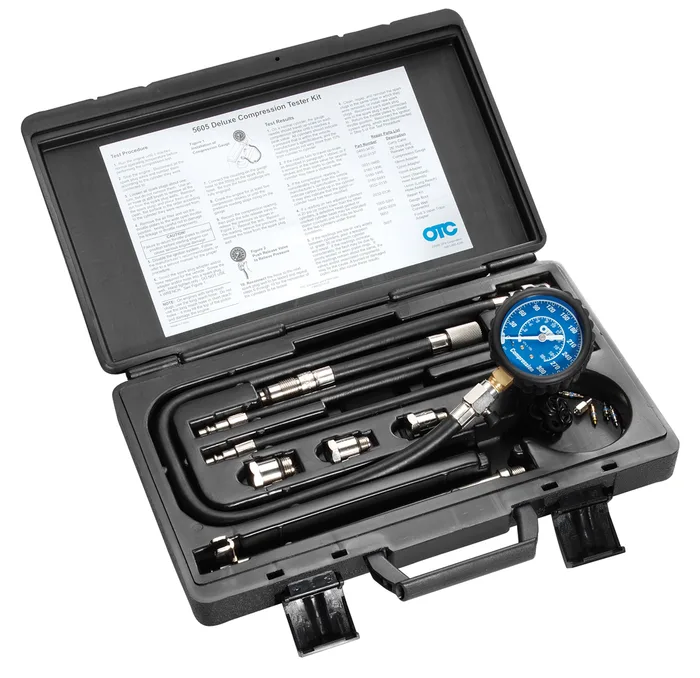
- OTC 5605 Deluxe Compression Tester Kit - Buy. The kit that already has the adapter for the awkward engine, on a 26 inch hose you can read from outside the bay.
- Innova 3612 Compression Tester, 4-piece kit - Buy. The cheap one that does the job properly, with a side release valve and the clearest instructions of the four.
- Motion Pro 08-0651 Compression Tester with 10 mm, 12 mm and 14 mm adapters - It depends. A powersports-first tester with a billet manifold and screw-in brass adapters, sized for bike and small-engine plugs rather than car ones.
- Lang Tools TU-20-2PB Jiffee Compression Tester with Gauge Boot - Skip. A cone-seal tester built for speed in a busy shop, which is exactly the wrong trade for a careful diagnosis.
The verdict in 30 seconds
What mattered most
- Gauge range
- Gauge face
- Hose
- Thread fitments included
- How it seals
- Pressure release valve
A compression tester is one of the simplest tools in the box: a gauge, a hose, and a fitting that seals in the spark plug hole. That simplicity means the differences between kits come down to reach, adapters and sealing, not electronics. It also means the tool is not where people go wrong. The procedure is, and a test done carelessly produces numbers that look like data but mean nothing.
The kit that already has the adapter for the awkward engine, on a 26 inch hose you can read from outside the bay.
Best for: Anyone who tests engines they do not own, especially anything with recessed plug wells or Ford three-valve heads.
- The 26 inch flex hose gauge assembly with quick coupler lets you set the gauge somewhere readable instead of squinting into a hot engine bay.
- Adapter coverage is the widest here: an 8 inch deep well 14 mm connector, a 7 inch flex 16 mm Ford Triton adapter, 12 inch flex 14 mm hoses in standard and long reach, plus 10 mm, 12 mm and 18 mm threaded adapters.
- OTC's own instruction sheet ships with the kit and spells out the test procedure and the 10 percent cylinder-to-cylinder limit, so you are not guessing at interpretation.
- It is a big blow-molded case for a job most home mechanics do a handful of times.
- Half the adapters are for engines you may never own, which is most of what you are paying for over the plain 5606 kit.
- The analog dual scale gauge reads 0-300 psi and 0-2100 kPa, so it is not rated for diesel cranking pressures.
- You still need a separate leak-down tester to find out where a low cylinder is leaking.
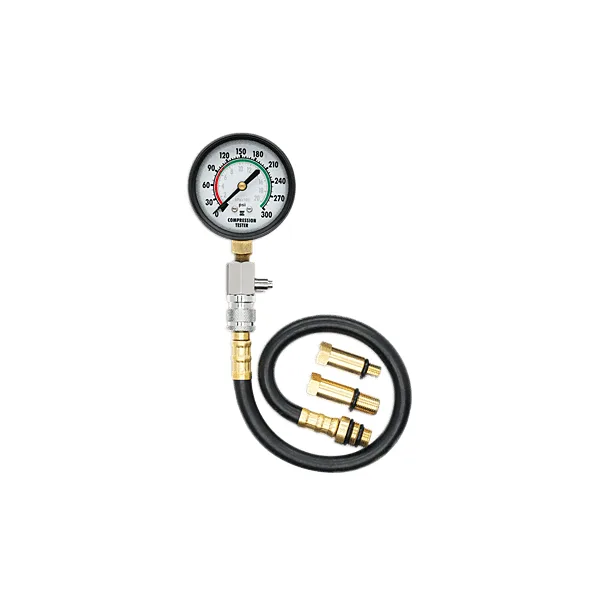
The cheap one that does the job properly, with a side release valve and the clearest instructions of the four.
Best for: Someone testing their own car or light truck who wants a correct answer without buying adapters for engines they will never see.
- A 2-1/2 inch dial with dual-calibrated, colour-coded scales reading to 300 psi, which is easy to read at arm's length.
- The side release valve lets you dump pressure and repeat a cylinder without unthreading the hose, which matters because a repeat test is how you catch a bad seal.
- Innova's operating instructions state the pre-test conditions plainly: fully charged battery, engine at operating temperature, all spark plugs removed, throttle plate secured wide open, and the same number of cranking strokes on every cylinder.
- The hose is 15 inches, so on some engines the gauge sits deeper in the bay than you would like.
- The hose is rubber rather than braided, and the kit is only four pieces: gauge, hose, 12 mm adapter and 14 mm adapter.
- Innova states the tool is designed for spark-ignited gasoline engines not exceeding 250 psi, so it is not a diesel tool.
- No hard case, and no deep well or long-reach option for recessed plugs.
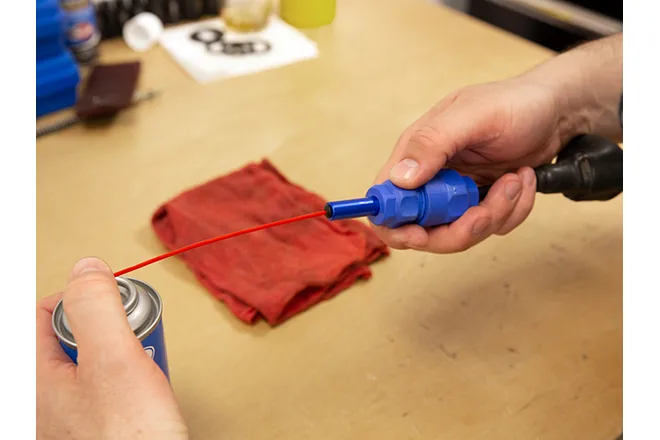
A powersports-first tester with a billet manifold and screw-in brass adapters, sized for bike and small-engine plugs rather than car ones.
Best for: Motorcycle, ATV and two-stroke owners who need 10 mm and 12 mm fitment done properly and will never point it at a V8.
- The billet gauge manifold has an integrated pressure release valve, so re-testing a cylinder is a button press.
- Brass screw-in adapters seat on an o-ring at the spark plug sealing surface, which removes the guesswork about whether the joint is holding.
- Motion Pro's instructions say it is designed for gasoline engines with 10 mm, 12 mm and 14 mm plugs and confirm the basics: engine at operating temperature, all plugs out, throttle fully open.
- Adapter coverage stops at 10 mm, 12 mm and 14 mm, so there is no 18 mm option for older or larger engines.
- Motion Pro does not publish the hose length, and there is no deep well or long-reach adapter for recessed car plug wells.
- It is priced in the premium tier here, above kits with more adapters.
- The 0-300 psi analog gauge is the same range as much cheaper tools, so you are paying for build and fitment rather than measurement.
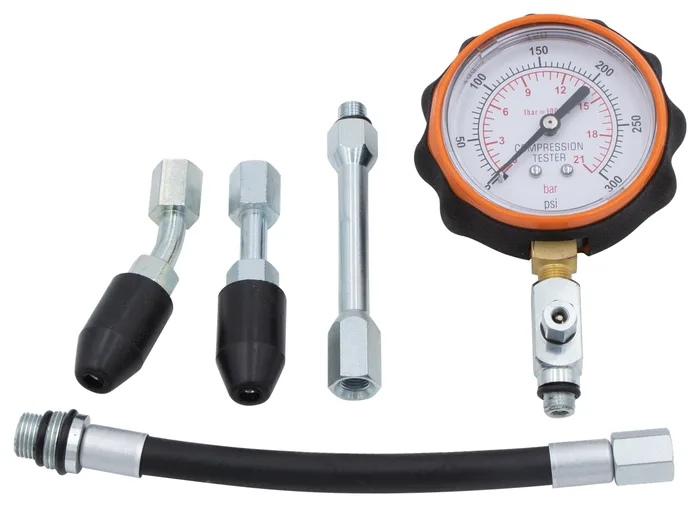
A cone-seal tester built for speed in a busy shop, which is exactly the wrong trade for a careful diagnosis.
Best for: A shop doing quick go or no-go checks on accessible plug holes, where speed matters more than a number you will act on.
- The straight and 45 degree cone adapters plus 4 inch solid and 7-1/2 inch flex extensions do reach plug holes that a rigid tester cannot.
- The 2-1/4 inch gauge carries a dual scale dial reading 0-300 psi and 0-21 bar.
- The tool is sold with a protective gauge boot.
- It seals with a rubber cone and Lang says the adapters hand-tighten without tools, so how well the joint holds depends on the pressure you keep on it rather than on a thread and o-ring.
- An inconsistent seal is the one variable that ruins the comparison you are trying to make, because a slow leak at the cone looks identical to a worn cylinder.
- Lang does not list a pressure release valve or a hose length, and there are no 10 mm, 12 mm, 14 mm or 18 mm threaded adapters in the set.
- It sits in a similar price tier to screw-in kits that include more adapters and a case.
| Criteria | 5605 Deluxe Compression Tester Kit Top pick | 3612 Compression Tester, 4-piece kit | 08-0651 Compression Tester with 10 mm, 12 mm and 14 mm adapters | TU-20-2PB Jiffee Compression Tester with Gauge Boot |
|---|---|---|---|---|
| Verdict | Buy it | Buy it | It depends | Skip it |
| Best for | Anyone who tests engines they do not own, especially anything with recessed plug wells or Ford three-valve heads. | Someone testing their own car or light truck who wants a correct answer without buying adapters for engines they will never see. | Motorcycle, ATV and two-stroke owners who need 10 mm and 12 mm fitment done properly and will never point it at a V8. | A shop doing quick go or no-go checks on accessible plug holes, where speed matters more than a number you will act on. |
| Price tier | $$ · mid-range | $ · budget | $$$ · premium | $$ · mid-range |
| Gauge range | 0-300 psi and 0-2100 kPa | 0-300 psi, dual-calibrated psi and kPa dial | 0-300 psi | 0-300 psi and 0-21 bar |
| Gauge face | 2-1/2 in, chrome bezel, protective boot | 2-1/2 in, colour-coded dual scale | Size not published, protective rubber boot | 2-1/4 in dual scale, gauge boot included |
| Hose | 26 in flex hose with quick coupler | 15 in high pressure rubber hose | Flex hose with quick disconnect, length not published | 4 in solid and 7-1/2 in flex extensions |
| Thread fitments included | 14 mm standard and long reach, 14 mm deep well, 16 mm Ford Triton, 10 mm, 12 mm, 18 mm | 14 mm and 18 mm hose end, 12 mm and 14 mm adapters | 10 mm, 10 mm long, 12 mm, 14 mm | Rubber cone, straight and 45 degree |
| How it seals | Screws in, hand tight only | Screws in, hand tight only | Screws in, brass adapter on an o-ring | Rubber cone, hand-tightened without tools |
| Pressure release valve | Yes, side release valve on the hose | Yes, side release valve | Yes, integrated in the billet manifold | Not listed |
| Storage | Blow-molded hard case with repair parts kit | Not listed | Not listed | Not listed |
| Engine type it suits | Cars and light trucks, including recessed plug wells | Everyday car and light truck petrol engines | Motorcycle, ATV and small-engine gasoline powersports | Quick shop checks on accessible plug holes |
Which one is right for you?
- Anyone who tests engines they do not own, especially anything with recessed plug wells or Ford three-valve heads. Buy it OTC 5605 Deluxe Compression Tester Kit
- Someone testing their own car or light truck who wants a correct answer without buying adapters for engines they will never see. Buy it Innova 3612 Compression Tester, 4-piece kit
- Motorcycle, ATV and two-stroke owners who need 10 mm and 12 mm fitment done properly and will never point it at a V8. It depends Motion Pro 08-0651 Compression Tester with 10 mm, 12 mm and 14 mm adapters
- A shop doing quick go or no-go checks on accessible plug holes, where speed matters more than a number you will act on. Skip it Lang Tools TU-20-2PB Jiffee Compression Tester with Gauge Boot
How we judged the field
Five things separate a compression tester that gives you a usable answer from one that gives you a number. First, fitment: the tool has to thread into your plug hole, which now means 14 mm and 12 mm far more often than the old 18 mm, and it has to reach the bottom of a deep well without bottoming out. Second, sealing: a threaded adapter on an o-ring holds itself, while a cone pressed into the hole holds only as well as your arm does, and any leak at the joint reads exactly like a worn cylinder. Third, hose length and flex, because a gauge you can put on the fender is a gauge you can read consistently instead of guessing at from an angle. Fourth, a pressure release valve, since the whole method depends on repeating a cylinder and on the wet test, and unthreading the hose every time makes that tedious enough that people skip it. Fifth, the gauge range and what the manufacturer rates the tool for, which is where the petrol and diesel line gets drawn.
The field splits along fitment more than quality. Car and truck kits are built around 14 mm and 18 mm threads with long-reach and deep-well options; powersports kits are built around 10 mm, 12 mm and 14 mm and drop the big threads entirely; diesel testers are a separate instrument with a much higher range and glow plug or nozzle adapters. Within each group the gauges are broadly similar analog dials reading to 300 psi, so we picked one comprehensive car and truck kit, one budget kit that covers the common cases without the padding, one powersports-specific tool to show where the fitment line falls, and one cone-seal tester to show the compromise we think is not worth making.
OTC 5605 Deluxe Compression Tester Kit
Buy itThe 5605 is the kit OTC built for someone who works on whatever rolls in. The gauge is a 2-1/2 inch analog dual scale face reading 0-300 psi and 0-2100 kPa, and it hangs off a 26 inch flex hose with a quick coupler, so you can rest it somewhere readable rather than leaning over a hot engine. The adapters are the reason to pay for this one over OTC’s plain kit: an 8 inch deep well 14 mm connector for recessed plug wells, a 7 inch flex 16 mm adapter for Ford three-valve Triton heads, 12 inch flex 14 mm hoses in standard and long reach, and 10 mm, 12 mm and 18 mm threaded adapters. Everything screws in, and OTC’s sheet says to hand tighten only and never use a wrench. A side release valve on the hose lets you dump pressure and repeat a cylinder, which is what the wet test needs. It all lives in a blow-molded case. The cost is bulk and adapters you may never fit. If you test engines you do not own, buy this one.
Innova 3612 Compression Tester, 4-piece kit
Buy itThe Innova 3612 is proof that the cheap version of this tool is not a compromised version. You get a 2-1/2 inch dial with dual-calibrated, colour-coded scales reading to 300 psi, a 15 inch high pressure rubber hose whose end covers the common 14 mm and 18 mm fittings, 12 mm and 14 mm adapters, a quick disconnect, and a side release valve so you can retest a cylinder without unthreading anything. Four pieces, nothing wasted. What raises it above other budget kits is the paperwork. Innova’s operating instructions state the conditions that make a reading valid, including a fully charged battery and a healthy starter, engine at operating temperature, all spark plugs removed, the throttle plate secured wide open, at least five compression strokes, and the same number of strokes on every cylinder. They also publish the interpretation rule and work an example. The limits are real: a shorter hose, a rubber rather than braided line, no deep well or long-reach option, no case, and Innova’s own rating of gasoline engines not exceeding 250 psi. For your own car, that is enough tool.
Motion Pro 08-0651 Compression Tester with 10 mm, 12 mm and 14 mm adapters
It dependsThe Motion Pro 08-0651 is the powersports answer, and it is genuinely better built than its price band suggests without being better for most readers. The manifold is billet with an integrated pressure release valve, the gauge is a 0-300 psi analog face under a protective rubber boot, and the hose uses an integrated quick disconnect. The brass adapters thread in and seat on an o-ring at the spark plug sealing surface, which is the sealing method you want. The catch is the adapter list: 10 mm, 10 mm long, 12 mm and 14 mm, sized for motorcycle, ATV and small-engine plugs. There is no 18 mm, no deep well and no long-reach car adapter, and Motion Pro does not publish the hose length. Motion Pro’s instructions say it is designed for gasoline engines with 10 mm, 12 mm and 14 mm plugs, and give the same pre-test rules the others do: warm engine, all plugs out, throttle fully open, crank until the reading peaks. It is also in the premium price tier for the same 300 psi gauge everyone else fits. Buy it if your garage has two wheels in it more often than four.
Lang Tools TU-20-2PB Jiffee Compression Tester with Gauge Boot
Skip itThe Lang TU-20-2PB Jiffee is a real professional tool and that is exactly why it is worth explaining. It is built for speed: a straight cone adapter, a 45 degree cone adapter, a 4 inch solid extension and a 7-1/2 inch flex extension, on a 2-1/4 inch dual scale gauge reading 0-300 psi and 0-21 bar. Lang says the adapters have straight threads that hand-tighten without tools, and the set is pitched at plug holes that are easy to reach and ones that are deeply recessed. That works in a shop where the question is whether a cylinder is dead. It works against you when the question is whether cylinder three is 12 psi below cylinder one, because a cone seal that varies from hole to hole introduces exactly the variation you are trying to measure. Lang lists no pressure release valve, no hose length, and no 10 mm, 12 mm, 14 mm or 18 mm threaded adapters, and it sits in a similar price tier to screw-in kits that include more adapters and a case. Skip it unless quick screening is your actual job.
Sources
Specs in this review come from these pages.
- OTC 5605 Deluxe Compression Tester Kit, instruction sheet (otctools.com)
- Innova Compression Tester Kits 3612 and 3614, operating instructions (images.carid.com)
- Motion Pro Compression Tester 08-0651, instructions (motionpro.com)
- OTC 5609 Cylinder Leakage Tester Kit, operating instructions (otctools.com)
- Motion Pro, Leak Down Tester 101 (motionpro.com)
- OTC 5020 Diesel Compression Tester with Adapters (otctools.com)
OTC 5605 Deluxe Compression Tester Kit vs Innova 3612 Compression Tester, 4-piece kit: which should you buy?
The choice between the OTC 5605 and the Innova 3612 is a choice about which engines you expect to meet. Both give you a 300 psi analog gauge, a screw-in fitting you hand tighten, and a side release valve so you can retest a cylinder and run a wet test without dismantling anything. Both ship with a written procedure that says the same things: warm engine, every plug out, throttle wide open, equal cranking strokes. On a normal 14 mm plug in an accessible head, they will tell you the same story, and the Innova costs a fraction of the OTC.
What you pay OTC for is reach. The 26 inch hose against Innova’s 15 inch means you can position the gauge where you can read it the same way every time, which is worth more than it sounds when you are comparing four numbers. The deep well 14 mm connector and the 16 mm Ford Triton adapter cover heads where the Innova simply will not reach the plug. So: if you own one or two ordinary cars and you are testing them in your own driveway, buy the Innova and put the difference toward a leak-down tester. If you help friends, run a side business, or own anything with a recessed plug well or a Ford three-valve engine, buy the OTC and stop worrying about fitment.
What to look for
- Thread size and reach: Check what is actually in your head before you buy, because 14 mm and 12 mm dominate modern engines while 18 mm is largely an older fitment, and a long-reach adapter used in a short-reach hole can hit the piston and cause damage.
- Screw-in over cone seal: A threaded adapter sealing on an o-ring holds itself at a consistent torque, while a rubber cone held against the hole introduces a variable into the one measurement whose whole point is comparing cylinders.
- Hose length and flex: A long flexible hose lets you park the gauge somewhere you can read straight on, which removes parallax and the temptation to eyeball a number from an awkward angle.
- A pressure release valve: You will test each cylinder at least twice, once dry and once wet, so a side or manifold release valve turns the wet test from a chore into a button press and makes you far more likely to actually do it.
- A published test procedure: The better kits ship an instruction sheet that states the conditions and the interpretation rule, and that sheet is worth more than a slightly nicer bezel.
- The right gauge range for the fuel: Petrol testers here read to 300 psi and Innova rates its tool for gasoline engines not exceeding 250 psi, whereas diesel testers read to 1000 psi and go in through a glow plug or nozzle port instead of a spark plug hole.
Our final take
Buy the OTC 5605 if you want one kit that will fit whatever you point it at, and the Innova 3612 if you want the correct answer on your own car for very little money. Both are screw-in, both have a release valve, and both come with instructions that tell you how to get a valid reading. Then use them properly. Warm engine, every plug out, throttle wide open, charged battery, equal cranking strokes on every cylinder, and judge the spread rather than the absolute figure. If a cylinder is low, add a little oil and test it again, because that one step tells you rings or valves. When you need to know where the air is going, that is a leak-down tester, not this one.
Questions, answered
What compression reading counts as good?
There is no single number, because the correct figure comes from the engine manufacturer, not the tool. What the tester is really measuring is the spread between cylinders, and two different rules get quoted for that. Innova's instructions for its compression tester kits say compression is normal if the lowest cylinder reads at least 75 percent of the highest, and they work an example: with a high of 140 psi the lowest acceptable reading is 105 psi. OTC's instruction sheet for its 5605 and 5606 kits states the reading should not vary more than 10 percent from cylinder to cylinder, which is the stricter of the two. Use the tighter rule as your warning line and the looser one as your alarm line, and always check the figure in the service data for your engine.
Do I really have to take every spark plug out?
Yes, and it is not optional if you want comparable numbers. Both OTC and Innova instruct you to remove all the spark plugs before testing, and Motion Pro's instructions say the same and explain why: it makes the engine easier to crank. Leaving plugs in means the starter is fighting compression in the other cylinders, so cranking speed drops and the cylinder you are measuring reads low. The same logic covers the other pre-test steps. Warm the engine to operating temperature, hold the throttle wide open so the cylinder can actually fill with air, disable the ignition, start with a fully charged battery and a healthy starter, and crank each cylinder the same number of strokes. Innova specifies at least five compression strokes and says the engine should be cranked the same number of strokes for every cylinder.
What does adding oil to a cylinder actually tell me?
This is the wet test, and it is the single most useful thing a compression tester does. You take a cylinder that read low, put a small amount of oil into it through the plug hole, and run the test again. OTC's instruction sheet says to pour a teaspoon of grade 30 oil into the cylinder and retest; Innova says roughly a tablespoon of medium-grade oil. The oil temporarily fills the gap between the piston rings and the bore. If the reading jumps up considerably, the leak was past the rings, which OTC describes as poorly seated or worn piston rings. If the reading stays about the same, the oil could not seal it, and the fault points at the valves or associated components instead. That one retest separates a bottom-end problem from a top-end one before you remove a single bolt.
Should I buy a leak-down tester instead?
They are different instruments and they answer different questions. A compression tester measures pressure the engine makes while cranking, and it tells you whether a cylinder seals and whether all cylinders are in similar condition. A leak-down tester does the opposite: it feeds shop air into a cylinder held at top dead center with the valves closed and shows you what percentage of that air escapes. Motion Pro's guidance is that 5 percent or less leakage indicates an engine in excellent condition, up to 15 percent is acceptable, and above 15 percent indicates repair is needed. The real advantage is that you can hear where the air goes. OTC's cylinder leakage tester instructions list the tells: air from the crankcase breather means defective rings or worn cylinder walls, air from the exhaust means an exhaust valve, air from the intake means an intake valve, and bubbles in the radiator mean a head gasket or a crack. Compression first to find the bad cylinder, leak-down second to find the cause.
Can I use a petrol compression tester on a diesel?
Generally no, and the numbers make it obvious. Innova states its compression tester is designed for spark-ignited gasoline engines that do not exceed 250 psi, and all four testers here top out at a 300 psi gauge. Diesel cranking pressures run far above that, which is why diesel testers are built to a different scale. Lang Tools' diesel compression tester carries a 0-1000 psi and 0-70 bar dial on a wire reinforced hydraulic hose, and OTC's diesel kit reads to 1000 psi and 7000 kPa. Fitment differs too. A diesel has no spark plug, so the tester goes in through a glow plug port or an injector nozzle bore, and the kits carry glow plug and nozzle adapters rather than 14 mm and 18 mm plug threads. Buy the tool that matches the engine.
Deciding between the top two? See our head-to-head: OTC 5605 Deluxe Compression Tester Kit vs Innova 3612 Compression Tester, 4-piece kit.
More Automotive reviews
 The Best Dash Cams: Four Current Models Compared
  The Best Detail Brushes: 4 Compared (and One to Skip)
  The Best Car Drying Towels: 4 Compared (and One to Skip)
  The Best Engine Degreasers: 4 Compared (and One to Skip)
  The Best Home EV Chargers: 4 Compared (and One to Skip)
  The Best Floor Jacks: 4 Compared (and One to Skip)