Explained
Cargo Liners, Explained
After reading this you'll know why a cargo liner is not a trunk mat, which specs actually decide whether a spill stays contained, and how to order the right part for your exact vehicle the first time.
In this guide
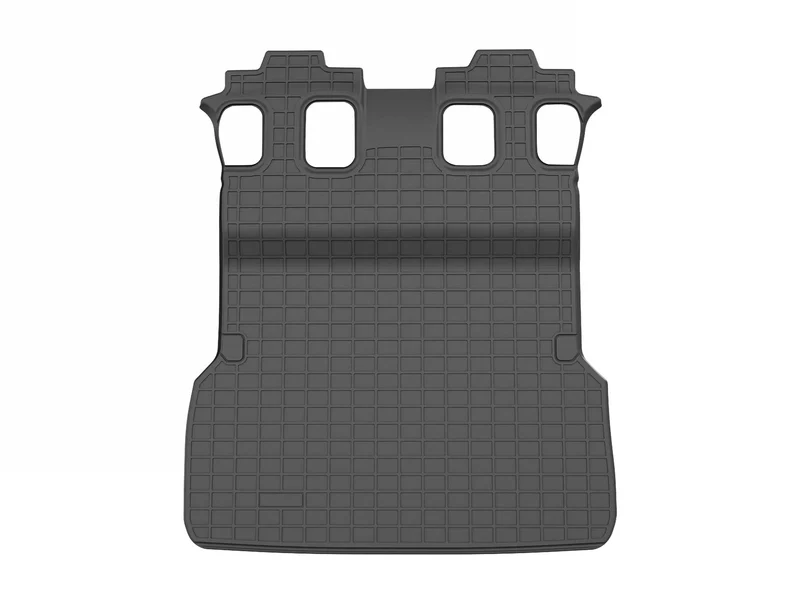
A cargo liner is a molded tray that sits in the back of your SUV, wagon or hatchback so mud, snowmelt, groceries and the occasional tipped-over jug never touch the factory carpet. The category looks simple from a product photo, which is exactly the problem: flat trimmable mats and deep molded trays are sold side by side under the same search term, and the photos are shot at angles that hide how tall the walls really are. The two things that trip up first-time buyers are mistaking a mat for a liner, and ordering a part that fits their model but not their seating configuration.
The 30-second version
- Walls are the whole product. A raised perimeter lip is the only thing standing between a spill and your carpet, so treat wall height as the primary spec and everything else as secondary.
- Vehicle-specific beats universal every time. Trim-to-fit mats leave gaps at the wheel wells and rear sill, which is precisely where liquid heads once it starts moving.
- Three-row SUVs need the right variant. Third-row-up and third-row-down are separate parts, they are not interchangeable, and they are usually non-returnable once used.
- Material choice is a comfort and cold-weather decision. Rigid thermoplastics hold walls up under a sloshing load, softer ones are nicer to kneel on and flex out of a tight hatch.
- Non-porous or nothing. Anything carpet-faced absorbs and holds odor, so look for a surface you can hose off rather than one you have to shampoo.
The products this guide is about
Our verdict on each, with the full reasoning on the companion review.
- Buy WeatherTech Cargo/Trunk Liner Tall walls and a scanned vehicle-specific fit, which is what you want when a gallon of paint tips over.
- Buy Husky Liners WeatherBeater Cargo Liner Softer, friendlier material and a warranty for less money, with lower walls as the tradeoff.
- It depends 3D MAXpider Kagu Cargo Liner The best-looking and lightest liner here, but the low-profile design trades away containment depth.
- Skip Motor Trend FlexTough Universal Cargo Liner A trimmable rubber mat that costs little and protects about as much as that suggests. Amazon
What actually matters
- Raised lip height. The single feature that separates a liner from a mat. A tall perimeter wall gives a tipped container somewhere to pool; a low or flat edge just routes the mess onto the carpet you bought the liner to protect. Product photos are shot to flatter shallow trays, so check the spec or the fitment diagram instead of trusting the image.
- Fitment method. Vehicle-specific liners are digitally scanned or laser-measured for your year, make, model and trim, so the tray follows wheel arches and body contours with no open channels. Universal mats you cut yourself will always leave gaps, and one bad scissor cut is permanent.
- Wall coverage up the seat backs and wheel wells. A surprising share of cargo-area mess lands on the vertical surfaces, not the floor. Liners that climb the seat backs and wrap the wheel arches catch it; ones that stop at the load floor do not.
- Material and cold-weather behavior. Non-porous thermoplastics do not absorb liquid, but they differ in stiffness. Rigid formulations keep the walls standing under weight; softer ones are more pleasant to handle. Both should stay flexible in freezing temperatures rather than going brittle and curling at the edges.
- Anti-skid backing. The liner has to stay put. Molded gripping nibs hold hard but can leave faint impressions in plush factory carpet over time. Nib-free textured backings are gentler and grip well enough on most factory surfaces.
- Sill or bumper coverage. Some applications add a flap that folds over the rear sill. It protects the painted lip that gets scraped every time you drag a bag of mulch or a toolbox out of the back.
- Warranty. Compare coverage terms on the maker's site; a shorter warranty is a signal about how long the maker expects the part to last.
The specs, in plain English
Green flags vs red flags
Green flags
- The listing asks for your year, make, model and trim before it shows you a part number.
- The product photos or diagrams clearly show a raised perimeter wall that climbs the wheel wells and the back of the rear seats.
- Separate part numbers exist for third-row-up and third-row-down configurations on three-row SUVs.
- The material is described as non-porous thermoplastic and the care instructions say hose it off rather than shampoo it.
- The warranty terms are stated plainly on the maker's site.
- The backing is described specifically, either gripping nibs or a nib-free anti-skid texture, rather than left vague.
Red flags
- The word 'universal' or 'trim to fit' anywhere in the title, paired with a picture of a flat sheet.
- Product photos shot only from a low angle or straight down, so you cannot judge wall height.
- A carpet or fabric top surface, which absorbs liquid and holds odor no matter how nice it looks in the listing.
- No fitment selector, or a vague 'fits most SUVs' claim in place of a model list.
- Owner reports mentioning edge curl, brittleness or shrinkage after one winter.
- Reviews describing gaps at the wheel wells or a tray that refuses to sit flat, which points to a fit that was adapted rather than scanned, plus a short or vague warranty.
Who's who: the brands
- WeatherTech - The premium benchmark for containment, known for laser-measured vehicle-specific fits, tall perimeter walls, and a wide application list including bumper-lip and third-row variants.
- Husky Liners - The mainstream value choice: molded vehicle-specific trays in a softer material, backed by a manufacturer warranty; check current terms on the maker's site.
- 3D MAXpider - The style-forward option, using a multi-layer foam-core build for light weight and sound deadening, with a carbon-fiber-look surface and deliberately low-profile edges.
- Motor Trend (FlexTough) - Budget universal trim-to-fit rubber, widely stocked and cheap, sold as a liner but functionally a flat mat.
- Lloyd Mats - Known for made-to-order carpeted and rubber cargo mats with logo embroidery options, aimed at buyers prioritizing appearance and factory-match color over spill containment.
- Smartliner (MAXLINER) - A lower-cost vehicle-specific alternative that copies the molded-tray formula at a friendlier price, with a narrower application list and less consistent wall depth.
How to read a listing without getting fooled
Start at the fitment selector, not the price. If the listing lets you buy without entering a year, make, model and trim, you are almost certainly looking at a universal mat regardless of what the title says. Once you are on a vehicle-specific page, find the side-profile image or the dimensional diagram and look for the perimeter wall: you want to see the tray climb the wheel arches and rise behind the rear seats, not just a lipped rectangle. Ignore the hero photo, which is usually shot from a high angle that exaggerates depth. Next, read the configuration options carefully. Three-row SUVs will have two or more part numbers, and split-folding rear seats sometimes have their own variant; picking the wrong one is the most common ordering mistake in this category. Then check the material line for a non-porous thermoplastic and the backing description for how it stays put. Finally, sort the owner reviews for your specific vehicle rather than reading the aggregate score, because these products are made per-application and a brand that nails one model can leave gaps on another. Watch for repeated mentions of corner gaps, edges that will not sit flat, or curling after cold weather.
How much should you spend?
Cargo liners spread across a wide range, and what you are actually paying for is fit engineering and wall height, not raw material. At the bottom sit universal trim-to-fit mats, which cost very little and protect roughly in proportion; they make sense as a stopgap in a lease return or a work beater, and almost nowhere else. The value sweet spot is the mid-tier molded, vehicle-specific liner: you get a scanned fit, real perimeter walls, wheel-well and seat-back coverage, and a manufacturer warranty, for a step down from the premium tier. For most households hauling groceries, luggage, sports bags and a wet umbrella, that tier covers every real-world case. Stepping up to the premium tier buys you taller walls, a tighter fit, a wider selection of third-row and bumper-lip variants, and it is genuinely worth it if you regularly carry dogs, snow, plants, paint or anything else that can pour, since one contained spill pays the difference back immediately. Where extra spending stops earning its keep is style: multi-layer and designer-finish liners charge premium money for looks, light weight and quiet rather than for containment depth, so buy those with your eyes open. The rule is to buy for the worst thing you actually haul, not the average thing, and if the budget only reaches universal-mat territory, wait for a mid-tier molded liner to go on sale instead. The protection gap is much larger than the price gap.
Questions, answered
What's the actual difference between a cargo liner and a cargo mat?
A mat is flat: a piece of rubber or carpet that sits on the load floor. A liner is a molded tray with raised perimeter walls that follows your vehicle's wheel wells and climbs the seat backs, so liquid pools inside instead of running off the edge. Sellers use both words loosely, so judge by the shape rather than the label. If containment matters to you at all, you want the tray.
Do I need a special version for a three-row SUV?
Yes. Makers sell separate parts for third row up, which is a small liner for the shallow area behind the last row, and third row down, which is a long liner covering the folded seat backs as well as the floor. They are not interchangeable, and they usually cannot be returned once installed. Run your exact trim through the fitment selector before ordering.
Will a liner damage the carpet underneath?
Not normally. The bigger risk is trapped moisture: if something soaks the liner, pull it out and let both the liner and the carpet dry before putting it back. Liners with aggressive gripping nibs can leave faint impressions in plush carpet over time, which is exactly why some brands use a nib-free anti-skid backing instead.
How do I clean one?
Pull it out, shake off the loose debris, hose it down and scrub with mild soap and a soft brush, then let it dry fully before reinstalling. Skip oily protectant sprays; they leave the surface slick, which is the last thing you want under a load of cargo.
Are the expensive liners really worth it?
It depends on what you carry. If your cargo area sees groceries and luggage, a mid-range molded liner does the job and you keep the difference. If you carry dogs, wet sports gear, potted plants, paint or firewood, the taller walls and tighter fit of a premium liner earn their money the first time something tips over.
Can I just trim a universal mat to fit?
You can, but you are cutting a flat sheet, not creating walls. Even a perfect cut leaves you with a mat that routes spills straight over the edge, and an imperfect cut leaves permanent gaps at the wheel wells where liquid heads first. It is a reasonable temporary carpet cover and a poor substitute for a molded liner.
Or jump to the head-to-head: WeatherTech Cargo/Trunk Liner vs Husky Liners WeatherBeater Cargo Liner.