Explained
Car Undercoating, Explained
After reading, you'll understand why undercoatings split into soft and hard families, what each maker's prep instruction is really telling you, and how to read a salt spray claim without being misled by it.
In this guide
Most first time buyers assume undercoating is one product with different brand names on it, and it is not. The word covers several unrelated chemistries that behave in opposite ways, and the most consequential difference, whether the film stays soft or cures hard, is rarely the thing printed on the front of the can. The second trap is surface prep, because nearly every hard coating quietly assumes clean, rust free metal, which is not what exists under a ten year old car. Get those two things straight and the rest of the category becomes easy to navigate.
The 30-second version
- Soft and hard coatings fail differently, so the choice between them matters more than any brand comparison you will read.
- A hard film only protects metal it touches, which is why the prep instruction on the can is the most important sentence on it.
- Wax and lanolin coatings are maintenance items, with makers publishing intervals from one year up to two or three depending on thickness.
- Salt spray hours are a lab comparison, and ASTM B117 itself says results have seldom been correlated with real world performance on their own.
- Temperature decides when you can do the job, with published windows clustering in the 60 to 95 F range and thick products needing to be warmed first.
The products this guide is about
Our verdict on each, with the full reasoning on the companion review.
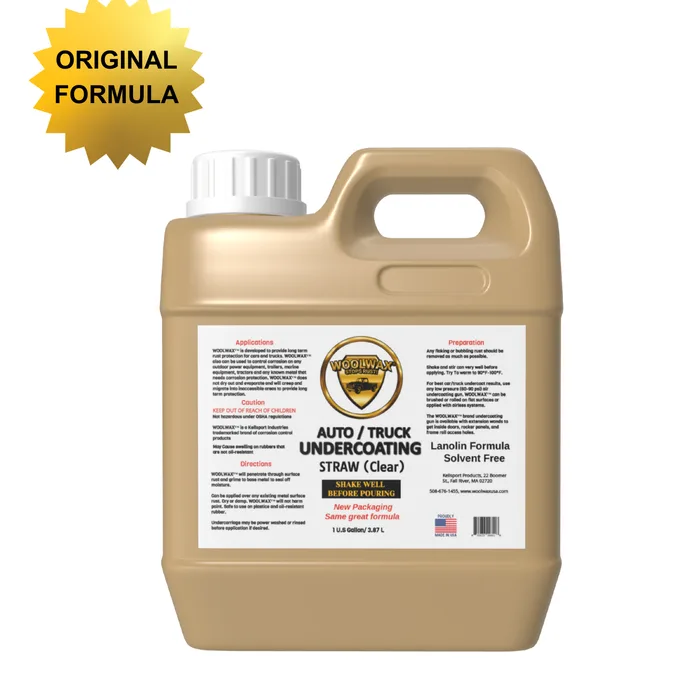
- Buy Woolwax Auto/Truck Undercoating (1 Gallon) A thick, solvent free wool grease coating that never dries and that you respray straight over the old coat. Amazon
- Buy Fluid Film Black Aerosol and Non-Aerosol The thinner lanolin coating that creeps furthest into seams and is by far the easiest first undercoating job. Amazon
- It depends POR-15 Rust Preventive Coating A moisture cured urethane that dries rock hard and is designed to be painted directly onto prepped rust. Amazon
- Skip Dupli-Color Undercoating (UC101) The rubberized aerosol on every parts store shelf, sold for spot repairs but bought as a whole underbody fix. Amazon
What actually matters
- Film state after application - Whether the coating stays soft and pliable or cures into a rigid shell determines everything about how it behaves over years. Soft films reflow over scratches and keep creeping into seams; hard films depend on staying intact.
- Surface preparation - Every coating makes an assumption about what is underneath it, and the instructions tell you which. Some are explicitly designed to be applied over surface rust, others tell you to remove rust and loose paint first.
- Solvent content - Solvent is carrier, not protection, so a coating that is mostly solvent leaves a thinner film once it flashes off. Fluid Film states its bulk product contains no solvents.
- Creep and migration - The ability of a coating to keep wicking into seams, spot welds and box sections after you spray it is what protects the areas you cannot reach with a wand. Only non-drying coatings can do this.
- Reapplication interval - A published interval is a maker telling you that the coating is consumable. Treat the absence of one as a claim of permanence that you should test against the rest of the product sheet.
- Compatibility with non-metal parts - An underbody is full of rubber bushings, plastic shields, wiring connectors and brake components. Makers that publish guidance on these are at least addressing vehicle use.
- Application equipment and temperature - A thick coating needs a low pressure gun, warmed material and a mild day, while an aerosol needs neither. This is usually the real constraint on whether the job gets done at all.
The specs, in plain English
Green flags vs red flags
Green flags
- The maker publishes a specific reapplication interval rather than implying the coating is permanent.
- The product sheet or label states explicitly whether the film stays soft or cures hard.
- There is written guidance on rubber, plastics, wiring and painted surfaces, not just on steel.
- Application temperature and equipment are specified, including pressure for gun applied products.
- The maker tells you how to reapply over the existing coating, which means it expects you to keep the vehicle.
Red flags
- The prep instruction requires removing rust and loose paint, but the product is marketed for whole underbody use.
- A permanence claim with no reapplication interval and no supporting test data anywhere on the page.
- A salt spray hour count presented as if it were years of service life on a vehicle.
- Coverage per container that is nowhere near the surface area of the job it is being sold for.
- No published information about behaviour near rubber bushings, wiring connectors or brake components.
Who's who: the brands
- Fluid Film (Eureka Chemical Company) - A lanolin based penetrant and corrosion inhibitor, sold as an aerosol as well as in bulk, which makes it an easy first undercoating for DIY owners.
- Woolwax (Kellsport Products) - A heavier raw wool grease formulation sold for vehicle undercarriages and applied with a low pressure undercoating gun.
- POR-15 (P.O.R. Products) - Known for a moisture cured urethane that is designed to be painted directly onto prepped rust, sold as part of a three step cleaner and etch system.
- Dupli-Color (Sherwin-Williams) - A mass market automotive refinish line whose rubberized undercoating aerosol is one of the most widely stocked products in the category.
How to read a listing without getting fooled
Work through a listing in a fixed order and it becomes hard to be fooled. Start with the chemistry line, which is usually one or two words: lanolin, wool grease, rubberized, urethane, asphalt. Then find the sentence describing the film after it is applied, looking specifically for words like soft, pliable, non-drying, or conversely hard, permanent, will not chip. Next find the preparation instructions, which are often further down the page than the marketing claims, and note whether they assume rust free metal. Then look for a stated reapplication interval and a coverage figure, and check the coverage against the area you actually need to cover. Only after all of that should you look at any salt spray number, and when you do, treat it as a ranking against other coatings tested the same way rather than a prediction of how many years the underside of your car will last.
How much should you spend?
This is a category where the cheap option and the expensive option are not doing the same job, so spending more does not straightforwardly buy more protection. Budget tier covers single aerosol cans, whether lanolin or rubberized, and a single can is realistic only for a wheel well, a repair area or a top-up. Mid-range covers a gallon of a soft coating, which Fluid Film says is about one vehicle, and a quart or gallon of a hard restoration coating plus its required prep chemicals. Budget for the application equipment as a separate line, because a thick wool grease product needs a low pressure undercoating gun and extension wands, and that gun is a one time purchase that pays back over several reapplications. Premium in this category usually means paying a shop to do it, which mostly buys you a lift, proper access and someone else lying in the overspray.
Questions, answered
What is the difference between undercoating, rustproofing and cavity wax?
Undercoating usually means treating the exposed underside: frame, floor pan, wheel wells and suspension components you can see from below. Rustproofing is the broader term and generally implies treating enclosed sections as well. Cavity wax is a thinner product made specifically to be injected through access holes into frame rails, rockers and door bottoms, where structural rust actually starts. A complete job normally involves both an exposed underbody coating and something thin enough to creep inside the cavities, which is one reason the thinner lanolin products still have a role even if you choose a thick one for the underside.
Will an aftermarket coating cause problems with a newer vehicle?
The main published cautions are about materials rather than electronics. Both lanolin makers here warn that their products may cause swelling on rubber that is not oil resistant, which is worth taking seriously around older bushings and boots. Fluid Film states its product is non-conductive and will not harm electrical connections, but adds that all connections should be made before applying. Beyond that, keep any coating away from brake friction surfaces, exhaust components and anything that needs to shed heat, and check your warranty terms before drilling access holes into a vehicle that is still covered.
If I coat the underbody, do I still need to wash it in winter?
Yes. A coating slows the corrosion reaction at the metal surface, but it does not remove the chloride sitting on top of the coating, in the seams, and packed into wheel wells and frame drain holes. Rinsing regularly through the salt season removes the source rather than just shielding against it, and it matters most on the areas a wand cannot reach. Woolwax explicitly tells owners they can rinse the existing coating with a garden hose without harming it, which makes the two practices complementary rather than competing.
Is a professional application worth paying for?
It depends on access more than skill. The hardest part of a good job is getting complete coverage into the areas you cannot see, and a shop with a lift, the right wands and no time pressure will reach places you will not while lying on cardboard. Against that, soft coatings are designed to be reapplied over themselves with no stripping, so once you own a gun the recurring cost of doing it yourself is only material. A reasonable middle path is to have the first application done properly, then maintain the exposed underside yourself between visits.
Or jump to the head-to-head: Woolwax Auto/Truck Undercoating (1 Gallon) vs Fluid Film Black Aerosol and Non-Aerosol.