Explained
Car Scratch Removers, Explained
After reading this you will know whether your scratch can be fixed from a bottle at all, and which kind of product does it.
In this guide
Every product in this aisle works the same way: fine abrasives shave a thin layer of clear coat down to the floor of the scratch until its edge stops catching light. So the only question that really matters is how deep your damage goes, and the second one is how much cutting power you need to reach the bottom of it. Most disappointment here comes from buying a mild polish for damage that needed a real compound, or buying anything at all for damage that no compound can reach.
The 30-second version
- The fingernail test decides everything. Drag a nail across the scratch: if it glides over, the damage sits inside the clear coat and abrasives can level it, and if it catches, the scratch has cut through to base coat or primer and nothing in a bottle will restore the color.
- Cut and gloss pull against each other. Coarser abrasives remove defects faster but leave a faint haze behind, which is why serious correction is usually a compound first and a finishing polish second.
- Hand use is a real specification, not an assumption. Many strong compounds only break down properly at machine speed, so check that a product is rated for hand application before you count on fixing anything with a towel.
- Fillers and sealers flatter the result. Glazes, waxes and ceramic sealers hide fine scratches for a few washes, so judge any product a month later rather than on the day you used it.
- Clear coat is a finite resource. Factory clear is only a few tens of microns thick and each correction pass takes a few of them, so a car has a limited number of corrections in its life.
The products this guide is about
Our verdict on each, with the full reasoning on the companion review.
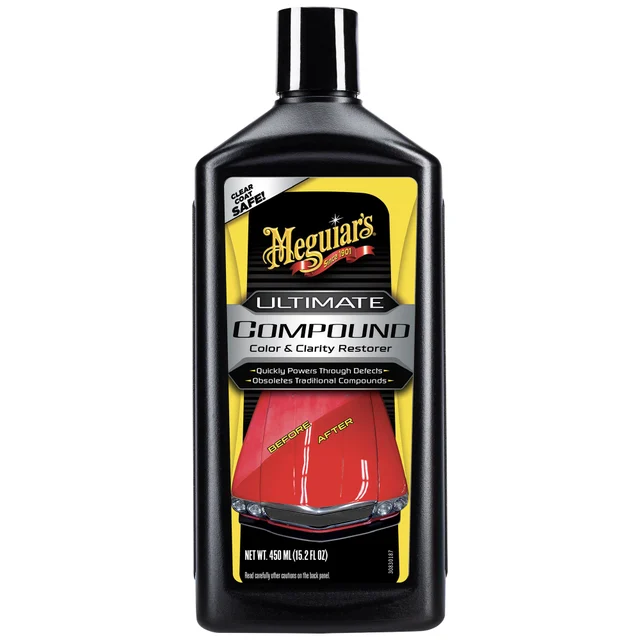
- Buy Meguiar's Ultimate Compound The default first bottle: enough cut for real clear coat scratches, and it still works if all you have is a microfiber towel and patience. Amazon
- Buy 3D Car Care 3D ONE Hybrid Compound & Polish One bottle that behaves like a compound or a finishing polish depending on the pad you pair it with, and it hides nothing. Amazon
- It depends Meguiar's ScratchX Fine Scratch and Blemish Remover A very mild hand-only spot treatment: excellent on one isolated blemish, underpowered for anything wider than your palm. Amazon
- Skip Carfidant Ultimate Car Scratch & Swirl Remover Sells itself as fixing scratches on any paint, delivers a mild one-step polish plus a sealer that flatters the result. Amazon
What actually matters
- Scratch depth is the criterion that overrules every other one. Clear coat scratches can be leveled by abrasives, while anything that reaches base coat or primer needs touch-up paint or a body shop, no matter what the bottle claims.
- Abrasive cut is how much material the product actually removes. Too little and you polish for an hour with nothing to show, too much on the wrong paint and you leave haze you then have to chase with a second product.
- The finish it leaves decides whether you are done. A compound that hazes soft or dark paint means adding a finishing polish step, which is fine if you planned for it and annoying if you did not.
- Hand versus machine application changes both the product and the budget. A hand-friendly compound gets you a fixed scuff this weekend, while a machine-oriented one assumes you already own a dual action polisher and pads.
- Filler-free versus sealer-loaded formulas determine whether you can trust what you see. Filler-free tells you the truth after wipe down, while a built-in sealer saves a step but hides how much correction you really achieved.
- Job size should match the product. A very mild spot treatment is right for one isolated scuff and hopeless across a whole hood, and a full-car one-step is far more product than a bumper scrape needs.
- Paint hardness and color affect how a product behaves. Soft paint marrs easily and shows haze from an aggressive pass, and dark colors reveal swirls and buffer trails that would be invisible on silver.
The specs, in plain English
Green flags vs red flags
Green flags
- The label states plainly whether the product is for hand use, machine use, or both.
- Cut is described in real terms, such as light swirls or moderate clear coat scratches, instead of a promise to fix any scratch.
- The maker describes the product as a true correction polish rather than a filler, so what you see after the wipe down reflects real correction.
- On a hybrid product, pad choice sets the cut, which lets one bottle both correct and finish.
- An easy wipe-off, low-dust formula, which forgives a beginner who lingers too long on one section.
- Owner reports describe the scratch still gone months later, not only on the day of application.
Red flags
- A claim to remove any scratch or restore all paint finishes, which no liquid can do once the clear coat is cut through.
- A wax or ceramic sealer mixed into the formula with no indication of how much abrasive is really in there.
- No word on whether the product works by hand, which usually means it quietly expects a machine.
- Owner reports that split hard between dramatic transformations and scratches reappearing after a few washes.
- A premium price on a small bottle when established compounds cut more and cost less.
- Before-and-after photos taken on wet or freshly sealed panels rather than a dry, properly inspected finish.
Who's who: the brands
- Meguiar's - The mass-market default, known for diminishing-abrasive compounds that are widely sold and usable by hand.
- 3D Car Care - Detailer-facing brand known for hybrid compound and polish products where machine and pad choice, not a second bottle, set the level of cut.
- Chemical Guys - Heavily marketed enthusiast line with a very broad catalog, which means reading the actual cut level matters more than the branding.
- Griot's Garage - Enthusiast brand with a reputation for beginner-friendly correction products and the dual action machines to pair them with.
- Turtle Wax - Long-running consumer brand sold at many parts stores, strongest on convenience kits and light-duty fixes rather than heavy cutting.
- Carfidant - Online-first brand whose scratch and swirl removers lean on broad marketing claims while delivering a mild polish with a sealer in it.
How to read a listing without getting fooled
Start with your car, not the label: run a fingernail across the scratch and decide whether you are shopping for a compound or an appointment. Then look for three things on the listing. First, the level of cut, described in defects it handles rather than in promises, because a bottle that claims to fix any scratch is telling you it has not thought about depth. Second, the application method, since a product that never mentions hand use is usually assuming a dual action polisher and pads you may not own. Third, what else is in the formula: wax, glaze and ceramic sealer all make a panel look corrected right after the wipe down, so a filler-free claim is worth more than a gloss claim. Ignore the before-and-after photos, which are frequently shot on wet or freshly sealed paint, and read owner reports for the sentence that matters, whether the scratch was still gone a month and several washes later.
How much should you spend?
This is one of the few categories where the cheapest serious product is also the right answer for most people. A capable, hand-friendly compound from a mainstream brand sits at the budget tier and has enough cut to remove genuine clear coat scratches, so paying more buys refinement rather than capability. The value sweet spot is a proper compound plus a separate sealant, which costs less than most all-in-one bottles and does both jobs better, because the sealant is not hiding how much correction you achieved. Spending up is worth it in exactly two cases: you own or plan to own a dual action polisher and want a hybrid that corrects and finishes from one bottle, or you are correcting a whole car and want to save hours. Spending up is not worth it when a bottle is priced at a premium tier for a small container while offering a mild cut and a sealer to flatter it. Budget for what surrounds the bottle too, since foam applicators, a stack of clean microfiber towels and good lighting affect your result more than which brand you picked, and a machine plus pads costs more than any compound on the shelf.
Questions, answered
How do I know whether a scratch remover will work on my scratch?
Run a fingernail across it. If your nail glides over the scratch, the damage is inside the clear coat and abrasives can level the surrounding clear down to it until it disappears. If your nail catches, the scratch has gone through the clear into the base coat or primer, and no compound in a bottle will bring the color back. That case calls for touch-up paint or a body shop. This one test decides more than the brand you buy.
What is the difference between a compound, a polish and a scratch filler?
A compound has coarser abrasives and removes material to level a defect. A polish uses finer abrasives to refine the surface and restore gloss after compounding. A filler or glaze removes nothing: it deposits oils or waxes into the scratch so it hides temporarily, then reappears after a few washes. Products that mix a mild polish with a sealer sit in between, which is why their results often look better on the day than a month later.
Do I need a machine polisher, or is doing it by hand fine?
By hand is fine for a scuff, a single scratch or a small patch of marring, provided the product is rated for hand use. It becomes impractical for swirl marks across a whole car, where you would work small sections for hours. Note that plenty of strong compounds will not break down properly without machine speed and simply leave haze when rubbed by hand, so check the label rather than assuming.
Can a compound damage my paint?
Yes, if you keep going. Every pass removes a little clear coat, and clear coat is thin, so there is a finite number of corrections a car can take. The usual mistakes are chasing a scratch that is too deep to remove, working one spot repeatedly, and using an aggressive pad on soft paint or over a panel edge where the coating is thinnest. Work in short passes, check progress often, and stop when the improvement stalls.
Do I need to wax or seal afterwards?
Yes. Compounding strips whatever protection was on the panel and leaves bare clear coat exposed to UV and contamination. Follow with a wax, sealant or ceramic spray once you are happy with the correction. Products with a sealer built into the compound save that step, but they also make it harder to judge how much correction you actually got.
Do these work on black paint, plastic bumpers and headlights?
On black and other dark paint, yes, but the finish is less forgiving: haze and buffer trails show up in direct sun, so plan on a finishing polish after compounding. Painted plastic bumpers have the same clear coat as metal panels and behave the same way, though they flex, so use lighter pressure. Headlights are polycarbonate rather than painted, and while a compound can knock back light yellowing, restoring them properly needs a dedicated headlight kit and a fresh UV coating.
Or jump to the head-to-head: Meguiar's Ultimate Compound vs 3D Car Care 3D ONE Hybrid Compound & Polish.