Explained
Car Glass Cleaners, Explained
After reading, you'll understand which label claims on a car glass cleaner are checkable, which are noise, and why the inside of your windshield is a different job from the outside.
In this guide
Car glass cleaner looks like the simplest thing in the aisle and mostly is. The confusion comes from a handful of terms that sound technical but are doing very different amounts of work: ammonia-free, tint-safe, streak-free, residue-free, VOC compliant. Two of those are checkable against what the maker publishes, one is a promise every bottle makes, and one is a regulatory limit that has nothing to do with how well it cleans. Knowing which is which takes about five minutes and saves you from buying the same thing three times.
The 30-second version
- Ammonia-free is a checkable claim, so look for it stated on the maker's own product page rather than on a retail listing.
- Tint film sits on the inside of the glass, which is why interior cleaning is where the caution belongs and outside cleaning mostly is not.
- Film makers disagree about ammonia, with some saying avoid it and others saying any household cleaner is fine, so treat it as cheap insurance rather than settled science.
- What a cleaner leaves out matters more than what it adds, because added soaps, scents, and dyes are the usual cause of the haze you see as night glare.
- Foam and liquid are not interchangeable, since foam clings to vertical glass while a liquid tends to run down it.
The products this guide is about
Our verdict on each, with the full reasoning on the companion review.
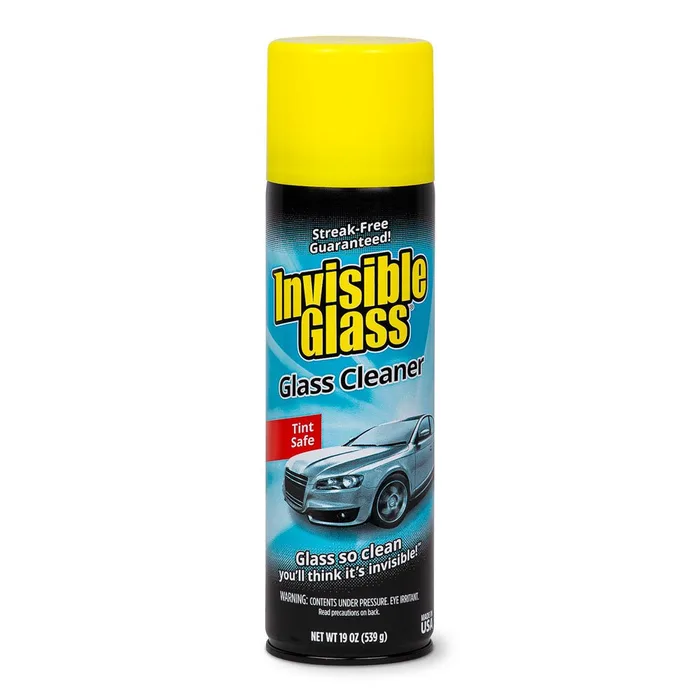
- Buy Invisible Glass Auto Glass Cleaner (Aerosol) A foaming aerosol that clings to vertical glass, with the clearest ammonia-free and residue-free wording of anything here. Amazon
- Buy Chemical Guys Signature Series Glass Cleaner Ammonia Free Spray A ready-to-use trigger spray that puts the ammonia-free claim in the product name and sells a gallon refill behind it. Amazon
- It depends Adam's Polishes Adam's Glass Cleaner A silane-infused cleaner that deliberately leaves a thin slick layer behind, which is either the feature you wanted or the thing you were trying to avoid. Amazon
- Skip SC Johnson Windex Original Glass Cleaner Fine on house windows, but SC Johnson's own ingredient page lists ammonium hydroxide, plus fragrance and dye, and none of that buys you anything on a car. Amazon
What actually matters
- Ammonia-free - This is one claim in the category you can verify by loading the maker's page, and the reason it exists is aftermarket tint. Some film manufacturers tell owners to use non-ammonia cleaners and others say ordinary household cleaner is fine, so it is a low-cost precaution rather than a guarantee of harm avoided.
- Tint-safe wording - Good automotive brands name window tint explicitly instead of gesturing at safety in general. Vague wording usually means nobody tested it against film, so treat the specific sentence as the signal.
- Residue behaviour - A cleaner that states it has no added soaps, scents, or dyes is telling you what it will not leave on the glass. That is a more useful promise than streak-free, which every bottle claims regardless.
- Format - Aerosol foam clings to vertical glass and gets dwell time on road film, while a trigger spray gives you a controlled stream you can aim into the base of a windshield. Neither is better in the abstract, they are just good at different halves of the car.
- Interior versus exterior use - The inside of a windshield builds a thin oily film that behaves nothing like outside road grime, and a product that lists interior haze on its label has usually been formulated for it. If a bottle only talks about exterior cleaning, expect to work harder on the inside.
- Refill or bulk size - Every bottle here is cheap, so the only real lever on running cost is whether the same formula is sold in a gallon. A brand with a gallon is telling you it expects people to use a lot of it.
- Hazard and Proposition 65 wording - Some makers publish a California Proposition 65 warning or a hazard line on the can, and some do not, which is worth a glance before you spray anything into a closed cabin. Absence of a warning on a web page is not proof of absence, but a posted one is real information.
The specs, in plain English
Green flags vs red flags
Green flags
- The maker states ammonia-free on its own product page, not just in a retailer's bullet list.
- Window tint is named explicitly in the safe-surfaces wording rather than implied.
- The page says what is not in the bottle, such as no added soaps, scents, or dyes.
- The same formula is offered in a refill or gallon size, which signals real volume use.
- Directions talk about towels, telling you to avoid fabric softener residue and wetting-agent paper towels.
Red flags
- The only claim on the page is streak-free, with nothing about ammonia, tint, or residue.
- The formula is coloured and heavily fragranced, which suggests dye and fragrance are going onto your windshield.
- It is a household glass cleaner being repurposed, so the label offers no automotive guidance at all.
- The product promises to clean glass, trim, screens, wheels, and paint from one bottle.
- Bulk sizing does not exist, so you are locked into the most expensive way to buy the formula.
Who's who: the brands
- Invisible Glass (Stoner) - An automotive glass specialist whose pages are unusually specific about what the formula leaves out, including ammonia, high pH ingredients, and added soaps, scents, and dyes.
- Chemical Guys - A large detailing brand that sells most formulas in both a trigger bottle and a gallon, and puts ammonia-free directly in this product's name.
- Adam's Polishes - A detailing brand that leans toward hybrid products, with a glass cleaner that is silane-infused to leave a thin layer of protection behind.
- SC Johnson (Windex) - A household cleaning company that publishes a full ingredient list for each product, which is how you can confirm the original blue formula contains ammonium hydroxide.
How to read a listing without getting fooled
Read a glass cleaner listing backwards. Ignore the headline, which will say streak-free on every bottle in the aisle, and go straight to the feature bullets to see whether ammonia and window tint are named in actual sentences. Then look for what the maker says is absent, since no added soaps, scents, or dyes tells you more about how it will behave on an interior windshield than any adjective will. Check the format next, because foam and liquid solve different halves of the car, and check the size options, because a gallon in the range means the brand expects heavy use and gives you a way to lower cost per clean. Finally, scan for a hazard or Proposition 65 line, which some brands post and others do not. If a page gives you none of that and just repeats crystal clear three times, you are reading marketing rather than a spec.
How much should you spend?
This is a category where the top pick and the budget pick sit in the same tier, so buying the best is not a stretch. Most well-regarded automotive glass cleaners land at $ · budget for a single trigger bottle or aerosol can, and the gap between the cheapest supermarket bottle and a specialist automotive one is small enough that it should not drive the decision. You step into $ · mid-range mainly for hybrids that also leave a silane or ceramic layer behind, and for those you are paying for a treatment as much as a cleaner. Dedicated glass coatings sit higher again at $$$ · premium and are a different product class entirely. The genuinely smart spend is buying the gallon of whatever plain cleaner you settle on and putting the savings toward two dedicated glass microfiber towels, since a contaminated towel will streak the best formula on the shelf.
Questions, answered
Aerosol foam or trigger spray, if I can only have one?
Trigger spray, if the choice is forced. It gives you a controlled stream you can aim into the base of a windshield and the tight corners of side glass without misting the dashboard, and it is the format that comes with gallon refills. The aerosol wins on the outside of the car, where foam clings to vertical glass long enough to soften bug protein and road film. Many people end up with both, keeping the can in the garage for exterior work and the bottle in the boot for touch-ups.
Can I just dilute a household cleaner instead?
You can, but you are solving the wrong problem. Diluting reduces how much ammonia, fragrance, and dye ends up on the glass without removing any of it, and it also weakens the solvent action that lifts oily interior film. The cost saving is negligible in a category this cheap. If you want a genuinely minimal option, some window film makers suggest a damp microfiber towel for routine cleaning.
Why do glass cleaners tell me not to use paper towels?
Because many paper towels contain wetting agents that transfer to glass and dry as a faint haze, and because they shed lint on a surface where lint is very visible. Invisible Glass names this directly in its directions and suggests lint-free towels or microfiber instead. The other common culprit is fabric softener, which leaves a hydrophobic film in microfiber fibres that smears straight onto the windshield. Wash glass towels separately with no softener and keep them away from polish and wax duty.
Does a glass cleaner help with fogging or rain?
A plain cleaner helps indirectly, because a clean interior surface fogs less evenly and clears faster than one coated in oily film, but it is not an anti-fog treatment. Products that actually repel rain or resist fogging are separate treatments, usually silane or SiO2 based, and some brands sell hybrids that clean and treat in one pass. If your real complaint is wet-weather visibility or a windshield that fogs every morning, buy the dedicated treatment and keep the plain cleaner for the prep step.
Or jump to the head-to-head: Invisible Glass Auto Glass Cleaner (Aerosol) vs Chemical Guys Signature Series Glass Cleaner Ammonia Free Spray.