Explained
Car Ramps, Explained
After reading this you will be able to look at any car ramp listing and know whether it fits your car, holds your axle, and lifts you high enough to actually work.
In this guide
Car ramps look like the simplest tool in the garage: two plastic wedges, drive on, done. Two things trip up almost every first-time buyer. The capacity number on the box describes a pair of ramps carrying one axle, not the weight of the whole vehicle, and the incline that a crossover shrugs off will scrape the nose off a low car before the tire ever touches the ramp. Get those two right and the rest of the spec sheet is easy.
The 30-second version
- Capacity is per pair and applies to one axle. A pair of ramps lifts one end of the car at a time, so the rating has to exceed the weight sitting on that axle, not the vehicle's curb weight. On a front engine car the front axle usually carries well over half the total, and the placard in the driver's door jamb or a scale ticket gives you the real number.
- Approach angle decides whether a ramp is usable at all. Anything around 10 to 11 degrees clears most low bumpers and lips. Steeper ramps, and any ramp that does not publish an angle, should be assumed to catch on a low front end.
- Lift height decides what job you can do. Under four inches gets a low profile jack under a pinch weld. Roughly seven to nine inches is real working room for an oil change, an underbody look, or exhaust work.
- Setup is the safety spec that no listing prints. Level hard ground only, parking brake set, transmission in park or in gear, the wheels still on the ground chocked on both sides, and the manufacturer's instructions read before anything of yours goes under the car.
- Ramps do not replace jack stands. Ramps lift an axle with the wheels attached, stands are what you rely on once a wheel comes off or when you will be underneath for a while, and chocks stop the car rolling. Budget for all three.
The products this guide is about
Our verdict on each, with the full reasoning on the companion review.
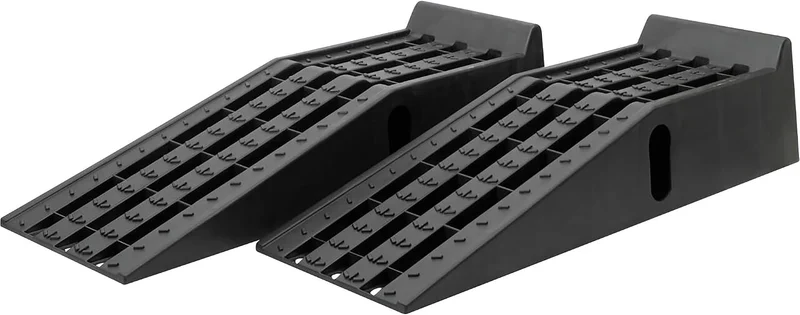
- Buy Ironton Poly Car Ramp Set, 12,000 lb. GVW The set most DIY owners should buy: 8.5 inches of lift, a wide tread, and capacity headroom to spare. Amazon
- Buy Race Ramps 56" Single Piece Race Ramps (RR-56) A 10.8 degree approach angle and 8 inches of lift on a 10 pound ramp: the answer for low cars.
- It depends MaxxHaul 50516 Low Profile Car Ramps A shallow 9.05 degree jack access ramp, useful for lowered cars and misleading if you expected to work underneath. Amazon
- Skip Big RED AGT16PR 3 Height Low Profile Car Ramps Sold as an oil change ramp, but under four inches of lift makes it a leveling block with better marketing. Amazon
What actually matters
- Rated capacity, read as a pair is the first filter. A set advertised at a large number usually means the total across both ramps, so halve it to get the per ramp figure and compare the pair figure against your heavier axle. Leave margin instead of sitting right at the limit.
- Approach angle is the spec that decides fit. It is the slope the tire climbs, and a low bumper, an air dam, or an aftermarket lip will hit the ramp before the tire does if that slope is too steep. Published angles under roughly 12 degrees suit most low cars.
- Lift height determines the job. Two to four inches is jack clearance, seven to nine inches is service height. A ramp sold for oil changes that only rises a few inches is a leveling block with better marketing.
- Tread width versus your tire width matters more than it sounds. A ramp that maxes out around ten inches of tire is fine on a hatchback and a problem on wide rear tires or truck rubber. Measure the section width printed on your sidewall.
- Grip and footprint decide whether the ramp stays put. Plastic ramps can skate on freshly sealed or painted concrete before the tread bites, so rubber feet, a textured base, or a scrap of rubber mat underneath earn their keep.
- Material affects weight, storage, and lifespan. Poly and high density foam do not rust and are light enough to move one handed. Steel is rigid and long lived but heavy, corrodes in a damp garage, and can slide on smooth floors.
- Ramp length and storage are real constraints. A very shallow angle is achieved by making the ramp long, so the gentlest sets need garage depth to use and shelf or wall space to store.
The specs, in plain English
Green flags vs red flags
Green flags
- A published approach angle, stated in degrees, rather than vague talk of a low profile design.
- Capacity stated clearly as per ramp and per pair, so you can do the axle math without guessing.
- Lift height in the seven to nine inch range if you intend to work underneath, with the flat top long enough for the tire to seat fully.
- A tread width and a maximum tire width that both comfortably exceed the tires you actually run.
- Rubber feet, a textured base, or a gripped surface, plus a wide footprint that resists creeping forward as the tire loads it.
- A full spec sheet with dimensions and weight you can check before ordering, from a maker that also sells replacement parts or honors a warranty.
Red flags
- A big headline capacity with no indication whether it is per ramp or per pair.
- No approach angle published anywhere, on a ramp marketed to low car owners.
- Under four inches of lift while the listing promises easy under vehicle access.
- Product copy that calls the same item a leveling block in one place and a service ramp in another.
- A narrow tread paired with a claim that it suits trucks and SUVs.
- Smooth, untextured plastic with no feet, no grip strip, and nothing to stop it sliding on sealed concrete.
Who's who: the brands
- Race Ramps - US maker of solid high density foam ramps built around very shallow approach angles, the default recommendation for low and lowered cars, with published spec sheets and premium pricing.
- Ironton - Northern Tool's house brand, known for high impact poly ramps with generous lift, wide tread, and a lot of capacity headroom for the money.
- RhinoGear - Maker of plastic ramps and vehicle stands, widely stocked and a common first set for ordinary sedans and crossovers.
- MaxxHaul - Budget towing and garage accessory brand whose low profile ramps are best understood as jack access aids rather than full service ramps.
- Big RED (Torin) - Value-focused jack and garage equipment brand, wide distribution, though some of its low profile ramp listings promise more under vehicle access than the lift height delivers.
How to read a listing without getting fooled
Start with the three numbers that most listings bury: lift height, approach angle, and the per ramp capacity. If the headline capacity is a single large figure, assume it is the pair total and divide by two to get the per ramp rating, then compare that pair total against the weight on the axle you plan to lift rather than the weight of the whole vehicle. Next, look for an approach angle in degrees. Marketing language like low profile or fits sports cars means nothing without the number, and its absence usually means the ramp is steep. Then check lift height against your intent: if the listing promises easy under vehicle access but only rises a few inches, it is a jack aid or a leveling block, and the product copy often gives this away by using both words for the same item. Cross-check the tread width and any published maximum tire width against your own tire's section width. Finally, read the dimensions as a system. A very shallow angle is only achievable on a long ramp, so a short ramp with a lot of lift is steep by definition, and a stepped ramp's tallest setting is usually its least stable one. Owner reports are most useful for the things spec sheets never cover: whether the ramp creeps on sealed concrete, whether the tire seats squarely on the flat top, and whether the plastic flexes under a heavier car.
How much should you spend?
Ramps are a garage tool where the cheapest tier can be usable, as long as you buy the right type. A basic poly or plastic set from a known brand, with real lift and a clearly stated capacity, covers most sedans, crossovers, vans, and light trucks and is where the value sits for the majority of buyers. Stepping up buys capacity headroom, a wider tread for truck tires, better grip hardware, and a spec sheet you can actually verify, all of which are worth the modest premium if you own something heavy or plan to use them for years. The one place a real premium is justified is a very shallow approach angle. That is achieved with a long, precisely shaped ramp in solid high density foam, it costs meaningfully more, and if your car is low it is often what makes ramps usable at all, so the price gap matters less. Spending more is not worth it if your car sits at normal ride height and your axle load is well inside a mid-tier rating, because you would be paying for an angle you do not need and giving up capacity in the process. At the other end, the sub-bargain multi-height blocks that top out at a few inches of lift are not a cheaper version of a service ramp, they are a different product, so buying one to save money usually means buying twice. Whatever tier you land in, leave room in the budget for wheel chocks and a pair of jack stands, since those belong with any ramp purchase.
Questions, answered
How much weight can car ramps actually hold?
Read the rating as a pair, and compare it to the axle you are lifting rather than to the whole vehicle. A pair of ramps carries one axle at a time, and on a front engine car the front axle usually carries well over half of curb weight. So a set rated 1,500 lb per ramp gives you 3,000 lb across the axle, which suits most sports cars and hatchbacks and rules out a pickup. Find your axle load on the placard in the driver's door jamb or from a scale ticket, and leave margin instead of sitting right at the limit.
Is it safe to work under a car on ramps?
It can be, if you set them up properly and follow the manufacturer's instructions, which take priority over anything you read here. Use level, hard ground only: concrete or asphalt, never grass, gravel, dirt, or a sloped driveway. Drive on slowly and squarely, stop when the tires seat on the flat top, set the parking brake, leave the transmission in park or in gear, and chock the wheels still on the ground on both sides. Race Ramps' own guidelines say to always use a jack stand if a person will be going under the vehicle, so put jack stands under proper lift points as well, and never rely on a ramp that is cracked, deformed, or sitting on an uneven surface.
Will car ramps fit my low or lowered car?
Only if the approach angle is shallow enough, and that is the spec that matters most. Around 10 to 11 degrees clears most low bumpers and aftermarket lips, which is why long foam ramps are the usual recommendation for sports cars. Steeper plastic ramps often catch the front lip before the tire even reaches the incline. Measure your front overhang and ground clearance before ordering. If you are borderline, ramp extenders or a length of sturdy board ahead of the ramp reduce the effective angle enough to make the difference.
How much lift do I actually need?
It depends on the job. Two to four inches is enough to slide a low profile floor jack under a pinch weld on a lowered car, and that is all it is enough for. Seven to nine inches is where a ramp becomes a service ramp: enough room to lie underneath for an oil change, an underbody inspection, or exhaust and suspension work. If a product promises under vehicle access but lists under four inches of lift, it is a jack aid or a leveling block regardless of how it is marketed.
Are plastic ramps as good as steel ones?
For home use, modern poly and high density foam ramps are generally the more practical choice. They do not rust, they are far lighter to move and store, and the rated capacities on quality sets are well beyond what a typical car axle needs. Steel is rigid and long lived but heavy, prone to corrosion in a damp garage, and it can slide on smooth concrete. Whatever the material, look for a textured surface, a stable base, and a published capacity rather than a vague claim.
Do I still need jack stands if I own ramps?
Yes, and they do different jobs. Ramps lift a whole axle quickly with the wheels still attached, which suits oil changes, underbody inspections, and exhaust work. Jack stands are what you use once a wheel is off, and they are the sensible backup any time you will be under the vehicle for a while. Chocks are separate again and stop the car rolling. Buying all three still costs less than one shop visit, and none of them replaces reading the manufacturer's instructions.
Or jump to the head-to-head: Ironton Poly Car Ramp Set, 12,000 lb. GVW vs Race Ramps 56" Single Piece Race Ramps (RR-56).