

Automotive
The Best Car Glass Cleaners: 4 Compared (and One to Skip)
We compared four glass cleaners on what the makers actually publish: whether the formula is stated ammonia-free, whether it is called tint-safe, what it leaves behind, and how well the format suits vertical car glass.
The short version
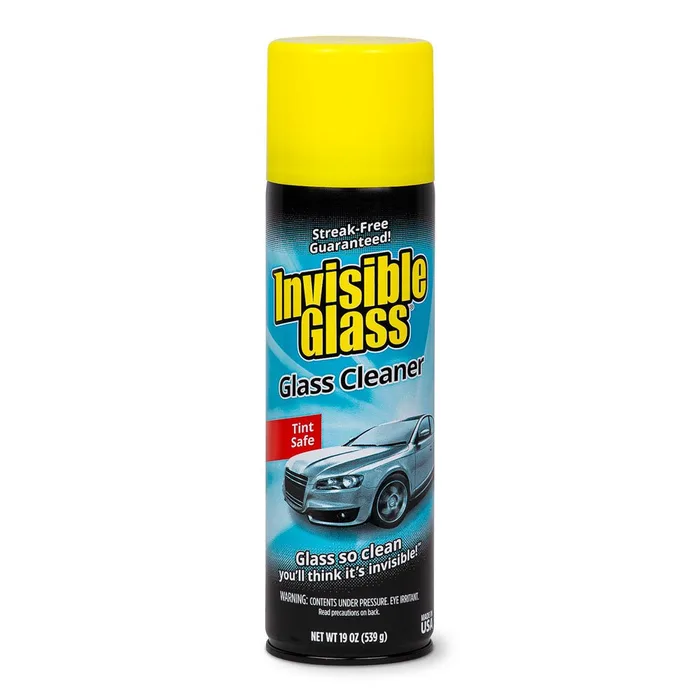
Invisible Glass Auto Glass Cleaner in the aerosol can is the one to buy. It is the only pick here whose maker spells out that it contains no ammonia, no high pH ingredients, and no added soaps, scents, or dyes, and the foam stays put on a vertical window instead of running into the door seal. Chemical Guys Signature Series Glass Cleaner is the value pick, because the ammonia-free and tint-safe wording is stated plainly and it is sold in a gallon refill. Adam's Glass Cleaner is the 'depends' one: it is silane-infused and deliberately leaves a thin slick layer, which is lovely if you want glass that stays clean longer and exactly wrong if you are about to coat the glass properly. Skip Windex Original in the car, not because it cleans badly but because SC Johnson's own ingredient page lists ammonium hydroxide, adds fragrance and a blue dye, and gives you no automotive guidance at all. Film makers do not fully agree on how dangerous ammonia is, but nothing in this category costs enough to justify finding out on your own windows. Best for: drivers who want glass clean enough that night glare stops being a thing.
Our picks at a glance
- Invisible Glass Auto Glass Cleaner (Aerosol) - Buy. A foaming aerosol that clings to vertical glass, with the clearest ammonia-free and residue-free wording of anything here.
- Chemical Guys Signature Series Glass Cleaner Ammonia Free Spray - Buy. A ready-to-use trigger spray that puts the ammonia-free claim in the product name and sells a gallon refill behind it.
- Adam's Polishes Adam's Glass Cleaner - It depends. A silane-infused cleaner that deliberately leaves a thin slick layer behind, which is either the feature you wanted or the thing you were trying to avoid.
- SC Johnson Windex Original Glass Cleaner - Skip. Fine on house windows, but SC Johnson's own ingredient page lists ammonium hydroxide, plus fragrance and dye, and none of that buys you anything on a car.
The verdict in 30 seconds
What mattered most
- Format
- Ammonia-free stated by maker
- Tint wording from the maker
- Added scent or dye
- Leaves anything behind
- Interior glass
Car glass is a different cleaning job from house glass. The outside collects road film, bug protein, and wiper rubber; the inside builds a faint oily haze that shows up as glare the moment you drive into low sun. Most cars on the road also have something on the glass that a household cleaner was never written for, whether that is aftermarket tint film, a rain-repellent treatment someone applied, or a camera bracket bonded to the inside. We picked four widely sold sprays and read what each maker publishes on its own product page rather than what the internet says about them.
A foaming aerosol that clings to vertical glass, with the clearest ammonia-free and residue-free wording of anything here.
Best for: Anyone fighting baked-on road film, bug splatter, and a windshield that never quite wipes clean.
- The maker states it contains no ammonia, no high pH ingredients, and no hazy silicon-wetting agents.
- Foaming action keeps the product where you sprayed it instead of running down the window into the door seal.
- Invisible Glass says the formula has no added soaps, scents, or dyes and was tested residue-free by independent laboratories.
- An aerosol is harder to aim into the tight wedge at the base of a windshield than a trigger spray with a reach tool.
- The only larger option listed is a six-pack of cans, so there is no refill or concentrate to bring the per-clean cost down.
- The product page says nothing about ceramic-coated or otherwise treated glass, so you are on your own there.
- Aerosol overspray lands on dashboards and door cards, which means more wiping than a controlled trigger stream.
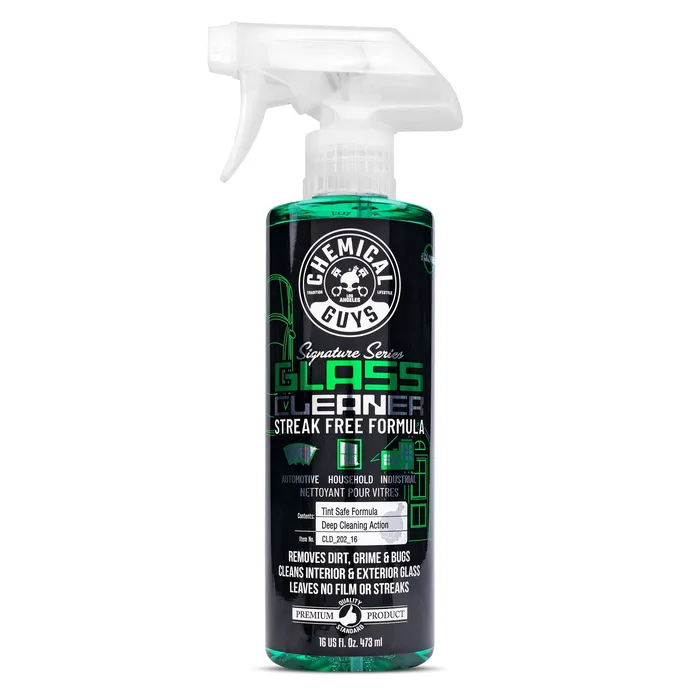
A ready-to-use trigger spray that puts the ammonia-free claim in the product name and sells a gallon refill behind it.
Best for: Someone who cleans glass often and wants one ammonia-free bottle for the car, the screens, and the house windows.
- Chemical Guys states the ammonia-free formula will not stain or damage window tints or clear plastics.
- Sold as a 16 oz bottle and a 1 gallon jug, so you refill the trigger bottle rather than rebuying it.
- The maker lists window tints, computer screens, LCD televisions, household windows, and Plexiglas as safe surfaces, so one bottle covers more than the car.
- Chemical Guys posts a California Proposition 65 warning for formaldehyde on this product page.
- A liquid trigger spray runs on vertical glass, so heavy road film takes more passes than a foam does.
- The gallon is a ready-to-use refill rather than a concentrate, so you are storing and shipping mostly water.
- Nothing on the page addresses ceramic-coated or treated glass.
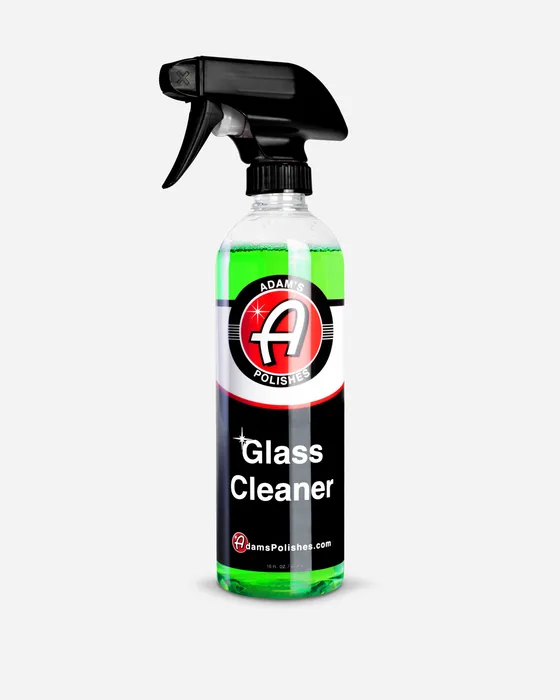
A silane-infused cleaner that deliberately leaves a thin slick layer behind, which is either the feature you wanted or the thing you were trying to avoid.
Best for: Someone who wants glass that feels slick and stays cleaner between washes, and does not mind a product that leaves something behind.
- Adam's says the silane-infused formula leaves behind a minor layer of protection and adds slickness and clarity.
- The maker states it is safe for all types of tints and for navigation screens.
- Offered in 16 oz, gallon, and 5 gallon, so the same product scales from one car to a busy shop.
- Adam's does not publish an ammonia-free claim on this product page, so if ammonia is your specific worry you cannot confirm it here.
- It is scented, which not everyone wants lingering inside a closed car.
- Leaving a silane layer behind is the wrong behaviour immediately before applying a dedicated glass coating, which needs bare glass.
- It sits a tier above the plain ammonia-free sprays for what is still, at heart, a glass cleaner.
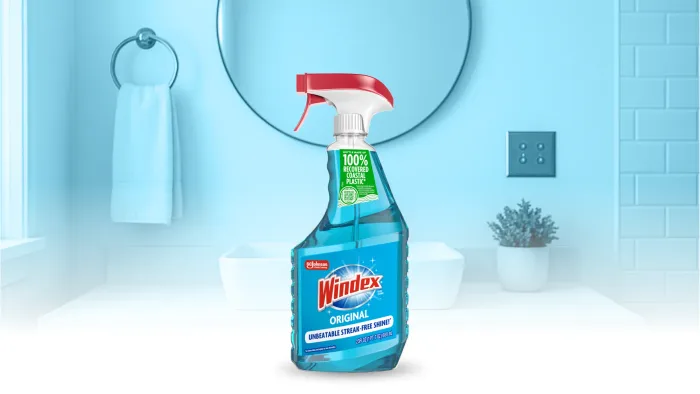
Fine on house windows, but SC Johnson's own ingredient page lists ammonium hydroxide, plus fragrance and dye, and none of that buys you anything on a car.
Best for: Household windows and mirrors, which is what it was formulated for.
- It is cheap, sold nearly everywhere, and probably already under your sink.
- SC Johnson publishes the full ingredient list and the stated purpose of every ingredient, which most car care brands do not.
- On household glass and mirrors, the job it was actually formulated for, it does that job well.
- The published ingredient list includes ammonium hydroxide, and SC Johnson's own page notes that ammonium hydroxide is commonly referred to as ammonia.
- It also contains added fragrance and a blue dye, exactly the sort of extras automotive formulas leave out to avoid film and haze.
- The label is written for household glass, so it offers no guidance about aftermarket tint film, cure times, or coated automotive glass.
- There is no upside to reaching for it in the car when purpose-made ammonia-free sprays sit in the same budget tier.
| Criteria | Auto Glass Cleaner (Aerosol) Top pick | Signature Series Glass Cleaner Ammonia Free Spray | Adam's Glass Cleaner | Windex Original Glass Cleaner |
|---|---|---|---|---|
| Verdict | Buy it | Buy it | It depends | Skip it |
| Best for | Anyone fighting baked-on road film, bug splatter, and a windshield that never quite wipes clean. | Someone who cleans glass often and wants one ammonia-free bottle for the car, the screens, and the house windows. | Someone who wants glass that feels slick and stays cleaner between washes, and does not mind a product that leaves something behind. | Household windows and mirrors, which is what it was formulated for. |
| Price tier | $ · budget | $ · budget | $$ · mid-range | $ · budget |
| Format | Foaming aerosol can | Trigger spray, 16 oz or 1 gallon | Trigger spray, 16 oz up to 5 gallon | Trigger spray |
| Ammonia-free stated by maker | Yes, states it contains no ammonia | Yes, ammonia-free is in the product name | Not stated on the product page | No, ingredient list includes ammonium hydroxide |
| Tint wording from the maker | Safe for use on all tinted glass surfaces | Will not stain or damage window tints | Safe for all types of tints | No tint guidance published |
| Added scent or dye | States no added soaps, scents, or dyes | Not stated either way | Sweet citrus scent by design | Fragrance plus Liquitint Sky Blue dye |
| Leaves anything behind | No, claims independently tested residue-free | No, claims streak-free clarity | Yes, a silane layer on purpose | No claim made; contains dye and fragrance |
| Interior glass | Yes, listed for interior haze and smoke film | Yes, inside and outside the vehicle | Yes, interior and exterior windows and screens | Written for household glass, not car interiors |
| Bulk or refill option | Six-pack of cans only | 1 gallon | 1 gallon and 5 gallon | None listed on the brand's product page |
| Hazard wording we saw | Can label: contents under pressure, eye irritant | Proposition 65 warning for formaldehyde | None seen on the product page | None seen on the product page |
Which one is right for you?
- Anyone fighting baked-on road film, bug splatter, and a windshield that never quite wipes clean. Buy it Invisible Glass Auto Glass Cleaner (Aerosol)
- Someone who cleans glass often and wants one ammonia-free bottle for the car, the screens, and the house windows. Buy it Chemical Guys Signature Series Glass Cleaner Ammonia Free Spray
- Someone who wants glass that feels slick and stays cleaner between washes, and does not mind a product that leaves something behind. It depends Adam's Polishes Adam's Glass Cleaner
- Household windows and mirrors, which is what it was formulated for. Skip it SC Johnson Windex Original Glass Cleaner
How we judged the field
Five things decide whether a car glass cleaner is worth buying. First, whether the maker actually states the formula is ammonia-free on its own product page, because that is the one claim in this category you can check rather than infer. Second, whether the maker says anything specific about tint film, since roughly every car with aftermarket tint has a plastic film on the inside surface of the glass and not on the outside. Third, what the product leaves behind: added soaps, scents, and dyes are the usual cause of the haze that shows up as glare at night. Fourth, the format, because a liquid trigger spray runs straight down a vertical side window while a foam sits where you put it. Fifth, whether the same product is sold in a refill size, which is the only lever on cost per clean in a category where every bottle is cheap.
The field splits three ways. There are plain residue-free cleaners whose whole pitch is that they leave nothing, there are cleaner plus treatment hybrids that deliberately leave a silane or SiO2 layer behind, and there are household glass cleaners people reach for out of habit. We took one strong example of each and added a second plain cleaner so there is a real choice between an aerosol foam and a trigger spray with a gallon refill. The claims below come from the maker’s own page or, for the household cleaner, from the manufacturer’s published ingredient list.
Invisible Glass Auto Glass Cleaner (Aerosol)
Buy itInvisible Glass Auto Glass Cleaner in the aerosol can is the pick because it is the only product here whose maker names the specific things it left out. The page states the formula contains no ammonia, no high pH ingredients, and no hazy silicon-wetting agents, and separately that there are no added soaps, scents, or dyes, which the brand says was verified residue-free by independent laboratories. It calls itself tint-safe for all tinted glass surfaces. In use, the foam is the real advantage: it clings to a vertical window long enough to soften bug protein and road film instead of running down into the door seal, which is what a liquid spray tends to do. A single can is the base size, with a six-pack as the only bulk option, so there is no way to lower the cost per clean. Aerosol overspray also lands on the dash and door cards, and the can is clumsy in the tight wedge at the base of a windshield. Best for anyone whose windshield never quite wipes clean.
Chemical Guys Signature Series Glass Cleaner Ammonia Free Spray
Buy itChemical Guys Signature Series Glass Cleaner puts ammonia-free right in the product name, and the page backs it up: the formula is described as safe for all glass surfaces including window tints, computer screens, LCD televisions, household windows, and Plexiglas, and the feature list says outright that it will not stain or damage window tints or clear plastics. That breadth is the point. One bottle handles the windshield, the infotainment screen, and the bathroom mirror, which is more than most car-specific sprays will claim. It is sold as a 16 oz trigger bottle and a 1 gallon jug, so you refill rather than rebuy, and that is why it is the value pick. Two honest caveats. Chemical Guys posts a California Proposition 65 warning for formaldehyde on this product page, which is worth knowing before you spray it in a closed cabin. And because it is a liquid rather than a foam, heavy road film takes more passes than the aerosol needs. Best for someone who cleans glass often and wants one ammonia-free bottle for everything.
Adam’s Polishes Adam’s Glass Cleaner
It dependsAdam’s Glass Cleaner is genuinely good and genuinely not for everyone, which is why it lands here. Adam’s says the formula is silane-infused using the same active ingredient as its glass sealant, and that it leaves behind a minor layer of protection along with added slickness and clarity. If your complaint is that clean glass gets dirty again within a week, that layer is the answer, and the maker states the product is safe for all types of tints and for navigation screens. It comes in 16 oz, gallon, and 5 gallon. The catch is the same sentence read backwards: it is designed to leave something on the glass. If you are prepping for a proper glass coating, that layer is contamination and you will have to strip it. It is also scented, which is a real consideration in a closed car, and Adam’s does not publish an ammonia-free claim on this page, so if that is the specific thing you are shopping for you cannot confirm it here. Best for people who want slick, self-cleaning glass and do not mind a residue by design.
SC Johnson Windex Original Glass Cleaner
Skip itWindex Original is the household bottle almost everyone has reached for on a car windshield at some point, and it is the skip. SC Johnson deserves credit for publishing a full ingredient list with the purpose of each component, which is more transparency than most car care brands offer. That list is also why it is here: it includes ammonium hydroxide, and SC Johnson’s own page notes that ammonium hydroxide is what people commonly call ammonia. Ammonia is precisely the ingredient the two ammonia-free picks above go out of their way to say they omit, largely because aftermarket tint is a plastic film bonded to the inside of the glass and sits right in the spray zone. The formula also carries added fragrance and a blue dye, the sort of extras that leave film behind on a windshield you then look through into low sun. On house windows it works fine. In a car there is no upside, since ammonia-free automotive sprays sit in the same budget tier. Best for household glass and mirrors.
Sources
Specs in this review come from these pages.
- Invisible Glass - Auto Glass Cleaner (Aerosol) product page (invisibleglass.com)
- Chemical Guys - Signature Series Glass Cleaner Ammonia Free Spray (chemicalguys.com)
- Adam's Polishes - Adam's Glass Cleaner (adamspolishes.com)
- SC Johnson - What's Inside: Windex Original Glass Cleaner ingredients (whatsinsidescjohnson.com)
- XPEL - Window film and paint protection product care (xpel.com)
- California Air Resources Board - Consumer Products Regulation, Article 2 (VOC standards) (ww2.arb.ca.gov)
Invisible Glass Auto Glass Cleaner (Aerosol) vs Chemical Guys Signature Series Glass Cleaner Ammonia Free Spray: which should you buy?
The two buys differ mainly in format, not in philosophy. Both are plain cleaners that aim to leave nothing behind, and both makers state the formula is ammonia-free and safe on tint. Invisible Glass wins on the outside of the car because foam has dwell time. Spray it on a windshield covered in dried bugs and wiper smear and it stays put long enough to soften the mess, so one pass can do what two passes of a liquid would. It also carries the tightest wording about what is not in it: no added soaps, scents, or dyes, and independent lab testing behind the residue-free claim.
Chemical Guys wins on flexibility and on cost over time. The gallon means you top up a trigger bottle instead of buying another one, and the trigger gives you a controlled stream you can aim at the base of the windshield without misting the whole dashboard. Its published safe-surface list also stretches to screens, household windows, and Plexiglas, so it does more jobs. Choose the aerosol if the outside of your car is the problem and you clean glass occasionally. Choose the trigger spray if you clean glass often, want a refill size, or want one bottle that also handles the infotainment screen. If your car park is a leafy street and the windshield is permanently filthy, buy both and keep the aerosol for the outside.
What to look for
- Ammonia-free in writing: treat it as a real claim only when the maker states it on its own product page, not when a listing or a reviewer says so.
- A specific tint sentence: good automotive brands name window tint explicitly, and the vaguer the wording the less it is worth.
- What the maker says it left out: phrases like no added soaps, scents, or dyes tell you more about streaking than any streak-free promise does.
- Foam versus liquid: foam clings to vertical glass and suits heavy outside grime, while a trigger stream is easier to aim into interior corners.
- Whether it deliberately leaves a layer: silane and SiO2 hybrids keep glass cleaner for longer but are the wrong prep before a proper glass coating.
- A refill or bulk size: the same formula in a gallon is the only meaningful way to cut cost per clean, since every bottle in this category is cheap.
Our final take
Buy the Invisible Glass aerosol if you only buy one. The foam does more work per pass on the outside of the car, and the maker is specific about what is not in the bottle, which is rare here. Buy the Chemical Guys trigger spray instead if you clean glass every week, want a gallon behind it, or want the same bottle for screens and house windows. Reach for Adam’s only if you actively want the glass to stay slick and self-cleaning and you are not planning a real glass coating. Leave Windex under the sink where it belongs. Then spend the small money you saved on two dedicated glass microfiber towels, because a contaminated towel will streak any cleaner on this list.
Questions, answered
Does ammonia actually damage window tint?
Film makers do not all say the same thing, which is worth knowing before you treat this as settled. XPEL's product care page tells owners to clean tinted windows with a damp microfiber towel and says that if a cleaner is needed, mild non-ammonia glass cleaners may be used. On the other side, the International Window Film Association's own FAQ simply says to use any normal glass cleaning solution that contains no abrasive materials. So the strong version of the claim is not universal. What both agree on is avoiding abrasives, and since ammonia-free automotive sprays are cheap, there is no practical reason to gamble.
I just had tint installed. How long before I can clean the windows?
Longer than most people expect, and the guidance varies by maker. XPEL says to wait roughly one to five days after installation before rolling the windows down or cleaning them, and notes that haze or moisture bubbles can last up to ten days. Other film makers publish longer cure windows. The safe move is to ask your installer for their own number and follow that one, because it is their warranty. Until then, leave the inside of the glass alone.
Why is the inside of my windshield always hazy no matter what I do?
Interior windshield haze is a different problem from outside road film, and it needs a different attitude. The inside surface collects a thin oily layer that comes off the interior itself, along with anything smoked, vaped, or cooked in the car. That layer is invisible straight on and turns into blinding glare the moment you drive toward low sun or oncoming headlights. It also means one wipe rarely fixes it, because the first pass just smears the oil around. The fix is two towels and two passes: one damp with cleaner to lift the film, one bone dry to buff it off before it flashes. Products that state they contain no added soaps, scents, or dyes make this easier, since they are not adding a new film while removing the old one.
Are these safe on ceramic-coated or rain-repellent glass?
None of the four makers here says anything specific about coated glass on the product pages we read, which is itself the answer: assume nothing. A plain, pH-neutral, residue-free cleaner is the conventional choice on top of a glass coating, because the risk to a coating comes from strong alkaline or acidic cleaners and from abrasion rather than from ordinary glass cleaner. The one to be careful with is a silane or SiO2 hybrid like Adam's, not because it harms a coating but because it layers something on top of it and can muddy how the coating behaves. If you have paid for a real glass coating, use whatever maintenance product its maker specifies. If you have not, the question is mostly academic.
Does the towel matter more than the cleaner?
It matters at least as much, and every maker here says so in its own way. Invisible Glass tells you to use clean lint-free towels or microfiber free of residual detergents and fabric softeners, and to avoid paper towels containing wetting agents. Adam's makes the same point differently, noting that a towel previously used for polish or wax will leach residue and smear the glass no matter which cleaner is in the bottle. Fabric softener is the quiet culprit, because it deposits a hydrophobic film in the fibres that transfers straight to glass. Keep two towels that only ever touch glass, wash them separately with no softener, and swap in a dry one as soon as the first gets saturated.
Deciding between the top two? See our head-to-head: Invisible Glass Auto Glass Cleaner (Aerosol) vs Chemical Guys Signature Series Glass Cleaner Ammonia Free Spray.
More Automotive reviews
 The Best Car Leather Cleaners & Conditioners: 4 Compared (and One to Skip)
  The Best Car Phone Mounts: 4 Compared (and One to Skip)
  The Best Car Ramps: 4 Compared (and One to Skip)
  The Best Car Scratch Removers: 4 Compared (and One to Skip)
  The Best Car Seat Covers: 4 Compared (and One to Skip)
  The Best Car Backseat & Trunk Organizers: 4 Compared (and One to Skip)