Explained
Brake Bleeders, Explained
After reading, you'll understand which bleeding method your car and your patience actually call for, how to check that a tool will physically fit your master cylinder, and why brake fluid gets replaced on a calendar rather than an odometer.
In this guide
Almost every bad brake bleeder purchase comes from one of three misunderstandings. The first is thinking all bleeders do the same thing, when in fact only some of them supply fresh fluid and the rest just move air. The second is buying a pressure bleeder without checking whether its cap adapter fits the reservoir on your particular car, which is the difference between a working tool and an ornament. The third is assuming any tool can bleed an ABS system, which on many vehicles is a job that also needs a scan tool. Get those three straight and the rest of the category is simple.
The 30-second version
- The method decides the tool, because pressure and reverse bleeding supply fresh fluid while vacuum and check-valve hoses only move what is already there.
- Cap fitment is the real spec, so match the adapter to your master cylinder reservoir before you look at anything else on the box.
- Never let the reservoir empty, because air pulled into the master cylinder is far harder to remove than air in a caliper and may force a bench bleed.
- Brake fluid ages on a calendar, since glycol fluid absorbs moisture from the air whether the car is driven or parked, which is why intervals are stated in years.
- ABS can need a scan tool, because air trapped behind the modulator's solenoid valves will not come out unless those valves are commanded to cycle.
The products this guide is about
Our verdict on each, with the full reasoning on the companion review.
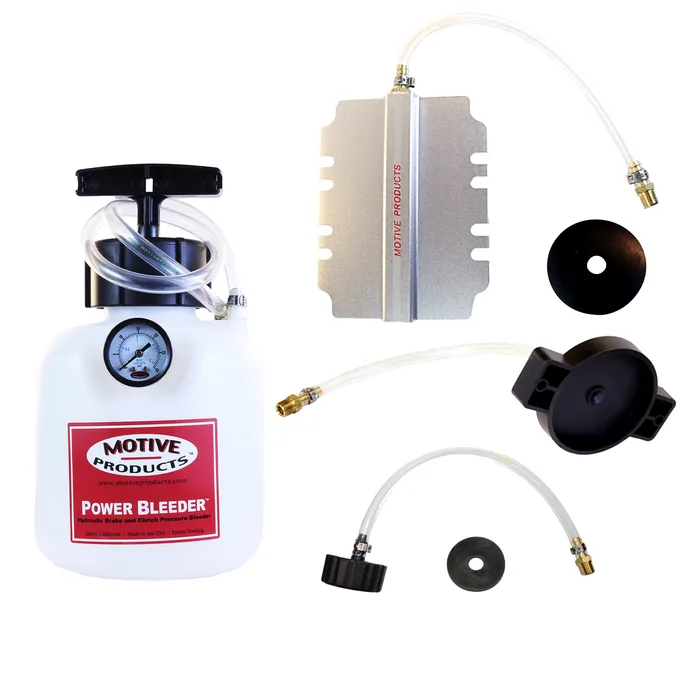
- Buy Motive Products 0250 Universal Brake Bleeder Kit A 2 quart hand-pumped pressure tank with three adapter caps, which is the closest thing here to a true one-person brake fluid flush. Amazon
- Buy OTC Tools 4809 Four Piece One-Man Brake Bleeder Hose Set Four check-valve hoses that let you open all four bleeders and work the pedal yourself without drawing air back into the system.
- It depends Phoenix Systems V-5 DIY Reverse One-Man Brake Bleeder A hand-operated injector that pushes fluid up from the bleed screw toward the master cylinder, which is unusually effective on trapped air and on clutches. Amazon
- Skip Performance Tool W89727 Hand Vacuum Pump Brake Bleeder A steel hand vacuum pump with a pile of adapters and tubes, sold as a brake bleeder but far better at testing vacuum switches. Amazon
What actually matters
- Bleeding method - Pressure, one-man check valve, reverse injection, vacuum and gravity are five different processes with five different weaknesses. Decide which job you are doing, a full fluid change or removing air after a repair, before you compare products.
- Adapter cap fitment - A pressure bleeder attaches by replacing your master cylinder reservoir cap, and reservoir necks vary wildly between makes and eras. Motive sells separate adapters for 45 mm European threads, round universal necks and rectangular chain-caps.
- Reservoir capacity - A two quart tank holds enough fluid to flush most passenger car systems in one go without stopping. It also means the master cylinder reservoir stays fed, which removes the most common way a brake job goes wrong.
- Fluid-compatible materials - Glycol brake fluid attacks many plastics, paints and petroleum-based greases. Look for a maker that explicitly states compatibility with DOT 3, DOT 4 and DOT 5.1, and follow its cleaning instructions rather than reaching for brake cleaner.
- Shop air requirement - Venturi-style bleeders generate vacuum from compressed air and typically need a real compressor with continuous flow. If you work in a driveway, a hand pump unit is not a compromise, it is the practical option.
- Catch bottle and check valve - A check valve at the collection end stops air being drawn back into the caliper between pedal strokes. A sealed catch bottle keeps corrosive fluid off your driveway and off the paint.
- Rebuildability - Pumps, o-rings and hoses are the parts that fail on these tools. Motive sells replacement seals and hoses and recommends replacing the hose every three to four years, while Phoenix states no rebuild kit exists for the V-5.
The specs, in plain English
Green flags vs red flags
Green flags
- The maker publishes an application guide that lists adapters against specific vehicle makes, models and years.
- The product page states explicit fluid compatibility, naming DOT 3, DOT 4 and DOT 5.1.
- The tool has a real reservoir, ideally two quarts or more, so the master cylinder cannot run dry.
- A pressure gauge is included and the instructions give a working pressure range rather than telling you to pump until it feels right.
- Replacement seals, hoses and pump parts are sold separately, which means the maker expects the tool to last.
Red flags
- A listing that says 'universal fit' with no adapter dimensions or vehicle list anywhere on the page.
- Marketing that claims the tool bleeds ABS systems without mentioning a scan tool or a vehicle-specific procedure.
- A venturi or air-powered unit with no stated air pressure or CFM requirement, which usually means it needs more compressor than you have.
- No stated fluid compatibility and no material listed for the tank, hose or seals.
- Vacuum-only tools sold on the promise of a firm pedal, when vacuum alone commonly draws air past the bleed screw threads.
Who's who: the brands
- Motive Products - The reference name in hand-pumped pressure bleeders, with a two quart tank and a very large catalogue of vehicle-specific reservoir cap adapters.
- Phoenix Systems - Built its business on patented reverse fluid injection, and its tools can also do vacuum, pressure and bench bleeding.
- OTC Tools - A long-standing professional tool brand, part of Bosch Automotive Service Solutions, known for straightforward shop staples like check-valve bleeder hoses.
- Lisle Corporation - An Iowa maker of inexpensive, purpose-built specialty tools, including basic brake bleeding kits with bottle and bleeder screw adapters.
- Performance Tool - A high-volume value brand whose hand vacuum pumps are widely sold as brake bleeders and are more convincing as vacuum diagnostic tools.
How to read a listing without getting fooled
Read a brake bleeder listing in this order. First find the method, and if the page will not say plainly whether the tool pressurises, pulls vacuum or injects from the caliper, treat that as a warning. Second, find the adapter: a specific cap size or a named vehicle list is good, the word 'universal' with no dimensions is not, and if the maker offers an application guide, use it before you add anything to a cart. Third, find the capacity, because a tool with no reservoir cannot flush a system and will leave you refilling by hand. Fourth, look for a stated fluid compatibility line naming DOT grades and a material for the tank and hose. Fifth, check whether compressed air is required and at what pressure and flow. Finally, look at whether spare seals, hoses and pump parts exist, because those are what wear out.
How much should you spend?
This is a category where the budget tier is genuinely useful rather than a trap. At the budget end you get check-valve hoses, catch bottles and hand vacuum pumps: the hoses and bottles do their narrow job well, the vacuum pumps are the weakest value for brake work specifically. The mid-range buys you a real bleeding system, either a single-adapter pressure tank or a reverse injector, and this is where most home mechanics should land. The premium tier is multi-adapter pressure kits and larger tanks, and it is worth it only if you service several different makes or expect to do this regularly, because what you are paying for is adapter coverage and rebuildability rather than better bleeding. Spending more does not make the job easier if the cap does not fit, so allocate your budget to the correct adapter first.
Questions, answered
Is gravity bleeding good enough?
Sometimes, and it costs nothing. Open a bleed screw, keep the reservoir topped up, and let atmospheric pressure and gravity push fluid down through the system on their own. It is slow, it will not shift a stubborn air pocket sitting in a high spot, and it demands constant attention to the reservoir level. It is a reasonable way to pre-fill a new line or caliper before you bleed properly, and a poor way to change all your fluid.
Do I need a helper to bleed brakes?
Not with any of the tools discussed here. Check-valve hoses let you pump the pedal yourself without air returning, a pressure tank does the pushing so nobody touches the pedal at all, and a reverse injector works entirely from the wheel end. The traditional two-person method still works, but it carries its own risk: repeatedly pushing the pedal to the floor drives the master cylinder piston across a part of the bore it never normally reaches, which can tear the seals on an older, corroded cylinder.
Does the order I bleed the wheels in matter?
Yes, and it is vehicle specific rather than a universal rule. Many cars use a sequence starting at the wheel furthest from the master cylinder, but plenty of modern vehicles with diagonally split circuits or electronic stability control specify something different. Motive's instructions tell you outright to determine the proper bleeding sequence from your vehicle service manual. Look it up rather than assuming.
Can I reuse an opened bottle of brake fluid from last year?
You should not. Glycol brake fluid absorbs moisture from the air, and federal labelling rules require containers to carry the instruction to store fluid only in its original container and keep it clean and tightly closed to prevent absorption of moisture. An opened bottle has already started taking on water, which lowers its boiling point before it ever reaches your brake lines. Buy the size you will actually use and dispose of leftovers properly.
Or jump to the head-to-head: Motive Products 0250 Universal Brake Bleeder Kit vs OTC Tools 4809 Four Piece One-Man Brake Bleeder Hose Set.