Explained
Brake Cleaners, Explained
After reading, you'll understand what separates chlorinated from non-chlorinated brake cleaner, why one is a fire hazard and the other is a toxic-gas hazard, and how to read a safety data sheet well enough to pick the right can for your state and your job.
In this guide
Most people buy brake cleaner by grabbing whichever can is cheapest, and that works right up until it does not. The category contains two chemistries that share a shelf and almost nothing else: one that cannot catch fire but turns into corrosive and toxic gas when it meets a hot surface, and one that cleans just as well but has a flash point below the temperature of your garage. Nothing on the front of the can explains this clearly, and the numbers that would explain it live in a safety data sheet the maker posts on its own website. Once you know which four lines to look for, the choice takes about a minute.
The 30-second version
- There are two chemistries, not twenty, and every can on the shelf is either chlorinated or non-chlorinated, which decides almost everything else about it.
- Chlorinated means it will not burn, and it also means its vapors can decompose on hot surfaces or under ultraviolet light into hydrogen chloride and phosgene.
- Non-chlorinated means it will burn, with published flash points below 20 F on the cans that state one at all, so pilot lights and hot rotors are the real risk.
- Acetone is why the legal cans are legal, because it is exempt from the VOC definition, letting a mostly-acetone formula clear a 10 percent VOC limit.
- Assume it attacks paint, plastic and rubber, because most makers either say so outright or publish nothing at all, and silence is not a safety claim.
The products this guide is about
Our verdict on each, with the full reasoning on the companion review.
- Buy CRC Industries BRAKLEEN Non-Chlorinated Brake Parts Cleaner, 50 State Formula (05050) An acetone-based can that CRC states is compliant for use in all 50 states, with no chlorinated residue to worry about. Amazon
- Buy Berryman Products Non-Chlorinated Brake Parts Cleaner, VOC Compliant (2420C) The simplest formula in the group: acetone, isohexane and carbon dioxide, with a published 10 percent VOC figure and no state restrictions on the label. Amazon
- It depends GUNK Pro Line Brake Parts Cleaner Acetone-Free (M719) The only can here whose maker publishes a claim about plastics, rubber and ABS sensors, paired with the thinnest published data.
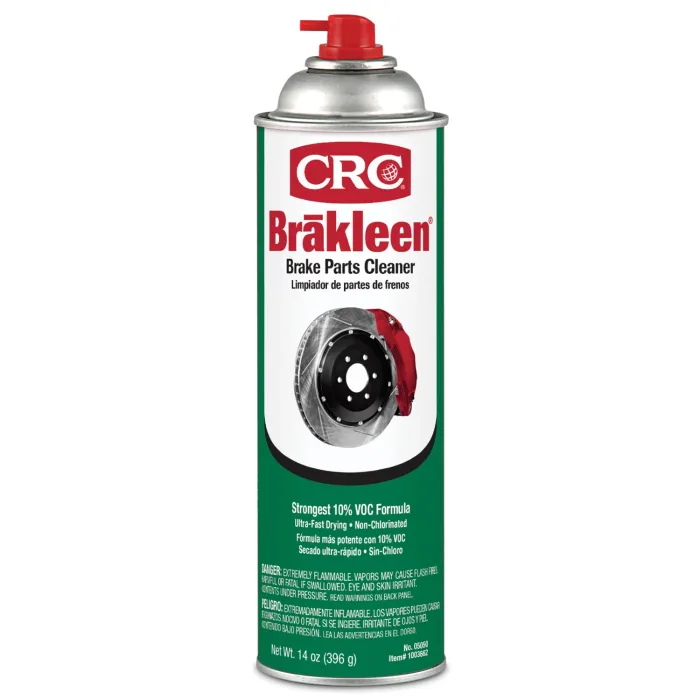
- Skip CRC Industries BRAKLEEN Brake Parts Cleaner, Chlorinated (05089) The famous red can genuinely does not burn, and that same chemistry is why it turns into hydrogen chloride and phosgene on a hot surface. Amazon
What actually matters
- Chlorinated versus non-chlorinated - this one word changes which hazard you are managing. Chlorinated cleaners are non-flammable but decompose into toxic gases near heat, and non-chlorinated cleaners are flammable but decompose into nothing unusual.
- Flash point - the temperature at which the liquid gives off enough vapor to ignite. The non-chlorinated cans here that publish one sit below 20 F, meaning there is ignitable vapor around an open can at any normal garage temperature.
- VOC content - the percentage of the product that counts as a smog-forming solvent under state rules. It determines where the can can legally be sold and correlates with how aggressive the solvent blend is.
- Residue - anything left on a rotor or pad contaminates the friction surface and can cause squeal or reduced bite. Every reputable brake cleaner claims to leave none, but evaporation rate still varies noticeably between formulas.
- Plastic, rubber and paint compatibility - modern brake assemblies contain sensor housings, seals and painted calipers that solvents can haze, swell or strip. Makers rarely publish a positive compatibility claim, so read what they do say very literally.
- Dielectric strength - the voltage a cleaner's residue can withstand without conducting, which matters when you are cleaning near connectors or a motor. The gap between formulas is large, so check it if electrical parts are in the spray path.
- Ventilation and exposure limits - every one of these solvents has a published OSHA permissible exposure limit, and a closed garage will beat those limits faster than people expect. Cross ventilation or outdoor use is the cheapest safety measure available.
The specs, in plain English
Green flags vs red flags
Green flags
- The maker posts a full safety data sheet on its own site with a composition section that names chemicals and CAS numbers.
- A flash point is actually stated, whether it is a number or an explicit None, rather than left as no data available.
- The VOC content appears as a percentage or in grams per litre, alongside a clear statement about which states the product can be sold in.
- The can is sold in matched sizes, including bulk containers, under related part numbers, which suggests professional use rather than a one-off retail SKU.
- The product page says something specific about plastic, rubber or painted surfaces instead of leaving it unaddressed.
Red flags
- The front of the can says non-flammable but the safety data sheet classifies it as a flammable aerosol, a contradiction that appears more often than it should.
- The composition section discloses only a fraction of the formula and withholds the rest as proprietary.
- No VOC figure appears anywhere, so you cannot tell whether it is legal where you live.
- Performance claims rest entirely on the maker's own lab testing, with no method or standard named.
- The product is chlorinated and you plan to weld, braze, cut or grind on the parts you are cleaning, which is the one combination to rule out completely.
Who's who: the brands
- CRC Industries - Makes both the chlorinated red can and the non-chlorinated green cans under the Brakleen name, and publishes the most detailed spec sheets in the category, down to dielectric strength.
- Berryman Products - Sells its brake cleaners in matched pairs, a standard version and a VOC-compliant version under a separate part number, with unusually short ingredient lists.
- GUNK - Offers a Pro Line brake cleaner series that includes an acetone-free formula with a 19 ounce and a 14 ounce size.
- Permatex - A mainstream maker of brake parts cleaners. Check each can's label or safety data sheet for its state restrictions, since similarly named cans can differ.
How to read a listing without getting fooled
Start with the can, then go to the maker's website for the safety data sheet, because the two documents answer different questions. On the can you are looking for one word, chlorinated or non-chlorinated, and the net weight, since a 14 ounce and a 19 ounce can often sit at similar prices. In the data sheet, four sections do all the work. Section 2 gives you the GHS classification, which tells you at a glance whether you are holding a Flammable Aerosol Category 1 product or a non-flammable Aerosol Category 3 one, and whether a carcinogen category is attached. Section 3 names the actual solvents and their percentages, which is the only honest answer to what is in the can. Section 9 gives the flash point and often the VOC percentage. Section 15 tells you which states the product may legally be sold in, and that line is frequently more restrictive than the marketing copy on the product page. If a sheet leaves any of those four blank, that absence is itself information.
How much should you spend?
Brake cleaner is a cheap product where the price spread across the whole category is narrow, so buying on price alone is a mistake in a way it rarely is elsewhere. Budget cans are usually straightforward acetone or petroleum solvent blends from established makers, and they clean perfectly well. Mid-range cans generally buy you either a larger fill, a better spray straw and nozzle, or a formula reformulated to clear a stricter state limit. Premium pricing in this category tends to mean a specialty formula, such as an acetone-free blend or a district-compliant version made in smaller volumes. The more useful way to think about value is cost per usable ounce combined with whether the can is legal where you live, because a cheaper can you cannot buy in your state is worth nothing. If you use brake cleaner regularly, gallon and five gallon containers with a refillable sprayer are the cheapest route by a wide margin.
Questions, answered
Can I use brake cleaner as a general degreaser?
You can, and plenty of people do, but it is an expensive way to buy solvent and the compatibility warnings still apply. Brake cleaner is formulated to flash off completely without residue, which is exactly what you want on a friction surface and often more than you need on a bracket. If you are cleaning painted, plastic or rubber parts, a purpose-made degreaser is usually the safer choice. For bulk work, a gallon of the same product with a refillable sprayer costs far less per ounce than aerosols.
Does brake cleaner expire?
The solvent itself does not meaningfully degrade, but the can does. Aerosols lose propellant through the valve over years, and a can stored in a hot vehicle or shed is a pressure vessel that manufacturers explicitly warn against exposing to temperatures above roughly 120 F. If a can sprays weakly or sputters, the propellant has gone rather than the cleaner. Store cans upright, out of sunlight, and away from anything that generates heat.
Is it safe to spray brake cleaner on hot brakes?
No, for two different reasons depending on which can you are holding. With a non-chlorinated cleaner, a hot rotor is an ignition source and the vapor is flammable at any normal temperature. With a chlorinated cleaner, a hot surface is precisely the condition under which the solvent decomposes into hydrogen chloride and phosgene. Let the brakes cool before you spray, which is good practice for the parts anyway.
What should I do about brake dust while I am at it?
Do not blow it around or dry brush it. OSHA's appendix on brake and clutch work prohibits dry brushing and describes wet methods, using water with a wetting agent or solvent applied gently, as the accepted way to keep dust out of the air. On older vehicles the concern is asbestos specifically, but the practice is sound regardless of what the pads are made of. Wet the assembly first, wipe with a cloth, and dispose of the cloth rather than shaking it out.
Or jump to the head-to-head: CRC Industries BRAKLEEN Non-Chlorinated Brake Parts Cleaner, 50 State Formula (05050) vs Berryman Products Non-Chlorinated Brake Parts Cleaner, VOC Compliant (2420C).