

Automotive
The Best Brake Cleaners: 4 Compared (and One to Skip)
We compared four aerosol brake parts cleaners on what their makers actually publish: chlorinated versus non-chlorinated chemistry, flash point, VOC content, where each can legally be sold, and what the label says about plastic and rubber.
The short version
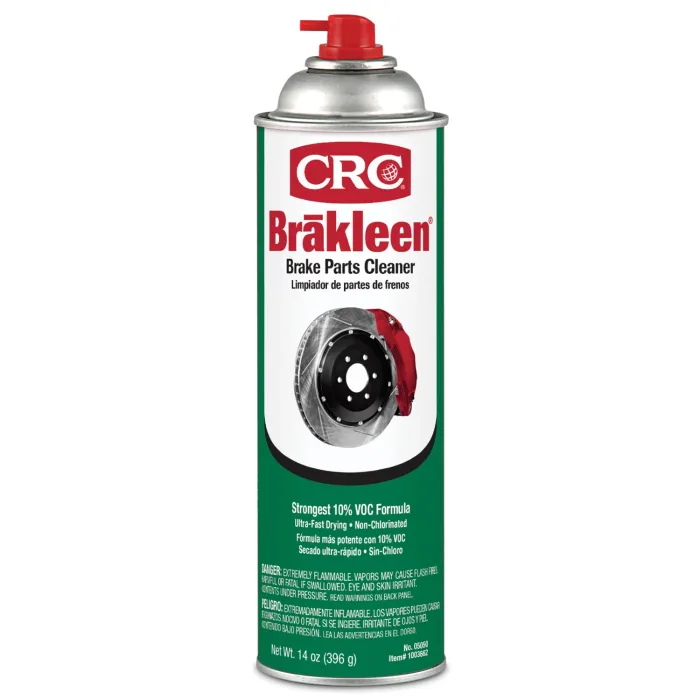
CRC BRAKLEEN Non-Chlorinated 50 State Formula is the best default. CRC's own safety data sheet puts it at 9.2 percent VOC, says it is compliant for use in all 50 states, and lists acetone rather than any chlorinated solvent. Berryman's VOC-compliant 2420C is the value pick, with a three-ingredient formula and a published 10 percent VOC figure. GUNK's acetone-free Pro Line can is worth considering if your calipers are full of plastic and rubber, because GUNK is the only maker here that publishes a plastics-and-seals claim, though it publishes neither a flash point nor a VOC number for it. Skip the chlorinated red can: CRC's own sheet says its vapors can decompose on hot surfaces into hydrogen chloride and possibly phosgene, classifies it as a Category 1B carcinogen by inhalation, and states it cannot be distributed to retailers after December 8, 2026. Remember that the non-chlorinated cans that do publish a flash point sit below 20 F and are rated Flammable Aerosol Category 1, which is the trade you are making. Best for: anyone who wants a can that is legal where they live, leaves no chlorinated residue near heat, and gets handled like the fire hazard it is.
Our picks at a glance
- CRC Industries BRAKLEEN Non-Chlorinated Brake Parts Cleaner, 50 State Formula (05050) - Buy. An acetone-based can that CRC states is compliant for use in all 50 states, with no chlorinated residue to worry about.
- Berryman Products Non-Chlorinated Brake Parts Cleaner, VOC Compliant (2420C) - Buy. The simplest formula in the group: acetone, isohexane and carbon dioxide, with a published 10 percent VOC figure and no state restrictions on the label.
- GUNK Pro Line Brake Parts Cleaner Acetone-Free (M719) - It depends. The only can here whose maker publishes a claim about plastics, rubber and ABS sensors, paired with the thinnest published data.
- CRC Industries BRAKLEEN Brake Parts Cleaner, Chlorinated (05089) - Skip. The famous red can genuinely does not burn, and that same chemistry is why it turns into hydrogen chloride and phosgene on a hot surface.
The verdict in 30 seconds
What mattered most
- Chlorinated
- Main solvent on the SDS
- Flash point
- VOC content
- Where the maker says it can be sold
- Maker's plastic and rubber guidance
Brake cleaner looks like the most boring can in the garage, and it has the most consequential label on the shelf. The category splits into two chemistries that behave completely differently: chlorinated cleaners built on perchloroethylene, which do not burn but decompose into nasty gases near heat, and non-chlorinated cleaners built on acetone or petroleum solvents, which burn readily. Every maker publishes a safety data sheet that tells you which one you are holding, what its flash point is, and which states it can legally be sold in. We read those sheets for all four cans here instead of trusting the front of the label.
An acetone-based can that CRC states is compliant for use in all 50 states, with no chlorinated residue to worry about.
Best for: Anyone who wants one can that is legal in every state and leaves nothing chlorinated behind.
- CRC's safety data sheet puts VOC content at 9.2 percent and states the product is compliant for use in all 50 states.
- Acetone at 80 to 100 percent on CRC's safety data sheet flashes off quickly.
- No perchloroethylene, so there is no chlorinated residue left on parts to decompose near heat.
- Sold in gallon, five gallon and drum sizes as well as the 14 ounce aerosol.
- Flash point below 0 F and a GHS Flammable Aerosol Category 1 rating, so it is a genuine fire hazard.
- CRC lists Plastic Safe: No for this product, so keep it off plastic and rubber components.
- Classified Aspiration Hazard Category 1, and the can carries a Proposition 65 cancer and reproductive harm warning.
- Dielectric strength of 6,300 V is far below the chlorinated can's, so it is a poor pick for electrical parts.
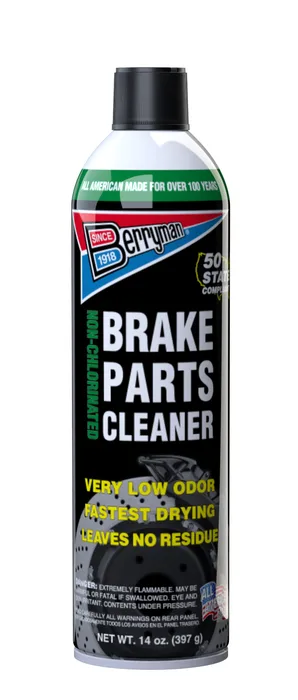
The simplest formula in the group: acetone, isohexane and carbon dioxide, with a published 10 percent VOC figure and no state restrictions on the label.
Best for: Someone who buys brake cleaner by the case and wants a short, legible ingredient list.
- Berryman's safety data sheet lists only three components: acetone at 80 to 90 percent, isohexane under 10 percent and carbon dioxide under 10 percent.
- VOC content is stated as 10 percent by weight, and Berryman sells it as compliant in all 50 states.
- Section 10 of the sheet lists no known hazardous decomposition products.
- Available in 14 ounce and 19 ounce aerosols plus gallon and five gallon containers under matching part numbers.
- Closed-cup flash point below 20 F and a Flammable Aerosol Category 1 classification with the Danger signal word.
- Berryman still directs South Coast air district users to a different part number, 2414SC, so it is not literally unrestricted everywhere.
- No plastics or rubber guidance is published for this SKU.
- No paint guidance is published for this SKU either.
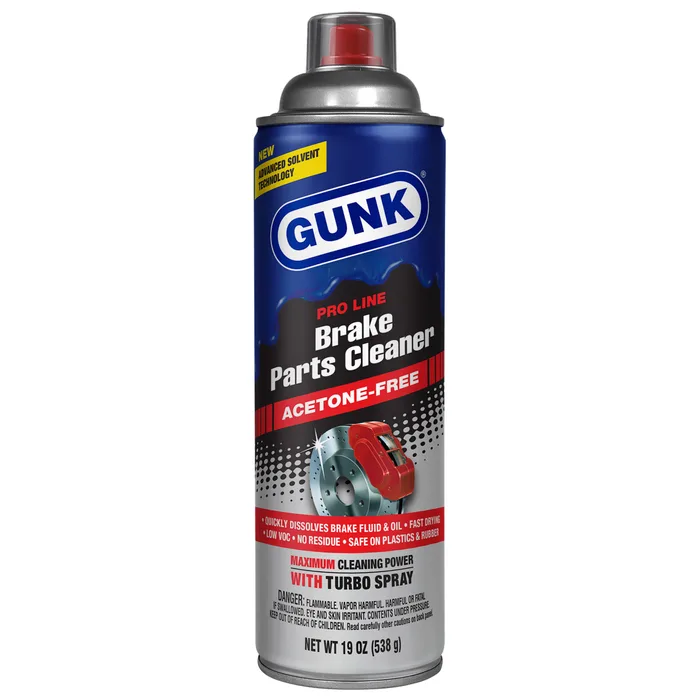
The only can here whose maker publishes a claim about plastics, rubber and ABS sensors, paired with the thinnest published data.
Best for: Someone servicing a late-model brake system full of plastic and sensors who wants the plastics claim and can live with a thin spec sheet.
- GUNK states the acetone-free formula is safe on most plastics, rubber, seals and ABS sensors found in modern brake assemblies.
- Being acetone-free removes the solvent most likely to haze plastic and attack seals.
- A 19 ounce fill, larger than the 14 ounce cans it competes with, with a 14 ounce version sold as M714.
- The product page does not state a flash point, so you cannot compare its fire risk to anything else.
- The product page does not disclose the composition beyond calling it acetone-free.
- The product page gives no VOC percentage for it and lists it as 49-State compliant rather than 50.
- The headline cleaning claim comes from the maker's own controlled lab testing, not an outside standard.
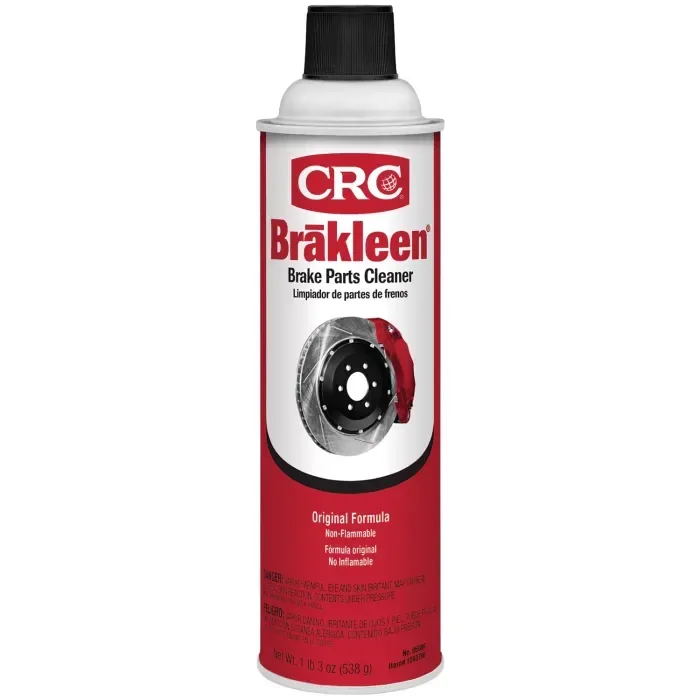
The famous red can genuinely does not burn, and that same chemistry is why it turns into hydrogen chloride and phosgene on a hot surface.
Best for: A well ventilated shop with no torch or welder anywhere near the parts, outside California and New Jersey, that understands what it is handling.
- CRC lists no flash point at all and classifies it as not flammable, a non-flammable Aerosol Category 3 product.
- VOC content is 0 percent, because perchloroethylene sits on the VOC-exempt list.
- Dielectric strength of 37,500 V is by far the highest here, and perchloroethylene at 80 to 100 percent cuts heavy grease fast.
- CRC's own safety data sheet: when exposed to extreme heat or hot surfaces, vapors may decompose to toxic gases such as hydrogen chloride and possibly phosgene.
- Classified GHS Carcinogenicity Category 1B, may cause cancer by inhalation.
- CRC states it is not compliant to be sold for use in California or New Jersey.
- Section 1 of CRC's sheet states that after December 8, 2026 the product cannot be distributed in commerce to retailers for any use, so it is a dead-end purchase.
| Criteria | BRAKLEEN Non-Chlorinated Brake Parts Cleaner, 50 State Formula (05050) Top pick | Non-Chlorinated Brake Parts Cleaner, VOC Compliant (2420C) | Pro Line Brake Parts Cleaner Acetone-Free (M719) | BRAKLEEN Brake Parts Cleaner, Chlorinated (05089) |
|---|---|---|---|---|
| Verdict | Buy it | Buy it | It depends | Skip it |
| Best for | Anyone who wants one can that is legal in every state and leaves nothing chlorinated behind. | Someone who buys brake cleaner by the case and wants a short, legible ingredient list. | Someone servicing a late-model brake system full of plastic and sensors who wants the plastics claim and can live with a thin spec sheet. | A well ventilated shop with no torch or welder anywhere near the parts, outside California and New Jersey, that understands what it is handling. |
| Price tier | $$ · mid-range | $ · budget | $$ · mid-range | $$ · mid-range |
| Chlorinated | No | No | No | Yes |
| Main solvent on the SDS | Acetone 80 to 100 percent | Acetone 80 to 90 percent | Not disclosed on the product page, acetone-free | Perchloroethylene 80 to 100 percent |
| Flash point | Below 0 F | Below 20 F, closed cup | Not stated on the product page | None |
| VOC content | 9.2 percent | 10 percent by weight | Not stated on the product page | 0 percent |
| Where the maker says it can be sold | All 50 states | All 50 states, SCAQMD users sent to 2414SC | 49 states, not California | Not for sale for use in California or New Jersey |
| Maker's plastic and rubber guidance | Plastic Safe: No | None published | Safe on most plastics, rubber, seals and ABS sensors | Plastic Safe: No, avoid plastic and rubber parts |
| Dielectric strength | 6,300 V | Not published | Not published | 37,500 V |
| Can size | 14 wt oz | 14 oz | 19 oz | 19 wt oz |
Which one is right for you?
- Anyone who wants one can that is legal in every state and leaves nothing chlorinated behind. Buy it CRC Industries BRAKLEEN Non-Chlorinated Brake Parts Cleaner, 50 State Formula (05050)
- Someone who buys brake cleaner by the case and wants a short, legible ingredient list. Buy it Berryman Products Non-Chlorinated Brake Parts Cleaner, VOC Compliant (2420C)
- Someone servicing a late-model brake system full of plastic and sensors who wants the plastics claim and can live with a thin spec sheet. It depends GUNK Pro Line Brake Parts Cleaner Acetone-Free (M719)
- A well ventilated shop with no torch or welder anywhere near the parts, outside California and New Jersey, that understands what it is handling. Skip it CRC Industries BRAKLEEN Brake Parts Cleaner, Chlorinated (05089)
How we judged the field
Five things decide whether a brake cleaner is the right can for you, and four of them are printed in documents most buyers never open. The first is chemistry: chlorinated or not, and which solvent is doing the work. The second is flash point, because it tells you whether the can is a fire hazard or a toxic-decomposition hazard, and every cleaner is one or the other. The third is VOC content, which determines whether the can is even legal where you live and how fast it flashes off. The fourth is what it leaves behind, since anything that stays on a friction surface will contaminate a fresh pad. The fifth is compatibility, meaning what the maker will and will not say about painted surfaces, rubber seals and plastic sensor housings. We took all of that from manufacturer safety data sheets and spec pages, plus government sources for the hazard and regulatory claims, and left out anything we could not find in writing.
The field splits cleanly. On one side are chlorinated cleaners built on perchloroethylene: no flash point, zero VOC, excellent solvency, and a well documented decomposition pathway to hydrogen chloride and phosgene when heat or ultraviolet light gets to them. On the other side are non-chlorinated cleaners, which subdivide again into high-solvent formulas that clean aggressively but are banned in a long list of states, and acetone-based low-VOC formulas that are legal everywhere because acetone is exempt from the VOC definition. We picked one representative of each meaningful branch: the acetone-based 50-state formula that most people should buy, a simpler and cheaper version of the same idea, an acetone-free option for people worried about plastics, and the iconic chlorinated red can as the thing to skip and why.
CRC Industries BRAKLEEN Non-Chlorinated Brake Parts Cleaner, 50 State Formula (05050)
Buy itCRC’s 50 State Formula solves the legality problem without any chlorinated chemistry. Section 3 of CRC’s safety data sheet lists acetone at 80 to 100 percent with carbon dioxide at 7 to 13 percent and small amounts of heptane and light naphtha, and Section 15 states plainly that the product is compliant for use in all 50 states. The VOC figure is 9.2 percent, which is how it clears California’s 10 percent cap for brake cleaner: acetone is on the VOC-exempt list, so most of what is in the can does not count against the limit. In use it does what you want, with a fast flash-off. The catch is fire. The flash point is below 0 F, CRC classifies it as a Flammable Aerosol Category 1 with an Aspiration Hazard Category 1 rating, and its dielectric strength of 6,300 V is a fraction of the red can’s. Right for anyone who wants a single can that works everywhere.
Berryman Products Non-Chlorinated Brake Parts Cleaner, VOC Compliant (2420C)
Buy itBerryman’s VOC-compliant can is the shortest ingredient list here, and that is the appeal. The safety data sheet for blend 5N-1 names three things: acetone at 80 to 90 percent, isohexane under 10 percent and carbon dioxide under 10 percent. Berryman puts VOC content at 10 percent by weight and sells it as compliant in all 50 states, in 14 ounce and 19 ounce aerosols plus gallon and five gallon containers if you go through a lot of it. Section 10 lists no known hazardous decomposition products. It is flammable, with a closed-cup flash point below 20 F and a Flammable Aerosol Category 1 classification carrying the Danger signal word. Two caveats are worth knowing: Berryman still points South Coast air district users to a separate part number, and it publishes no plastics or rubber guidance for this SKU or paint. Right for the person buying by the case.
GUNK Pro Line Brake Parts Cleaner Acetone-Free (M719)
It dependsGUNK’s acetone-free Pro Line can is the only one here whose maker makes a claim about what it will not eat. The product page says the acetone-free formula is safe on most plastics, rubber, seals and ABS sensors found in modern brake assemblies, which matters if you are working around a wheel speed sensor, a plastic caliper guide or a painted caliper. That is a genuine differentiator, because acetone-heavy cleaners are exactly the ones most likely to haze plastic and swell seals. The problem is what GUNK does not publish. The product page states no flash point, discloses no composition beyond calling it acetone-free, and gives no VOC percentage. The page lists it as compliant in 49 states rather than California, and the headline cleaning claim comes from the maker’s own controlled lab testing. Right for someone servicing a late-model brake system who wants the plastics claim and accepts a thinner spec sheet.
CRC Industries BRAKLEEN Brake Parts Cleaner, Chlorinated (05089)
Skip itThe red can earns its reputation, and that is the problem. Perchloroethylene at 80 to 100 percent cuts baked-on grease faster than anything acetone-based, CRC lists no flash point at all and classifies it as not flammable, and its 37,500 V dielectric strength is roughly six times the green can’s. Those advantages are inseparable from the reason to skip it. CRC’s own safety data sheet states that when exposed to extreme heat or hot surfaces, vapors may decompose to toxic gases such as hydrogen chloride and possibly phosgene, and lists phosgene among the hazardous decomposition products. It is classified GHS Carcinogenicity Category 1B, may cause cancer by inhalation. CRC states it is not compliant to be sold for use in California or New Jersey, and Section 1 of the sheet says that after December 8, 2026 it cannot be distributed in commerce to retailers for any use. You would be buying into a chemistry that is being withdrawn. Right only for a ventilated shop with no torch in the building.
Sources
Specs in this review come from these pages.
- CRC Industries, Safety Data Sheet: Brakleen Brake Parts Cleaner, 19 Wt Oz (chlorinated, 05089) (crcindustries.com)
- Berryman Products, Safety Data Sheet: Chlorinated Brake Parts Cleaner 1820 (berrymanproducts.com)
- New Jersey Department of Health, Hazardous Substance Fact Sheet: Tetrachloroethylene (nj.gov)
- U.S. Environmental Protection Agency, Phosgene Hazard Summary (epa.gov)
- OSHA Annotated Permissible Exposure Limits, Table Z-1 (osha.gov)
- California Air Resources Board, Consumer Products Regulation, Article 2 (ww2.arb.ca.gov)
CRC Industries BRAKLEEN Non-Chlorinated Brake Parts Cleaner, 50 State Formula (05050) vs Berryman Products Non-Chlorinated Brake Parts Cleaner, VOC Compliant (2420C): which should you buy?
The two picks are close cousins. Both are acetone-based, both clear the 10 percent VOC threshold that makes a can sellable in every state, both flash off fast and leave nothing on the rotor, and both are unambiguously flammable. The differences are in the details around the edges. CRC’s formula is acetone at 80 to 100 percent with carbon dioxide, heptane and light naphtha filling out the rest, and CRC publishes more numbers than anyone else here, including a dielectric strength figure and a spec sheet entry telling you it is not plastic safe. Berryman’s is nearly pure acetone at 80 to 90 percent with isohexane and carbon dioxide, published VOC content of 10 percent by weight, and a Section 10 that lists no known hazardous decomposition products.
Choose CRC if you want the most documented can on the shelf and the reassurance of a manufacturer that publishes what its product will and will not touch. The Plastic Safe: No line is not good news, but knowing it is better than guessing. Choose Berryman if you are buying in volume, since the same blend is sold in gallon and five gallon containers under matching part numbers, or if you simply prefer a formula with three ingredients over one with six. One practical note in Berryman’s disfavor: if you work in the South Coast air district in California, Berryman sends you to a different part number, so the 50-state label is not quite the whole story. If none of that decides it, buy whichever one your local store stocks in the size you want, because on the actual job they behave the same.
What to look for
- Chlorinated or not: the single most important word on the can, because chlorinated cleaners do not burn but decompose near heat, and non-chlorinated cleaners burn but do not.
- Flash point on the SDS: a number at or below room temperature means the liquid gives off ignitable vapor in a normal garage, so pilot lights and hot rotors matter more than the aerosol warning suggests.
- VOC content and your state: the figure in Section 15 tells you whether the can is legal where you live, and a high number usually means a more aggressive petroleum solvent blend.
- Whether the maker says anything about plastic: most publish nothing or an explicit Plastic Safe: No, so treat silence as a warning rather than permission.
- Dielectric strength: only relevant if you are cleaning around sensors, connectors or motors, but the gap between formulas is large enough to matter when it does.
- Where the residue goes: every can here claims to leave none, so judge on evaporation rate and whether the straw lets you flush a caliper without soaking everything around it.
Our final take
Buy a non-chlorinated, 50-state, acetone-based can and treat it like the flammable it is. CRC’s 50 State Formula and Berryman’s 2420C both do the job, both are legal everywhere, and neither leaves a chlorinated residue on a part you might later put a torch to. If your brake assembly is full of plastic and sensors, GUNK’s acetone-free can is the only one making a compatibility claim, though you accept a much thinner spec sheet for it. The chlorinated red can is the outlier: genuinely non-flammable, genuinely more aggressive, and genuinely the one that produces hydrogen chloride and phosgene on a hot surface. It is also on its way off retail shelves. There is no reason left for most people to start with it.
Questions, answered
Is the phosgene thing with chlorinated brake cleaner real, or a garage myth?
It is real, and it is narrower than the internet version. Perchloroethylene, the solvent in chlorinated brake cleaner, does not burn on its own, but the New Jersey Department of Health's fact sheet for the chemical states that it decomposes slowly with heating, and with exposure to ultraviolet light or on contact with hot surfaces, to form toxic hydrogen chloride and phosgene gases. CRC's own safety data sheet for the red can says the same thing and lists phosgene among the hazardous decomposition products. The hazard applies when heat, flame, a hot surface or the ultraviolet light of a welding arc meets the solvent or its residue, not when you spray a cold caliper outdoors. Phosgene has an OSHA permissible exposure limit of 0.1 ppm as an 8-hour average, and EPA's hazard summary notes that acute inhalation has caused pulmonary edema and death in humans. The practical rule is simple: never weld, braze, cut or grind on a part that has been cleaned with a chlorinated solvent, and never leave the residue on something you are about to heat.
Chlorinated or non-chlorinated: which should I actually buy?
For almost everyone, non-chlorinated. Chlorinated cleaners cut grease harder and do not catch fire, which is a real advantage, but the trade is a solvent classified as a Category 1B carcinogen by inhalation that decomposes into corrosive and toxic gases near heat. Non-chlorinated cleaners avoid that entirely, and the trade is that they are flammable: both CRC's and Berryman's 50-state cans are rated GHS Flammable Aerosol Category 1, with closed-cup flash points below 0 F and below 20 F respectively. That is a hazard you already know how to manage, because it is the same one as gasoline or carb cleaner. The regulatory picture has also settled the argument in a lot of places, with California and New Jersey barring chlorinated brake cleaner outright and CRC stating that its own red can leaves retail distribution after December 8, 2026.
Will brake cleaner damage paint, plastic or rubber?
Assume yes unless the maker says otherwise, and most of them do not say otherwise. CRC lists Plastic Safe: No on both its chlorinated and non-chlorinated Brakleen products, and the chlorinated product page tells you to avoid applying it to plastic or rubber parts. Berryman publishes no plastics, rubber or paint guidance for its VOC-compliant can. GUNK is the exception in this group: it claims its acetone-free Pro Line formula is safe on most plastics, rubber, seals and ABS sensors. Acetone is the usual culprit, and the acetone-heavy 50-state formulas are exactly the ones most likely to haze a plastic reservoir or swell a seal. If overspray on a painted caliper or a wheel speed sensor is a real risk, mask it or wipe it off immediately.
Why can I not buy the same can in every state?
Two separate rules are at work. The first is toxicity: California's airborne toxic control measure for automotive maintenance and repair prohibits selling any automotive consumer product containing methylene chloride, perchloroethylene or trichloroethylene at 1.0 percent or more by weight in brake cleaner. That is why the chlorinated red can is not sold for use in California, and New Jersey takes the same position. The second is smog: California's consumer products regulation caps brake cleaner at 10 percent VOC by weight, a limit that stepped down from 50 percent in 1997 to 45, then 20, then 10 percent at the end of 2010. Several Northeast and Midwest states have adopted similar limits, which is why a high-solvent can like CRC's 05088 is restricted in more than a dozen states while its 50 State sibling is not.
Non-chlorinated cleaner is flammable. How careful do I need to be?
Careful in a specific way, not a vague one. These cans carry flash points at or below 20 F, meaning the liquid gives off ignitable vapor well below room temperature, and CRC classifies its 50 State formula as Flammable Aerosol Category 1 with the warning that vapors will accumulate readily and may ignite. The realistic failure modes are a water heater pilot light in the corner of the garage, a hot exhaust manifold or brake rotor you just drove in on, a droplight, and static from spraying into a plastic bucket. Extinguish pilot lights and heaters, let hot parts cool, work outdoors or with cross ventilation, and do not spray toward any ignition source. Several of these cleaners also carry an Aspiration Hazard Category 1 rating, which is the reason the label tells you not to induce vomiting if it is swallowed.
Deciding between the top two? See our head-to-head: CRC Industries BRAKLEEN Non-Chlorinated Brake Parts Cleaner, 50 State Formula (05050) vs Berryman Products Non-Chlorinated Brake Parts Cleaner, VOC Compliant (2420C).
More Automotive reviews
 The Best Bug and Tar Removers: 4 Compared (and One to Skip)
  The Best Car Air Fresheners and Odour Eliminators: 4 Compared (and One to Skip)
  The Best Car Battery Chargers & Maintainers: 4 Compared (and One to Skip)
  The Best Car Covers: 4 Compared (and One to Skip)
  The Best Car Detailing Kits: 4 Compared (and One to Skip)
  The Best Car Emergency Kits: 4 Compared (and One to Skip)