

Automotive
The Best Brake Bleeders: 4 Compared (and One to Skip)
We compared pressure, one-man check-valve, reverse-injection and vacuum brake bleeders on cap fitment, reservoir capacity, fluid compatibility and whether they actually flush the system or only pull air out.
The short version
The Motive Products 0250 Universal Brake Bleeder Kit is the best overall pick: a 2 quart pressure tank with a hand pump, a 0 to 30 psi gauge and three adapter caps covering European, import and classic domestic reservoirs, so one person can do a full flush without a helper or an air compressor. The value pick is the OTC 4809 four piece one-man bleeder hose set, which puts a check valve on each of four hoses so you can pump the pedal alone without sucking air back in, for a fraction of the cost of a tank. The Phoenix Systems V-5 is the depends pick: its reverse injection method is unusually good at clearing stubborn trapped air and at bleeding clutches, but it pushes fluid from the caliper up toward the master cylinder and the ABS unit, so it belongs in the hands of someone who flushes the old fluid out first and watches the reservoir level. Skip the Performance Tool W89727 hand vacuum pump bleeder, and vacuum-only bleeding in general, because vacuum pulls air past the bleed screw threads and gives you an endless stream of bubbles that tells you nothing about the state of your brakes. Whatever you buy, confirm the adapter cap fits your master cylinder before you order, because cap fitment is where most of these purchases go wrong. And on any ABS car, understand up front that a tool alone may not be enough if air has reached the modulator. Best for: a home mechanic who wants a genuinely one-person flush and a firm pedal without guessing.
Our picks at a glance
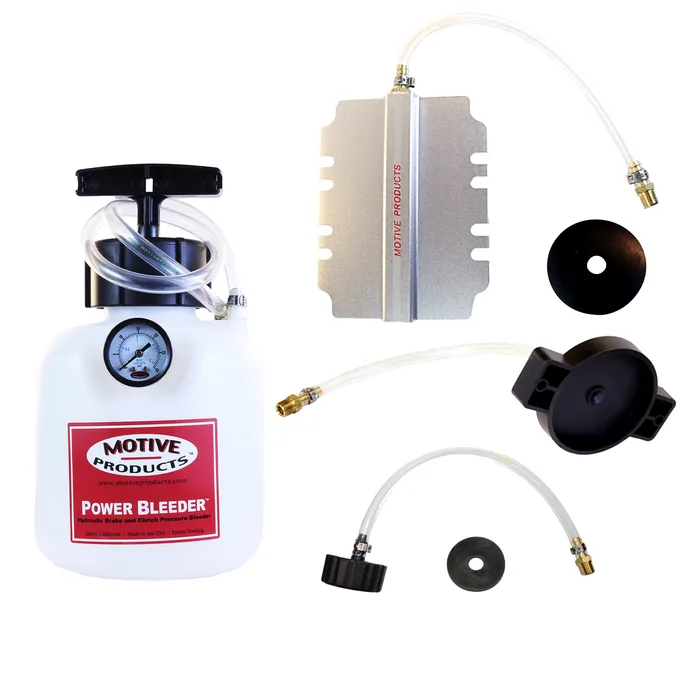
- Motive Products 0250 Universal Brake Bleeder Kit - Buy. A 2 quart hand-pumped pressure tank with three adapter caps, which is the closest thing here to a true one-person brake fluid flush.
- OTC Tools 4809 Four Piece One-Man Brake Bleeder Hose Set - Buy. Four check-valve hoses that let you open all four bleeders and work the pedal yourself without drawing air back into the system.
- Phoenix Systems V-5 DIY Reverse One-Man Brake Bleeder - It depends. A hand-operated injector that pushes fluid up from the bleed screw toward the master cylinder, which is unusually effective on trapped air and on clutches.
- Performance Tool W89727 Hand Vacuum Pump Brake Bleeder - Skip. A steel hand vacuum pump with a pile of adapters and tubes, sold as a brake bleeder but far better at testing vacuum switches.
The verdict in 30 seconds
What mattered most
- Method
- Flush or air removal
- Reservoir capacity
- Adapter cap included
- Power source
- Shop air required
A brake bleeder is one of the few tools where the method matters more than the brand. Pressure bleeders push fresh fluid down from the master cylinder reservoir, one-man hoses use a check valve so you can work the pedal alone, reverse bleeders inject fluid up from the caliper, and vacuum bleeders suck from the bleed screw. Each of those does a different job and each fails in a different way, which is why a lot of buyers end up with a tool that cannot do the thing they bought it for. We looked at four tools that each represent one of those methods, and judged them on what actually decides the job: whether the cap adapter fits your car, how much fresh fluid the tool can hold, what the maker says about fluid compatibility, and how likely the tool is to hand you a false result.
A 2 quart hand-pumped pressure tank with three adapter caps, which is the closest thing here to a true one-person brake fluid flush.
Best for: Anyone who services more than one make and wants to flush fluid alone, cleanly, on a schedule.
- Holds two quarts of fresh fluid, so the master cylinder reservoir cannot empty mid-job the way it can with vacuum or pedal bleeding.
- Ships with three adapters that Motive lists for European 45 mm ATE-style caps, round universal necks from 1.5 in to 2.90 in, and rectangular chain-cap masters.
- Motive states the reservoir is chemical resistant for DOT 3, DOT 4 and DOT 5.1 fluid, and the unit is rebuildable with Viton seals and replacement parts.
- Three adapters is not every adapter, and Motive still tells you to check its application guide for your specific cap.
- The rectangular 1105 chain-cap adapter is aimed at classic Ford, GM and Chrysler dual-reservoir masters, so check it against your reservoir.
- Motive says not to exceed 20 psi unless your service manual specifies otherwise, because higher pressure can damage the vehicle reservoir.
- Maintenance is finicky: Motive says never store fluid in the tank, clean only with isopropyl alcohol and not brake cleaner, and replace the hose every three to four years.
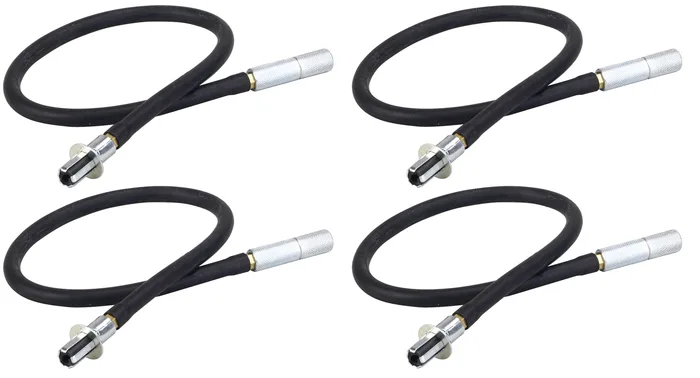
Four check-valve hoses that let you open all four bleeders and work the pedal yourself without drawing air back into the system.
Best for: A DIYer doing an occasional bleed after a caliper or hose change who does not want to buy a pressure tank.
- OTC states the check valve on the end of each hose prevents air from entering the brake system when you pump the brake pedal.
- The set includes four of the single No. 4599 hose, so you can set up all four wheels at once instead of walking around the car repeatedly.
- OTC states the hose attaches to the bleeder screw and is held in place by it, which keeps the connection from leaking as you work.
- It removes air, it does not flush: there is no tank of fresh fluid, so you have to keep topping the master cylinder reservoir by hand.
- You are still pumping the pedal, and Motive warns that pushing the pedal past its normal travel can gouge master cylinder seals against a corroded or worn bore.
- No reservoir cap adapter and no fluid capacity are listed, so plan on a separate catch bottle for anything more than a quick bleed.
- Nothing here helps with air trapped in an ABS modulator.
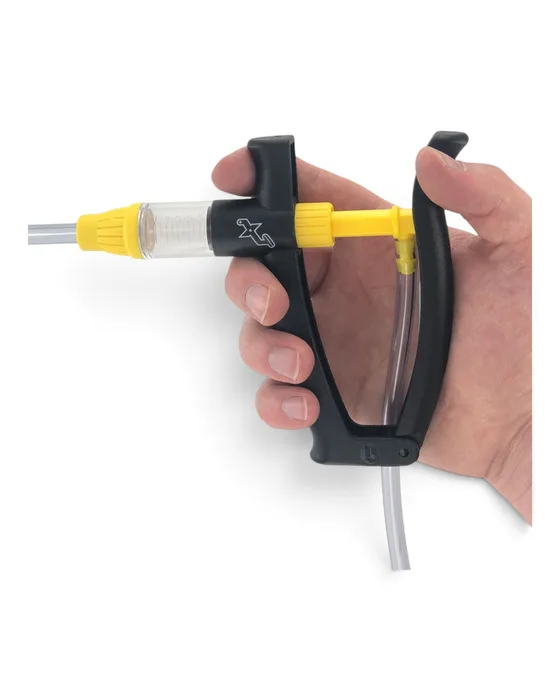
A hand-operated injector that pushes fluid up from the bleed screw toward the master cylinder, which is unusually effective on trapped air and on clutches.
Best for: Someone chasing a spongy pedal that normal bleeding will not fix, or bleeding a clutch, who is willing to flush first and read the instructions.
- Phoenix's patented reverse fluid injection sends fluid the way air naturally wants to travel, upward, which is why it clears stubborn pockets other methods miss.
- Phoenix states the same tool can also perform vacuum, pressure and bench bleeding, so one tool covers several methods including clutch hydraulics.
- Sold in a Universal version (SKU 2104-B) and a European version (SKU 2104-Euro) that adds a 45 mm threaded reservoir cap for pressure bleeding.
- Reverse bleeding pushes whatever is sitting in the caliper and lines upward, and Motive Products argues in its own technical FAQ that this can force contaminants into the ABS unit and master cylinder, so flush the old fluid out first.
- Because you are filling the master cylinder from below, it is easy to overflow the reservoir onto painted bodywork if you are not watching the level.
- Phoenix does not publish an injector fluid capacity or construction materials on the product page.
- Phoenix states there are no rebuild kits available for the V-5, so wear parts are not serviceable.
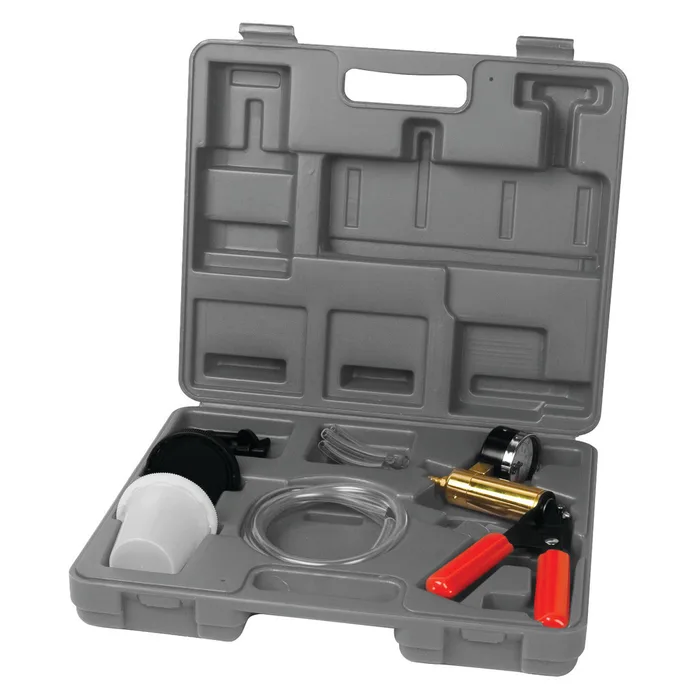
A steel hand vacuum pump with a pile of adapters and tubes, sold as a brake bleeder but far better at testing vacuum switches.
Best for: Someone who genuinely wants a general-purpose hand vacuum pump for diagnostics and views brake bleeding as a bonus.
- Performance Tool states it is durable steel construction and carries a lifetime warranty.
- Includes tubes, various adapters and containers, and Performance Tool lists it for testing vacuum switches and removing fluids as well as bleeding.
- Needs no compressed air, so it works in a driveway with no compressor.
- Vacuum applied at the bleed screw tends to pull air in past the screw threads, so you get a continuous stream of bubbles that has nothing to do with air in your brake lines.
- Phoenix Systems notes that with vacuum, gravity or pedal flushing you probably will not flush contamination out of the brake system properly.
- There is no fresh fluid supply, so the master cylinder reservoir can run dry while you are under the car, which pulls air into the master and turns a short job into a long one.
- No reservoir cap adapter and no stated collection capacity, and Performance Tool does not publish a vacuum rating for the pump.
| Criteria | 0250 Universal Brake Bleeder Kit Top pick | 4809 Four Piece One-Man Brake Bleeder Hose Set | V-5 DIY Reverse One-Man Brake Bleeder | W89727 Hand Vacuum Pump Brake Bleeder |
|---|---|---|---|---|
| Verdict | Buy it | Buy it | It depends | Skip it |
| Best for | Anyone who services more than one make and wants to flush fluid alone, cleanly, on a schedule. | A DIYer doing an occasional bleed after a caliper or hose change who does not want to buy a pressure tank. | Someone chasing a spongy pedal that normal bleeding will not fix, or bleeding a clutch, who is willing to flush first and read the instructions. | Someone who genuinely wants a general-purpose hand vacuum pump for diagnostics and views brake bleeding as a bonus. |
| Price tier | $$$ · premium | $ · budget | $$ · mid-range | $ · budget |
| Method | Pressure, top down from the reservoir | One-man check-valve hoses at the bleed screws | Reverse injection from the caliper, plus vacuum, pressure and bench | Vacuum, hand pump at the bleed screw |
| Flush or air removal | Full flush, tank feeds fresh fluid | Air removal only, no fluid supply | Both, injects fresh fluid upward | Air removal only, no fluid supply |
| Reservoir capacity | 2 quarts | None, hoses only | Not published by the manufacturer | Not published by the manufacturer |
| Adapter cap included | Three: 1100 European 45 mm ATE-style, 1101 round universal 1.5 in to 2.90 in, 1105 rectangular chain-cap | None, connects at the bleed screws | Universal version none; European version adds a 45 mm threaded cap | None, connects at the bleed screw |
| Power source | Built-in hand pump, 0 to 30 psi gauge | Your foot on the brake pedal | Hand-operated hydraulic pump | Hand vacuum pump |
| Shop air required | No | No | No | No |
| Stated fluid compatibility | DOT 3, DOT 4, DOT 5.1 | Not stated on the product page | DOT 3, DOT 4, DOT 5.1 only, not petroleum-based fluids | Not stated on the product page |
| Warranty | 1 year from date of purchase | Not stated on the product page | Up to 2 years | Lifetime |
Which one is right for you?
- Anyone who services more than one make and wants to flush fluid alone, cleanly, on a schedule. Buy it Motive Products 0250 Universal Brake Bleeder Kit
- A DIYer doing an occasional bleed after a caliper or hose change who does not want to buy a pressure tank. Buy it OTC Tools 4809 Four Piece One-Man Brake Bleeder Hose Set
- Someone chasing a spongy pedal that normal bleeding will not fix, or bleeding a clutch, who is willing to flush first and read the instructions. It depends Phoenix Systems V-5 DIY Reverse One-Man Brake Bleeder
- Someone who genuinely wants a general-purpose hand vacuum pump for diagnostics and views brake bleeding as a bonus. Skip it Performance Tool W89727 Hand Vacuum Pump Brake Bleeder
How we judged the field
Five things decide whether a brake bleeder earns its shelf space. First, method: pressure, one-man check valve, reverse injection and vacuum are genuinely different processes, and only the first and third put fresh fluid into the system. Second, cap fitment, which is the practical trap in this whole category, because a pressure bleeder is useless until its adapter seals to your specific master cylinder reservoir. Third, reservoir capacity, because a tool that holds fluid is a tool that stops the master cylinder from running dry and pulling air into the master. Fourth, materials and stated fluid compatibility, since glycol brake fluid attacks a lot of plastics and every published warning says to keep it clean and dry. Fifth, whether the tool needs shop air, which quietly rules out a lot of otherwise good pressure and venturi units for people without a compressor.
The field splits along those method lines rather than by brand. Pressure bleeders are the shop standard and the only practical way to do a full flush alone, so we wanted the best-supported one with more than a single adapter. One-man check-valve hoses are the honest budget answer and do one job well, so we wanted a set from a serious tool maker rather than an anonymous bag of tubing. Reverse bleeding is a real technique with real advantages and a real drawback, so it belongs in the field as a conditional recommendation rather than a headline pick. And vacuum bleeding is the method most often sold to first-time buyers and the one most likely to leave them with a soft pedal and a bottle full of meaningless bubbles, so a representative vacuum kit belongs here as the thing to avoid.
Motive Products 0250 Universal Brake Bleeder Kit
Buy itThe Motive Products 0250 is the do-everything version of the tool this category is built around. You fill the two quart tank with fresh fluid, clamp the right adapter to the master cylinder reservoir, pump the handle to 15 to 20 psi on the built-in 0 to 30 psi gauge, then crack each bleed screw in the sequence your service manual specifies. Because the tank feeds the reservoir the whole time, the master cannot run dry, and because the pressure is steady rather than a series of pedal shoves, you get a consistent flush instead of a series of surges. Motive states the reservoir is chemical resistant for DOT 3, DOT 4 and DOT 5.1, and the unit is rebuildable with Viton seals. The catch is fitment. The three included adapters cover a lot of ground, but Motive still points you at an application guide, and the rectangular chain-cap adapter is aimed at classic Ford, GM and Chrysler dual-reservoir masters. It is for the person who wants to flush fluid properly, alone, more than once.
OTC Tools 4809 Four Piece One-Man Brake Bleeder Hose Set
Buy itThe OTC 4809 is deliberately unambitious and better for it. It is four of OTC’s No. 4599 hose, each with a check valve on the outlet end, and OTC’s own literature states the valve prevents air from entering the brake system when you pump the brake pedal. Attach one to each bleed screw, open all four, and work the pedal yourself: fluid and air leave, nothing gets sucked back. That solves the specific failure that ruins solo pedal bleeding without asking you to buy a tank. What it does not do is supply fluid, so you are still walking back to top the reservoir, and it does not stop the other pedal-bleeding hazard, which is pushing the master cylinder piston past its normal travel across a bore that may be pitted. There is no cap adapter and no stated collection volume, so budget for a catch bottle. It is the right buy for someone bleeding after a caliper or hose job a few times a year.
Phoenix Systems V-5 DIY Reverse One-Man Brake Bleeder
It dependsThe Phoenix Systems V-5 does something the others cannot. Instead of chasing air downhill, it injects fluid upward from the bleed screw so trapped air travels the direction it wants to go, out through the master cylinder reservoir. That is genuinely effective on the spongy pedal that survives conventional bleeding, and it works on clutch hydraulics too, which is where a lot of people first discover the tool. Phoenix states the same unit can also vacuum, pressure and bench bleed, and the European version adds a 45 mm threaded reservoir cap. The trade-off is direction of travel. Everything sitting in the caliper and lines gets pushed toward the master cylinder and, on an ABS car, toward the modulator; Motive argues in its own FAQ that reverse bleeding can force contaminants into exactly those parts. So flush the old fluid out first, watch the reservoir so it does not overflow onto paint, and accept that Phoenix offers no rebuild kit for this model. It is for the person solving a problem, not doing routine maintenance.
Performance Tool W89727 Hand Vacuum Pump Brake Bleeder
Skip itThe Performance Tool W89727 is a well-made hand vacuum pump that happens to be sold as a brake bleeder. Performance Tool describes durable steel construction, a lifetime warranty, and a generous set of tubes, adapters and containers, and it is a legitimately useful diagnostic tool for testing vacuum switches and pulling fluid out of reservoirs. The problem is the physics of using vacuum at a bleed screw. Open the screw and pull a vacuum on the outside and atmospheric pressure pushes air in past the tapered threads, so your hose fills with bubbles that came from the threads rather than the brake line. Phoenix Systems makes a similar point about vacuum flushing on its FAQ. Meanwhile nothing is feeding the reservoir, so the master cylinder can quietly run dry while you are underneath the car, which is the one mistake that reliably turns a one hour job into an afternoon. Buy it if you want a vacuum tester. Do not buy it expecting a firm pedal.
Sources
Specs in this review come from these pages.
- FMVSS 116, Motor vehicle brake fluids (49 CFR 571.116) (law.cornell.edu)
- Motive Products, Power Bleeder Instructions (motiveproducts.com)
- Motive Products, Power Bleeder FAQ (motiveproducts.com)
- Wilwood Engineering, Brake Fluid Tech Tips (wilwood.com)
- Phoenix Systems, Brake Fluid and Bleeding FAQ (phoenixsystems.co)
- OTC Tools, One-Man Brake Bleeder Hose literature (08-127) (otctools.com)
Motive Products 0250 Universal Brake Bleeder Kit vs OTC Tools 4809 Four Piece One-Man Brake Bleeder Hose Set: which should you buy?
The Motive 0250 and the OTC 4809 are not really competing for the same job, and that is the useful way to choose between them. The Motive is a fluid delivery system: it holds two quarts, it feeds the master cylinder reservoir continuously, and it lets one person push a complete change of fluid through the whole system at a controlled 15 to 20 psi. The OTC is an air management accessory: it stops air from re-entering when you release the pedal, and nothing more. If your goal is the two year fluid change your owner’s manual asks for, the OTC will not get you there without a lot of walking back and forth and a real risk of running the reservoir dry. If your goal is to get the air out after replacing one caliper, the Motive is more tool than the job needs.
The deciding question is how often you will do this and on what. If you own one car and you touch the brakes every few years, buy the hose set, keep a bottle of fresh fluid handy, and top the reservoir religiously. If you own two or three cars, do track days, or maintain anything on a schedule, the pressure tank pays for itself the first time you flush a system alone in under an hour without spilling fluid on the paint. One warning applies to the Motive and not the OTC: check the adapter against Motive’s application guide before you order, because the tank is only as useful as the cap that seals to your reservoir. And one applies to both: on an ABS vehicle that has been opened up or run dry, neither one clears air out of the modulator by itself.
What to look for
- Confirm the cap adapter first: a pressure bleeder is only as good as the adapter that seals to your master cylinder reservoir, so check the maker’s application guide against your exact year and model before you buy anything.
- Prefer a tool that holds fluid: a tank that feeds the reservoir means the master cylinder cannot run dry mid-job, which is the failure that pulls air into the master and forces a bench bleed.
- Check the stated fluid compatibility: Motive lists its reservoir as chemical resistant for DOT 3, DOT 4 and DOT 5.1 and Phoenix restricts its tool to those same three, and a tool that says nothing about fluid compatibility is telling you something.
- Respect the pressure ceiling: Motive instructs users not to exceed 20 psi unless the vehicle service manual specifies otherwise, because higher pressure can damage the vehicle’s reservoir.
- Treat brake fluid as paint stripper: Motive’s own warning says hydraulic fluid is corrosive and may damage automobile paint or other surfaces, and to flush any spill with water immediately, so lay a rag over the fender before you start.
- Assume vacuum bubbles are lying to you: vacuum applied at a bleed screw draws air past the tapered threads, so use vacuum as a helper alongside pressure or reverse bleeding rather than as your only method.
Our final take
Buy the method, not the marketing. If you want to change brake fluid properly and alone, a two quart pressure bleeder with the correct cap adapter is the tool, and the Motive 0250 is the best-supported version of it. If you only need to get air out after a repair, four check-valve hoses do that job honestly for very little money. Reverse injection is a genuine problem-solver in the right hands and a way to push old fluid somewhere you do not want it in the wrong ones. Vacuum-only bleeding is the trap. Whatever you choose, top the reservoir before you start, never let it empty, keep fluid off the paint, and look up your car’s bleed sequence before you crack the first screw.
Questions, answered
Will any of these bleed the air out of my ABS unit?
Not reliably, and this is the single biggest gap between what these tools promise and what they can do. On an ABS-equipped vehicle, air that has reached the hydraulic control unit sits behind solenoid valves that stay closed during ordinary bleeding, so pushing or pulling fluid at the calipers will not sweep it out. Clearing it generally requires a scan tool that can command the module to cycle those valves while you bleed, and the exact routine is vehicle specific. Phoenix Systems lists a scan tool alongside pressure flush equipment as part of doing an ABS brake fluid service properly. The good news is that this usually only applies after the system has been opened, run dry or had the modulator replaced. For a routine fluid change on a system that was never opened, a pressure bleeder and the manufacturer's bleed sequence are normally enough.
What happens if I let the master cylinder run dry while bleeding?
Air gets pulled into the master cylinder itself, and that is a much harder problem than air in a caliper. Once the master has air in it, bleeding at the wheels often will not fix the pedal, and you may end up having to bench bleed the master cylinder or remove it entirely. This is why every published bleeding procedure starts with topping the reservoir with fresh fluid and keeping it topped up. It is also the strongest practical argument for a pressure tank: a two quart tank feeds the reservoir continuously, so it physically cannot empty while you are under the car. Motive's own instructions make the same point, with topping off the reservoir with fresh fluid as the first step.
Why do vacuum bleeders show bubbles that never stop?
Because a bleed screw is a tapered thread, not a sealed fitting. When you open it and apply vacuum on the outside, atmospheric pressure pushes air down the threads and into your collection hose, where it looks exactly like air coming out of the brake line. Phoenix Systems says that with vacuum, gravity or pedal flushing you probably will not flush contamination out of the system properly. You can reduce it by wrapping the screw threads in PTFE tape or smearing them with grease, but it is a workaround, not a fix. If you want an honest read on whether the system is clear, use a method that pressurises the fluid rather than one that depressurises it.
Can I use DOT 5 fluid in a system that had DOT 3 or DOT 4 in it?
No. DOT 5 is silicone based, and federal brake fluid rules treat it as a separate product: containers must be labelled either DOT 5 SILICONE BASE or DOT 5.1 NON-SILICONE BASE, which is the whole point of the confusing numbering. DOT 3, DOT 4 and DOT 5.1 are glycol based and are broadly compatible with each other, while DOT 5 is not interchangeable with any of them. Wilwood's technical material puts it plainly, saying never mix fluids of different DOT classifications, and adds that because DOT 5 is not hygroscopic, water entering the system stays as separate beads that can collect in the calipers and boil. If you want a higher boiling point than DOT 4, the answer is DOT 5.1, not DOT 5.
How often should brake fluid actually be changed?
By time rather than by mileage, because the thing that degrades it is moisture absorbed from the air, not distance driven. Glycol brake fluid is hygroscopic, so a car parked for two years has aged its fluid roughly as much as a car driven hard for two years, and the wet boiling point falls as water content rises. Motive's technical FAQ recommends fully flushing hydraulic fluid annually. Follow whatever interval your owner's manual specifies first. And bleed the system any time it has been opened, regardless of the calendar.
Deciding between the top two? See our head-to-head: Motive Products 0250 Universal Brake Bleeder Kit vs OTC Tools 4809 Four Piece One-Man Brake Bleeder Hose Set.
More Automotive reviews
 The Best Brake Cleaners: 4 Compared (and One to Skip)
  The Best Bug and Tar Removers: 4 Compared (and One to Skip)
  The Best Car Air Fresheners and Odour Eliminators: 4 Compared (and One to Skip)
  The Best Car Battery Chargers & Maintainers: 4 Compared (and One to Skip)
  The Best Car Covers: 4 Compared (and One to Skip)
  The Best Car Detailing Kits: 4 Compared (and One to Skip)