

Automotive
The Best Battery Tenders: 4 Compared (and One to Skip)
We compared four battery maintainers on published float behavior, chemistry support, safety listings, and what each maker actually puts in writing about leaving one connected for months.
The short version
The NOCO GENIUS2 is the one to buy first, because it publishes a charge voltage for every mode, covers 6V and 12V, handles both lead-acid and lithium, and states in its own manual that it can be left connected indefinitely. The Battery Tender Junior Multi-Chemistry is the value pick and a correct answer for a lithium powersports battery, since it has a physical lead-acid or LiFePO4 selector, though Deltran rates it only for 3Ah to 30Ah so it is not meant for a car. The CTEK CT5 TIME TO GO suits a specific person: someone laying up a full-size car or light truck battery who wants published charge voltages and a recondition program, and who owns nothing lithium, because CTEK lists this model's chemistry as lead acid only. Skip the BatteryMINDer 1500. It is a competent lead-acid maintainer, but its headline feature is full-time pulse desulfation, which is the claim with the thinnest engineering support, it lists no lithium mode, and the AGM support it names is Optima brand sealed AGM rather than AGM in general. Buy for the chemistry you actually own, and check that the maker states its float behavior in numbers. Best for: keeping a stored car, motorcycle, or seasonal vehicle battery healthy through months of not being driven.
Our picks at a glance
- NOCO GENIUS2 - Buy. The most flexible small maintainer here, because it covers 6V and 12V, lead-acid and lithium, and NOCO states in writing that it can stay connected indefinitely.
- Battery Tender Junior Multi-Chemistry 12V 1 Amp Battery Charger and Maintainer - Buy. A correct answer if the thing you are storing has a lithium powersports battery, thanks to a physical chemistry selector on the case.
- CTEK CT5 TIME TO GO - It depends. A premium lead-acid storage charger sized for a real car battery, with published charge voltages and a recondition program, and no lithium mode at all.
- BatteryMINDer Model 1500 - Skip. A competent lead-acid maintainer whose headline feature, full-time pulse desulfation, is the part of the pitch with the weakest evidence behind it.
The verdict in 30 seconds
What mattered most
- Rated output
- Battery voltages
- Chemistries listed
- Battery size range
- Published charge voltages
- Maker on leaving it connected
A maintainer has one job: hold a battery that is already full at a safe voltage for weeks or months without cooking it. That is a different job from bulk charging, and it gets judged on different things. What voltage does it hold, does it know your battery's chemistry, and will the maker actually state that you can leave it plugged in? We looked at four units sold for storage duty on cars, motorcycles, and seasonal vehicles, and we read the published specification sheets rather than the box copy. The gap between them turns out to be mostly about chemistry support and how much each maker is willing to commit to in print.
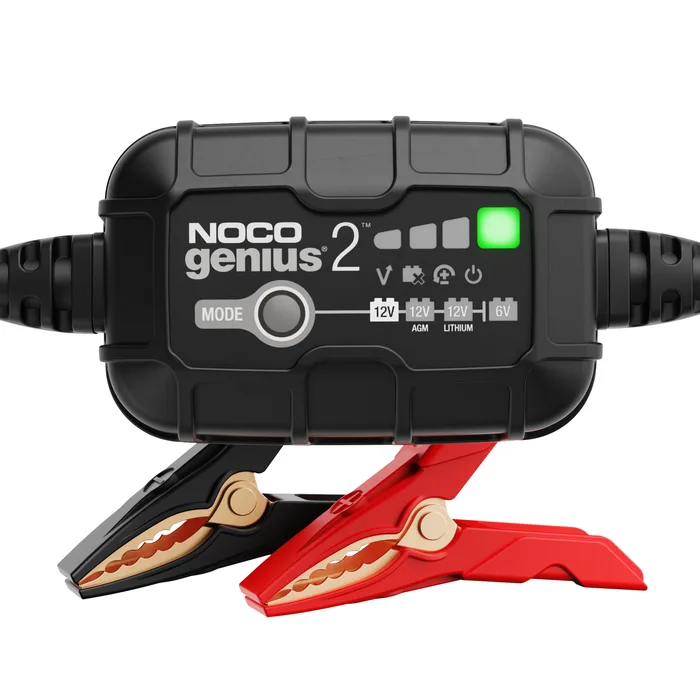
The most flexible small maintainer here, because it covers 6V and 12V, lead-acid and lithium, and NOCO states in writing that it can stay connected indefinitely.
Best for: Someone with a mixed garage who wants one small unit that can sit on a car, a bike, or a 6V classic through the whole off-season.
- Publishes a charge voltage for every mode: 14.5V standard, 14.8V AGM, 14.6V lithium, and 7.25V for 6V batteries
- Rated up to 40Ah for charging and stated to maintain all battery sizes, so it works on a stored car as well as a bike
- IP65 housing and a back current drain under 0.5mA, which matters when it lives on a battery for months
- The user guide states plainly that the charger can be left connected to the battery indefinitely
- Three-year warranty is the shortest in this group
- The GENIUS2 manual lists no separate repair or desulfation mode, even though the product page markets the unit as a desulfator
- Lithium mode is restricted to packs with a built-in battery management system, and NOCO tells you to confirm with the battery maker first
- The 40Ah charging limit means it tops up rather than bulk charges a large car battery
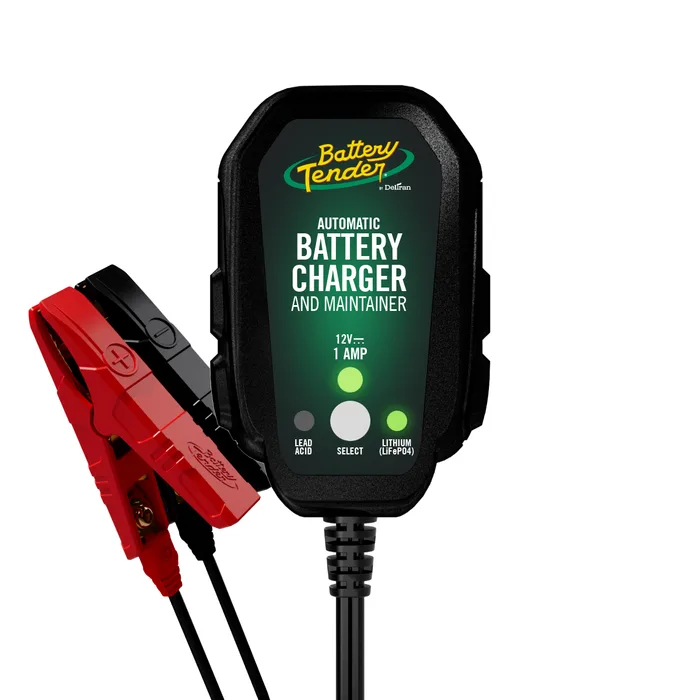
A correct answer if the thing you are storing has a lithium powersports battery, thanks to a physical chemistry selector on the case.
Best for: Anyone tending a motorcycle, ATV, jet ski, or snowmobile battery, and especially anyone who has switched that machine to lithium.
- A manual lead-acid or LiFePO4 selector sets the right absorption and float behavior before any current flows
- ETL and CETL certified, with published spark-proof connection, reverse-polarity, and short-circuit protection
- Five-year limited warranty, longer than the NOCO
- Deltran explains what float actually means on its own site: holding the battery a tenth to half a volt above its resting voltage, well below the gassing voltage of lead acid
- Rated for 3Ah to 30Ah at 12V, so it is not intended for a car battery
- 12V only, with no 6V mode for older machines
- Deltran does not publish an ingress rating for it, so treat it as an indoor or sheltered-garage unit
- No per-stage voltage table is published for this model the way NOCO publishes one
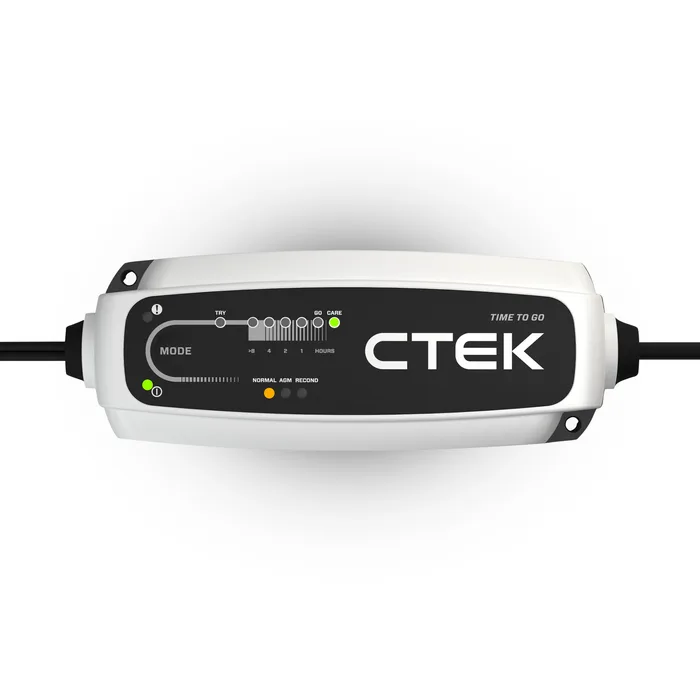
A premium lead-acid storage charger sized for a real car battery, with published charge voltages and a recondition program, and no lithium mode at all.
Best for: Someone laying up a car, classic, or light truck on a flooded or AGM battery who wants the charge voltages and the recondition step stated in numbers.
- Rated 20Ah to 160Ah, the largest published capacity range here
- Publishes its output as 14.4, 14.7, and 15.8V across the Normal, AGM, and Recond programs
- IP65, built-in charge voltage temperature compensation, and a five-year warranty
- CTEK states it can be connected directly to the battery indefinitely if required, and it ships with both alligator clamps and eyelets
- CTEK lists this model's battery chemistry as lead acid, with no lithium program
- At 4.3 amps it is more charger than a pure storage job needs, and it is priced accordingly
- The 20Ah minimum makes it the wrong size for a motorcycle or ATV battery
- The countdown readout is genuinely useful while charging and largely irrelevant once the unit is only maintaining
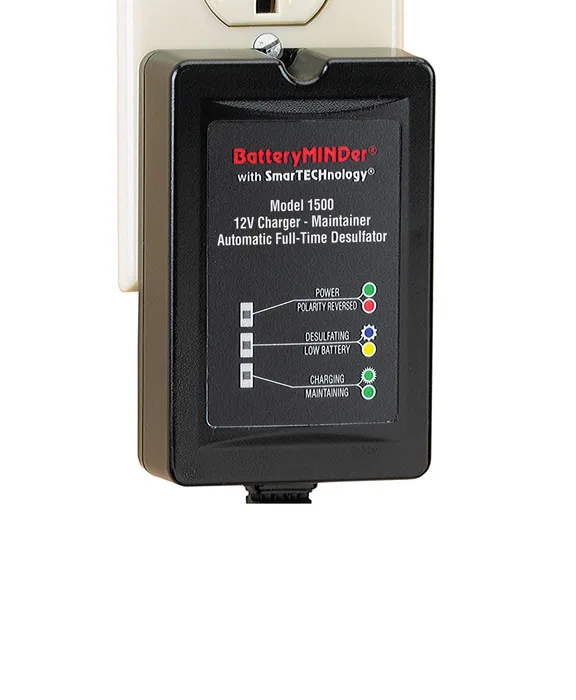
A competent lead-acid maintainer whose headline feature, full-time pulse desulfation, is the part of the pitch with the weakest evidence behind it.
Best for: A flooded lead-acid owner tending several batteries in parallel who owns nothing lithium and specifically wants the desulfation pitch.
- Full-time temperature compensation from an installed ambient sensor for -4F to 122F
- Can maintain up to four 6V or 12V batteries at once in parallel using the maker's Y-connectors
- Reverse-polarity, short-circuit, and over-temperature protection, with a five-year warranty
- Worldwide 90 to 240 VAC input
- No lithium or LiFePO4 mode is listed, which rules it out for the powersports batteries a lot of people are now storing
- The AGM support VDC names is Optima brand sealed AGM, not AGM generally, which is a real limit on modern cars
- Its central selling point is full-time pulse desulfation, and the battery engineering literature treats blanket pulse treatment as unproven and as a possible cause of grid corrosion
- The published claim of extending battery life up to four times is stated against batteries that were never properly maintained, which is a very soft comparison
- No ingress rating or per-stage voltage table is published for it
| Criteria | GENIUS2 Top pick | Battery Tender Junior Multi-Chemistry 12V 1 Amp Battery Charger and Maintainer | CT5 TIME TO GO | BatteryMINDer Model 1500 |
|---|---|---|---|---|
| Verdict | Buy it | Buy it | It depends | Skip it |
| Best for | Someone with a mixed garage who wants one small unit that can sit on a car, a bike, or a 6V classic through the whole off-season. | Anyone tending a motorcycle, ATV, jet ski, or snowmobile battery, and especially anyone who has switched that machine to lithium. | Someone laying up a car, classic, or light truck on a flooded or AGM battery who wants the charge voltages and the recondition step stated in numbers. | A flooded lead-acid owner tending several batteries in parallel who owns nothing lithium and specifically wants the desulfation pitch. |
| Price tier | $$ · mid-range | $ · budget | $$$ · premium | $$ · mid-range |
| Rated output | 2 amps | 1 amp | 4.3 amps | 1.5 amps |
| Battery voltages | 6V and 12V | 12V only | 12V only | 12V only |
| Chemistries listed | Wet, gel, MF, CA, EFB, AGM, lithium | Flooded, AGM, GEL, sealed MF, LiFePO4 | Lead acid: WET, MF, Ca/Ca, AGM, GEL | Flooded, sealed, MF, deep cycle, Optima brand sealed AGM |
| Battery size range | Up to 40Ah charging, maintains all sizes | 3 to 30Ah at 12V | 20 to 160Ah | Not published |
| Published charge voltages | 14.5 / 14.8 AGM / 14.6 lithium / 7.25 at 6V | Not published per stage | 14.4 / 14.7 / 15.8 | Not published |
| Maker on leaving it connected | Can be left connected indefinitely | Four-stage program ends in chemistry-matched float | Can be connected indefinitely if required | Full-time maintain with continuous pulse desulfation |
| Published protection | IP65 housing, reverse-polarity detection, under 0.5mA back drain | Spark-proof, reverse-polarity, short-circuit, ETL and CETL | IP65 housing, temperature compensation | Reverse-polarity, short-circuit, over-temperature |
| Warranty | 3 years | 5 years | 5 years | 5 years |
Which one is right for you?
- Someone with a mixed garage who wants one small unit that can sit on a car, a bike, or a 6V classic through the whole off-season. Buy it NOCO GENIUS2
- Anyone tending a motorcycle, ATV, jet ski, or snowmobile battery, and especially anyone who has switched that machine to lithium. Buy it Battery Tender Junior Multi-Chemistry 12V 1 Amp Battery Charger and Maintainer
- Someone laying up a car, classic, or light truck on a flooded or AGM battery who wants the charge voltages and the recondition step stated in numbers. It depends CTEK CT5 TIME TO GO
- A flooded lead-acid owner tending several batteries in parallel who owns nothing lithium and specifically wants the desulfation pitch. Skip it BatteryMINDer Model 1500
How we judged the field
Maintaining a battery is a narrower job than charging one, so we judged these on a narrow set of things. First, chemistry: does the unit know the difference between flooded, AGM, and LiFePO4, and does it say what voltage it applies to each? Second, size: every maker publishes an Ah range, and a unit rated to 30Ah is not a car charger no matter what the packaging implies. Third, what the maker will actually commit to about leaving it connected, because that single sentence in a manual is the difference between a maintainer and a trickle charger with a nicer case. Fourth, the safety and durability specifications you only care about after three months on a garage floor: ingress rating, back current drain, reverse-polarity protection, and a real safety listing. Fifth, warranty, which is the cheapest signal a maker gives.
The field splits cleanly. On one side are the small multi-chemistry units built for exactly this job, which is where the NOCO GENIUS2 and the Battery Tender Junior Multi-Chemistry sit, the first covering more voltages and battery sizes and the second doing lithium powersports duty for less. On the other side are the specialists: bigger lead-acid units like the CTEK CT5 TIME TO GO that are sized for a car battery but have no lithium program at all, and desulfation-first units like the BatteryMINDer 1500 that sell a recovery claim rather than a maintenance specification. We picked one from each corner so the trade-off is visible instead of buried, and we deliberately avoided the units we already covered in our charger roundup so this is about float, not bulk charging.
NOCO GENIUS2
Buy itThe GENIUS2 is the unit we would put on a stored vehicle first, mostly because NOCO tells you more about what it is doing than anyone else here. The manual lists a charge voltage for every mode: 14.5V for wet, gel, enhanced flooded, maintenance-free and calcium, 14.8V for AGM, 14.6V for lithium iron phosphate, and 7.25V on the 6V setting. It is rated to charge batteries up to 40Ah and to maintain all battery sizes, which is why it works equally well clipped to a stored sedan or a dirt bike. The housing is IP65 and back current drain is under 0.5mA, so it is not quietly discharging the battery when the power goes out. Most importantly, the manual says the charger can be left connected to the battery indefinitely, in those words. The trade-offs are a three-year warranty, the shortest here, and the fact that the GENIUS2 manual lists no dedicated repair mode even though the marketing calls it a desulfator. Buy it if you want one small unit that fits every battery in a mixed garage.
Battery Tender (Deltran) Battery Tender Junior Multi-Chemistry 12V 1 Amp Battery Charger and Maintainer
Buy itThe Junior Multi-Chemistry exists because powersports went lithium and most tenders did not. It has a physical selector on the case with lead acid on one side and LiFePO4 on the other, and Deltran is unusually direct about why that matters: lithium charges at higher absorption voltages and does not tolerate the continuous float that lead acid needs, so applying a lead-acid float to a lithium pack over time can damage it. The four-stage program adapts to whichever chemistry you pick, the unit is ETL and CETL certified, it publishes spark-proof connection, reverse-polarity and short-circuit protection, and the warranty runs five years. The limits are size and scope. Deltran rates it for 3Ah to 30Ah at 12V, which is a powersports range and not a car range, there is no 6V mode, and no ingress rating is published so it belongs indoors or in a dry garage. If the thing you store has a motorcycle-sized battery, this is a fitting choice.
CTEK CT5 TIME TO GO
It dependsThe CT5 TIME TO GO is the one built for an actual car battery, and its spec sheet is refreshingly concrete: output 14.4, 14.7, and 15.8V at 4.3 amps, a 20Ah to 160Ah range, three programs called Normal, AGM, and Recond, IP65 protection, built-in charge voltage temperature compensation, and a five-year warranty. CTEK states it can be connected directly to the battery indefinitely if required and will not over or under charge, which is exactly the sentence you want before leaving something plugged in for a season. It ships with both clamps and eyelets, so hard-wiring it to a stored classic is easy. The reason this is a depends and not a buy is one line on the spec sheet: battery chemistry, lead acid. There is no lithium program on this model, so if any battery in your garage is LiFePO4 you will need a second unit anyway. It is also more charger, and more money, than a pure storage job requires. Right for a lead-acid car in hibernation, wrong for a mixed fleet.
BatteryMINDer (VDC Electronics) BatteryMINDer Model 1500
Skip itThe BatteryMINDer 1500 is not a bad piece of hardware. It has a real ambient temperature sensor rated across a -4F to 122F operating range, reverse-polarity, short-circuit, and over-temperature protection, a worldwide 90 to 240 VAC input, a five-year warranty, and the genuinely useful ability to maintain up to four batteries in parallel with the maker’s Y-connectors. The problem is what you are paying for. The entire pitch is full-time high-frequency pulse desulfation and a claim of extending battery life up to four times, which VDC states against batteries that were never properly maintained, so the comparison is soft by construction. Published testing of pulse desulfation swings wildly between batteries, and battery engineering references warn that indiscriminate pulsing can promote grid corrosion and soft shorts. Meanwhile the specification sheet lists no lithium mode, names its AGM support as Optima brand sealed AGM rather than AGM in general, and publishes no ingress rating or per-stage voltages. Skip it and buy a maintainer that documents its float behavior instead.
Sources
Specs in this review come from these pages.
- Battery Tender (Deltran) product FAQs: trickle chargers, float mode, and leaving a charger connected (batterytender.com)
- NOCO GENIUS2 User Guide and Warranty (charge voltages, IP65, indefinite maintenance) (no.co)
- CTEK CT5 TIME TO GO NA product page and technical data (ctek.com)
- Antigravity Batteries: lithium starter battery FAQ on chargers, desulfation modes, and storage (antigravitybatteries.com)
- BatteryMINDer Model 1500 product specification page (batteryminders.com)
- UL 1236, Standard for Battery Chargers for Charging Engine-Starter Batteries (standardscatalog.ul.com)
NOCO GENIUS2 vs Battery Tender (Deltran) Battery Tender Junior Multi-Chemistry 12V 1 Amp Battery Charger and Maintainer: which should you buy?
The GENIUS2 and the Junior Multi-Chemistry solve the same problem from opposite ends. The NOCO is the generalist: 6V and 12V, every common lead-acid type plus lithium, rated to charge up to 40Ah and stated to maintain any size, IP65, with a published voltage for each mode and a manual that says you can leave it on indefinitely. The Battery Tender is the specialist: 12V only, 3Ah to 30Ah, but with a physical chemistry switch, ETL and CETL certification, published spark-proof connection, and a five-year warranty for less money. Neither is a compromise version of the other.
Choose by what you park. If the vehicles you store include a car, a truck, or anything with a 6V system, the NOCO is the only one of the two that is rated for the job, and its published mode voltages make it easy to verify you have selected correctly. If everything you store is a motorcycle, ATV, jet ski, or snowmobile, and especially if any of them has been converted to lithium, the Battery Tender does that job for less and backs it longer. If you are torn, note that the NOCO covers the powersports case too, just without the tactile certainty of a switch you can see, and that it is the safer single purchase for a garage whose contents change.
What to look for
- Chemistry first: a maintainer without a lithium or LiFePO4 mode is the wrong tool for a modern powersports battery, and lithium makers such as Antigravity warn specifically that lead-acid tenders and their desulfation modes can spike voltage and overcharge the pack.
- Published voltages beat adjectives: NOCO lists 14.5V, 14.8V AGM, and 14.6V lithium, and CTEK lists 14.4, 14.7, and 15.8V, which lets you check the unit against your battery’s data sheet instead of trusting the word smart.
- Match the Ah range, not the amperage: a unit rated 3Ah to 30Ah is a powersports tender and one rated 20Ah to 160Ah is a car charger, and the amp figure on the box describes bulk charging headroom rather than what flows during float.
- Look for a stated float or maintenance stage: the makers worth buying say plainly that the charger can be left connected indefinitely, while an unregulated trickle charger can let output voltage climb past 16 VDC and cook a battery over months.
- Check the safety listing, not just the logo: these are covered by UL 1236, and an ETL or cETL mark means the product was tested to that same UL standard by a different laboratory, so ETL and CETL certification is not a downgrade.
- Read the small durability numbers: an IP rating tells you whether it survives a damp garage, and a published back current drain in the sub-milliamp range tells you it will not slowly drain the battery during a power cut.
Our final take
Buy the NOCO GENIUS2 if you want one maintainer that fits everything, because it publishes a voltage for every mode, spans 6V and 12V, handles lead-acid and lithium, and states in its own manual that it can be left connected indefinitely. Buy the Battery Tender Junior Multi-Chemistry if your storage problem is entirely powersports, where its chemistry selector, ETL and CETL certification, and five-year warranty cost less. Buy the CTEK CT5 TIME TO GO only if you are laying up a full-size lead-acid or AGM car battery and want the charge voltages and recondition step in writing. Skip the BatteryMINDer 1500, because you would be paying a premium for a desulfation claim the evidence does not support while giving up lithium support entirely.
Questions, answered
Is a battery maintainer the same thing as a trickle charger?
Not in engineering terms, though the marketing blurs it constantly. A true maintainer watches battery voltage and drops to a regulated float once the battery is full, holding it just above its resting voltage. An old unregulated trickle charger keeps pushing current regardless, and Deltran's own support pages note that a trickle charger's output voltage can climb higher than 16 VDC depending on the charger and the battery, which is far above the gassing voltage of lead acid and will damage a battery left on it. The terms are not used consistently by makers: NOCO's own product titles describe its microprocessor-controlled GENIUS units as trickle chargers, and Deltran notes that legacy marketing called the Junior a trickle charger with a brain. Judge the unit by whether the maker publishes a regulated float stage, not by the word on the box.
Can I really leave one of these connected to my car all winter?
For lead-acid, yes, and the makers say so. NOCO's GENIUS2 user guide states the charger can be left connected to the battery indefinitely. CTEK says the CT5 TIME TO GO can be connected directly to the battery indefinitely if required and will not over or under charge. Deltran puts it more carefully: in theory you can leave a Battery Tender connected forever, but it recommends checking on the battery at least once every couple of weeks, because a battery can develop a weak cell at any time. Lithium is the exception. Antigravity, for example, tells owners not to leave a battery connected if the machine will sit for a long time, and to disconnect it and check the state of charge every four to five months instead.
Will a lead-acid maintainer damage a lithium powersports battery?
It can, and lithium battery makers say so plainly. Antigravity's own guidance is not to use a battery tender or standalone lead-acid charger on a lithium battery, because lead-acid chargers tend to overcharge lithium and often include modes such as desulfation that spike the voltage. It gives 14.7V as the maximum the battery should see and warns against constant charging above 14.8V. Charge profiles genuinely differ: NOCO publishes 14.5V for standard lead-acid, 14.8V for AGM and 14.6V for lithium on the GENIUS2, and Deltran notes that lithium does not tolerate the continuous float that lead acid needs. If your bike came with a lithium battery, buy a unit with a lithium mode or a chemistry selector, and set it before you clip it on.
Do desulfation and reconditioning modes actually do anything?
Be skeptical, and buy the maintainer for its float behavior rather than for this. The mechanism is real in principle, and sulfation caught early can sometimes be reduced by a controlled overcharge. But the results from published testing of pulse desulfation vary enormously between batteries, from large capacity gains on some to almost none on others, and battery engineering references warn that applying random pulses or blindly inducing an overcharge can promote grid corrosion and create soft shorts that raise self-discharge. In short, it sometimes helps a mildly sulfated lead-acid battery, does nothing for a battery with a failed cell, and is not a reason to pay a premium. Keeping the battery properly charged in the first place is the part that demonstrably works.
Is 1 or 2 amps enough, or should I buy something bigger?
For maintenance alone, 1 to 2 amps is plenty, because a healthy full battery on float draws milliamps, not amps. The rated figure on the box is the bulk current the unit can deliver when the battery is low, not what flows while it is holding a full battery. That is why the same Deltran Junior appears as 800mA in some part numbers and as 1 Amp on the current product page: the number describes charging headroom, not maintenance. What the amperage does tell you is how long a recovery takes if the battery is flat, and what battery sizes the maker will rate the unit for. Match the published Ah range to your battery instead of chasing amps.
Deciding between the top two? See our head-to-head: NOCO GENIUS2 vs Battery Tender Junior Multi-Chemistry 12V 1 Amp Battery Charger and Maintainer.
More Automotive reviews
 The Best Borescopes: 4 Compared (and One to Skip)
  The Best Brake Bleeders: 4 Compared (and One to Skip)
  The Best Brake Cleaners: 4 Compared (and One to Skip)
  The Best Bug and Tar Removers: 4 Compared (and One to Skip)
  The Best Car Air Fresheners and Odour Eliminators: 4 Compared (and One to Skip)
  The Best Car Battery Chargers & Maintainers: 4 Compared (and One to Skip)