

Automotive
The Best Borescopes: 4 Compared (and One to Skip)
We compared four handheld inspection cameras on the spec that actually decides what you see: the resolution of the sensor in the probe tip, not the number on the box.
The short version
The Teslong NTS500 wins because Teslong publishes the sensor resolution separately from the screen resolution and the file resolution, and because it is the only unit here whose maker states plainly that the monitor is rated IP45 while only the probe is IP67. The DEPSTECH DS300 is the value pick: a 5.5 mm semi-rigid probe on a 4.3-inch screen for budget money, with the caveat that DEPSTECH does not publish a native sensor figure for it. The RIDGID micro CA-350 is a depends: its 640x480 output is dated and the standard imager is 17 mm thick, but nothing else here connects to SeeSnake reels or carries a lifetime warranty. Skip the General Tools DCS1600, which pairs a QVGA probe with a QVGA display at a premium price. Read the sensor line, not the screen line, and treat any number above about 2 MP on a probe this small as an output setting rather than a sensor. Best for: anyone who wants to see inside a cylinder, a wall, or a drain without paying for pixels that do not exist.
Our picks at a glance
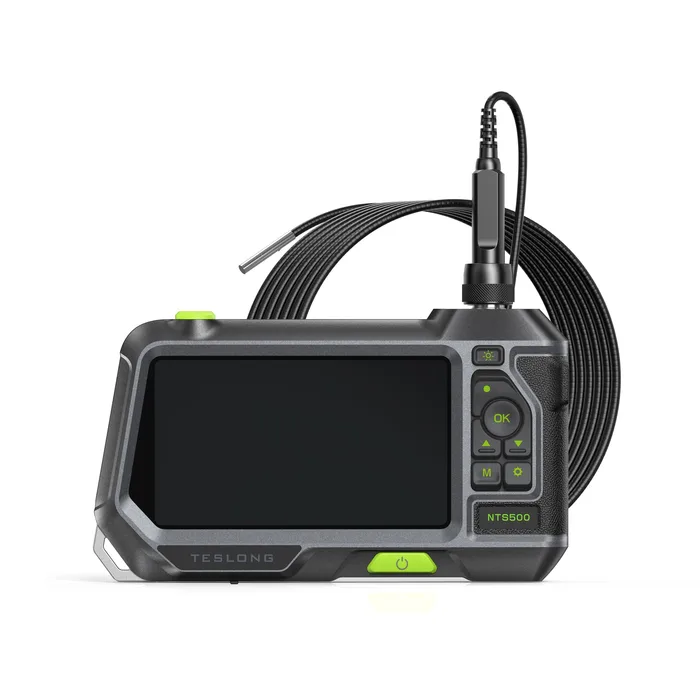
- Teslong NTS500 Inspection Camera with 5-inch Screen - Buy. The best-documented borescope here, and the documentation is what makes it the safest buy.
- DEPSTECH DS300 Industrial Endoscope - Buy. A 5.5 mm semi-rigid probe and a 4.3-inch screen for budget money, which is most of what a homeowner needs.
- RIDGID micro CA-350 Inspection Camera - It depends. Buy it for the ecosystem and the warranty, not for the picture.
- General Tools DCS1600 Recording Video Inspection Camera / Borescope - Skip. A QVGA probe feeding a QVGA display, sold at the top of the price range.
The verdict in 30 seconds
What mattered most
- Published sensor resolution
- Stills / video written
- Screen
- Probe diameter
- Probe reach
- Probe style
A borescope is a camera on the end of a wire, a light next to it, and a screen to look at. Almost every buying mistake in this category comes from reading the wrong resolution number, because manufacturers publish three of them and only one describes the sensor at the tip of the probe. We pulled the published specifications for four inspection cameras that people actually buy for engine cylinders, wall cavities, and drains, and lined up what each maker will and will not tell you. The gap between the best and the worst here is not only image quality. It is how much each maker will state.
The best-documented borescope here, and the documentation is what makes it the safest buy.
Best for: Someone who wants one monitor and several probe sizes, and who wants to know what they actually bought.
- Teslong's own probe table lists camera resolution of 1280x720 separately from the 1920x1080 capture resolution and the 1280x720 screen, so you can see exactly what the sensor does.
- Probes thread on and swap, with 3.9 mm and 5.5 mm heads in 1 m and 3 m lengths sharing the same monitor.
- The 5-inch IPS panel at 1280x720 with tempered glass is the highest-resolution published screen in this comparison.
- The product page bullet advertises a flat IP67 rating while Teslong's comparison table states IP45 monitor and IP67 probe, so the handset is splash-rated only.
- Focus is fixed, with a stated depth of field of 1.18 to 3.15 inches, which is a narrow working window.
- Stills are written at 1920x1080 from a 1280x720 sensor, so the extra pixels are upscaling rather than detail.
- No articulation and no Wi-Fi on this model.
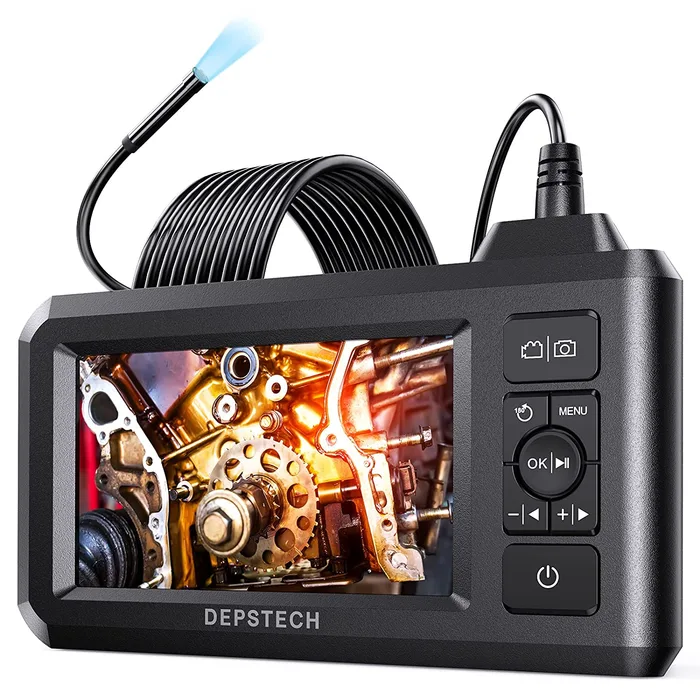
A 5.5 mm semi-rigid probe and a 4.3-inch screen for budget money, which is most of what a homeowner needs.
Best for: A homeowner or weekend mechanic who needs to look in a cylinder or behind drywall a few times a year.
- The 5 m semi-rigid cable bends and holds its shape, which is what lets you steer a probe into a wall cavity without a second pair of hands.
- 5.5 mm probe head fits spark plug holes and small drilled inspection holes.
- One-button 180 degree image rotation, six adjustable LEDs, and a stated four hours of continuous runtime on a USB-rechargeable battery.
- DEPSTECH markets it as 1080P but does not publish a native sensor resolution for this model, so the number describes the output file, not the tip.
- The 170 degree figure on the listing is described as a horizontal viewing angle, which is easy to mistake for the lens field of view.
- The IP67 rating is described for the probe; the handset is not separately rated on the page.
- Stated focal range is 1.96 to 3.93 inches, so anything closer or further goes soft, and the probe is not interchangeable.
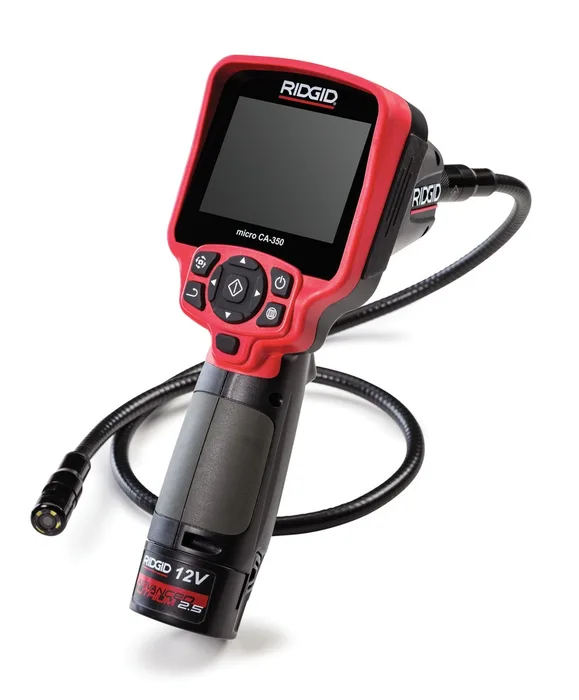
Buy it for the ecosystem and the warranty, not for the picture.
Best for: A drain or service pro who already owns RIDGID 12V batteries and SeeSnake reels and needs the tool to survive a decade.
- RIDGID lists a Full Lifetime Warranty for this tool, which nothing else in this comparison approaches.
- Reach extends to 30 ft with cable extensions and up to 100 ft on microDRAIN, microReel, and nanoReel small-diameter reels.
- Runs on the same 12V rechargeable lithium-ion battery as other RIDGID 12V tools, and imager heads are replaceable, including 6 mm imagers on 1 m and 4 m cables.
- Stills and video are both 640x480 on RIDGID's own spec sheet, which is the lowest published output of any unit here.
- The standard imager is 17 mm across, too fat for a spark plug hole, so engine work means buying the optional 6 mm imager.
- The published specification table lists no IP rating at all, for either the imager or the handset.
- The 3.5-inch TFT is small next to the 5-inch panels at a fraction of the price.
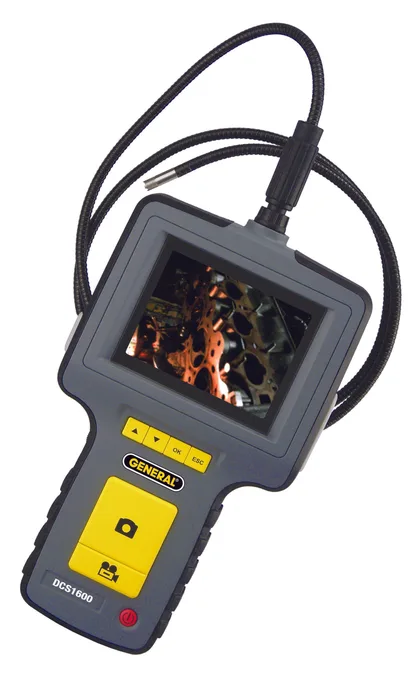
A QVGA probe feeding a QVGA display, sold at the top of the price range.
Best for: Almost nobody at this price; only a shop already standardized on General probes and mirrored tips.
- The console accepts any General QVGA or VGA probe, including 6 mm articulating probes, so the system is genuinely modular.
- Three interchangeable mirrored tips give 70, 90, and 110 degree off-axis views without buying another probe.
- The probe carries an IP67 water, oil, and dust rating and at least four adjustable-brightness LEDs.
- The bundled 1 m x 5.5 mm probe is stated as QVGA resolution, meaning 320 by 240 pixels at the tip.
- The H16 console's own display resolution is 320 by 240, so even a VGA probe is downsampled before you see it.
- General's two pages for the same system disagree on recording resolution: the kit page says 320x240 video and 640x480 stills, the console page says it records VGA video and stills.
- Warranty is stated as one year limited, against a lifetime warranty on the RIDGID.
| Criteria | NTS500 Inspection Camera with 5-inch Screen Top pick | DS300 Industrial Endoscope | micro CA-350 Inspection Camera | DCS1600 Recording Video Inspection Camera / Borescope |
|---|---|---|---|---|
| Verdict | Buy it | Buy it | It depends | Skip it |
| Best for | Someone who wants one monitor and several probe sizes, and who wants to know what they actually bought. | A homeowner or weekend mechanic who needs to look in a cylinder or behind drywall a few times a year. | A drain or service pro who already owns RIDGID 12V batteries and SeeSnake reels and needs the tool to survive a decade. | Almost nobody at this price; only a shop already standardized on General probes and mirrored tips. |
| Price tier | $$ · mid-range | $ · budget | $$$ · premium | $$$ · premium |
| Published sensor resolution | 1280x720 per probe, stated | Not published; listed as 1080P | Not published; output stated 640x480 | QVGA, 320x240, stated |
| Stills / video written | 1920x1080 / 1280x720 | Not itemized | 640x480 / 640x480 | 640x480 / 320x240 per kit page |
| Screen | 5-inch IPS, 1280x720 | 4.3-inch color LCD | 3.5-inch color TFT | 3.5-inch TFT, 320x240 |
| Probe diameter | 3.9 mm or 5.5 mm | 5.5 mm | 17 mm standard, 6 mm optional | 5.5 mm bundled |
| Probe reach | 1 m or 3 m | 5 m | 0.9 m, to 30 ft with extensions | 1 m |
| Probe style | Flexible, thread-on swappable | Semi-rigid, fixed to handset | Flexible, swappable imagers | Semi-rigid, swappable, articulating optional |
| IP rating as published | IP45 monitor, IP67 probe | IP67 probe | None listed on spec sheet | IP67 probe; none listed for console |
| Warranty stated | 12 months | Not stated on the product page | Full Lifetime Warranty | 1 year limited |
Which one is right for you?
- Someone who wants one monitor and several probe sizes, and who wants to know what they actually bought. Buy it Teslong NTS500 Inspection Camera with 5-inch Screen
- A homeowner or weekend mechanic who needs to look in a cylinder or behind drywall a few times a year. Buy it DEPSTECH DS300 Industrial Endoscope
- A drain or service pro who already owns RIDGID 12V batteries and SeeSnake reels and needs the tool to survive a decade. It depends RIDGID micro CA-350 Inspection Camera
- Almost nobody at this price; only a shop already standardized on General probes and mirrored tips. Skip it General Tools DCS1600 Recording Video Inspection Camera / Borescope
How we judged the field
Five things decide whether a borescope is useful. First, the resolution of the sensor at the tip of the probe, which is the only resolution that creates detail; the screen resolution and the saved file resolution are downstream of it and can be larger without meaning anything. Second, probe diameter, because a probe that does not fit through the hole is worth nothing regardless of its picture. Third, probe behaviour: flexible cable goes around corners but flops, semi-rigid cable holds a bend you set by hand, and an articulating tip lets you aim after insertion. Fourth, light, since everything you inspect is dark and LED count and brightness control matter more than most buyers expect. Fifth, what the IP rating actually covers, because these ratings are assigned per enclosure under IEC 60529 and the probe is almost always rated higher than the handset holding it.
The field splits cleanly by how much the maker is willing to tell you. Teslong publishes a per-probe camera resolution alongside the capture resolution, the screen resolution, and a split IP rating, which lets you check its claims against each other. General Tools labels its probes QVGA or VGA outright, which is unflattering but direct. RIDGID publishes only output resolution and no IP rating. DEPSTECH publishes a native sensor figure on some models and not others. We picked one unit from each posture: the best-documented mid-range tablet, the budget semi-rigid that most people actually buy, the trade tool whose value is the ecosystem rather than the image, and the premium system whose own spec sheet reveals a QVGA probe.
Teslong NTS500 Inspection Camera with 5-inch Screen
Buy itThe Teslong NTS500 is the pick because it is checkable. Teslong’s professional camera probe table lists camera resolution as 1280x720 for the 3.9 mm and 5.5 mm probes, and the monitor spec separately lists a 1920x1080 image capture resolution and a 1280x720 video recording resolution. Put those side by side and you learn something no listing will tell you outright: the 1080p stills are upscaled from a 720p sensor. The same page is the only one here that splits the IP rating into IP45 monitor and IP67 probe, though the marketing bullet above still says a flat IP67, so read the table rather than the badge. You get a 5-inch IPS screen at 1280x720 behind tempered glass, thread-on probes you can swap between diameters and lengths, six adjustable LEDs, a 3500 mAh battery rated for 4 to 5 hours, and a 32 GB card in the box. Focus is fixed with a depth of field of 1.18 to 3.15 inches, so it rewards getting the tip in close. For someone who wants one monitor and a small collection of probes, this is the sane buy.
DEPSTECH DS300 Industrial Endoscope
Buy itThe DEPSTECH DS300 is the value pick because it gets the physical decisions right at a budget price. The probe is 5.5 mm, which clears a spark plug hole, and the 5 m cable is semi-rigid: you bend it into a shape and it stays there, which is the single most useful property for feeding a camera into a wall cavity or over a fuel tank baffle. You get a 4.3-inch colour screen, six LEDs with three brightness levels, one-button 180 degree image rotation so text is not upside down, and a stated four hours of runtime on USB charging. The caveats are about disclosure rather than hardware. DEPSTECH markets the DS300 as 1080P but does not publish a native sensor resolution for it, so that number describes the file. The 170 degree figure on the listing is described as a horizontal viewing angle, not a lens field of view. The IP67 rating is stated for the probe. Stated focal range is 1.96 to 3.93 inches, and the probe does not detach. For occasional use, none of that is disqualifying.
RIDGID micro CA-350 Inspection Camera
It dependsThe RIDGID micro CA-350 is the depends, and it depends almost entirely on whether you are already inside RIDGID’s world. On image quality it loses outright: RIDGID’s specification table lists JPG stills at 640x480 and MP4 video at 640x480, on a 3.5-inch colour TFT, for premium money. The standard imager is 17 mm across, which will not enter a spark plug hole, so engine work means adding one of RIDGID’s 6 mm imagers on a 1 m or 4 m cable. The specification table lists no IP rating for either the imager or the handset. What you get instead is infrastructure. The 3 ft cable extends to 30 ft with universal extensions and reaches up to 100 ft on microDRAIN, microReel, and nanoReel small-diameter reels, the tool shares a 12V lithium-ion battery with other RIDGID 12V tools, imager heads are user-replaceable, and RIDGID lists a Full Lifetime Warranty. If you inspect drains for a living, that package is the product. If you want to see inside a cylinder, buy something else.
General Tools DCS1600 Recording Video Inspection Camera / Borescope
Skip itThe General Tools DCS1600 is the skip, and its own specification sheet is the reason. The bundled probe is described as a 1 m by 5.5 mm QVGA resolution probe, meaning 320 by 240 pixels at the tip. The H16 console it plugs into has a display resolution of 320 by 240. So the picture is QVGA from end to end, in a system priced at the very top of this comparison. General’s two pages for the same product also disagree with each other on what gets recorded: the kit page states 320x240 video and 640x480 stills, while the console page says it records VGA video and stills to SD. There is real engineering here. The probe carries an IP67 water, oil, and dust rating, the three mirrored tips give 70, 90, and 110 degree off-axis views, and the console will accept any General QVGA or VGA probe including 6 mm articulating ones. But warranty is one year limited, and you can buy a 1280x720 sensor on a 1280x720 screen for a small fraction of the money. Skip it.
Sources
Specs in this review come from these pages.
- Teslong - NTS500 Inspection Camera with 5-inch Screen, technical specs and camera probe comparison table (teslong.com)
- DEPSTECH - DS300 5.5mm Industrial Endoscope product page (depstech.com)
- RIDGID - micro CA-350 Inspection Camera specifications (ridgid.com)
- General Tools - DCS1600 Recording Video Inspection Camera / Borescope specifications (generaltools.com)
- General Tools - H16 DCS1600 Recording Console specifications (generaltools.com)
- IEC 60529 - Degrees of protection provided by enclosures (IP Code) (webstore.iec.ch)
Teslong NTS500 Inspection Camera with 5-inch Screen vs DEPSTECH DS300 Industrial Endoscope: which should you buy?
The Teslong NTS500 and the DEPSTECH DS300 are aimed at the same job from opposite ends of the budget, and the split is frequency of use. The Teslong gives you a 5-inch 1280x720 IPS panel against the DEPSTECH’s 4.3-inch screen, a published 1280x720 sensor figure against a 1080P marketing claim with no sensor number behind it, and thread-on probes you can swap between 3.9 mm and 5.5 mm and between 1 m and 3 m. That last point is the real separator: the NTS500 is a monitor you keep and build a probe collection around, while the DS300 is a sealed unit where the cable you bought is the cable you have forever.
Choose the DEPSTECH if you will use this a handful of times a year and your inspections are within about 5 m of where you are standing. Its semi-rigid cable is genuinely better than the Teslong’s flexible probe for pushing into wall cavities, and at budget money you are not agonizing over whether it earns its shelf space. Choose the Teslong if you inspect regularly, if you need more than one probe diameter, or if you simply want to be able to verify a claim before you buy. Neither is waterproof as a whole unit, whatever the badge on the box says; on the Teslong the monitor is IP45 and only the probe is IP67, and DEPSTECH describes IP67 for the probe as well.
What to look for
- Find the sensor line, not the screen line: a listing can quote a screen resolution, a saved-file resolution, and a sensor resolution, and only the last one creates detail, so a spec sheet that gives you all three is the easiest to check.
- Treat big megapixel claims on tiny probes with suspicion: among the makers here who publish a native figure, the numbers run from 320 by 240 up to about 2 MP, and anything above that on the listing is typically an output setting, an upscale, or a mode that only works over a PC connection.
- Read what the IP rating covers: IP codes are defined per enclosure under IEC 60529, and Teslong’s own table separates IP45 for the monitor from IP67 for the probe, so a splash on the handset is a very different event from dunking the tip.
- Match the probe diameter to the hole before anything else: 3.9 to 5.5 mm heads clear spark plug holes and small drilled inspection holes, while 17 mm imagers are for drains and wall cavities and will not fit an engine.
- Pick the cable behaviour that matches your job: semi-rigid cable holds a shape you bend by hand and is the easiest way to steer into a cavity, flexible cable follows corners in a pipe, and an articulating tip is the only option if you need to aim after the probe is already inside.
- Check whether the probe detaches: a threaded, swappable probe means one monitor can serve several diameters and lengths and a damaged cable is a part rather than a write-off, which is the main structural advantage of the mid-range tablet units.
Our final take
Buy the Teslong NTS500 if you use a borescope often enough to care, because it is the only unit here where every number is stated plainly enough to check, and the swappable thread-on probes mean the monitor outlives any single cable. Buy the DEPSTECH DS300 if this is an occasional tool; its 5.5 mm semi-rigid probe does the two jobs most people need, and at budget money the missing sensor spec is a fair trade. The RIDGID micro CA-350 makes sense only as part of the RIDGID drain ecosystem, where the lifetime warranty and reel compatibility outweigh a 640x480 picture. Skip the General Tools DCS1600, whose own spec sheet describes a QVGA probe on a QVGA display at a premium price.
Questions, answered
Does a higher megapixel number mean a sharper borescope image?
Usually not, because the number on the listing rarely describes the sensor. Teslong is unusually specific here: its probe comparison table lists camera resolution as 1280x720 for the NTS500 probes, while the same monitors write stills at 1920x1080. That means the extra pixels in the file are interpolated from a 720p sensor. General Tools is equally blunt in the other direction, labelling its bundled probe QVGA and its console display QVGA. When you see a big megapixel claim next to a probe only a few millimetres across, assume it describes the output file or the display until the maker tells you otherwise.
If a borescope says IP67, can I drop the whole thing in water?
No, and this is the most commonly misread spec in the category. IP ratings are defined by IEC 60529 and are assigned to a specific enclosure, not to a product as a whole. Teslong's comparison table spells it out: IP45 monitor, IP67 probe. That means the handset is protected against water jets but not immersion, while the probe is rated for immersion to one metre. DEPSTECH and General Tools both describe IP67 in relation to the probe or cable rather than the console. RIDGID's published CA-350 specification table lists no IP rating at all.
Is a dual-lens borescope worth paying more for?
Sometimes, but not for the reason the listings imply. On the Teslong dual-lens probes in its comparison table, the side lens is the same 1280x720 as the front lens, so you are not being sold a downgraded second camera. What actually differs is focal distance: the side lenses focus at roughly 0.79 to 1.97 inches versus roughly 1.18 to 3.15 inches for the front. That makes the side lens a close-focus tool for looking at a cylinder wall you are sliding past, which the front lens cannot do well. If your inspections are end-on, down a pipe or into a cavity, a second lens adds cost and probe diameter for little gain.
Do I need an articulating probe?
Only if you need to aim the tip after it is already inside something. Articulation lets you look at a cylinder wall or a valve face from inside a spark plug hole, which a fixed probe cannot do without a mirror tip. It also costs you elsewhere, and manufacturers are open about the trade. Teslong's own catalogue shows its two-way articulating model capturing at 1280x720 with an 854x480 screen, while its non-articulating NTS500 captures at 1920x1080 with a 1280x720 screen. For wall cavities and drains, a semi-rigid cable that holds a bend usually does more for you than an articulating tip.
What probe diameter do I need for engine work?
For looking into a cylinder through a spark plug hole, you want a probe in the range of about 4 to 8 mm, and smaller is easier to steer around the electrode boss. The Teslong NTS500 offers 3.9 mm and 5.5 mm heads, and the DEPSTECH DS300 and the General Tools bundled probe are both 5.5 mm. The RIDGID micro CA-350's standard imager is 17 mm, which is a drain and wall-cavity tool rather than a cylinder tool, though RIDGID sells 6 mm imagers separately. Thinner probes trade away light output and lens size, so do not go smaller than the hole requires.
Deciding between the top two? See our head-to-head: Teslong NTS500 Inspection Camera with 5-inch Screen vs DEPSTECH DS300 Industrial Endoscope.
More Automotive reviews
 The Best Brake Bleeders: 4 Compared (and One to Skip)
  The Best Brake Cleaners: 4 Compared (and One to Skip)
  The Best Bug and Tar Removers: 4 Compared (and One to Skip)
  The Best Car Air Fresheners and Odour Eliminators: 4 Compared (and One to Skip)
  The Best Car Battery Chargers & Maintainers: 4 Compared (and One to Skip)
  The Best Car Covers: 4 Compared (and One to Skip)