Explained
Car Battery Testers, Explained
After reading, you'll understand what a battery tester is actually measuring, why two testers can disagree about the same battery, and which specs decide whether one will work on yours.
In this guide
The single biggest trap in this category is the phrase load tester, which gets applied to two instruments that work on opposite principles. One drags hundreds of amps out of the battery and shows you how far the voltage falls. The other barely touches it and calculates an answer. Both can be right, both can be fooled, and they are fooled by different things. Once you know which one you are looking at, the rest of the spec sheet starts making sense.
The 30-second version
- Two principles, one name, so check whether the listing says carbon pile or conductance before you compare anything else.
- Conductance is the shop default now, because it is fast, safe, and works on a battery that is too flat for a load test.
- A load test needs a charged battery, and the classic procedure pulls about half the rated CCA for 15 seconds and looks for 9.60V or better.
- Chemistry profiles are not marketing, because AGM and EFB need different algorithms and lithium needs a tester that says lithium.
- The battery test is only a third of the job, so pay for the cranking and charging tests that tell you whether the starter or alternator is the real fault.
The products this guide is about
Our verdict on each, with the full reasoning on the companion review.
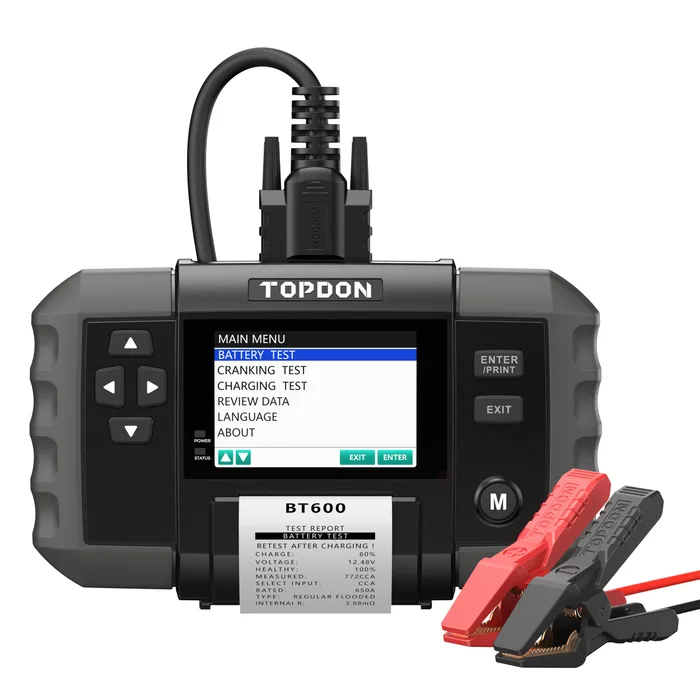
- Buy TOPDON BT600 Battery Tester A conductance tester that covers five lead-acid battery profiles, both 12V and 24V systems, and prints the result on the spot. Amazon
- Buy ANCEL BA301 Battery Tester A budget conductance tester that covers 6V as well as 12V lead-acid. Amazon
- It depends Clore Automotive SOLAR 1876 Carbon Pile Battery Load Tester A proper variable carbon pile to 1000 amps, the tester here that comes closest to making the battery do the work it is rated for. Amazon
- Skip Schumacher Electric BT-100 Battery Load Tester A fixed 100 amp load and an analogue needle, sold for batteries rated up to 1000 CCA, which is the arithmetic problem in a nutshell. Amazon
What actually matters
- Measurement principle - This decides whether the tester measures delivered current or infers it from internal resistance. A carbon pile proves capability under load; a conductance tester estimates it in seconds without stressing the battery.
- Chemistry profile support - Flooded, AGM flat plate, AGM spiral, EFB and Gel batteries have different internal resistance signatures. Midtronics states that a tester needs profiles matched to those chemistries for the result to be accurate.
- Lithium and LiFePO4 handling - Lithium starting batteries have a flat voltage curve and a protection board, so lead-acid logic does not transfer. None of the four here list lithium support.
- CCA range - This is the ceiling on what the tester can assess. A fixed-load tester also needs enough amps to reach half the CCA of your battery, or the load is too gentle to reveal a weak cell.
- Rating standard support - The same battery carries different numbers under SAE, EN, DIN, IEC and JIS. If the tester cannot accept the standard printed on your label, you will be typing in the wrong figure.
- Charging and ripple test - A ripple reading looks at AC content on the alternator output, which is how you catch failed rectifier diodes. It is the cheapest way to stop replacing batteries that keep dying for another reason.
- State of charge before testing - A load test needs a battery that is already close to full, while conductance testers work far lower down. Midtronics says its conductance profiling stays accurate often down to 9V, which decides whether you have to charge the battery before you can diagnose it.
The specs, in plain English
Green flags vs red flags
Green flags
- The listing names the measurement principle outright, such as carbon pile, conductance or conductivity testing.
- Selectable battery profiles are listed by name: flooded, AGM flat plate, AGM spiral, EFB, Gel.
- A range of rating standards is supported, so you can enter the number actually printed on your battery.
- Cranking and charging tests are listed as separate functions, ideally with a ripple measurement.
- The CCA range comfortably exceeds the largest battery you own, and a fixed-load unit can reach half that battery's CCA.
Red flags
- The listing says load tester but never says whether the load is a real resistive one or a micro load.
- No battery chemistry is named anywhere, or the page just claims it works on all batteries.
- Lithium or LiFePO4 is implied by the photos or the title but never stated in the specification.
- A fixed-load tester is rated for a CCA far higher than its load current could ever meaningfully stress.
- The only output is a coloured band on a needle, with the manual telling you to check specific gravity to interpret it.
Who's who: the brands
- Midtronics - Battery testing company with a technical library on conductance and load testing.
- TOPDON - Prosumer diagnostic brand whose BT600 pairs conductance testing with a colour screen, a printer and 12V and 24V testing.
- ANCEL - Diagnostic maker whose BA301 conductance tester covers 6V and 12V lead-acid and lists its supported battery types.
- Clore Automotive (SOLAR) - Maker of the SOLAR line, which includes the 1876 variable carbon pile load tester.
- Schumacher Electric - Consumer battery charger and tester brand with an analogue load tester, the BT-100.
How to read a listing without getting fooled
Start at the bottom of the listing, not the top. Find the specification table and look for four rows: testing principle or technology, applicable battery types, testing voltage, and testing range in CCA and Ah. If the applicable battery types row names flooded, AGM, EFB and Gel individually, the tester has profiles for them. If it says lead-acid and nothing else, assume one generic algorithm. Check the testing voltage row against your vehicles, because 6V, 12V and 24V are three separate capabilities and a tester that does 12V and 24V may not do 6V. Then look at the function list for cranking test, charging test and ripple test as named line items rather than a general claim to diagnose your charging system. For a fixed-load tester, do the arithmetic yourself: divide your battery's CCA in half and compare that to the tester's load current. If the tester cannot get close, it will not stress the battery enough to find a weak one.
How much should you spend?
Budget conductance testers can cover the common lead-acid types and run cranking and charging tests. That is enough for most car owners and is a step up from a multimeter. Mid-range adds 24V support, more rating standards, a colour screen, a ripple test and often a built-in printer, which is what makes it worth the jump for anyone testing trucks or explaining results to someone else. Premium in this category means one of two things: a proper variable carbon pile load tester built for shop and warranty work, or a dealer-grade analyser that adds conductance profiling and charge acceptance testing on top of basic conductance. Neither premium option is a better version of the budget tool; they answer different questions, so pay up only when you actually need those questions answered.
Questions, answered
Why does my tester ask me to type in the CCA?
A conductance tester measures your battery's actual conductance and converts it to an equivalent cold cranking amp figure. To tell you whether that number is good, it has to know what the battery was rated for when new. Typing the wrong figure, or using an EN rating where the tester expects SAE, will skew the verdict. The rating is printed on the battery label, and most testers let you pick which standard you are entering.
Why does the result change right after I charge the battery?
Freshly charged plates hold a surface charge that raises measured voltage and can flatter a weak battery. ODYSSEY advises letting a flooded battery rest about 30 minutes after charging and an AGM battery 10 to 12 hours before testing. If you cannot wait, briefly pulling a load off the battery, such as running the headlights for a short spell, knocks the surface charge down. Conductance testers are less sensitive to this than voltage-based checks, but not immune.
Is a battery tester any better than a multimeter?
Yes, because they measure different things. A multimeter tells you the battery's voltage, which is roughly its state of charge, and a fully charged but worn-out battery reads perfectly fine at rest. A tester goes a level deeper, either by loading the battery or by measuring internal resistance, so it can tell a healthy battery from a full one. A multimeter is still useful alongside a tester for tracking down parasitic drain and checking connections.
Can these testers tell me if my alternator is bad?
They can give you strong evidence. The charging test runs with the engine going and compares the system voltage against what a healthy alternator should be producing under load and unloaded. A ripple test, which the TOPDON BT600 lists, looks for AC content on the output that points at failed rectifier diodes. Analogue testers do a coarser version of the same thing with a charging system band on the meter face. If the charging test fails, the alternator, the belt or the wiring to it is the next place to look.
Or jump to the head-to-head: TOPDON BT600 Battery Tester vs ANCEL BA301 Battery Tester.