

Automotive
The Best Car Battery and Load Testers: 4 Compared (and One to Skip)
We compared four battery testers on the thing that actually decides the result: whether they apply a real load or infer capacity electronically, and which battery chemistries they are set up to handle.
The short version
The TOPDON BT600 is the best all-round pick: conductance testing across 100 to 2000 CCA, selectable flooded, AGM, Gel, EFB and VRLA profiles, cranking and charging tests on both 12V and 24V, a ripple test, a colour screen and a built-in printer. The ANCEL BA301 is the value pick, covering 6V and 12V lead-acid with the same conductance approach and a cranking voltage waveform, for a lot less money and a lot less capability. The SOLAR 1876 is the one that genuinely earns the phrase load tester: a variable carbon pile to 1000 amps that physically stresses a battery up to 2000 CCA, which is right for heavy duty and warranty work and wrong for a driveway. Skip the Schumacher BT-100: its load is fixed at 100 amps on 12V, which is nowhere near half the CCA of a modern battery, and its manual tells you to read the specific gravity to work out what the needle meant. Every tester here is a lead-acid instrument, and none of them lists lithium or LiFePO4 support. Best for: anyone who wants a definite answer about a battery before spending money on a replacement.
Our picks at a glance
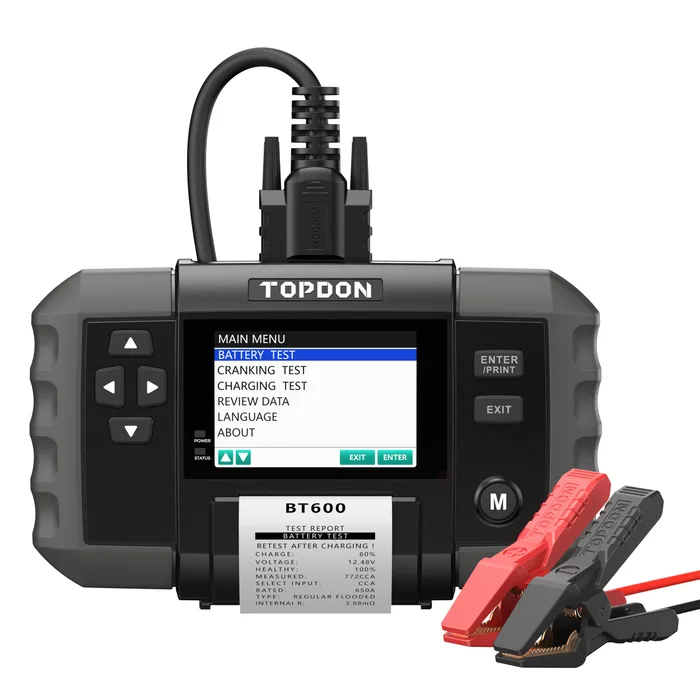
- TOPDON BT600 Battery Tester - Buy. A conductance tester that covers five lead-acid battery profiles, both 12V and 24V systems, and prints the result on the spot.
- ANCEL BA301 Battery Tester - Buy. A budget conductance tester that covers 6V as well as 12V lead-acid.
- Clore Automotive SOLAR 1876 Carbon Pile Battery Load Tester - It depends. A proper variable carbon pile to 1000 amps, the tester here that comes closest to making the battery do the work it is rated for.
- Schumacher Electric BT-100 Battery Load Tester - Skip. A fixed 100 amp load and an analogue needle, sold for batteries rated up to 1000 CCA, which is the arithmetic problem in a nutshell.
The verdict in 30 seconds
What mattered most
- Measurement principle
- Load applied
- Battery types stated
- Lithium / LiFePO4
- System voltages
- CCA range
Two completely different instruments are sold as "battery load testers", and most listings do not make it obvious which one you are buying. One applies a genuine high-current resistive load and watches the voltage sag. The other injects a small AC signal, measures how well the battery conducts, and calculates a cold cranking amp figure from that. Clore Automotive, which sells both kinds, even files them in separate catalogue sections labelled digital testers and invasive testers. We picked four current models that sit at the four corners of that split, and judged them on measurement principle, stated chemistry support, CCA range, and how much of the rest of the starting circuit they can check.
A conductance tester that covers five lead-acid battery profiles, both 12V and 24V systems, and prints the result on the spot.
Best for: Someone who works on a mix of cars and trucks and wants one tester that covers the battery, the starter and the alternator with a printed record.
- TOPDON states conductivity-based testing with a 100 to 2000 CCA and 30 to 220 Ah range, so it covers everything from a small car to a light truck.
- The spec sheet lists selectable flooded, AGM, Gel, EFB and VRLA profiles plus CCA, CA, BCI, MCA, DIN, IEC, EN, SAE, JIS and GB rating standards.
- Cranking and charging tests run on both 12V and 24V, and a ripple test is listed, so you can check the alternator as well as the battery.
- No lithium or LiFePO4 support appears anywhere on the product page, so a drop-in LiFePO4 starting battery is out of scope.
- Testing voltage is listed as 12V and 24V, so a 6V motorcycle or classic battery is not the target here.
- A conductance reading infers capacity rather than measuring delivered current, so it can be thrown by surface charge on a freshly charged battery.
- The thermal printer needs paper, which is one more consumable to keep in the toolbox.
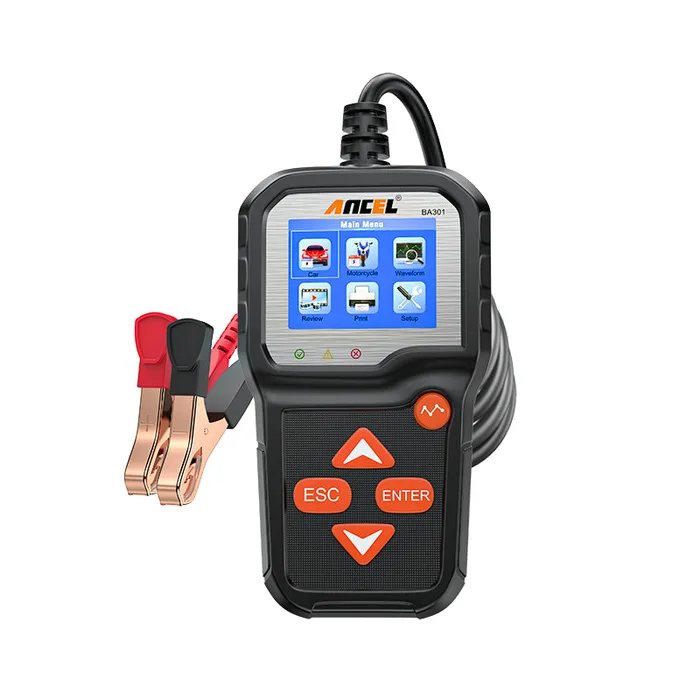
A budget conductance tester that covers 6V as well as 12V lead-acid.
Best for: A home mechanic who wants a real diagnosis instead of a guess, and who also has motorcycles, mowers or a 6V battery in the mix.
- ANCEL states conductance testing technology for 6V and 12V lead-acid batteries from 100 to 2000 CCA, including flooded, AGM flat plate, AGM spiral, Gel and EFB.
- A one-click waveform function plots the voltage during cranking, which is genuinely useful for spotting a starter that drags rather than a battery that is flat.
- ANCEL says it can test batteries with loss of electricity without a full charge first, and can test them on or off the vehicle.
- No 24V support, so heavy trucks and most marine 24V setups are out.
- No lithium or LiFePO4 listed, and no lithium profile to select.
- The charging system test is described as checking alternator output, but ANCEL does not spell out a ripple measurement the way the BT600 spec sheet does.
- You have to read the Ah or CCA rating off the battery label and type it in, which is awkward when the battery is buried under trim.
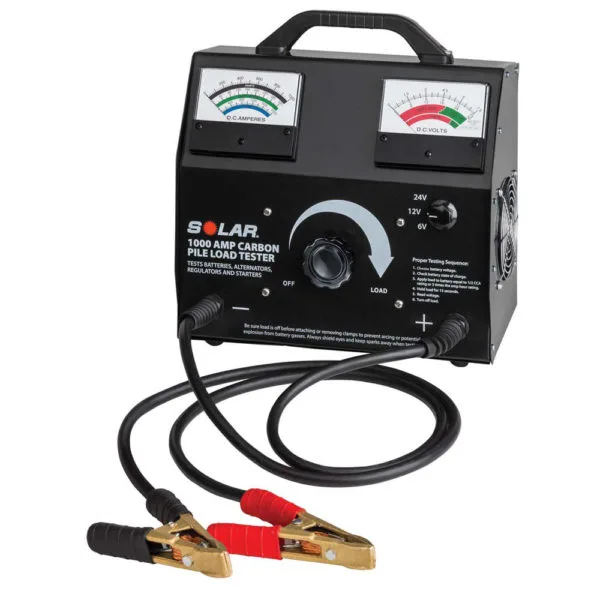
A proper variable carbon pile to 1000 amps, the tester here that comes closest to making the battery do the work it is rated for.
Best for: A shop, fleet bay or serious home garage that needs load test confirmation for warranty claims or heavy duty batteries and has somewhere to keep a heavy tool.
- Variable load capability to 1000 amps means you can dial in half the rated CCA of almost any starting battery, which is the classic load test.
- Handles 6, 12 or 24 volt batteries up to 2000 CCA with a voltage selector, so one unit covers cars, trucks and equipment.
- Dual gauges and 56 inch cable reach let you watch load current and voltage together, and assess the starter and alternator from the same hook-up.
- It weighs about 25.6 pounds and a carbon pile gets hot, so this is a bench and bay tool, not something you keep in the trunk.
- Clore does not list selectable AGM, EFB or lithium profiles, because a carbon pile has no algorithm to select.
- A load test needs a battery that is already close to charged, so a deeply flat battery has to go on a charger first.
- You read the answer off analogue gauges and interpret it yourself, with no pass or fail message and no printout.
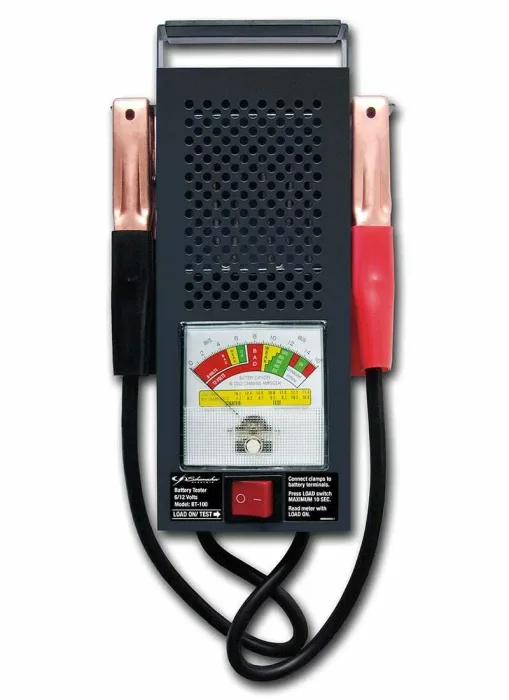
A fixed 100 amp load and an analogue needle, sold for batteries rated up to 1000 CCA, which is the arithmetic problem in a nutshell.
Best for: Almost nobody today, though it is still workable on small 6V and 12V flooded batteries where 100 amps is a meaningful share of the rating.
- It is a real resistive load tester, not a voltmeter pretending to be one, and Schumacher states 50 amps on 6V and 100 amps on 12V.
- The meter face carries a charging system band and a starter test voltage table, so one tool covers three checks.
- Simple, with no firmware, batteries or paper to run out.
- The load is fixed at 100 amps on 12V, but the tester is rated for batteries up to 1000 CCA, so on a typical modern battery you are loading well below the half-CCA figure a load test is supposed to use.
- Schumacher's manual warns that the housing gets hot enough to burn skin, limits the load switch to ten seconds and tells you to let the unit cool for five minutes between tests.
- There are no chemistry profiles and no mention of AGM, EFB or lithium anywhere on the product page.
- The manual's own result table repeatedly sends you off to check the specific gravity to tell a defective battery from a discharged one, which means the tester often does not settle the question.
| Criteria | BT600 Battery Tester Top pick | BA301 Battery Tester | SOLAR 1876 Carbon Pile Battery Load Tester | BT-100 Battery Load Tester |
|---|---|---|---|---|
| Verdict | Buy it | Buy it | It depends | Skip it |
| Best for | Someone who works on a mix of cars and trucks and wants one tester that covers the battery, the starter and the alternator with a printed record. | A home mechanic who wants a real diagnosis instead of a guess, and who also has motorcycles, mowers or a 6V battery in the mix. | A shop, fleet bay or serious home garage that needs load test confirmation for warranty claims or heavy duty batteries and has somewhere to keep a heavy tool. | Almost nobody today, though it is still workable on small 6V and 12V flooded batteries where 100 amps is a meaningful share of the rating. |
| Price tier | $$ · mid-range | $ · budget | $$$ · premium | $ · budget |
| Measurement principle | Conductance (small AC signal) | Conductance (small AC signal) | Carbon pile, variable real load | Fixed resistive load |
| Load applied | Micro load only | Micro load only | Variable to 1000 A | 50 A on 6V, 100 A on 12V |
| Battery types stated | Flooded, AGM, Gel, EFB, VRLA | Flooded, AGM flat, AGM spiral, Gel, EFB | Lead-acid, no profiles to select | 6V and 12V lead-acid, no profiles |
| Lithium / LiFePO4 | Not listed | Not listed | Not listed | Not listed |
| System voltages | 12V and 24V | 6V and 12V | 6V, 12V and 24V | 6V and 12V |
| CCA range | 100 to 2000 CCA, 30 to 220 Ah | 100 to 2000 CCA | Batteries to 2000 CCA | Batteries to 1000 CCA |
| Charging system check | 12V and 24V charging test, ripple test listed | Alternator charging test, ripple not stated | Alternator output on gauge | Charging system band on meter |
| Result readout | 3.5 inch colour screen, built-in thermal printer | Colour LCD plus green, yellow and red LEDs | Dual analogue gauges, you interpret | Single analogue needle, colour bands |
Which one is right for you?
- Someone who works on a mix of cars and trucks and wants one tester that covers the battery, the starter and the alternator with a printed record. Buy it TOPDON BT600 Battery Tester
- A home mechanic who wants a real diagnosis instead of a guess, and who also has motorcycles, mowers or a 6V battery in the mix. Buy it ANCEL BA301 Battery Tester
- A shop, fleet bay or serious home garage that needs load test confirmation for warranty claims or heavy duty batteries and has somewhere to keep a heavy tool. It depends Clore Automotive SOLAR 1876 Carbon Pile Battery Load Tester
- Almost nobody today, though it is still workable on small 6V and 12V flooded batteries where 100 amps is a meaningful share of the rating. Skip it Schumacher Electric BT-100 Battery Load Tester
How we judged the field
Five things decide whether a battery tester is worth owning. First, the measurement principle, because it determines what the number even means: a carbon pile applies a real resistive load and shows you the voltage sag, while a conductance tester injects a small AC signal and calculates a CCA figure from how well the battery conducts. Second, stated chemistry support, because flooded, AGM, EFB and lithium behave differently and Midtronics is explicit that a tester needs profiles matched to the chemistry or the result is unreliable. Third, CCA range and rating standards, since a tester that stops at 1000 CCA cannot properly assess a truck battery and one that only speaks SAE is awkward with a European battery labelled EN or DIN. Fourth, whether it checks the rest of the circuit: cranking voltage and starter draw, alternator output, and ripple. Fifth, how it reports the answer, because a needle in a coloured band is not the same as a printed pass or fail.
The field splits cleanly along the first of those. On one side sit the handheld electronic testers that now dominate service lanes, and on the other the heavy invasive testers that Clore Automotive lists in its own separate catalogue section. We took two conductance units at different price points, the TOPDON BT600 for the widest profile and voltage coverage and the ANCEL BA301 as the budget option, then one real carbon pile in the SOLAR 1876 to represent the load-test approach done properly. The fourth is the Schumacher BT-100, which is the tester most people picture when they hear load tester and the one whose fixed 100 amp load no longer matches the batteries it is sold to test.
TOPDON BT600 Battery Tester
Buy itThe TOPDON BT600 is the most complete tool here for the money. TOPDON states conductivity-based testing over a 100 to 2000 CCA and 30 to 220 Ah range, with selectable flooded, AGM, Gel, EFB and VRLA profiles and a long list of rating standards including CCA, CA, BCI, MCA, DIN, IEC, EN, SAE, JIS and GB, which matters if you ever put hands on a European or Japanese battery. Testing voltage is listed as 12V and 24V, and the spec sheet adds 12V and 24V cranking tests, 12V and 24V charging tests, a resistance test and a ripple test. Results land on a 3.5 inch colour screen and can go straight to a built-in thermal printer. The trade-off is the one that comes with the whole conductance category: it infers capacity rather than making the battery prove it, and it is a lead-acid instrument with no lithium profile. If you want one tester that covers the battery, the starter and the alternator and leaves a paper trail, this is it.
ANCEL BA301 Battery Tester
Buy itThe ANCEL BA301 does the same kind of test for a lot less and gives up the things you can most easily live without. ANCEL states conductance testing technology across 6V and 12V lead-acid batteries from 100 to 2000 CCA, covering regular flooded, AGM flat plate, AGM spiral, Gel and EFB, with CCA, BCI, CA, MCA, JIS, DIN and SAE standards supported. Its 6V coverage suits motorcycles, mowers, golf carts or something old, while TOPDON’s testing voltage is listed as 12V and 24V. A one-click waveform function graphs voltage through the cranking event, which is a genuinely useful way to see a starter dragging rather than a battery failing, and ANCEL says it will test a discharged battery without charging it first and works on or off the vehicle. What you lose is 24V, a printer, and any explicit ripple specification. For a driveway diagnosis on cars and small engines, that is a fair trade.
Clore Automotive SOLAR 1876 Carbon Pile Battery Load Tester
It dependsThe SOLAR 1876 from Clore Automotive is the one instrument here that makes a battery earn its rating. It is a variable carbon pile good for up to 1000 amps, which means you can set the load to half the rated CCA the way the classic procedure calls for, and it covers 6, 12 or 24 volt batteries up to 2000 CCA with a voltage selector. Dual gauges let you watch load and voltage at the same time, 56 inch cables reach an awkwardly placed battery, and the same hook-up assesses the starter and alternator. The catch is physical and procedural. It weighs about 25.6 pounds, a carbon pile turns the load into heat, and there are no chemistry profiles because there is no algorithm to profile. It also needs the battery close to charged first, and it gives you gauge readings rather than a verdict. That is exactly right for a bay doing warranty work and exactly wrong for someone checking one car twice a year.
Schumacher Electric BT-100 Battery Load Tester
Skip itThe Schumacher BT-100 is the tester most people think of, and the arithmetic is what sinks it. Schumacher rates it for batteries up to 1000 CCA but the load is fixed: 50 amps on 6V and 100 amps on 12V. A load test is meant to pull roughly half the rated CCA, so on a common 600 to 700 CCA car battery this thing is applying a fraction of the stress the test assumes, and a tired battery can hold the needle up. The manual covers the rest: the housing gets hot enough to burn skin, the load switch is limited to ten seconds, and you have to let it cool five minutes before testing again. Worse, its own result table keeps telling you to check the specific gravity to work out whether a weak reading means a bad battery or just a flat one, which is the question you bought the tester to answer. The charging system band and starter voltage table are useful, but not enough. Buy it only for small flooded 6V and 12V batteries where 100 amps is actually a meaningful load.
Sources
Specs in this review come from these pages.
- Midtronics - Which Battery Test Technology is Right for You? (midtronics.com)
- ODYSSEY Battery (EnerSys) - Proper Battery Testing and Maintenance (odysseybattery.com)
- Battery Council International - Battery Technical Manual (batterycouncil.org)
- TOPDON - BT600 Battery Tester product page (topdon.us)
- Clore Automotive - SOLAR 1876 6/12/24-Volt Carbon Pile Battery Load Tester (cloreautomotive.com)
- Schumacher Electric - BT-100 Battery Load Tester (schumacherelectric.com)
TOPDON BT600 Battery Tester vs ANCEL BA301 Battery Tester: which should you buy?
The BT600 and the BA301 use the same measurement principle, so the decision is about coverage rather than accuracy. The BT600 tests 12V and 24V systems, lists five lead-acid profiles including VRLA, speaks ten rating standards, adds a resistance test and a ripple test, and prints. The BA301 covers 6V and 12V only, lists five lead-acid profiles, speaks seven standards, and reports on a colour screen with green, yellow and red status LEDs. If a truck, RV, boat or anything else with a 24V system ever comes near your driveway, the BA301 simply cannot help and the BT600 can.
The other split is what you do with the result. If the tester is for you alone, a screen is fine and the BA301’s cranking voltage waveform is arguably more diagnostic than a printout. If you are showing a customer, a family member or a warranty desk why a battery needs replacing, the BT600’s thermal printer turns an opinion into a document, and the ripple figure gives you something concrete to say about the alternator. Buy the BA301 if your fleet is cars and small engines and you are the only person who needs convincing. Buy the BT600 if anything runs 24V or anyone else needs to see the evidence.
What to look for
- State the principle: If a listing never says whether it is a carbon pile, a conductance tester or an electronic tester, you do not know what you are buying, and that alone is a reason to move on.
- Chemistry profiles, named: Midtronics is explicit that a tester needs profiles matched to the chemistry, so look for flooded, AGM and EFB listed as selectable options rather than a vague claim to test all batteries.
- Lithium is a separate question: A lead-acid conductance algorithm can return a confident wrong answer on LiFePO4, so if you own lithium starting batteries insist on a manufacturer statement, not an inference.
- Match the CCA range to your worst case: A tester that stops at 1000 CCA cannot properly assess a diesel truck battery, and a fixed-load unit needs enough amps to reach half the CCA of the biggest battery you own.
- Rating standards matter more than they look: CCA, CA, MCA, EN, DIN, IEC, JIS and SAE are different numbers for the same battery, so the tester has to accept the one printed on your label.
- Buy the circuit tests, not just the battery test: Cranking voltage, starter draw and a charging or ripple test are what tell you the battery was innocent, and they cost little extra on a conductance tester.
Our final take
Most people should buy a conductance tester and stop thinking about carbon piles. The TOPDON BT600 covers the widest set of batteries and systems and hands you a printed result, and the ANCEL BA301 does the same job on 6V and 12V for a fraction of the outlay. The SOLAR 1876 is a genuinely better instrument for the narrow case where somebody needs proof that a battery delivers current under real load, and it is heavy, hot and overkill for anyone else. The Schumacher BT-100 is the cautionary example: a real load tester whose fixed 100 amps stopped matching real batteries a long time ago, backed by a manual that keeps referring you to a hydrometer. Decide which question you are actually asking, then buy the tool built for it.
Questions, answered
Load tester or conductance tester: which one do I actually need?
For almost every home and light-shop job, a conductance tester is the right tool. Midtronics describes conductance testing as sending a small AC signal through the battery and analysing the response, and notes that it does not require a fully charged battery, takes under two minutes and does not stress the battery. A carbon pile load tester answers a different question: it confirms the battery can actually deliver high current right now. Midtronics says load testers are still used where absolute confirmation of high-current delivery is needed, particularly in motorsport and commercial applications where a specification calls for load test verification. If you are diagnosing a car that will not start, buy conductance. If you are settling a warranty claim on a heavy duty battery, buy the carbon pile.
Can I test a battery that is too flat to start the car?
A conductance tester generally can, and a load tester generally cannot. ANCEL states that the BA301 can test batteries with loss of electricity without needing a full charge first. Midtronics goes further and says its conductance profiling test stays accurate at a much lower state of charge, often down to 9V, so a technician does not have to charge the battery before diagnosing it. A load test is the opposite: ODYSSEY Battery's own guidance says the battery should be at least 75 percent state of charge before you load it, which for their thin plate pure lead batteries means 12.60V. So with a carbon pile you charge first, then test. With a conductance tester you can usually test first.
Do I have to take the battery out of the car?
Usually not. ANCEL explicitly says the BA301 can test batteries both inside and outside the vehicle, and handheld conductance testers are designed to clamp onto the terminals in place. The carbon pile testers can also be used in place, and the SOLAR 1876's 56 inch cables exist precisely so you can reach a battery that is buried. What you should do either way is disconnect nothing, turn the ignition and all accessories off, and clean the terminals first, because a corroded post will make a good battery look bad. The one time you want the battery out is when you cannot get clean, solid clamp contact on the terminal itself.
Will any of these work on a lithium or LiFePO4 battery?
None of the four lists lithium or LiFePO4 support, so treat all of them as lead-acid instruments. This matters more than it used to, because drop-in LiFePO4 starting batteries and lithium powersports batteries are now common, and their voltage curve and internal resistance behave nothing like lead-acid. A conductance algorithm tuned for lead-acid can return a confident, wrong number on a lithium pack, and a carbon pile can trip a lithium battery's internal protection board. If you own lithium starting batteries, look for a tester whose manufacturer states lithium or LiFePO4 support explicitly, and treat a listing that stays silent on chemistry as a no.
My tester says the battery is good, but the car still will not start. Now what?
That is exactly why the cranking and charging tests on these tools exist. Run the cranking test next: it watches how far the voltage drops and how long the engine turns, which separates a weak battery from a starter drawing too much current. The Schumacher manual's starter test works the same way in analogue form, comparing load voltage against a minimum cranking voltage table. After that, run the charging test with the engine running to see whether the alternator is putting anything back. A ripple reading, which the TOPDON BT600 spec sheet lists, points at failed diodes in the alternator's rectifier. If all three pass, the fault is more likely wiring, grounds or the ignition circuit.
Deciding between the top two? See our head-to-head: TOPDON BT600 Battery Tester vs ANCEL BA301 Battery Tester.
More Automotive reviews
 The Best Battery Tenders: 4 Compared (and One to Skip)
  The Best Borescopes: 4 Compared (and One to Skip)
  The Best Brake Bleeders: 4 Compared (and One to Skip)
  The Best Brake Cleaners: 4 Compared (and One to Skip)
  The Best Bug and Tar Removers: 4 Compared (and One to Skip)
  The Best Car Air Fresheners and Odour Eliminators: 4 Compared (and One to Skip)