Explained
Under-Desk Footrests, Explained
You will know whether a footrest solves your problem, what height to shop for, and which specs predict whether it still works in three years.
In this guide
A footrest exists to fix one specific mismatch: your desk is a fixed height, you raised your chair until your elbows sat level with the desktop, and now your feet do not reach the floor. It is the rare accessory where the first question is whether you need one at all, because plenty of them are bought by people whose chair was simply set wrong. Once you do need one, the whole decision comes down to a single measurement and whether the product can still hit that number after a year of daily weight.
The 30-second version
- Set the chair first, then look down. Raise or lower your seat until your elbows are level with the desk and your shoulders relax. If your feet are already flat with thighs roughly parallel to the floor, you do not need a footrest, and adding one only closes your knee angle.
- Your gap is the only number that matters. Measure floor to heel with the chair set correctly, and shop for a platform that lands at or just under that figure. Too tall pushes your knees above your hips and rolls your pelvis backwards, which is worse than nothing.
- Tilt is not height. Plenty of listings say adjustable when they mean the angle changes and the height does not. Changing where your toes point does nothing for a heel that is still hanging in the air.
- Soft foam gives back the height you chose. Under sustained daily weight, low-density foam takes a compression set and thins where your heels sit. Wood, steel and rigid plastic keep their dimensions; foam is a comfort purchase, not a posture one.
- Weight and grip decide whether you chase it around. A hollow plastic wedge on a hard floor skates away every time you brace against it. Mass, rubber feet or a textured base matter more than any feature on the listing.
The products this guide is about
Our verdict on each, with the full reasoning on the companion review.
- Buy Humanscale FR300 Foot Rocker The only rocker here that lets you set the height to your actual gap, then rocks quietly under the desk for years. Amazon
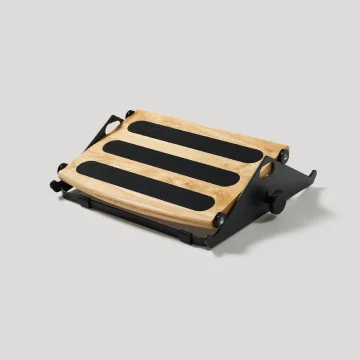
- Buy StrongTek Wooden Rocking Footrest Solid wood and three positions: the value pick with no foam to compress or sag. Amazon
- It depends VIVO Adjustable Foot Rest (STAND-FT01) A steel stool with a wide height range, right when the gap is big and wrong when you wanted a low rocker. Amazon
- Skip Mount-It! MI-7802 Adjustable Ergonomic Footrest It tilts up to 30 degrees but never really raises you, which is the one job you bought a footrest to do.
What actually matters
- Height range is the whole product. Adjustable models let you set your measured gap exactly and change it later if you swap chairs or desks. A fixed platform is a bet that one manufacturer's number matches yours, which is fine when it does and unfixable when it does not.
- Motion type decides what your ankles do all day. A rocker lets them cycle through their range instead of holding one angle for hours; a rigid platform holds you steady but static. The best of both is a rocker that also locks flat when you want your feet still.
- Platform size should let you plant both feet without hunting for the edges. Look for enough width to set your feet at hip distance and enough front-to-back depth that your heels and the balls of your feet are both supported.
- Material and construction predict how long the height you set stays the height you get. Solid wood, plywood and steel hold their dimensions for years. Molded plastic flexes under load and eventually cracks at the pivot. Foam compresses.
- Grip and mass keep it where you put it. Rubber pads, weight, or a textured base stop it creeping on hardwood and laminate. On carpet almost anything stays put, so grip matters most on hard floors.
- Footprint versus legroom is the trade nobody mentions. A tall adjustable stool takes real floor space and can crowd a shallow desk, while a low wedge tucks away. Measure the space under your desk, not just the gap under your feet.
- Adjustment mechanism determines whether you actually use the range. Pin-and-hole settings mean getting under the desk to change anything; a foot-operated or free-tilting design lets you adjust without leaving your chair.
The specs, in plain English
Green flags vs red flags
Green flags
- A stated height range rather than a single overall height, so you can match your measured gap instead of hoping
- Solid wood, plywood or steel construction, materials that hold their dimensions for years under daily load
- A rocking platform that also locks flat, giving you movement and a stable surface to brace against
- Rubber feet or genuine weight, especially if you are on hardwood, laminate or tile
- A platform wide and deep enough to place both feet flat without feeling for the edges
- A long warranty on a mechanical part, which is the maker betting its own money on the pivot and the height lock
Red flags
- "Adjustable" in the headline where the only adjustment is tilt, with an overall height too low to close a real gap
- Soft foam or memory foam as the main structure on a rest you plan to use all day, with no density figure quoted
- Hollow molded plastic with no mention of weight or non-slip base, the classic combination that skates on hard floors
- Massage bumps and similar listing features standing in for a height spec that is missing
- Photos taken from above only, so you cannot judge platform depth or how the base contacts the floor
- Height set by pins under the desk, sold as if you will adjust it daily, when in practice you will set it once and never touch it
Who's who: the brands
- Humanscale - Office ergonomics maker known for foot rockers built from wood and metal, including a height-adjustable model, backed by a 15-year warranty.
- StrongTek - Value-focused maker of solid wood rockers and balance boards, typically fixed height with multiple rocking and flat positions.
- VIVO - Desk accessory brand whose steel stool-style rests cover the widest height ranges, aimed at short users at tall desks rather than at active sitting.
- Mount-It! - Budget mounting and accessory brand with a broad line of molded plastic tilting wedges, where the adjustment is usually angle rather than height.
- Fellowes - Long-established office supply brand whose rests are widely stocked and cover both rocking and fixed formats, with quality that varies by line.
- 3M - Known in this category for extra-wide platforms with slip-resistant surfaces, favored where floor space is available and a large landing area matters.
How to read a listing without getting fooled
Start at the bottom of the spec table, not the top. Find the overall height and the height range, and treat a listing that gives only one number as a fixed-height product no matter what the headline says. Next, check whether "adjustable" refers to height or tilt; a tilt-only wedge that stands three inches tall cannot bridge the gap a raised chair creates, and no number of degrees changes that. Then look for the platform dimensions, particularly depth, because stool-style rests are often much shallower front to back than the photos suggest. Material is the durability tell: solid wood, plywood and steel keep their dimensions, molded plastic flexes, and foam compresses unless a density figure is quoted, which it rarely is. Finally, look at the underside in the images. Rubber pads, a wide contact area or real mass tell you it will stay put; a smooth hollow shell tells you it will not. Marketing language to discount includes massage bumps, ergonomic in place of an actual measurement, and photos shot only from above.
How much should you spend?
This is a category where the cheapest option is often fine and the most expensive one is buying something specific. At the low end you are paying for a solid wood rocker with no adjustment, and if your measured gap happens to match its fixed height, that is genuinely all you need, because a wood platform has no foam to compress or sag. Spend up and what you get is adjustment range, a mechanism that holds its setting, and a warranty long enough to be a real commitment. That premium is worth paying in three situations: your gap falls between common fixed heights, more than one person uses the desk, or you expect to change chairs or desks and want the rest to follow. Spending in the middle usually buys a steel stool with a wide height range but no movement, which is the right call only if your gap is unusually large or your desk is too tall to fix otherwise. What is almost never worth money is a cushioned rest bought for all-day use, because you are paying for comfort that erodes and a height that quietly disappears with it. The worst value in the category is a cheap tilting wedge, not because it costs much, but because it does not do the job you bought it for.
Questions, answered
How do I know whether I need a footrest at all?
Set your chair first and ignore your feet while you do it. Raise or lower the seat until your elbows sit roughly level with the desk surface and your shoulders are relaxed. Now look down. If your feet rest flat on the floor with your thighs roughly parallel to it, you do not need a footrest and adding one will only close your knee angle. If your feet dangle or only your toes touch, the gap you are looking at is exactly what a footrest fills, and measuring it is the next step.
What height should I be shopping for?
Measure floor to heel once the chair is set for your elbows, and look for a rest that lands at or just under that number. Erring low is safer than erring high: a rest that is too tall pushes your knees above your hips and rolls your pelvis backwards, which is worse than no footrest at all. Because gaps vary by a few inches between people, an adjustable model removes the guesswork, while a fixed-height rest is a bet that one height matches yours.
Fixed, rocking or adjustable tilt: which format should I get?
Rocking suits long sitting sessions, because your ankles cycle through their range instead of locking at one angle for hours. Fixed suits anyone who wants a firm surface to brace both feet against, and it is the simplest thing to keep clean and stable. Adjustable tilt sounds like the best of both but usually comes on wedges that offer no height adjustment at all, which is the wrong trade. If you can, buy a rocker that also locks flat, since that gives you movement and stability in one product.
Do foam and memory foam footrests hold up?
This is the most common long-run complaint in the category. Foam takes a compression set under sustained daily weight, so a cushion that felt supportive in week one thins out where your heels sit and quietly lowers the height you carefully chose. Density is the spec that predicts this, and low-density foam of the kind used in inexpensive rests tends to lose shape within a year or two of full-time use, with covers picking up odor along the way. Foam is fine for propping tired feet occasionally. For an all-day setup, wood, steel or rigid plastic keeps its dimensions.
Will it slide around on my floor?
On carpet, almost nothing slides. On hardwood, laminate or tile, the deciding factors are mass and what touches the floor. Hollow molded plastic is light enough to skate away every time you push against it, which is how footrests end up abandoned in a corner. Look for rubber pads, a wide base contact area or genuine weight. A textured top surface is about your socks, not the floor, so do not read it as a grip claim.
Are footrests actually good for your back and posture?
General ergonomics guidance treats a footrest as a way to keep your thighs supported and your knees at a comfortable angle when the desk height forces your chair up beyond your leg length. It is a fit correction, not a treatment. This guide is general information, not medical advice: if you have ongoing pain, numbness, circulation problems or an existing condition, talk to a doctor or a qualified ergonomics professional rather than buying an accessory and hoping.
Or jump to the head-to-head: Humanscale FR300 Foot Rocker vs StrongTek Wooden Rocking Footrest.