

Office & WFH
The Best Under-Desk Footrests: 4 Compared (and One to Skip)
Four current under-desk footrests compared on height fit, rocking motion, stability and what wears out, including one worth skipping.
The short version
Before buying anything, check whether you need a footrest at all: set your chair so your elbows are level with the desktop, and only if your feet then dangle does a footrest have a job. If it does, the Humanscale FR300 Foot Rocker is the pick, because three inches of height adjustment means you match your actual gap instead of guessing, and solid wood construction with a 15-year warranty means the height you set stays set. The StrongTek Wooden Rocking Footrest is the value buy: solid wood, three rocking and flat positions, and no foam to compress. Treat the VIVO Adjustable Foot Rest as a conditional yes, worth it when your gap is unusually large or your desk is too tall, but it is a rigid steel stool with no rocking. Skip the Mount-It! MI-7802, which tilts but does not raise, so it cannot fix the height problem you bought it for. Best for: people at fixed-height desks whose feet do not reach the floor once the chair is set correctly.
Our picks at a glance
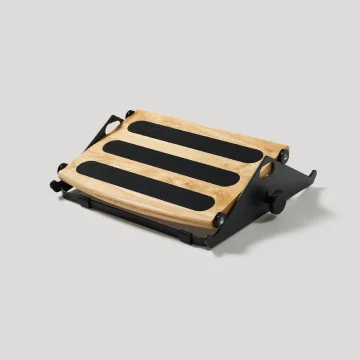
- Humanscale FR300 Foot Rocker - Buy. The only rocker here that lets you set the height to your actual gap, then rocks quietly under the desk for years.
- StrongTek Wooden Rocking Footrest - Buy. Solid wood and three positions: the value pick with no foam to compress or sag.
- VIVO Adjustable Foot Rest (STAND-FT01) - It depends. A steel stool with a wide height range, right when the gap is big and wrong when you wanted a low rocker.
- Mount-It! MI-7802 Adjustable Ergonomic Footrest - Skip. It tilts up to 30 degrees but never really raises you, which is the one job you bought a footrest to do.
The verdict in 30 seconds
What mattered most
- Height adjustment
- Motion
- Build materials
- Gap it suits
- Doubles as a standing-desk aid
- What ages first
A footrest solves exactly one problem: your desk is a fixed height, you raised your chair so your elbows sit level with the desktop, and now your feet hang. If your feet already reach the floor at that chair height, you do not need one. If they do not, the footrest that works is the one whose height matches your gap and whose platform still measures the same in two years. We read across independent ergonomics guidance and long-run owner reports to sort two footrests worth buying from one conditional pick and one to skip.
The only rocker here that lets you set the height to your actual gap, then rocks quietly under the desk for years.
Best for: Anyone with a fixed-height desk who wants the footrest set to one exact height and then forgotten.
- Three inches of height adjustment, so you match the gap your chair height creates instead of hoping a fixed platform lands right
- Solid wood construction with a non-slip surface, and the maker backs it with a 15-year warranty
- Rocking motion keeps ankles and calves moving through long sitting sessions rather than locking them at one angle
- Costs several times what a wooden rocker does, and most of that premium buys adjustment and warranty rather than comfort
- Bare wood platform is firm underfoot, with no cushioning
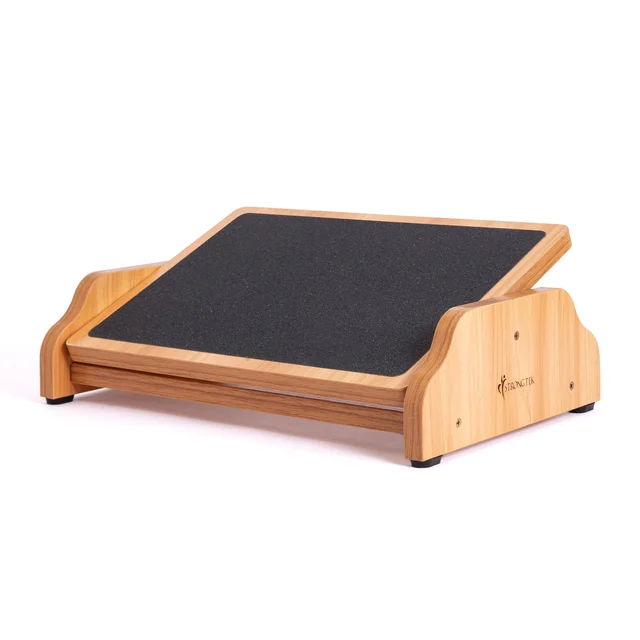
Solid wood and three positions: the value pick with no foam to compress or sag.
Best for: Most home offices with a normal-sized height gap who want something that outlasts the desk.
- Solid wood platform with no foam, so it holds its shape and its height for years
- Three positions (rock forward, rock back, or sit flat as a stationary platform) cover both active sitting and a stable place to plant both feet
- Doubles as a calf stretcher and balance board at a standing desk
- Fixed platform height, so it either matches your gap or it does not; there is nothing to adjust
- Bare wood under socks is firm, and it is heavier and less easy to nudge aside than a plastic wedge
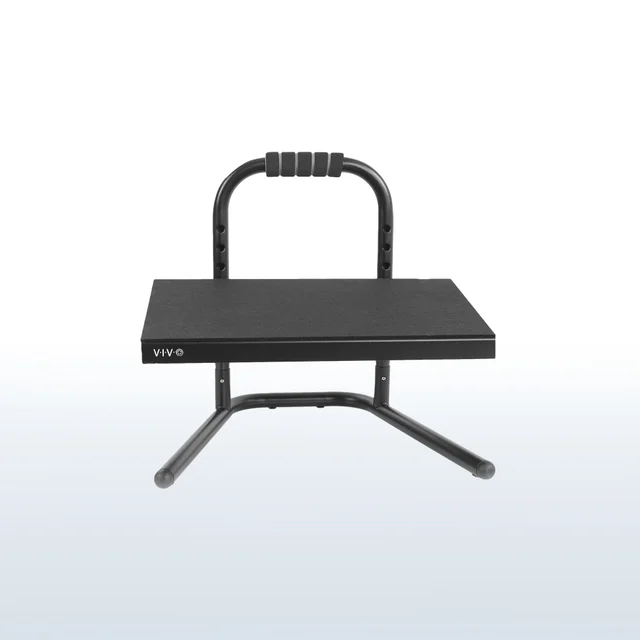
A steel stool with a wide height range, right when the gap is big and wrong when you wanted a low rocker.
Best for: Short users at tall or non-adjustable desks, and anyone whose gap is bigger than a normal footrest can bridge.
- Height adjusts from 5 to 10.25 inches, far more range than a wedge or a wooden rocker offers
- Heavy-duty steel frame with a textured platform and padding underneath to keep it from sliding on the floor
- The tall end of the range also works as a footrest at a standing desk or a bar-height counter
- Rigid and static: no tilt and no rocking, so your ankles stay at one angle all day
- Platform is about 10 by 15.7 inches, narrower front to back than the flat rests here, and the frame takes real floor space
- Needs minimal assembly, and the height is not adjusted on the fly with your foot
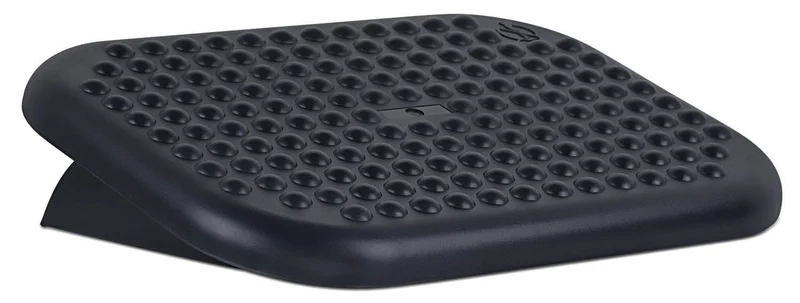
It tilts up to 30 degrees but never really raises you, which is the one job you bought a footrest to do.
Best for: Only propping tired feet occasionally, not correcting a seated posture.
- Cheap, light, and easy to slide out of the way when you want the floor back
- Textured non-slip surface and three tilt settings, so the angle at least is not fixed
- Overall height is 3.25 inches with tilt only and no height adjustment, so it cannot be matched to your gap
- Light molded body can skate on hard floors when you push against it
- The molded massage bumps do more for the product listing than for your feet
| Criteria | Humanscale FR300 Foot Rocker Top pick | StrongTek Wooden Rocking Footrest | VIVO Adjustable Foot Rest (STAND-FT01) | Mount-It! MI-7802 Adjustable Ergonomic Footrest |
|---|---|---|---|---|
| Verdict | Buy it | Buy it | It depends | Skip it |
| Best for | Anyone with a fixed-height desk who wants the footrest set to one exact height and then forgotten. | Most home offices with a normal-sized height gap who want something that outlasts the desk. | Short users at tall or non-adjustable desks, and anyone whose gap is bigger than a normal footrest can bridge. | Only propping tired feet occasionally, not correcting a seated posture. |
| Price tier | $$ · premium | $ · budget | $ · mid-range | $ · budget |
| Height adjustment | 3 in of range | None, fixed platform | About 5 to 10.25 in | None, tilt only |
| Motion | Rocking | Rock forward, rock back, or lock flat | Rigid, no rocking or tilt | Three tilt settings, no rocking |
| Build materials | Solid wood | Solid wood | Steel frame and platform | Lightweight molded body |
| Gap it suits | Small to medium, set precisely | One typical small gap | Medium to large gaps | Very small gaps only |
| Doubles as a standing-desk aid | No | Yes, calf stretch and balance board | Yes, at the tall settings | No |
| What ages first | Very little, solid wood | Very little, solid wood | Adjustment hardware and pads over time | Tilt mechanism and light body |
| Price tier | $$ · premium | $ · budget | $ · mid-range | $ · budget |
Which one is right for you?
- Anyone with a fixed-height desk who wants the footrest set to one exact height and then forgotten. Buy it Humanscale FR300 Foot Rocker
- Most home offices with a normal-sized height gap who want something that outlasts the desk. Buy it StrongTek Wooden Rocking Footrest
- Short users at tall or non-adjustable desks, and anyone whose gap is bigger than a normal footrest can bridge. It depends VIVO Adjustable Foot Rest (STAND-FT01)
- Only propping tired feet occasionally, not correcting a seated posture. Skip it Mount-It! MI-7802 Adjustable Ergonomic Footrest
How we judged the field
We do not run a lab. We read across independent ergonomics guidance and long-run owner reports, then weighted what actually decides whether a footrest gets used daily or shoved into a corner after a month.
The first question is whether you need one at all, and it is worth answering before you spend anything. A footrest exists to solve one specific situation: your desk is a fixed height, you raised your chair until your elbows sat level with the desktop, and your feet no longer reach the floor. Set the chair for your upper body first, then look down. If your feet are already flat with your thighs roughly parallel to the floor, a footrest adds nothing and can close your knee angle for the worse. If they dangle, the gap you just measured is the single most useful number in this review.
From there we compared four things. Whether the height can be matched to your gap rather than guessed at, because a rest that is too tall pushes your knees above your hips and rolls your pelvis back, while one that is too short is just a place for your toes. Whether the platform is wide enough to plant both feet without hunting for it. Whether it stays put on your floor when you push against it. And what wears out, which splits cleanly by material: solid wood and steel hold their dimensions for years, while soft foam takes a compression set under daily weight and quietly gives back the height you set. That last point is the most common long-run complaint in the category, and it is why no soft-foam cushion made the shortlist.
Two footrests earned a buy, one is a conditional yes for a specific problem, and one earned a skip because it does not do the job the category exists for.
The FR300 is the only rocking footrest here that lets you set a height rather than accept one. The maker rates it for three inches of height adjustment, which is enough to cover the range of gaps most people measure once the chair is set correctly. That single feature is why it is the pick: every other decision in this category is downstream of getting the height right, and a fixed platform is a bet that someone else’s number matches yours.
The rest of it is built to not change. The platform is solid wood rather than molded plastic, with a non-slip surface, and the maker backs it with a 15-year warranty. Cheap plastic rockers flex under load, which blunts the rocking action and eventually cracks the pivot; this one does not have that failure mode. The rocking lets your ankles cycle through their range while you work instead of holding one angle for hours.
What owners like less is the price and the buying experience. It costs several times what a wooden rocker does, and most of that premium buys adjustment range and warranty rather than day-to-day comfort. If you want the footrest right rather than roughly right, that is the trade.
The StrongTek is the value buy, and it earns it by having almost nothing that can go wrong. It is a solid wood platform on a wooden base. There is no foam to flatten, no gas strut to lose pressure, no plastic catch to snap.
The three positions are more useful than they sound. You can set it to rock forward, rock back, or sit flat as a stationary platform, which means it works both as an active-sitting rocker and as a plain stable surface when you want your feet still. It also doubles as a calf stretcher and a balance board at a standing desk, so it does not go idle when you stand up.
The catch is the fixed height. There is no adjustment, so it either matches the gap you measured or it does not, and there is no fixing that after the fact. It is also firm under socks, and heavier and less easy to nudge aside than a plastic wedge. For a normal-sized gap, none of that outweighs a footrest that will still be exactly the same height in five years.
The VIVO is not really a rocker or a wedge; it is a small steel stool with a height-adjustable platform, and it answers a problem the other three cannot. Its range runs from 5 inches to 10.25, which covers gaps that a low wooden rest simply cannot bridge. If you are short, your desk is tall, or the desktop is a non-adjustable slab at counter height, this is the format that fits.
The build supports that use. It is heavy-duty steel with a textured platform and padding underneath to keep it from sliding, and the tall settings work as a footrest at a standing desk or bar-height counter too.
The trade-offs are what make it conditional rather than a straight buy. It is rigid: no tilt, no rocking, so your ankles hold one angle all day, which is the opposite of what the rockers here are for. The platform is about 10 by 15.7 inches, narrower front to back than the flat rests, so there is less room to shift your feet around. It needs minimal assembly, and the height is not adjusted on the fly with your foot. Buy it if your gap is genuinely large; buy a rocker if it is not.
The MI-7802 is a molded plastic wedge with three tilt settings, a non-slip textured top, and rows of massage bumps. It is cheap, it is light, and on a product page it reads like a complete solution.
The problem is what “adjustable” means here. The adjustment is tilt only, up to 30 degrees, on a body that is 3.25 inches tall overall. Changing the angle changes where your toes point; it does not raise your heels to meet the gap under your feet, which is the entire reason you went looking for a footrest. If your gap happens to be tiny, that is fine. For most people who raised their chair to get their elbows level, it is not nearly enough.
The secondary issue is mass. The light molded body can skate on hard floors when you push against it, so you end up chasing it back into place. The massage bumps do more for the listing than for your feet. It works as a place to prop tired feet occasionally, but in this company it is the one that fails at the core job, which is why it is a skip rather than a cheaper buy.
Humanscale FR300 vs StrongTek Wooden Rocking Footrest: which should you buy?
Both are wood-based rockers that will hold their shape for years, so the decision comes down to one question: do you know your gap, and does the StrongTek’s fixed height match it? Measure from the floor to your heels with the chair set for your elbows. If that number is close to what a standard wooden rocker delivers, the StrongTek gives you the same durability, the same rocking action, a flat locking position and a standing-desk use case, for a fraction of the outlay.
The FR300 wins when the answer is anything other than a clean match. Three inches of adjustment means you set it to your number rather than the nearest available one, and you can change it later if you swap desks or chairs. Add the solid wood build and a 15-year warranty and you are buying a component you never think about again. Choose the StrongTek for value and a gap that happens to fit; choose the FR300 when you want the height to be right rather than close, or when more than one person uses the desk.
What to look for
Start with the measurement, not the product. Set your chair so your elbows are level with the desk and your shoulders are relaxed, then measure floor to heel. That number, give or take an inch, is the height you are shopping for. Prefer an adjustable model if your measurement sits between common fixed heights, or if the desk is shared.
Check the platform before the features. You want enough width and depth to place both feet flat without searching for the edges, and enough weight or grip underneath that it stays put when you brace against it. Light hollow plastic on a hard floor is the classic combination that slides.
Weigh the material against how long you want it to last. Solid wood and steel keep the height you chose. Soft foam feels better on day one and is the most common source of long-run complaints, because foam takes a compression set and thins out under daily weight, taking your carefully chosen height with it. If you want softness, plan on replacing it.
Finally, decide whether you want movement. A rocking platform lets your ankles cycle instead of locking at one angle, and the better ones also sit flat when you want stability. Foot hammocks are a different product entirely: they suspend your feet rather than supporting them, need a compatible desk or under-desk mount, and cannot give you a surface to push against while you type.
Our final take
Answer the height question first, because half the footrests sold are bought by people whose chair was simply set too high. If your feet really do dangle once your elbows are at desk height, buy the Humanscale FR300 Foot Rocker: it is the one here you can set to your actual gap, it is built from materials that do not change shape, and it is backed by a 15-year warranty. The StrongTek Wooden Rocking Footrest is the value buy for a standard gap, with three positions and no foam to compress. Consider the VIVO Adjustable Foot Rest only when your gap is unusually large or your desk is too tall to fix any other way. Skip the Mount-It! MI-7802: a footrest that tilts but does not raise is solving a problem you did not have.
Questions, answered
How do I know whether I even need a footrest?
Set your chair first, ignoring your feet. Raise or lower it until your elbows are roughly level with the desk surface and your shoulders are relaxed. Now look down. If your feet rest flat on the floor with your thighs roughly parallel to it, you do not need a footrest and adding one will close your knee angle for no benefit. If your feet dangle or only your toes touch, the gap you are looking at is exactly what a footrest fills.
What height should a footrest be?
Measure the gap between the floor and your heels once your chair is set for your elbows, then look for a footrest that lands at or just under that number. A rest that is too tall pushes your knees above your hips and rolls your pelvis backwards, which is worse than no footrest at all. Because gaps vary by a few inches from person to person, an adjustable model removes the guesswork; a fixed-height rest is a bet that its one height matches yours.
Do memory foam footrests hold up?
This is the most common durability complaint in the category. Foam takes a compression set under sustained daily weight, so a cushion that felt supportive in week one thins out over months and quietly lowers the height you chose. Owners frequently report soft-foam rests flattening within a year or two, and covers picking up odor along the way. If softness underfoot matters more than an exact height, foam is fine for occasional use, but for an all-day setup wood, steel or rigid plastic keeps its dimensions.
Is a rocking footrest better than a flat one?
It is better for movement, not for support. Rocking lets your ankles cycle through their range instead of holding one angle for hours, which is why several models here also lock flat. What matters more is that the platform is wide enough to plant both feet without hunting for it, and stable enough that it does not tip when you shift your weight. A rocker that also locks flat gives you both options, which is why it is the format worth paying for.
What about under-desk foot hammocks?
A hammock suspends your feet rather than supporting them, so it is a lounging accessory rather than a posture fix. It cannot give you a stable surface to push against while typing, it needs a desk with a suitable crossbar or an under-desk mount, and cheaper versions sag or slip off within an hour or two according to owner reports. Buy one for reading and calls if you like the idea, but do not expect it to replace a footrest that sets a specific height.
Deciding between the top two? See our head-to-head: Humanscale FR300 Foot Rocker vs StrongTek Wooden Rocking Footrest.
More Office & WFH reviews
 The Best USB-C Docking Stations: 4 Compared (and One to Skip)
  The Best Vertical Mice for Wrist Comfort: 4 Compared (and One to Skip)
  The Best Under-Desk Walking Pads: 4 Compared (and One to Skip)
  The Best Webcams for Working From Home (and One to Skip)
  The Best Whiteboards: 4 Compared (and One to Skip)
  The Best Wireless Presenters: 4 Compared (and One to Skip)