Explained
Tubeless Sealant, Explained
After reading, you'll understand what a sealant's hole size and longevity claims really mean, how much to put in your tire, and which restrictions to check before you buy.
In this guide
Most people buy their first bottle of sealant on a shop recommendation and their second one on habit. The result is that the numbers on the label go unread, and they are the only thing that distinguishes the products. Two figures matter more than the rest: the largest hole the maker claims to seal, and how long the liquid lasts inside the tire. A third, whether you can inject it through a valve, decides how annoying ownership is.
The 30-second version
- Hole size is the headline spec, and a maker willing to print a millimetre figure has tested for it.
- Sealant dries out before it fails, so the months figure matters more than most buyers expect.
- Volume scales with tire size, and the good makers publish a chart rather than a single number.
- Injectability through the valve core is the difference between a two minute top-up and a workshop session.
- Ammonia free matters for cotton casings, and is irrelevant for a standard nylon casing tubeless tire.
The products this guide is about
Our verdict on each, with the full reasoning on the companion review.
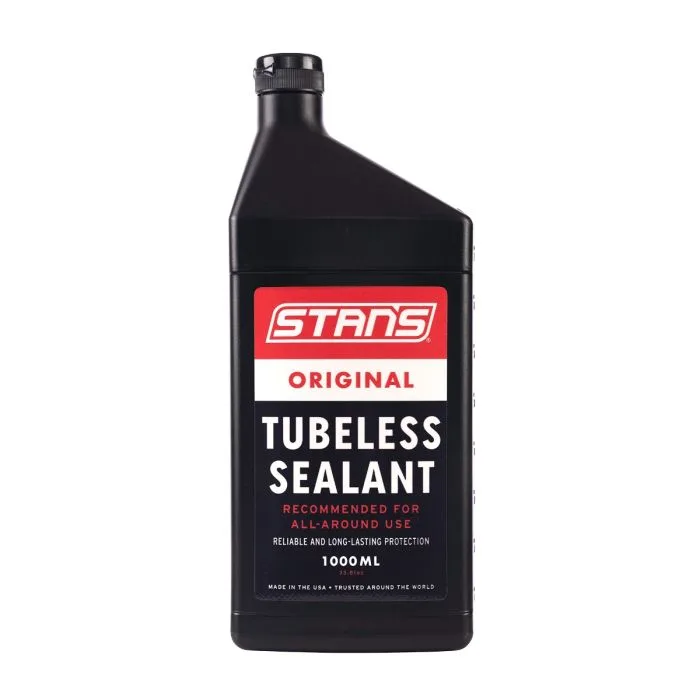
- Buy Stan's NoTubes Original Tubeless Sealant The sealant everything else gets compared to, and the one that publishes the most numbers.
- Buy Orange Seal Endurance Tubeless Tire Sealant Same sealing claim as the standard formula, built to go two to three times longer between top-offs.
- It depends SILCA Ultimate Tubeless Sealant Carbon fibre strands in a foaming latex carrier, ammonia free, with two setup restrictions worth knowing first.
- Skip Effetto Mariposa Caffelatex Tire Sealant Good chemistry and real versatility, but Effetto Mariposa's own sealing figures are the smallest in this group.
What actually matters
- Maximum puncture size - the largest hole the maker says the sealant will close, usually in millimetres or fractions of an inch. It is the single figure that separates the field, and the range across common sealants runs from around 3mm to well over 6mm.
- Liquid life - how long the sealant stays wet enough to work. Stan's states 2 to 7 months for its Original formula and SILCA states 6 months and up for Ultimate, while other makers give a multiple of their own standard product instead.
- Injectability - whether the sealant will pass through a removable Presta valve core. Products with long fibres or large particles sometimes will not, and a few, like Stan's Race Day, are explicitly pour-only.
- Freeze and cold sealing - two different claims. Anti-freeze agents stop the carrier from freezing, while a tested cold sealing figure, like SILCA's -15C, says the sealant still closes holes at that temperature.
- Suspended solids - the particles doing the plugging. Crystals, chopped carbon fibre, biodegradable fibres and sub-2-micron silicates all work differently, and the fibre based ones generally claim the biggest holes.
- Ammonia content - used to stabilise natural latex. It is a real consideration for cotton and other natural fibre casings, and largely a non-issue for standard tubeless tires.
- Dosing guidance - the volume chart for your tire size. Underfilling causes the slow bead weep that people mistake for a bad tire, and overfilling adds rotating weight for nothing.
The specs, in plain English
Green flags vs red flags
Green flags
- The maker prints a maximum puncture size in millimetres or inches.
- There is a dosing chart covering your tire width, not just a single suggested volume.
- The bottle size you want is also sold as a cheaper refill.
- The product page states a low temperature figure rather than saying "all conditions".
- The maker says plainly whether the sealant injects through a valve core.
Red flags
- The only performance claim is that it seals large punctures, with no figure attached.
- Longevity is expressed only as a comparison with the maker's own other product.
- The listing does not say whether an injector is included, and the photo is ambiguous.
- There is no statement about mixing with other sealants, on a product you would be topping up.
- A giant jug is the cheapest way to buy, but you own two tires and will never finish it.
Who's who: the brands
- Stan's NoTubes - Made the first tubeless sealant in 2001 and still publishes the most complete dosing and specification detail of the major brands.
- Orange Seal - Known for the Endurance formula built around going longer between top-offs, and for shipping a dipstick with its injector bottles.
- SILCA - A premium tools and consumables brand whose Ultimate sealant uses reclaimed carbon fibre strands and an ammonia free latex blend.
- Effetto Mariposa - Italian maker of Caffelatex, an ammonia free synthetic latex sealant rated for tubeless, tubular and latex or butyl inner tubes.
- Peaty's - UK brand whose Holeshot Biofibre sealant is developed with World Cup mechanics and states CO2 compatibility and a 15 to 120 psi operating range.
How to read a listing without getting fooled
Start at the bottom of the product page, not the top. The marketing paragraph will tell you the sealant is trusted by professionals; the specification block underneath is where the millimetre figure, the months figure and the restrictions live, and on some sites it is collapsed behind a tab that looks like boilerplate. Read the restrictions first, because they are absolute: not injectable in a particular valve, not to be mixed with the maker's previous formula, not rated for TPU tubes. Then check whether the listing you are looking at is the injector bottle or the refill, since the photos are often nearly identical and the refill leaves you without an applicator. Finally, find the dosing chart and work out how many tires your bottle will actually fill, which is the number that tells you what you are paying per fill rather than per bottle.
How much should you spend?
Sealant is a budget purchase that people manage to overspend on by buying the wrong format. The mainstream all-rounders sit in the budget tier per bottle, and buying a mid-size bottle plus an injector once is cheaper across a season than repeatedly buying small single-fill bottles. Premium tier sealants charge for fibre content and specific chemistry, and they are worth it for cotton casings or for riders who genuinely puncture large holes; they are not worth it as a general upgrade. The trap at the cheap end is the workshop jug, which looks like excellent value and then thickens in the bottle long before a two-bike household gets through it. Buy the smallest size that covers a full refresh of every tubeless tire you own, plus one top-up.
Questions, answered
How often should I actually check the sealant level?
Twice a season is a reasonable default, moving to every couple of months if you live somewhere hot and dry. Stan's states its Original formula stays liquid 2 to 7 months and specifically flags arid conditions as needing more frequent monitoring. The easiest check is a dipstick or a zip tie through the valve with the core removed, which takes under a minute per wheel.
Is more sealant always better?
No. Volume is set by tire size for a reason: too little leaves porous casing and bead gaps unsealed, and too much adds rotating weight and sloshes. The makers publish charts, and Stan's runs from 50ml for a 700c x 28mm road tire to 230ml for a 26 x 5 fat tire. Follow the chart for your tire width rather than filling by eye.
Does sealant go off in the bottle?
It settles and can thicken over time, which is why makers give storage instructions. Stan's tells you to keep it in a cool dry place, out of direct sunlight and extreme temperatures, and sealed when not in use. Shake any bottle thoroughly before pouring, because the solids that do the sealing are the part that sinks.
Can sealant fix a cut in the sidewall?
Not reliably. Published sealing figures assume a hole in the tread, where the casing is thickest and the pressure is pushing sealant straight into the hole. Sidewalls flex constantly and a cut there reopens as the tire deforms. A tire plug or a boot and a tube is the trailside answer for a sidewall, and the sealant's job afterwards is just to seal what the plug leaves behind.
Or jump to the head-to-head: Stan's NoTubes Original Tubeless Sealant vs Orange Seal Endurance Tubeless Tire Sealant.