Explained
Tubeless Valves, Explained
After reading, you'll understand how to size a valve to your rim, why airflow and base shape matter, and what you give up by leaving the Presta standard.
In this guide
Tubeless valves look like a solved problem and are not. The stem has to be long enough for your rim, the rubber base has to match the shape of your rim bed, and the path through the valve has to stay clear of drying sealant. Get any of the three wrong and the symptoms look like a tire problem or a pump problem, which is why people replace the wrong thing first.
The 30-second version
- Stem length is set by rim depth, and being a few millimetres short makes the wheel unpumpable.
- The rubber base does the sealing, so a valve that offers more than one base shape fits more rims.
- Airflow matters twice, once when seating the bead and again every time sealant passes the core.
- Tire inserts can blank off a valve, which is why insert compatibility is a real specification and not marketing.
- A standard Presta core is replaceable anywhere, and a proprietary mechanism is not.
The products this guide is about
Our verdict on each, with the full reasoning on the companion review.
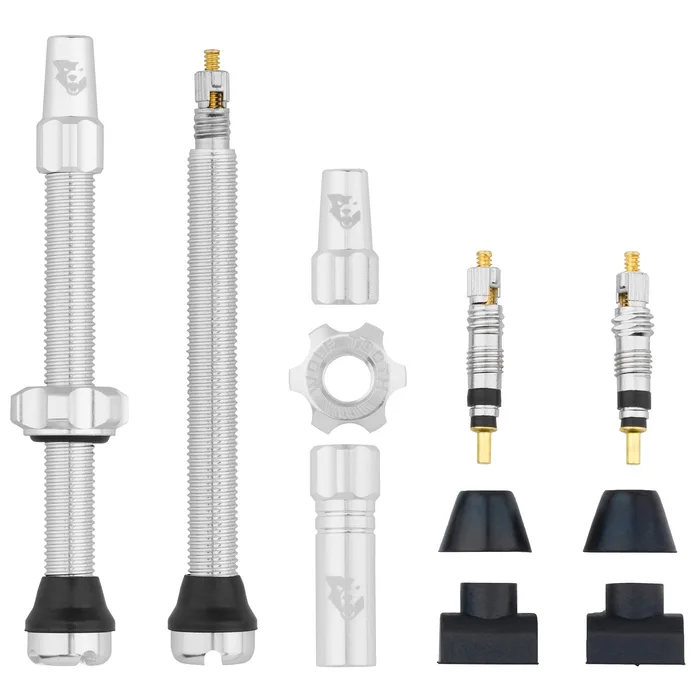
- Buy Wolf Tooth Tubeless Presta Valve Stem Kit The most complete valve kit here, with spare cores, a core remover and three rubber bases in the box.
- Buy Stan's NoTubes Tubeless Universal+ Valves Six lengths, five airflow holes and an upgrade path, at the lowest price here.
- It depends Muc-Off Big Bore Lite Tubeless Valves Replaces the Presta core with a lever-operated ball valve for a claimed 230 percent more airflow.
- Skip SILCA Ultimate Tubeless Valves Well made and well finished, with the narrowest size range and the least published detail here.
What actually matters
- Stem length - measured from the rim bed to the top of the threads. It has to clear your rim depth with enough thread left to take a pump head and the lock nut, which is why makers offer everything from 20mm to 85mm.
- Rubber base shape - the cone or channel that presses against the inside of the rim and makes the seal. Rim internal profiles vary, and a base that suits a deep channel will not seal a flat bed.
- Airflow path - how easily air moves through the valve. Stan's uses five holes, Wolf Tooth uses a slotted base, and Muc-Off removes the core from the path entirely with a ball valve.
- Insert compatibility - whether a foam tire insert pressed against the valve blocks it. A valve with only a bottom hole can be sealed off completely, which looks exactly like a faulty pump.
- Core type - a standard Presta core can be replaced by any shop, a proprietary ball valve or a different valve standard cannot. It is a serviceability decision more than a performance one.
- Lock nut and tool interface - how the valve is held in and tightened. An oversized knurled nut is hand-tightenable, and a hex interface makes torque repeatable without pliers.
- What is included - spare cores, a core remover, extra rubber bases and caps. These are cheap parts that are annoying to source on their own.
The specs, in plain English
Green flags vs red flags
Green flags
- Several stem lengths are offered and the maker states a maximum rim depth.
- More than one rubber base shape is included in the box.
- Spare valve cores and a core remover are listed as included.
- Insert compatibility is explained by a mechanism, such as counted airflow holes or a slotted base.
- Replacement nuts, caps and cores can be bought separately.
Red flags
- Only one stem length, or a length range that stops well short of your rim depth.
- High flow claimed with no figure and no description of what makes it flow.
- No weight and no material published on a machined alloy part.
- A proprietary core with no stated route to a replacement.
- Product copy that references a companion product the maker has since discontinued or replaced.
Who's who: the brands
- Stan's NoTubes - Originated the modern tubeless system and sells the widest range of stem lengths, up to rims 86mm tall.
- Wolf Tooth - Minnesota component brand that sells valves as complete kits with spares, and supports them under a repair programme.
- Muc-Off - Best known for cleaning products, and the driver of the big bore ball valve idea with its Big Bore Lite and Hybrid.
- SILCA - Premium tools and consumables brand whose tubeless valves are designed around its own tape and sealant system.
- Peaty's - UK brand whose Holeshot Fast Flow valves move the valve mechanism inside the rim and stay compatible with Presta pump heads.
How to read a listing without getting fooled
Start with the size chart, not the feature list. Find your rim depth, add roughly 15mm to 20mm so a pump head has thread to grip, and see whether the valve is offered in that length at all. If it is not, nothing else on the page matters. Next look for the words that describe how sealant gets past the core: counted airflow holes, a slotted base, or a straight-through bore. A listing that says high flow without saying why has told you nothing. Then check what comes in the box, since spare cores, a core remover and alternative rubber bases are each a separate annoyance to buy later. Finally read the compatibility line carefully on anything that is not a plain Presta valve, because a different standard means a different pump head, and makers do state this plainly when it applies.
How much should you spend?
Valves are a budget purchase in absolute terms, and the sensible ceiling is low. A plain pair of alloy stems sits at the bottom of the budget tier and is often all you need. A mid-range kit buys you spare cores, a core remover and alternative rubber bases, which is usually worth it because those parts cost almost as much bought separately. Premium tier valves are buying you either a genuine airflow redesign, like a big bore ball valve, or a finish that matches the rest of a build. The airflow redesign is defensible if you regularly fight stubborn beads; the finish is a preference. What is never good value is a premium valve in the wrong length, and rim depth is the specification to settle first.
Questions, answered
How often should tubeless valves be replaced?
The stem itself lasts for years, and the parts that wear are the core, the rubber base and sometimes the nut. The practical schedule is to pull and clean the core whenever you top up sealant, and to replace it when it stops sealing cleanly. Wolf Tooth includes two spare cores in its kit for exactly this reason, and sells cores, nuts and caps separately afterwards.
Why does my tire lose air overnight even though the tire is fine?
A valve that weeps at the rim is a common cause and an easy one to miss, because the leak is hidden under the rim tape line. Soapy water around the base of the valve will show it. The usual fixes are a cleaner rim bed, a different rubber base shape, or a slightly firmer but not overtightened nut. Do not keep tightening: the rubber seals by being compressed, and past a point more torque deforms it and makes the leak worse.
Can I reuse valves when I change tires?
Yes, and most people should. Clean the dried sealant off the stem and the base, check the rubber for splits, fit a fresh core if the old one is crusted, and reuse the rest. A machined alloy stem outlives several tires. Replace the whole valve if the rubber base has hardened or torn, since that is the part doing the sealing.
Is a longer valve ever a bad idea?
Only mildly. An overlong stem adds a few grams and leaves more thread exposed, which is slightly more to catch and slightly more to bend if the bike goes over. Neither is a real problem. A stem that is too short, by contrast, cannot be fixed without a new valve or a valve extender, so when you are between sizes take the longer one.
Or jump to the head-to-head: Wolf Tooth Tubeless Presta Valve Stem Kit vs Stan's NoTubes Tubeless Universal+ Valves.