Explained
Bike Bottle Cages, Explained
After reading, you'll know which cage suits your frame, whether your insulated bottle will fit, and when weight is worth paying for.
In this guide
A bottle cage is the cheapest component on a bike and the one most often bought twice, usually because the bottle will not come out of the first one. The specifications that decide that are mounting adjustment, loading direction and bottle diameter, and none of them is the number printed on the packaging. Weight is, and across the whole category it varies by less than the water in a single mouthful.
The 30-second version
- Weight is close to irrelevant, because the spread across good cages is about 20 grams against a 750 gram full bottle.
- Mounting adjustment is the real feature, moving the bottle up, down, forward or back relative to fixed frame bosses.
- Side loading solves tight frames, when there is not enough room to pull a bottle straight up out of the cage.
- Insulated bottles need a published diameter, and a 2.9 inch base is the figure that separates fits from does not.
- Metal cages can be tuned, since tubing eases open or closed by hand while a moulded cage is fixed at manufacture.
The products this guide is about
Our verdict on each, with the full reasoning on the companion review.
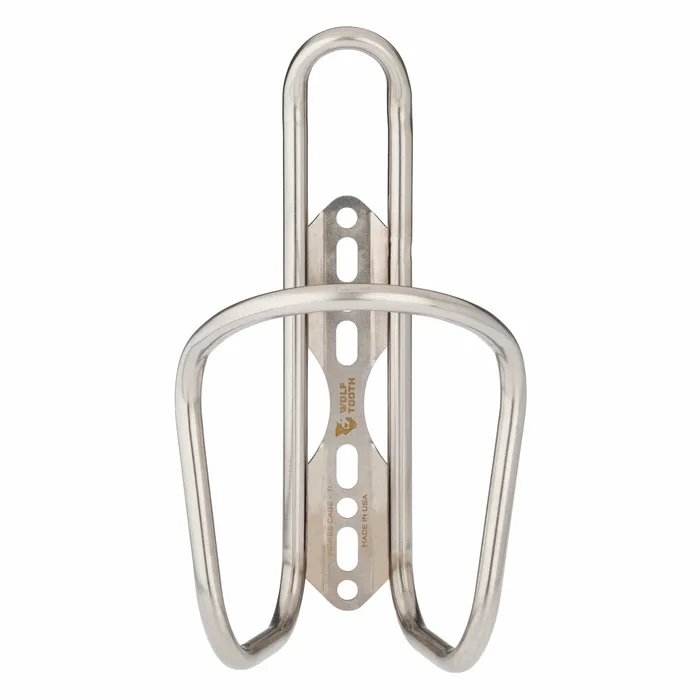
- Buy Wolf Tooth Morse Cage Ti Hand-bent titanium at a stated 33 grams on a base plate that slides the bottle up to 32mm up or down the frame.
- Buy Lezyne Matrix Team Cage A stated 36 grams of one-piece composite that loads from either side, at a fraction of what the metal cages cost.
- It depends King Cage Iris Stainless Steel The heaviest cage here and the only one that tells you which bottles it will actually hold.
- Skip Arundel Mandible The lightest cage in the comparison at a stated 28 grams, which buys you five grams over titanium and costs you the ability to adjust the grip.
What actually matters
- Mounting adjustment - how far the cage can move the bottle relative to the frame's bottle bosses. Published as a vertical or fore-and-aft range in millimetres, and the single most useful spec for a small or full-suspension frame.
- Loading direction - whether the bottle lifts straight out or can be pulled sideways, and if sideways, from which side. Decides usability where a top tube, shock or frame bag is in the way.
- Bottle compatibility - the base diameter the cage accepts. Standard cycling bottles are around 2.9 inches; wide insulated flasks often are not, and most makers publish nothing.
- Material and construction - tubular titanium or stainless, moulded composite, or carbon layup. This determines whether retention can be adjusted after purchase.
- Retention strength - how hard the cage grips. Too loose ejects bottles on rough ground; too tight makes one-handed removal difficult at speed.
- Weight - published by everybody and worth very little, given the spread relative to the contents.
- Bolt spacing - 64mm between bosses is the standard. A cage that states it is confirming it will fit a conventional frame.
The specs, in plain English
Green flags vs red flags
Green flags
- A mounting adjustment range published in millimetres.
- A stated bottle base diameter or named compatible bottles.
- Loading direction described explicitly, including which side.
- Bolt spacing confirmed as standard 64mm.
- A tubular metal construction if you expect to change bottle types.
Red flags
- Weight presented as the only specification.
- No indication of whether the cage side-loads.
- No bottle dimension on a cage marketed for adventure or touring use, where insulated bottles are common.
- Claims of maximum retention with no way to adjust it.
- No stated bolt spacing, on a part whose entire job is bolting to a frame.
Who's who: the brands
- Wolf Tooth - Hand-bent titanium cages built around an adjustable base plate, publishing both weight and the adjustment range it delivers.
- Lezyne - One-piece composite cages at low prices, notable for publishing weight and for side-loading from either direction.
- King Cage - US-machined stainless and titanium tube cages, and unusually willing to publish which bottles will actually fit.
- Arundel - Carbon cages aimed at racing, with the lowest weights in the category and mounting holes offset for frame clearance.
- SILCA - Seamless titanium tubing with a published fore and aft adjustment range, positioned for gravel and under-down-tube mounting.
How to read a listing without getting fooled
Find the weight, note it, and then put it aside, because it will not decide anything. What to look for instead is a number in millimetres describing how far the cage can move the bottle, since that is what rescues a frame with no room. Then read for the loading direction and check it against whatever is in the way on your bike, whether that is a top tube, a shock or a frame bag. If you use an insulated bottle, search the page for a base diameter and treat its absence as a warning rather than a detail. Finally look at the material, because that tells you whether the grip is something you can adjust later or something you are committing to.
How much should you spend?
Budget buys a moulded composite cage, and these are genuinely good: light enough that the weight argument is over, often side-loading, and cheap enough to buy several. The mid-range is tubular stainless, where you gain adjustability by hand and durability, and lose a few grams. Premium splits between titanium, where you are paying for low weight plus adjustment features like a multi-position base plate, and carbon, where you are paying purely for the lowest number. Given that the entire category fits within about 20 grams, the sensible way to spend more is on a cage that solves a fit problem, not on one that shaves a gram.
Questions, answered
How tight should the bolts be?
Barely more than snug. Bottle cage bolts thread into thin frame bosses, and overtightening strips them, which is a much worse problem than a slightly loose cage. Aim for firm by hand with a short tool, and if a bolt keeps working loose, use a drop of threadlocker rather than more torque. On carbon frames this matters more, not less.
Will a cage fit a frame with no bosses?
Yes, with an adapter. Clamp-on adapters wrap the seat tube or down tube and present a standard 64mm pair of bosses, and there are versions that mount to a fork leg or handlebar. They add weight and can slip under load, but they are the standard answer on frames, especially small ones, that only have one set of mounts or none.
Why does my bottle eject on rough ground?
Usually retention rather than the cage being wrong. Bottles bounce out when the grip has relaxed, when the bottle is a slimmer profile than the cage expects, or when the cage is mounted where it takes the worst of the impacts. On a metal tube cage, easing the arms closed a few millimetres usually fixes it. On a moulded cage, the fix is a different bottle or a different cage.
Do I need a special cage for the underside of the down tube?
Not strictly, but retention becomes the priority because the bottle is upside down and taking road spray directly. Cages designed with that position in mind tend to grip harder and use materials that survive grit. It is also the position where losing a bottle is least noticeable until much later, which is an argument for the tighter fit.
Or jump to the head-to-head: Wolf Tooth Morse Cage Ti vs Lezyne Matrix Team Cage.