Explained
Bike Degreasers, Explained
After reading, you'll know which format suits your cleaning routine, what materials compatibility claims actually cover, and how to degrease without wrecking bearings or brakes.
In this guide
A bike degreaser has an unusually narrow job: dissolve cured chain lube and waterproof grease off a drivetrain, and leave every other lubricant, seal, coating and friction surface on the bike untouched. Everything worth knowing about the category follows from that tension, and most of the differences between products are about how they manage it and how honestly they describe it.
The 30-second version
- Bearing seals set the limit, so keep strong solvents aimed at the chain and cassette.
- Brake contamination is the expensive mistake, because a soaked pad usually has to be replaced.
- Format decides cost per use, with aerosols the most convenient and concentrates the cheapest.
- Foam clings and liquid penetrates, which is why they suit different levels of filth.
- Biodegradable describes the chemistry, not the runoff and not always the packaging.
The products this guide is about
Our verdict on each, with the full reasoning on the companion review.
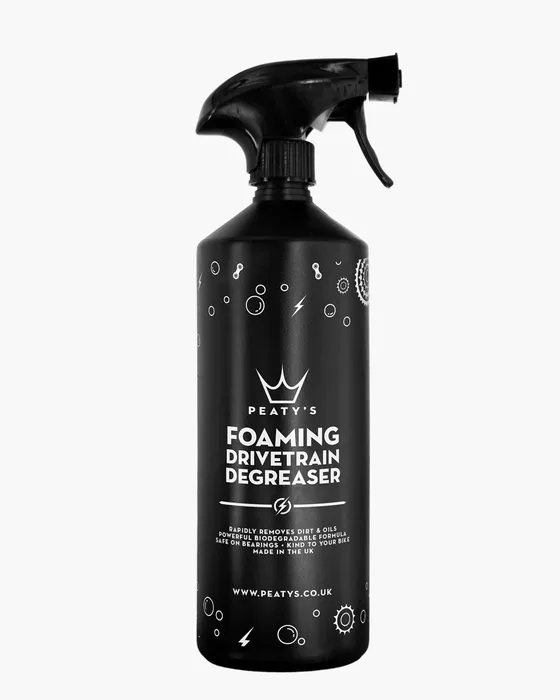
- Buy Peaty's Foaming Drivetrain Degreaser A clinging biodegradable foam with a stated dwell time and a published safety data sheet.
- Buy Pedro's Oranj Peelz A citrus solvent built to penetrate, biodegradable, and cheapest per use in the gallon.
- It depends Muc-Off Bio Degreaser 500ml The convenient aerosol, carbon safe and effective, in the least defensible packaging here.
- Skip Finish Line Citrus Degreaser A long-established citrus degreaser described in one sentence and sold in two sizes.
What actually matters
- Chemistry - citrus solvent, general solvent blend or water-based surfactant. Citrus and solvent blends cut heavy build-up; water-based formulas are gentler and safer around seals.
- Format - aerosol, foaming trigger spray, pour-on liquid or bulk concentrate. This decides reach, how much runs off, and cost per clean.
- Materials compatibility - whether the maker states it is safe on carbon fibre, anodised aluminium, rubber seals, paint and brake surfaces.
- Bearing grease behaviour - whether the formula is designed to leave packed grease alone, which is the single most important safety claim in the category.
- Biodegradability - and specifically whether the claim covers the contents, the packaging or both. Aerosol cans usually fall outside it.
- Dwell time and method - how long the product needs to work and whether it should be agitated with a brush before rinsing.
- Sizes offered - a range from a trigger bottle to a bulk container lets you buy the same chemistry at the right price for how much you ride.
The specs, in plain English
Green flags vs red flags
Green flags
- A stated claim about not stripping bearing greases.
- Named materials it is safe on, including carbon and seals.
- A published dwell time and application method.
- A safety data sheet linked from the product page.
- Sizes from a trigger bottle up to bulk, so the same chemistry scales.
Red flags
- A one-sentence description with no ingredients and no compatibility.
- Biodegradable claimed without saying whether the packaging is included.
- No dilution ratio offered on a product sold by the gallon.
- Nothing on the page about brake pads or rotors.
- Only one size, in the most expensive format.
Who's who: the brands
- Peaty's - UK brand built around biodegradable bike care, known for foaming formulas, published safety data sheets and a bulk size in most of the range.
- Pedro's - Long-established American bike tool and chemical maker, best known for the citrus Oranj Peelz degreaser and the Chain Pig cleaning tool.
- Muc-Off - UK brand with the widest bike care range and heavy aerosol use, marking qualifying products with a Project Green credential.
- Finish Line - American lubricant and cleaner brand with a long history in citrus and speed degreasers, though its product pages publish very little detail.
- Green Oil - Small UK maker focused on plant-based bike lubricants and cleaners with minimal packaging, for riders prioritising that over convenience.
How to read a listing without getting fooled
Look first for any sentence about what the product is safe on, and specifically for bearing grease, carbon fibre and brake surfaces. Those three cover every expensive mistake in this category, and a page that names none of them has told you nothing about the risk you are taking. Then read the format and work out cost per clean honestly: an aerosol that lasts five cleans is not cheap, however small the number on the shelf. Check whether a dwell time and method are published, because a product designed to sit for two minutes and be brushed is used differently from one meant to be flushed. Read any biodegradability claim down to its footnote, since aerosol cans are routinely excluded. Finally look at the size ladder, because a maker that offers a bulk option is one that expects you to keep buying it, and a maker that jumps from a small can straight to a gallon is not thinking about how you actually use it.
How much should you spend?
Degreaser is cheap in absolute terms and expensive per use if you buy it wrong. The budget end means buying concentrate or a gallon of a citrus formula and decanting it, which brings the cost of a drivetrain clean down to almost nothing and is what workshops do. Mid-range is a 500ml or 1 litre trigger bottle of a bike-specific foam, which is the right buy for most riders because the format wastes so little and the bottle refills from a bulk container later. Aerosols sit at the same nominal price for a fraction of the volume, and you are paying for reach and speed rather than chemistry. The genuinely poor value is a small aerosol of a product whose maker will not say what it is safe to touch, because you are paying a premium for less information than the cheaper options give away.
Questions, answered
What do I do if I get degreaser on my brake pads?
Assume the pads are contaminated and plan to replace them. Disc pads are porous and absorb oil and solvent into the friction material, which is why cleaning the surface usually only helps briefly before the squeal and the poor bite come back. Some people burn contaminated pads off with a blowtorch or sand the surface, and results are inconsistent. The rotor itself is recoverable: clean it with a dedicated disc brake cleaner or isopropyl alcohol and a clean rag. Prevention is much cheaper, so remove the wheel or shield the rotor before you spray.
Is a chain cleaner tool better than spraying?
For the chain itself, yes, on both results and waste. A clip-on chain cleaner runs the chain through a bath of degreaser between brushes, so the solvent goes exactly where it is needed, the runoff is caught in the reservoir rather than on the floor, and you use a fraction of the product. It does nothing for the cassette, chainrings or derailleur cage, so most people use a tool for the chain and a brush with degreaser for everything else.
Should I degrease before or after washing the bike?
Degrease the drivetrain first, then wash the bike. Working the other way round means the degreaser runoff, which carries dissolved lube and metal paste, runs down over a frame you have just cleaned. Spray or brush the degreaser onto the drivetrain, let it dwell for whatever time the maker states, agitate with a brush, rinse, and only then wash the frame. Dry the chain properly and relubricate it while the rest of the bike dries.
Do I need to relubricate immediately after degreasing?
Yes, and this is the step people skip. A full degrease strips the lubricant out of the chain rollers as well as off the outside, so the chain is running metal on metal until it is relubricated. Water sitting in a bare chain also flash-rusts quickly. Dry the chain thoroughly, ideally by running it through a clean rag and then leaving it a few minutes, then apply lube to each roller and wipe the excess off the outside where it would only collect grit.
Or jump to the head-to-head: Peaty's Foaming Drivetrain Degreaser vs Pedro's Oranj Peelz.