Explained
Bike Floor Pumps, Explained
After reading, you'll understand why a higher maximum pressure makes a pump worse for most riders, how to read a chuck specification, and which parts of a pump you should expect to replace.
In this guide
First-time buyers almost always shop on maximum pressure, because it is the biggest number on the box and it looks like a measure of quality. It is not. It is a measure of how far the dial's tolerance is spread out, and stretching it hurts you at every pressure you actually use. The second trap is the head, which is where pumps leak and where cheap ones become disposable. Almost nothing else on a floor pump spec sheet changes your experience much.
The 30-second version
- Maximum pressure is a range setting, not a quality rating, and a lower one usually gives you a more useful gauge.
- Dial accuracy is a percentage of full scale, so the same percentage costs you far more psi on a 220 psi gauge than on a 100 psi one.
- Most makers publish no accuracy figure, which means the words on the page are claims rather than specifications.
- The chuck is the part that fails, so buy a pump whose head and seals are sold as spare parts.
- Seating a tubeless tyre needs a charge chamber, and no amount of effort on a conventional pump substitutes for one.
The products this guide is about
Our verdict on each, with the full reasoning on the companion review.
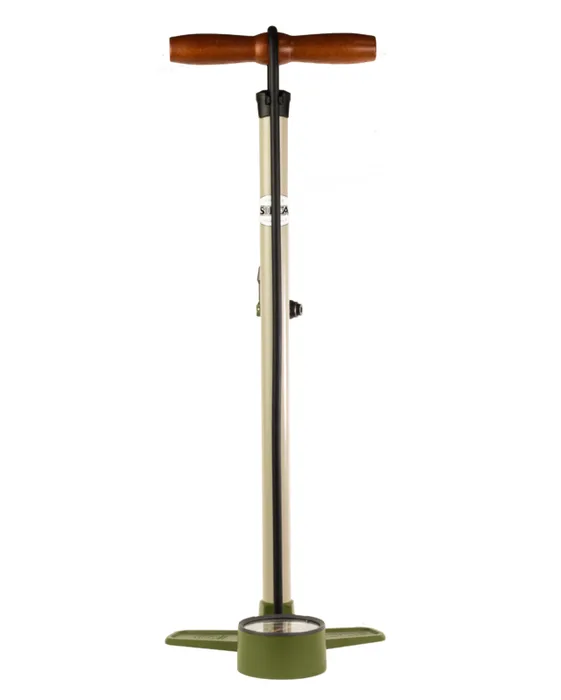
- Buy Silca Terra Floor Pump A track pump designed around a low-pressure gauge that still reaches road pressures, and the one here whose maker states what the dial can resolve. Amazon
- Buy Topeak JoeBlow Sport III The default sensible floor pump: steel barrel, hardened steel base, a head that takes three valve types without disassembly, and every wear part sold separately. Amazon
- It depends Topeak JoeBlow Booster A floor pump with a 1 litre air chamber built in, so it can blast a tubeless tyre onto the rim the way a shop compressor does. Amazon
- Skip Lezyne Steel Floor Drive 3.5 A beautifully made steel and wood pump whose headline spec, a 220 psi gauge, works against almost every rider who buys it. Amazon
What actually matters
- Gauge range - The maximum pressure on the dial sets how finely the needle can resolve any given reading, because the whole scale has to fit in the same arc. Pick the lowest range that still covers your highest tyre pressure with a little headroom.
- Accuracy basis - A percentage figure is meaningless until you know whether it refers to full scale or to the reading. Pressure gauge makers normally specify percentage of span, which is the harsher of the two at low readings.
- Chuck design - Press-on lever heads are quick, threaded heads grip harder and take longer, and two-port heads switch valve types without disassembly. This is the single biggest difference in daily use.
- Valve compatibility - Presta and Schrader are the two you will meet, with Dunlop a distant third. Check whether switching between them needs a flipped insert, a second port, or nothing at all.
- Rebuildability - Head seals, piston seals and check valves are consumables on any pump. A published spares list is the difference between a pump that lasts decades and one that goes in the bin.
- Barrel and base - A metal barrel resists the flex and cracking that kills plastic ones, and a wide, heavy base keeps the pump planted when you lean on the handle. Steel is heavier and tougher; aluminium is lighter and rust-free.
- Charge chamber - A pressurised reservoir that releases a large volume of air at once, which is what seats a tubeless bead. It makes a pump heavier and more expensive and does nothing for tubed tyres.
The specs, in plain English
Green flags vs red flags
Green flags
- The maximum pressure on the dial is close to, rather than far above, the highest pressure you actually run.
- The manufacturer publishes a numeric accuracy or precision figure for the gauge instead of an adjective.
- The head, hose, gauge and seal kits are all listed as replacement parts on the maker's own site.
- The head takes Presta and Schrader with no internal parts to change or lose.
- The barrel is steel or aluminium and the base is wide enough that the pump stays put under load.
Red flags
- A 200 psi or higher gauge on a pump marketed for mountain bikes, gravel bikes or general use.
- Accuracy described only as 'precision', 'oversized' or 'highly accurate' with no number attached.
- No spare chuck, seal kit or gauge listed anywhere on the manufacturer's site.
- A plastic barrel, or a narrow base that lifts when you push down on the handle.
- A tubeless claim on a pump that has no charge chamber, since a conventional barrel cannot deliver that flow rate.
Who's who: the brands
- Silca - The one maker here that publishes gauge accuracy and precision figures, sells gaskets, rebuild kits and replacement gauges, and builds a low-pressure-specific dial in the Terra.
- Topeak - A wide floor pump range that includes tubeless charge pumps, with published spares for heads, gauges and check valves but no published accuracy figures.
- Lezyne - Steel, alloy and CNC pumps with wood handles and threaded ABS chucks, plus separately sold replacement gauges including a 100 psi option for standard floor pumps.
- Park Tool - Home mechanic pumps with locking heads; the long-running PFP-8 (Presta, Schrader and Dunlop) has been discontinued and replaced by the PFP-10, whose page lists Presta and Schrader.
How to read a listing without getting fooled
Start at maximum pressure and treat it as a range selector rather than a performance figure, then check it against the highest pressure you personally use. Next, look for a numeric accuracy or precision claim and note whether it is expressed in psi or as a percentage; if it is a percentage, check whether the maker says of what, because percent of span and percent of reading are very different promises. Then read the head line carefully: the words to look for are which valve types it takes and whether switching between them requires changing or flipping a part. After that, confirm the barrel and base materials and the hose length, since a short hose forces you to move the bike. Finally, open the maker's spare parts page for that specific pump. If the chuck, the seal kit and the gauge are all listed, you are buying a tool. If they are not, you are buying a consumable.
How much should you spend?
Budget floor pumps get you a metal barrel, a workable base and a head that handles both common valve types, which covers the actual job of inflating a tyre. Mid-range money mostly buys structure and features rather than measurement: a heavier base, a longer hose, better handle ergonomics, or a tubeless charge chamber, which is the one feature genuinely worth stepping up for if you mount your own tubeless tyres. Premium pumps buy longevity and, occasionally, a gauge worth paying for, with all-metal construction, published accuracy or precision figures and a full spares catalogue that makes the pump rebuildable indefinitely. The trap is premium pumps that spend their price on materials and finish while fitting a gauge scaled far beyond any bicycle tyre, which is a lot of money for a nice object that tells you less than a cheap one.
Questions, answered
Should I buy a separate pressure gauge as well?
It is a reasonable move if you ride low pressures and your pump has a wide-range dial. A dedicated gauge with a narrow range can be read after inflating and used to trim down through the bleed valve. Check whether the standalone gauge publishes an accuracy figure, because many do not. Whatever you use, be consistent, since a repeatable reading you trust is more useful than chasing an absolute truth.
Is a digital gauge more accurate than a dial?
Not automatically. A digital display shows more decimal places, which reads as precision but says nothing about the accuracy of the sensor behind it. Some digital pumps do publish tighter figures, and Silca's SuperPista Digital states a 1 percent accurate gauge with a 0.5 psi readout, but plenty of digital gauges publish nothing at all. Digital also means batteries, and a display that is harder to read at a glance while pumping.
Why does my tyre read lower after I take the chuck off?
Some air escapes as the chuck comes off the valve, and on a press-on head that loss is a puff rather than a leak. The reading you saw on the gauge also includes the volume of the hose and pump head, which equalises with the tyre while connected. Neither effect is large on a road tyre, but on a small-volume or very low-pressure tyre it is worth measuring again after disconnecting. A bleed button lets you creep down to your target rather than repeatedly connecting and disconnecting.
Can I use a floor pump on a suspension fork or rear shock?
No. Suspension air springs need pressures in the hundreds of psi delivered into a tiny volume, and they require a threaded chuck that does not lose air on removal, which is what a dedicated shock pump provides. Using a floor pump risks damaging the shock's air valve and will not reach the pressures the fork needs. Shock pumps are a separate, inexpensive tool, and several of these brands make one.
Or jump to the head-to-head: Silca Terra Floor Pump vs Topeak JoeBlow Sport III.