

Cycling
The Best Bike Floor Pumps: 4 Compared (and One to Skip)
We compared four track pumps on the thing nobody checks: whether the gauge can actually resolve the pressure you ride at. Head design, rebuildability and tubeless capability decided the rest.
The short version
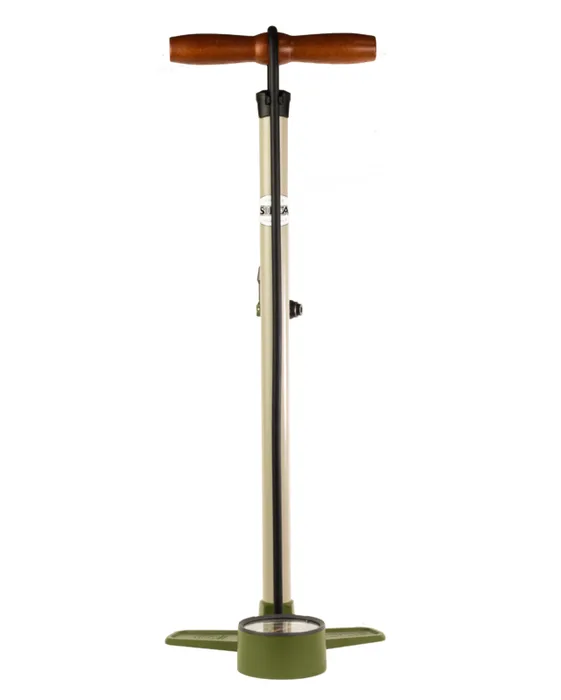
The Silca Terra wins because it is the one pump here that treats the gauge as the product: a two-stage non-linear dial that gives 0.5 psi precision at the low end and devotes half the dial face to 0 to 30 psi, while still going to 120 psi. The Topeak JoeBlow Sport III is the value pick, with a steel barrel, a hardened steel base, a two-port TwinHead DX that takes Presta, Schrader and Dunlop, and a full published spares list including the head, gauge and check valve. The Topeak JoeBlow Booster is the 'depends' pick: its 1 litre charge chamber genuinely seats stubborn tubeless tyres, but it weighs 2.9 kg and its 160 psi dial is poorly matched to the low-pressure tyres tubeless riders actually run. Skip the Lezyne Steel Floor Drive 3.5, a lovely object saddled with a 220 psi gauge and a chuck that threads onto the valve. Lezyne itself sells a 100 psi replacement gauge and says it 'allows for more precise pressure measurements', which tells you what the 220 psi dial costs you. If your tyres are wide, buy for the gauge range first and everything else second. Best for: riders who want the number on the dial to mean something, whatever pressure they run.
Our picks at a glance
- Silca Terra Floor Pump - Buy. A track pump designed around a low-pressure gauge that still reaches road pressures, and the one here whose maker states what the dial can resolve.
- Topeak JoeBlow Sport III - Buy. The default sensible floor pump: steel barrel, hardened steel base, a head that takes three valve types without disassembly, and every wear part sold separately.
- Topeak JoeBlow Booster - It depends. A floor pump with a 1 litre air chamber built in, so it can blast a tubeless tyre onto the rim the way a shop compressor does.
- Lezyne Steel Floor Drive 3.5 - Skip. A beautifully made steel and wood pump whose headline spec, a 220 psi gauge, works against almost every rider who buys it.
The verdict in 30 seconds
What mattered most
- Max pressure
- Gauge
- Published accuracy
- Head type
- Presta to Schrader
- Barrel and base
A floor pump is two tools bolted together: an air compressor you work with your legs, and a pressure gauge. The pump half is close to a solved problem, and almost any metal-barrelled track pump will fill a tyre. The gauge half is where the real differences hide, because a dial's usable resolution depends on its full-scale range, and the industry sells 220 psi dials to people who ride at 22 psi. We picked four pumps that show the whole spread, from a gauge built specifically for low pressure to one that is scaled for pressures no bicycle tyre should ever see.
A track pump designed around a low-pressure gauge that still reaches road pressures, and the one here whose maker states what the dial can resolve.
Best for: Anyone running gravel, mountain or wide road tyres who wants to hit a target pressure rather than guess at it.
- Two-stage non-linear gauge gives 0.5 psi precision at the low end and 2 psi at the high end, with half the dial face covering 0 to 30 psi.
- Rated to 120 psi, so one pump covers gravel, mountain and most road tyres without an oversized scale.
- All-metal construction with an aluminium barrel, a lever-locking metal chuck with an inline bleed button; Silca says replacement Terra chucks are available and sells gaskets, rebuild kits and gauges as parts.
- Switching between Presta and Schrader means unscrewing and flipping the threaded end cap, not just moving to a second port.
- Silca does not publish a hose length or a percentage accuracy figure for this gauge, only absolute precision claims.
- No charge chamber, so it is not a tubeless seating tool.
- Sits at the top of the price range for what is, mechanically, a conventional single-barrel pump.
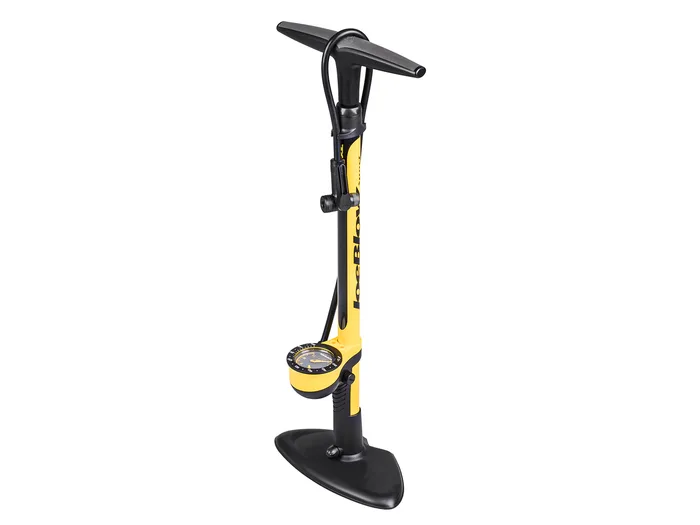
The default sensible floor pump: steel barrel, hardened steel base, a head that takes three valve types without disassembly, and every wear part sold separately.
Best for: A road, commuter or general household pump where you want durability and cheap spares rather than a precision instrument.
- TwinHead DX takes Presta, Schrader and Dunlop by moving to the appropriate port, with no internal parts to change.
- Painted steel barrel on a hardened steel base, with a 72 cm hose on a rotating connection, at a stated 1.68 kg.
- Topeak lists the head, gauge, gauge set, hose cap, check valve and a parts kit as replacement items, so the usual failure points are fixable.
- The 160 psi scale puts a 22 psi mountain bike tyre in the first quarter of the dial, where a commercial-grade gauge is at its least trustworthy.
- The 3 inch gauge is mid-mounted, so you read it lower down rather than at the top of the barrel.
- Topeak publishes no accuracy figure for this gauge.
- Ball and bladder needles are included but there is no tubeless charge function.
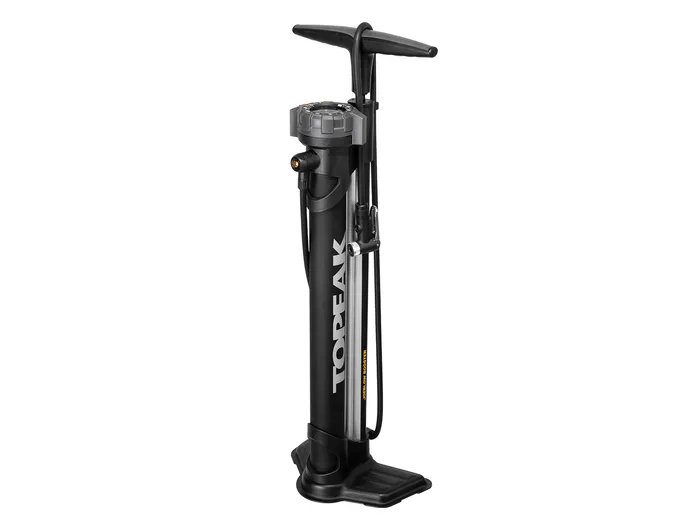
A floor pump with a 1 litre air chamber built in, so it can blast a tubeless tyre onto the rim the way a shop compressor does.
Best for: Riders who mount their own tubeless tyres at home and are tired of stubborn beads that will not seat.
- Integrated aluminium chamber stores a one litre charge up to 160 psi, then dumps it into the tyre when you flip the selector from CHARGE to INFLATE.
- SmartHead DX3 fits Presta and Schrader with no internal parts to change, and includes an air release button for backing off overshoot.
- Anodised aluminium barrel on a steel base with a long 152 cm hose, and Topeak sells the head, gauge, hose, check valve and parts kits separately.
- At a stated 2.9 kg and 74 cm tall it is a heavy, bulky thing to store next to a bike.
- The 3 inch top-mount dial reads to 160 psi, which is a poor match for the 18 to 35 psi tubeless tyres the pump exists to seat.
- You pay a clear premium over a plain floor pump for a feature you may use a handful of times a year.
- If you run inner tubes only, the charge chamber adds strokes and weight and gives you nothing.
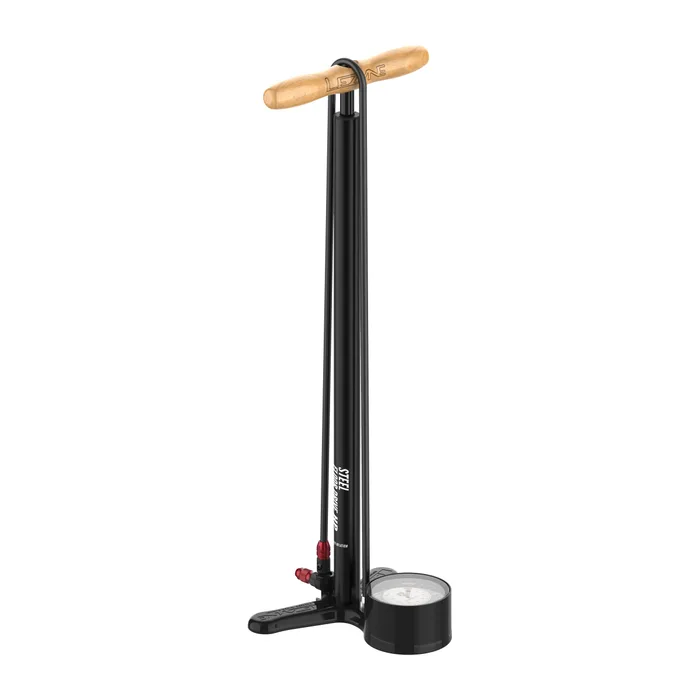
A beautifully made steel and wood pump whose headline spec, a 220 psi gauge, works against almost every rider who buys it.
Best for: Someone who specifically wants a threaded chuck and a steel and wood pump, and who rides at high enough pressures to use a 220 psi dial.
- Steel barrel and steel piston on a machined aluminium base with a varnished wood handle, at a stated 1616 g.
- Lezyne sells an HP Floor Pump O-Ring Kit with a replacement swivel and piston seal that fits the CNC, Alloy, Classic, Steel and Sport Floor Drives.
- Replacement 3.5 inch gauges are sold separately, including a 100 psi version that fits standard floor pumps.
- The 220 psi range squeezes almost every pressure a bicycle uses into the bottom half of the dial, and commercial-grade dial gauges are least accurate near the ends of their scale.
- Lezyne publishes no accuracy figure for the gauge, describing it only as 'highly accurate'.
- The ABS-1 Pro chuck threads onto the valve rather than pressing on, so every inflation involves screwing on and off, and switching valve types means flipping the insert.
- Lezyne's own 100 psi replacement gauge, listed for standard floor pumps, is sold on the promise of 'more precise pressure measurements', which says what a 220 psi dial gives up.
| Criteria | Terra Floor Pump Top pick | JoeBlow Sport III | JoeBlow Booster | Steel Floor Drive 3.5 |
|---|---|---|---|---|
| Verdict | Buy it | Buy it | It depends | Skip it |
| Best for | Anyone running gravel, mountain or wide road tyres who wants to hit a target pressure rather than guess at it. | A road, commuter or general household pump where you want durability and cheap spares rather than a precision instrument. | Riders who mount their own tubeless tyres at home and are tired of stubborn beads that will not seat. | Someone who specifically wants a threaded chuck and a steel and wood pump, and who rides at high enough pressures to use a 220 psi dial. |
| Price tier | $$$ · premium | $ · budget | $$ · mid-range | $$$ · premium |
| Max pressure | 120 psi | 160 psi | 160 psi | 220 psi |
| Gauge | Two-stage non-linear analog | 3 in mid-mount analog | 3 in top-mount analog | 3.5 in analog |
| Published accuracy | 0.5 psi low end, 2 psi high end | None published | None published | None published |
| Head type | Lever-locking metal chuck | TwinHead DX, two ports | SmartHead DX3, single port | ABS-1 Pro, threads on |
| Presta to Schrader | Unscrew and flip end cap | Move to the other port | No parts to change | Flip the chuck insert |
| Barrel and base | Aluminium barrel, all metal | Painted steel, hardened steel base | Anodised aluminium, steel base | Steel barrel, aluminium base |
| Hose length | Not published | 72 cm | 152 cm | Not published |
| Tubeless charge chamber | No | No | Yes, 1 litre | No |
Which one is right for you?
- Anyone running gravel, mountain or wide road tyres who wants to hit a target pressure rather than guess at it. Buy it Silca Terra Floor Pump
- A road, commuter or general household pump where you want durability and cheap spares rather than a precision instrument. Buy it Topeak JoeBlow Sport III
- Riders who mount their own tubeless tyres at home and are tired of stubborn beads that will not seat. It depends Topeak JoeBlow Booster
- Someone who specifically wants a threaded chuck and a steel and wood pump, and who rides at high enough pressures to use a 220 psi dial. Skip it Lezyne Steel Floor Drive 3.5
How we judged the field
Five things separate floor pumps, and only one of them is the pumping. First is gauge range relative to your tyres, because dial accuracy is specified as a percentage of the full scale rather than of the reading, so a big number on the dial buys you nothing and costs you resolution. Second is whether the maker publishes an accuracy figure at all, which almost none do. Third is the head: whether it presses on or threads on, whether it handles Presta and Schrader without you taking anything apart, and whether you can buy a replacement when the seals go, since head seals are the usual failure point. Fourth is structure, meaning a metal barrel and a base wide and heavy enough that the pump does not walk across the floor. Fifth is whether the pump is built to seat a tubeless tyre, which needs a charge chamber and is a separate product category rather than a premium version of the same thing.
The field splits cleanly along the gauge. At one end are pumps built around low or moderate pressure dials that resolve the 18 to 40 psi band where gravel and mountain tyres live. In the middle sit the 160 psi generalists, which are a fair compromise for a household with road and mountain bikes in it. At the far end are the 200 to 260 psi pumps, sold on the implication that a bigger number means a better pump, which is backwards. We picked one pump built specifically around low-pressure resolution, one steel-barrelled 160 psi generalist that is honest about being a generalist, one tubeless charge pump to show what that category actually is, and one expensive, well-made 220 psi pump to show what the wrong gauge range costs you.
Silca Terra Floor Pump
Buy itSilca’s Terra is the rare case of a pump designed backwards from the gauge. The dial uses a non-linear scale so that half the face covers 0 to 30 psi, which yields 0.5 psi precision at the low end climbing to 2 psi at the top of its 120 psi range. That is the single most useful engineering decision anyone has made in this category, because it means a 24 psi mountain bike tyre is read on a spread-out portion of the dial rather than squeezed into the first few degrees of needle travel. The rest is conventional Silca: an aluminium barrel, all-metal construction, an ash handle with a hose guide, and a lever-operated chuck with an inline bleed button. The compromise is at the head, where switching between Presta and Schrader means unscrewing and reversing a threaded end cap rather than simply moving to another port. Silca does not publish a hose length, and its own page lists the Terra as rated to 120 psi in the specs but says up to 110 psi in its FAQ. If you ride wide tyres and care what the number means, this is the one.
Topeak JoeBlow Sport III
Buy itThe JoeBlow Sport III is what most people should buy if they are not buying for the gauge. It is a painted steel barrel on a hardened steel base, 1.68 kg, with a 72 cm hose on a rotating connection so it does not tangle, and a TwinHead DX head that takes Presta, Schrader and Dunlop by moving to the appropriate port with no internal parts to change. Topeak publishes a spares list covering the head, the gauge, the gauge set, the check valve, the hose cap and a general parts kit, which is the difference between a pump you maintain and a pump you replace. The honest weakness is the gauge: a 3 inch mid-mount analog dial reading to 160 psi, with no published accuracy figure, which puts low mountain bike pressures down in the least trustworthy part of the scale. For road tyres it is fine. For a household with a road bike, a kid’s bike and a commuter, it is the sensible default.
Topeak JoeBlow Booster
It dependsThe JoeBlow Booster is a floor pump with an air compressor’s trick built in. A cylindrical aluminium chamber wrapped around the barrel stores a one litre charge at up to 160 psi, and flipping the selector from CHARGE to INFLATE dumps that charge into the tyre in one burst, which is what actually pops a stubborn tubeless bead onto a rim. In INFLATE mode air bypasses the chamber and it works as a normal pump. The head is a SmartHead DX3 with an air release button, fitting Presta and Schrader with no parts to change, on a long 152 cm hose. The costs are real: 2.9 kg, 74 cm tall, and a price step over a plain pump. The irony is the gauge, a 160 psi top-mount analog dial with no published accuracy figure, on a tool whose entire purpose is tubeless tyres that mostly run under 35 psi. Buy it if you mount your own tubeless tyres. Skip it if you do not.
Lezyne Steel Floor Drive 3.5
Skip itThe Lezyne Steel Floor Drive 3.5 is genuinely well made. Steel barrel, steel piston, machined aluminium base, varnished wood handle, 1616 g, and Lezyne sells an o-ring kit with a replacement swivel and piston seal that covers most of the Floor Drive family. The problem is that its defining specification is a 220 psi maximum with a 3.5 inch dial to match, a range that only a narrow slice of track and tubular riders will ever approach. Because dial gauges are specified as a percentage of span, stretching the scale to 220 psi widens the tolerance band across every pressure you will ever use, and pushes normal riding pressures into the lower part of the dial where commercial-grade gauges are least accurate. Lezyne publishes no accuracy figure, only the phrase ‘highly accurate’. It also sells a 100 psi replacement gauge for standard floor pumps on the promise of ‘more precise pressure measurements’, which is a quiet admission. Add a chuck that threads onto the valve every time and needs its insert flipped to change valve types, and there are better ways to spend this money.
Sources
Specs in this review come from these pages.
- SILCA - Terra Floor Pump product page (silca.cc)
- SILCA - Pista Plus Floor Pump product page (silca.cc)
- Topeak - JoeBlow Sport III product page (topeak.com)
- Topeak - JoeBlow Booster product page (topeak.com)
- Lezyne - Steel Floor Drive 3.5 product page (ride.lezyne.com)
- Ashcroft - pressure gauge accuracy, 3-2-3 percent of span explained (ashcroft.com)
Silca Terra Floor Pump vs Topeak JoeBlow Sport III: which should you buy?
The Terra and the JoeBlow Sport III solve the same job at opposite ends of the market, and the gap between them is almost entirely the gauge. Mechanically they are close cousins: metal barrel, stable base, long hose, lever head, decades-old technology executed properly. The Terra costs far more and gives you a dial that devotes half its face to 0 to 30 psi and a stated 0.5 psi of precision down there, plus replacement chucks and a parts range of gaskets, rebuild kits and gauges. The Sport III gives you a heavier steel structure, a three-valve head that switches without touching anything, and a 160 psi dial with no published accuracy claim whatsoever.
Choose by tyre width, not by budget. If your narrowest tyre is 35 mm or wider and you run under 45 psi, the Terra’s gauge is the whole reason to buy it, and the difference between 22 and 26 psi in a mountain bike tyre is something you feel on every corner. If you mostly inflate 25 to 32 mm road tyres to 60 to 90 psi, a 160 psi dial is reading in a sensible part of its range, the Sport III’s structure is arguably tougher, and the money saved is real. If you have both kinds of bike in the garage and only want one pump, the Terra covers the range; the alternative is two cheaper pumps, one with a low-range gauge.
What to look for
- Match the gauge to your tyres: a dial’s tolerance is a percentage of its full scale, so pick the lowest maximum pressure that comfortably covers what you ride, rather than the highest number on the shelf.
- Treat unpublished accuracy as unknown: most makers print no accuracy figure at all, so ‘highly accurate’ and ‘precision gauge’ in the copy are marketing rather than specification.
- Check how the head switches valve types: a two-port head or a single head with no internal parts to change is faster and less losable than a threaded insert you have to unscrew and flip.
- Confirm the head is a replaceable part: head seals wear out first, so look for a published replacement chuck or rebuild kit before you buy, not after it starts leaking.
- Insist on a metal barrel and a wide base: a steel or aluminium barrel with a broad, heavy foot stops the pump twisting and walking when you put weight through the handle.
- Only pay for a charge chamber if you seat your own tubeless tyres: it is a genuinely different tool, and it adds weight, bulk and cost that do nothing for anyone running inner tubes.
Our final take
Buy the pump whose gauge can resolve the pressure you actually ride at, and everything else follows. The Silca Terra is the best of these because its two-stage dial spends its resolution where wide modern tyres live while still reaching 120 psi, and because Silca is one of the few makers willing to publish what its gauge can do. The Topeak JoeBlow Sport III is the honest cheap answer: tough, fully rebuildable, three valve types on one head, and a gauge that is fine for road pressures if unremarkable elsewhere. Add the JoeBlow Booster only if stubborn tubeless beads are a problem you have. Leave the 220 psi pumps to whoever thinks a bigger number is a better pump.
Questions, answered
Why does a 220 psi gauge matter if I only pump to 30 psi?
Because dial gauge accuracy is normally specified as a percentage of span, meaning the full scale, rather than a percentage of the number you are reading. Ashcroft, a pressure gauge manufacturer, describes commercial-grade gauges as typically 3-2-3 percent of span: 3 percent in the first quarter of the scale, 2 percent through the middle half, and 3 percent again in the last quarter. Run that arithmetic on a 220 psi dial and the first quarter of the scale carries a tolerance band of about 6.6 psi. That is a rounding error on a 100 psi road tyre and a completely different tyre on a 25 psi mountain bike. The same tolerance on a 120 psi dial is about 3.6 psi, and on a gauge that dedicates half its face to 0 to 30 psi it is smaller again. This is why range matters more than the word 'accurate' in the marketing copy.
Do any pump makers actually publish a gauge accuracy number?
Very few. Silca is the exception we found: the Pista Plus page states the 64 mm gauge is 'accurate to 2%', and the Terra page states 0.5 psi precision at the low end climbing to 2 psi at the high end. Even Silca's percentage claim does not say whether it is 2 percent of full scale or 2 percent of reading, which are meaningfully different things. Topeak lists no accuracy figure on the JoeBlow Sport III or Booster pages. Lezyne describes its 3.5 inch dial as 'highly accurate' without a number. If a specification is not published, treat it as unknown rather than good.
Is a screw-on chuck better than a press-on one?
Not inherently, and for most people it is worse. A threaded chuck like Lezyne's ABS-1 Pro grips the valve securely and will not blow off at high pressure, which matters for track tyres and some tubulars. The cost is that you thread it on and off for every single inflation, and switching between Presta and Schrader means flipping the insert. A lever-locking press-on head, like Silca's Terra chuck or Topeak's SmartHead, goes on and comes off in a second and holds fine at any pressure a road tyre reaches. A two-port head like Topeak's TwinHead DX is the most convenient of all, since you just move to the other port. Choose threaded only if you have a specific reason to.
Do I need a tubeless-specific pump with a charge chamber?
Only if you mount your own tubeless tyres and have had beads refuse to seat. Seating a tubeless bead needs a large, fast volume of air, which a normal floor pump cannot deliver no matter how hard you push, because it meters air out one stroke at a time. A charge chamber like the one in the Topeak JoeBlow Booster stores a litre of air at up to 160 psi and releases it in one burst, doing the job a shop compressor does. If you run inner tubes, or you have tubeless tyres fitted at a shop, the chamber is dead weight. It is a genuinely different product rather than a better version of the same one.
How often does a floor pump actually fail, and can I fix it?
The head seals go first, usually as a slow leak or a chuck that no longer grips the valve, followed by the piston seal and the check valve. All of these are consumable parts rather than defects. Topeak lists parts kits, check valves, gauges and complete replacement heads for the JoeBlow Sport III and Booster. Lezyne sells an HP Floor Pump O-Ring Kit containing a swivel and a piston seal that covers most of its Floor Drive range, plus replacement gauges. Silca sells gaskets, rebuild kits and gauges as parts, and says replacement Terra chucks are available. Before you buy, check that the specific pump has a published spares list, because a sealed pump with no parts is a disposable one.
Deciding between the top two? See our head-to-head: Silca Terra Floor Pump vs Topeak JoeBlow Sport III.
More Cycling reviews
 The Best Bike Frame Protection: 4 Compared (and One to Skip)
  The Best Bike Grips: 4 Compared (and One to Skip)
  The Best Bike Lights: 4 Compared (and One to Skip)
  The Best Bike Locks: 4 Compared (and One to Skip)
  The Best Bike Mirrors: 4 Compared (and One to Skip)
  The Best Bike Multitools: 4 Compared (and One to Skip)