

Cycling
The Best Bike Mirrors: 4 Compared (and One to Skip)
We compared bar-end mirrors for flat bars, a drop-bar mirror and a popular mini strap-on mirror on mirror size, mounting, weight and how well each holds its view.
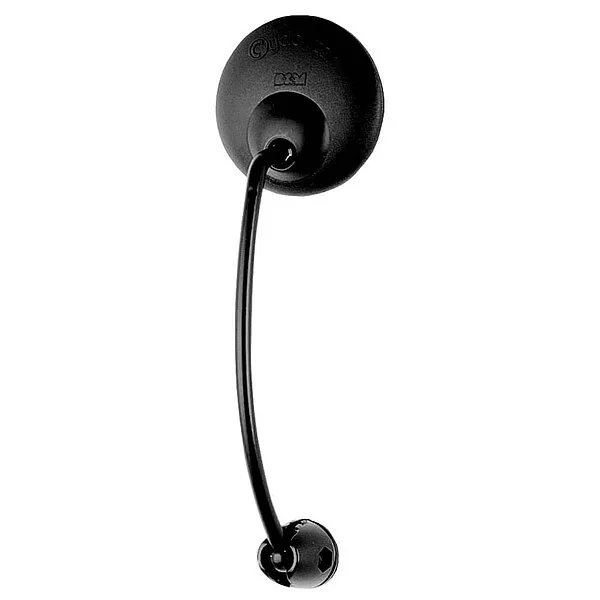
The short version
The Busch+Müller Cycle Star 901 is our pick for flat bars: a strongly curved 60 mm glass mirror with shatter protection, a mount that fixes inside the bar end and a body that folds in, all at 50 g. The Zéfal Cyclop is the value pick, a 46 cm² bar-end mirror with three axes of adjustment that folds under the bar. The Sprintech Racing is the one for road bikes with drop bars, at 24 g, but it only suits that handlebar shape. Skip the Zéfal Spy 15 for traffic riding: it is a mini mirror on a silicone strap, and a small mirror shows you less of the road behind. Best for: commuters and touring riders on flat-bar bikes.
Our picks at a glance
- Busch+Müller Cycle Star 901 - Buy. A bar-end mirror with strongly curved 60 mm glass and a stable mount inside the handlebar.
- Zéfal Cyclop - Buy. An affordable bar-end mirror with a 46 cm² mirror that folds under the handlebar.
- Sprintech Racing Drop Bar Mirror - It depends. A sleek 24 g mirror that continues the line of a drop handlebar, made for road bikes.
- Zéfal Spy 15 - Skip. A tiny strap-on mirror that fits almost anywhere but shows too little of the road for traffic riding.
The verdict in 30 seconds
What mattered most
- Mount
- Handlebar type
- Mirror
- Weight
- Folds
- Left or right
A mirror lets you check traffic without turning your head and wobbling your line, which is why commuters and touring riders swear by them. The catch is that mirror size, mounting and handlebar type decide whether you actually get a useful view. We compared a premium bar-end mirror, a well-priced folding bar-end mirror, a sleek mirror for drop bars and a popular mini mirror that straps on anywhere.
A bar-end mirror with strongly curved 60 mm glass and a stable mount inside the handlebar.
Best for: Commuters and touring riders on flat or upright handlebars who want the clearest view.
- Busch+Müller says the pronounced curvature gives an extra large field of vision, and the glass is protected against shattering.
- The aluminum internal handlebar mount (17.2 to 20 mm) is especially sturdy, with optional mounts for smaller bars.
- Extremely adjustable, folds in, fits left or right and weighs about 50 g.
- Needs an open bar end with a compatible inner diameter, so check your grips and bar before buying.
- The 13 cm arm sticks out beyond the bar, which can catch in tight bike parking.
- Busch+Müller lists city and touring bikes as its field of use, not drop-bar road bikes.
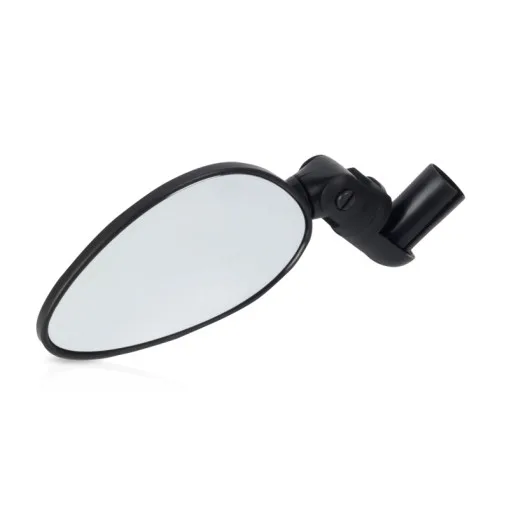
An affordable bar-end mirror with a 46 cm² mirror that folds under the handlebar.
Best for: Budget-minded commuters who want a proper bar-end mirror that tucks away.
- 46 cm² mirror area, larger than Zéfal's mini mirrors.
- Three axes of orientation let you fine-tune the view to your riding position.
- Folds under the handlebar for storage or when passing between vehicles, fits either side and is made in France.
- Chrome-plated ABS mirror rather than glass.
- Mounts at the bar end, so it needs a flat or upright handlebar with an open end.
- Zéfal publishes the mirror area but no weight for this model.
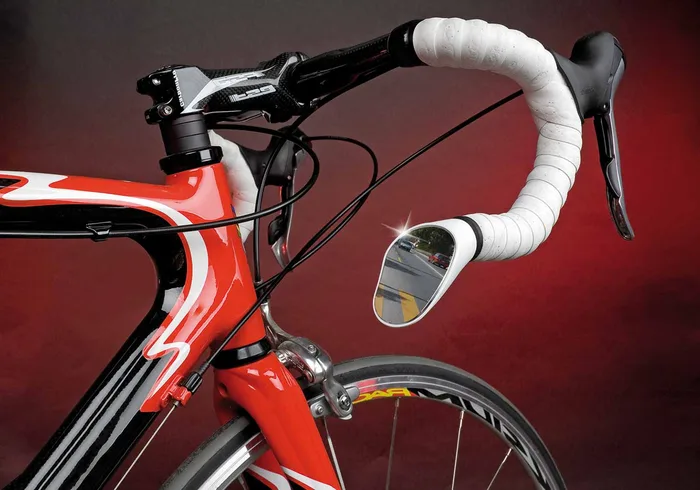
A sleek 24 g mirror that continues the line of a drop handlebar, made for road bikes.
Best for: Road and gravel riders on drop bars who want a clean, low-profile mirror.
- Designed as a continuation of the drop bar, so it looks and feels integrated on a road bike.
- Impact-resistant plastic with a slightly convex mirror coated in 9 chrome layers for a wide view.
- Light at 24 grams, made in Switzerland and sold in 6 colors.
- Only suits drop handlebars; flat-bar riders need a different mirror.
- Sits low at the end of the drops, so the view changes as you move your hands and head.
- Sprintech calls it absolutely vibration-free, but rough roads test any mirror.
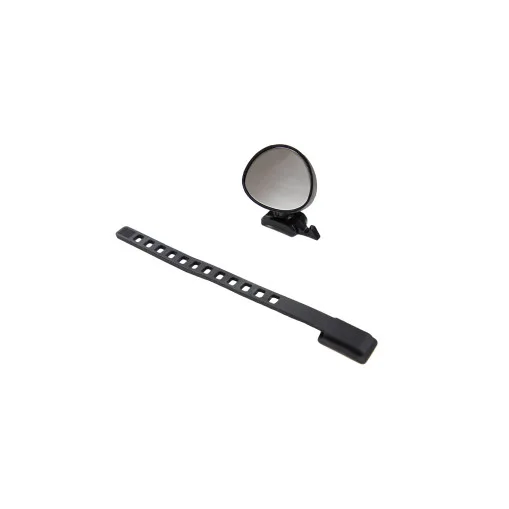
A tiny strap-on mirror that fits almost anywhere but shows too little of the road for traffic riding.
Best for: Occasional riders who want a quick glance behind on quiet roads or trails.
- Fits tubes from 22 mm to 86 mm, so it mounts on handlebars, stems or forks.
- Tool-free silicone strap and unbreakable chrome-plated ABS mirror.
- Small, light and discreet on road, gravel and mountain bikes.
- It is a mini mirror; a small mirror shows less of the road behind than the larger mirrors here.
- Zéfal describes the view as sufficient, not wide.
- A stretchy strap mount is easier to knock out of alignment than a bar-end or clamped mount.
- Riders who rely on a mirror in traffic tend to outgrow it.
| Criteria | Busch+Müller Cycle Star 901 Top pick | Zéfal Cyclop | Sprintech Racing Drop Bar Mirror | Zéfal Spy 15 |
|---|---|---|---|---|
| Verdict | Buy it | Buy it | It depends | Skip it |
| Best for | Commuters and touring riders on flat or upright handlebars who want the clearest view. | Budget-minded commuters who want a proper bar-end mirror that tucks away. | Road and gravel riders on drop bars who want a clean, low-profile mirror. | Occasional riders who want a quick glance behind on quiet roads or trails. |
| Price tier | $$ · mid-range | $ · budget | $$ · mid-range | $ · budget |
| Mount | Inside the bar end | Bar end | End of drop bar | Silicone strap, 22 to 86 mm tubes |
| Handlebar type | Flat or upright | Flat or upright | Drop bars | Any tube |
| Mirror | 60 mm convex glass, shatter protected | 46 cm² chrome-plated ABS | Slightly convex, 9 chrome layers | Mini chrome-plated ABS |
| Weight | About 50 g | Not published | 24 g | Not published |
| Folds | Yes | Yes, under the bar | Not listed | Not listed |
| Left or right | Either | Either | Not listed | Several positions |
| Made in | Not listed | France | Switzerland | Not listed |
| Best for | Commuting, touring | Budget commuting | Road bikes | Occasional quick glances |
Which one is right for you?
- Commuters and touring riders on flat or upright handlebars who want the clearest view. Buy it Busch+Müller Cycle Star 901
- Budget-minded commuters who want a proper bar-end mirror that tucks away. Buy it Zéfal Cyclop
- Road and gravel riders on drop bars who want a clean, low-profile mirror. It depends Sprintech Racing Drop Bar Mirror
- Occasional riders who want a quick glance behind on quiet roads or trails. Skip it Zéfal Spy 15
How we judged the field
Five things decide whether a bike mirror earns its place: how much of the road it shows, how steady the mount is, whether it fits your handlebar, whether it folds out of the way and how much it weighs. The view comes from mirror size and curvature. A steady mount keeps that view from shaking or drifting. Handlebar fit matters because flat bars, drop bars and strap-on mounts need very different designs.
The field splits into bar-end mirrors for flat and upright bars, mirrors built for drop bars, helmet or eyeglass mirrors and small strap-on mirrors. We picked a premium bar-end mirror, a budget bar-end mirror, a drop-bar mirror and a popular mini strap-on mirror, then compared them on what each maker publishes about size, mount and weight.
The Busch+Müller Cycle Star 901 is the mirror we would fit to a commuter or touring bike. Its glass has a pronounced curvature that Busch+Müller says gives an extra large field of vision, and the glass is protected against shattering. The mount is the other reason to buy it: an aluminum fitting that sits inside the handlebar end, which Busch+Müller describes as especially sturdy, with optional mounts for smaller bar diameters. The black casing is extremely adjustable, folds in when you park and fits either side of the bar, all at about 50 g. The limits are practical. You need an open bar end with a compatible inner diameter, so some grips need trimming or swapping, and the 13 cm arm sticks out beyond the bar. It is made for city and touring bikes, not drop bars. On a flat-bar bike used in traffic, it gives the clearest, steadiest view here.
The Zéfal Cyclop is the budget bar-end mirror to buy. Its 46 cm² mirror is far larger than Zéfal’s mini mirrors, and three axes of orientation let you set the view precisely for your riding position. It folds under the handlebar, which protects it when the bike is parked and lets you tuck it away when squeezing between vehicles, and it fits either side of the bar. It is made in France. The mirror is chrome-plated ABS rather than glass, which is less crisp but will not shatter, and Zéfal does not publish a weight. Like any bar-end mirror, it needs a flat or upright handlebar with an open end. For most commuters who want a proper mirror without paying premium prices, it does the job well and costs little.
The Sprintech Racing solves a problem the bar-end mirrors cannot: drop handlebars. It is shaped as a continuation of the drop bar, so on a road bike it looks integrated rather than bolted on. Sprintech makes it from impact-resistant plastic with a slightly convex mirror coated in 9 chrome layers for a wide view, and it weighs just 24 grams. It is made in Switzerland, sold in 6 colors and was an award winner at an innovation competition in 1996. The trade-offs come from its position. It only suits drop bars, it sits low at the end of the drops, and your view shifts as you change hand positions, so it takes some adjustment to find an angle that works. Sprintech calls it absolutely vibration-free; rough roads will be the real test. If you ride a road or gravel bike and want a mirror, this is the design to look at.
The Zéfal Spy 15 is one of the easiest mirrors to fit, and that is its appeal. A silicone strap wraps around tubes from 22 mm to 86 mm, so it goes on handlebars, stems or forks without tools, and the chrome-plated ABS mirror is unbreakable. It is small, light and discreet. The problem is the size. It is a mini mirror, and a small mirror shows you less of the road behind than the larger mirrors in this comparison. Zéfal itself describes the view as sufficient rather than wide. A stretchy strap is also easier to knock out of alignment than a mount that sits inside the bar or clamps in place. For a quick glance on quiet roads or trails, it is fine. If you want a mirror because you ride in traffic, a larger bar-end or drop-bar mirror is the better buy.
Busch+Müller Cycle Star 901 vs Zéfal Cyclop: which should you buy?
The Busch+Müller Cycle Star 901 and the Zéfal Cyclop are both bar-end mirrors for flat and upright bars, and both fold. The Cycle Star uses curved glass with shatter protection and a sturdy internal mount, which gives the clearest, steadiest view. The Cyclop uses chrome-plated ABS, costs less and still offers a 46 cm² mirror with three axes of adjustment.
If you commute daily in traffic or ride long touring days, the Cycle Star is worth the extra money for its view and mount. If you ride less often or want a mirror you will not worry about in bike racks, the Cyclop covers most of what matters. Drop-bar riders should skip both and look at the Sprintech Racing.
What to look for
- Fit for your handlebar: bar-end mirrors suit flat bars, while drop bars need a dedicated design.
- Mirror size and curvature: a larger, convex mirror shows more of the road behind you.
- A steady mount: internal bar-end and clamped mounts hold their angle better than stretchy straps.
- Folding: a mirror that folds survives bike racks and tight gaps.
- Glass or plastic: glass looks crisper; chrome-plated plastic will not shatter.
- Adjustability: several axes of adjustment let you match the mirror to your riding position.
Our final take
For flat-bar commuting and touring, buy the Busch+Müller Cycle Star 901: its curved, shatter-protected glass and internal bar-end mount give the clearest and steadiest view. The Zéfal Cyclop is the value choice, with a 46 cm² folding mirror for a lot less money. Drop-bar riders should look at the Sprintech Racing, which suits that handlebar shape at just 24 g. Skip mini strap-on mirrors like the Zéfal Spy 15 if you ride in traffic; they fit anywhere, but they show too little of what is behind you. Whichever you choose, match it to your handlebar first.
Questions, answered
Is a bike mirror worth it?
For riding in traffic, a good mirror lets you check behind you without turning your head, which helps you hold a straight line. It does not replace a shoulder check before you change lanes or turn. Commuters and touring riders tend to value mirrors most. On quiet trails, many riders do without.
Bar-end, helmet or strap-on: which is best?
Bar-end mirrors are stable and give a consistent view, which suits commuting on flat bars. Helmet and eyeglass mirrors move with your head, so you can scan by turning slightly, but they take getting used to. Strap-on mini mirrors are the easiest to fit anywhere but usually offer the smallest view. Your handlebar type often decides the question.
Do mirrors work on drop handlebars?
Yes, but you need a mirror designed for drops, like the Sprintech Racing, which sits at the end of the drop bar. Flat-bar bar-end mirrors do not fit that shape well. Because your hand position changes on drop bars, expect to adjust the angle until it suits your usual position.
Why are bike mirrors convex?
A convex, outward-curved mirror shows a wider area behind you in a small mirror. The trade-off is that objects look smaller and farther away than they are. Busch+Müller calls this out as a pronounced curvature for an extra large field of view. Take time to learn how distances look before relying on it in traffic.
How do I stop my mirror from vibrating?
Tighten the mount properly and keep the arm as short as your view allows. Internal bar-end mounts and clamped mounts are generally steadier than stretchy straps. Check the angle after a few rides, since mounts can settle.
Deciding between the top two? See our head-to-head: Busch+Müller Cycle Star 901 vs Zéfal Cyclop.
More Cycling reviews
 The Best Bike Multitools: 4 Compared (and One to Skip)
  The Best Bike Panniers: 4 Compared (and One to Skip)
  The Best Bike Phone Mounts: 4 Compared (and One to Skip)
  The Best Car Bike Racks: 4 Compared (and One to Skip)
  The Best Bike Repair Stands: 4 Compared (and One to Skip)
  The Best Bike Saddles: 4 Compared (and One to Skip)