

Cycling
The Best Bike Multitools: 4 Compared (and One to Skip)
We compared four bicycle multitools on the things that decide whether you ride home or walk: the hex sizes and T25 you actually use, whether the chain tool can be worked in the field, whether there is any way to carry and fit a quick link, and what each one does about torque.
The short version
The Wolf Tooth 8-Bit Kit One wins because it treats a broken chain as a two-part problem: it has a proper chainbreaker driven by an included 3 mm L key, and master link pliers with storage for the spare link that is the actual fix. The Topeak Mini PT30 is the value pick and gets you most of the way there in one 169 g body, with a removable chain tool, a separate master link tool, a link storage compartment and tools that extend for leverage. Fix It Sticks Multi-Tool Cycling suits the carbon-bike rider who cares more about not cracking a seatpost than about chain repair, because its two steel sticks form a real T handle and accept Fix It Sticks torque limiters from 1 to 6 Nm. It ships with no chain tool, no lever and no torque limiter, so it is a system you build rather than a tool you buy. Skip the Crankbrothers M20: it is the heaviest here at 203 g, and Crankbrothers lists its chain tool as chain-breaking only, so the twenty functions buy you a way to open a chain but no way to close it. Best for: riders who want the two tools that end a ride, a usable chain fix and a T25, rather than the biggest number on the packaging.
Our picks at a glance
- Wolf Tooth Components 8-Bit Kit One - Buy. Three nesting tools that split the job properly, so the chainbreaker has a handle and the quick link has a home.
- Topeak Mini PT30 - Buy. The one-body tool that still gets the chain right, with a removable chain tool, a separate master link tool and somewhere to keep the link.
- Fix It Sticks Multi-Tool Cycling - It depends. Two steel sticks that lock into a T handle, and the one design here that can be turned into a torque-controlled tool.
- Crankbrothers M20 - Skip. Twenty functions and 203 g, with a chain tool Crankbrothers itself describes as chain-breaking only.
The verdict in 30 seconds
What mattered most
- Published weight
- Hex sizes
- Torx
- Chain tool
- Quick link handling
- Tyre lever
Function count is the number printed on the box, and it is close to useless. A modern bike hands you a short list of fasteners: mostly 4, 5 and 6 mm hex, plus T25 Torx on disc rotor bolts and some stem and bar hardware. What separates a multitool that saves your ride from one that just adds weight to your jersey is whether it covers that short list properly, whether its chain tool is a real tool with a real handle, and whether you have a quick link and somewhere to keep it. We picked four tools that sit at very different points on that trade-off.
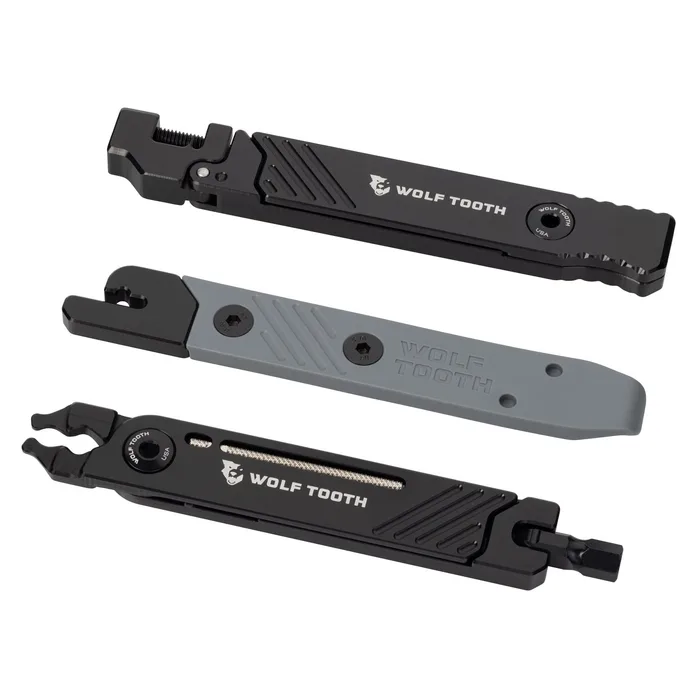
Three nesting tools that split the job properly, so the chainbreaker has a handle and the quick link has a home.
Best for: The rider who wants one kit that handles a snapped chain, a rotor bolt and a tyre without borrowing anything.
- Master link pliers open and close 9 to 12 speed links, with built-in master link storage for the spare link.
- The chainbreaker is a separate tool driven by an included 3 mm hex L key, so you are not pushing a rivet with a folded plate.
- Wolf Tooth publishes a max torque for each bit, including 40 Nm for the 8 mm hex and 20 Nm for the 4, 5, 6 mm and T25 bits.
- By far the most expensive tool here, and you are buying three separate objects that can be separated and lost.
- Master links are not included, so you have to buy and load the link yourself.
- Wolf Tooth notes the pliers do not work with Campagnolo 12 speed chains and the link storage does not take Wippermann Connex links.
- The 5 and 6 mm bits are rated to 20 Nm, which Wolf Tooth says may not be enough for pedals or a seized axle.
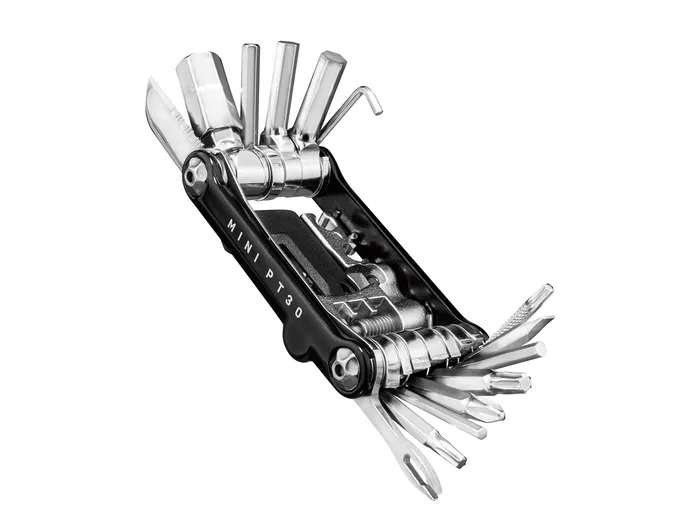
The one-body tool that still gets the chain right, with a removable chain tool, a separate master link tool and somewhere to keep the link.
Best for: Most riders, who want one tool in the saddle bag that can actually finish a chain repair.
- The CrMo chain tool comes out of the body to be used, and there is a separate CrMo master link tool alongside it.
- Topeak lists a master link storage compartment and a chain hook, so the spare link and the slack chain are both handled.
- Three Torx sizes including T25, seven hex sizes plus a 10 mm socket, and tools that extend from the body for extra leverage.
- No tyre lever at all, so you still carry a pair separately.
- Nothing here measures or limits torque, which matters on a carbon post or bar clamp.
- The tyre plug insertion tool is built in but Topeak does not include the plugs.
- Topeak notes the chain tool does not cover Campagnolo hollow pin chains.
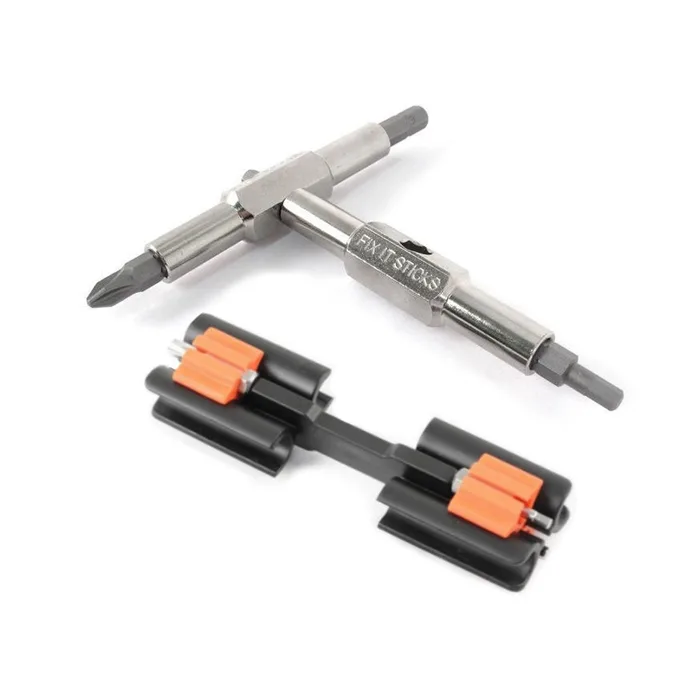
Two steel sticks that lock into a T handle, and the one design here that can be turned into a torque-controlled tool.
Best for: Riders with carbon bars, stems or seatposts who would rather carry a torque limiter than a chain tool.
- The T handle gives you leverage and a straight push on the bolt, which a folding body cannot match.
- Fix It Sticks sells Newton-meter torque limiters from 1 to 6 Nm, quoted at plus or minus 6 percent and rated for up to 20,000 cycles.
- At 116 g with bits and bracket it is the lightest tool here, and the bracket holds up to 18 quarter inch bits of your choosing.
- No chain tool in the box, and the Fix It Sticks chain breaker is a separate 51 g purchase.
- No tyre lever and no quick link storage in the box either, so the full kit costs more and packs bigger than the sticker suggests.
- The supplied bit set is hex 2 to 6 mm, T25 and Phillips #2 only, with no 8 mm and no spoke wrench.
- Fix It Sticks says its chain breaker is not compatible with Campagnolo 11 speed chains.
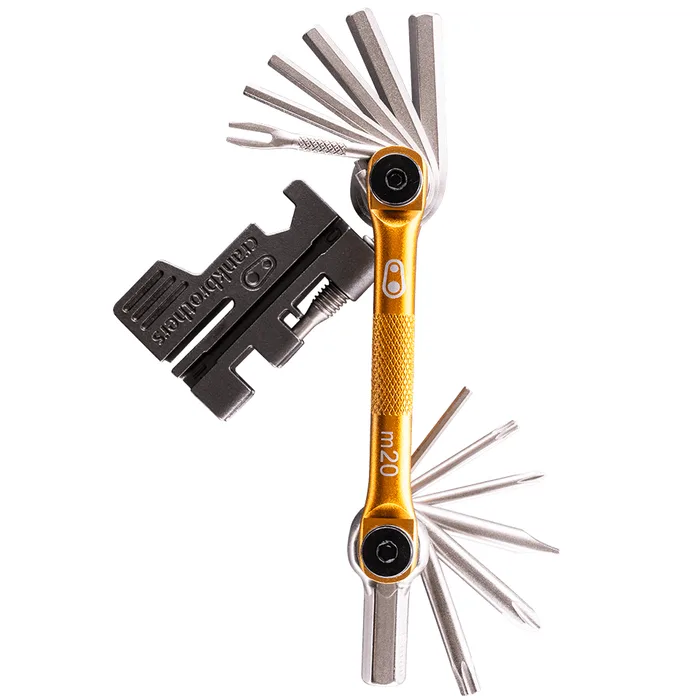
Twenty functions and 203 g, with a chain tool Crankbrothers itself describes as chain-breaking only.
Best for: Somebody who wants every bit size in one folding body and does not expect to repair a chain on the trail.
- The bit coverage is genuinely complete, with 2 to 8 mm hex, T10 and T25, three spoke wrenches and three screwdrivers.
- The included plug case mounts to the tool and Crankbrothers says it can also be used to store chain links.
- High tensile steel tools and a tyre plug tool with plugs supplied, so tubeless punctures are covered out of the box.
- At 203 g it is the heaviest tool here, roughly 34 g more than the Topeak and 87 g more than the Fix It Sticks.
- Crankbrothers lists the chain tool as 8 to 12 speed for chain-breaking only, with no master link function.
- The folding plate body puts your hand close to the bolt, which is the wrong shape for a tight stem or crank bolt.
- Nothing in the spec addresses torque, and several of the functions duplicate kit most riders already carry.
| Criteria | 8-Bit Kit One Top pick | Mini PT30 | Multi-Tool Cycling | M20 |
|---|---|---|---|---|
| Verdict | Buy it | Buy it | It depends | Skip it |
| Best for | The rider who wants one kit that handles a snapped chain, a rotor bolt and a tyre without borrowing anything. | Most riders, who want one tool in the saddle bag that can actually finish a chain repair. | Riders with carbon bars, stems or seatposts who would rather carry a torque limiter than a chain tool. | Somebody who wants every bit size in one folding body and does not expect to repair a chain on the trail. |
| Price tier | $$$ · premium | $$ · mid-range | $$ · mid-range | $$ · mid-range |
| Published weight | 171 g for all three tools | 169 g | 116 g with bits and bracket | 203 g |
| Hex sizes | 2, 2.5, 3, 4, 5, 6 mm bits plus 8 mm swivel head | 2L, 2.5, 3, 4, 5, 6, 8 mm plus 10 mm socket | 2, 2.5, 3, 4, 5, 6 mm | 2, 2.5, 3, 4, 5, 6, 8 mm |
| Torx | T10, T25 | T10, T15, T25 | T25 | T10, T25 |
| Chain tool | Separate chainbreaker, 3 mm L key drive | Removable CrMo tool, up to 12 speed | Not included, sold separately | Integrated, 8 to 12 speed, chain-breaking only |
| Quick link handling | Master link pliers plus master link storage | CrMo master link tool plus storage compartment | None | Plug case can hold chain links |
| Tyre lever | Separate nylon composite lever included | None, tyre reamer and plug tool only | Sold separately | None, tyre plug tool with plugs |
| Torque feature | Max torque published per bit, no measurement | None listed | 1 to 6 Nm torque limiters sold separately | None listed |
| Body and leverage | Aluminium handles, bendable swivel head acts as breaker bar | Forged aluminium body, tools extend for leverage | Two steel sticks form a T handle | Folding steel plates |
Which one is right for you?
- The rider who wants one kit that handles a snapped chain, a rotor bolt and a tyre without borrowing anything. Buy it Wolf Tooth Components 8-Bit Kit One
- Most riders, who want one tool in the saddle bag that can actually finish a chain repair. Buy it Topeak Mini PT30
- Riders with carbon bars, stems or seatposts who would rather carry a torque limiter than a chain tool. It depends Fix It Sticks Multi-Tool Cycling
- Somebody who wants every bit size in one folding body and does not expect to repair a chain on the trail. Skip it Crankbrothers M20
How we judged the field
Five things decide whether a multitool earns its place. First, bit coverage where it counts: 4, 5 and 6 mm hex handle most of what you will touch at the roadside, and T25 Torx is no longer optional because SRAM’s Zipp wheel manual specs it for six bolt rotors. Second, the chain problem, which is really two problems: a breaker you can grip and turn, and a quick link plus a way to fit it. Third, leverage, because a folding plate body puts your knuckles against the frame and a bolt that has been torqued by a shop will not move. Fourth, torque, since carbon components are specified at low values and a short tool gives no feedback at all. Fifth, weight and honesty about what is missing, including tyre levers.
The field splits three ways. There are one-body folding tools that chase function counts, there are modular kits that break the job into separate purpose-built tools, and there are driver systems built around interchangeable quarter inch bits where torque control is the point. We took the strongest example of each and added a fourth that shows what happens when the function count wins. The Wolf Tooth 8-Bit Kit One represents the modular approach, the Topeak Mini PT30 is the best case for the single body, Fix It Sticks Multi-Tool Cycling is the bit driver, and the Crankbrothers M20 is the twenty function folder that most stores put on the counter.
Wolf Tooth Components 8-Bit Kit One
Buy itWolf Tooth’s answer is to stop pretending one folded body can do everything. The 8-Bit Kit One is three tools that nest magnetically and weigh 171 g together: the Pack Pliers at 70 g, the Chainbreaker and Utility Knife at 71 g, and a nylon composite tyre lever with a rim dent remover at 29.5 g. The Pack Pliers hold 2 to 6 mm hex, T10 and T25 bits in an 8 mm ball detent swivel head, and the pliers themselves open and close 9 to 12 speed master links, with master link storage for the spare link you supply. The chainbreaker is a separate tool driven by an included 3 mm hex L key, which is the difference between turning a screw and fighting one. Wolf Tooth also publishes a torque ceiling for every bit, 40 Nm for the 8 mm and 20 Nm for the 4, 5, 6 mm and T25 bits, and warns that pedals and seized axles may be past that. It costs the most here and you can lose one of the three pieces, but nothing else covers the whole roadside job this cleanly.
Topeak Mini PT30
Buy itThe Mini PT30 is the strongest argument for keeping everything in one body. It weighs 169 g in a forged aluminium shell measuring 7.4 by 4 by 1.9 cm, with chrome vanadium tools that extend from the body when you need extra leverage. The list matters more than the headline thirty: 2L to 8 mm hex plus a 10 mm socket, T10, T15 and T25, four spoke wrench sizes, a #2 Phillips and a flat blade. What earns it a place is the chain section. The CrMo chain tool lifts out of the body so you can hold it properly, there is a distinct CrMo master link tool next to it, a chain hook to take the slack, and a dedicated master link storage compartment. That is the whole chain repair, not half of it. The gaps are real: no tyre lever, no torque feature, and the tyre plugs for the built-in insertion tool are not supplied. For most riders it is the sensible buy.
Fix It Sticks Multi-Tool Cycling
It dependsFix It Sticks solves a different problem. Two solid steel sticks lock together into a T handle, so you get length either side of the bolt and a straight push instead of a knuckle-scraping fold. The whole thing weighs 116 g with bits and the moulded bracket, which also holds up to 18 quarter inch bits, and the supplied cycling set covers 2 to 6 mm hex, T25 and Phillips #2. The reason to choose it is torque. Fix It Sticks sells Newton-meter limiters in 1, 2, 3, 3.5, 4, 5, 5.5 and 6 Nm, quoted at plus or minus 6 percent and rated for up to 20,000 cycles, and they take any standard quarter inch bit. Drop a 5 Nm limiter in and a carbon seatpost clamp stops being a guess. The catch is everything that is not in the box: the chain breaker is a separate 51 g purchase, the tyre levers are separate, and there is no quick link storage. It is a system, not a tool, and it suits a carbon road or gravel bike more than a remote trail day.
Crankbrothers M20
Skip itThe M20 is the tool that shows why function counts mislead. Twenty high tensile steel tools cover 2 to 8 mm hex, T10 and T25, three spoke wrench sizes, three screwdrivers, an 8 mm open wrench, a valve core remover, a rotor straightener and an integrated tyre plug tool with plugs and a case. On paper it is complete. In the hand it weighs 203 g, more than any other tool here, and it is a folding plate design, which is exactly the shape you do not want when a stem bolt has been done up by a shop. The chain tool is the real problem. Crankbrothers lists it as 8 to 12 speed for chain-breaking only, so it will open a chain and give you no way to close it, and the link storage it does offer is inside the plug case rather than anywhere secure on the tool. If you want twenty functions in one folding body and treat chain failure as a phone call, it is fine. Most riders should spend the same money more carefully.
Sources
Specs in this review come from these pages.
- Wolf Tooth Components, 8-Bit Kit One product page (wolftoothcomponents.com)
- Topeak, Mini PT30 product page (topeak.com)
- Crankbrothers, M20 product page (crankbrothers.com)
- Fix It Sticks, Newton-meter Torque Limiters product page (fixitsticks.com)
- SRAM, Zipp MTB Wheels User Manual (six bolt rotor, T25, 6.2 N-m) (sram.com)
- SRAM, Eagle, Flattop and 11 speed Chain Compatible Tools (sram.com)
Wolf Tooth Components 8-Bit Kit One vs Topeak Mini PT30: which should you buy?
The choice between the Wolf Tooth 8-Bit Kit One and the Topeak Mini PT30 is a choice about form factor, not about coverage. Both have the hex sizes that matter and both have T25. Both can fit a quick link, which is the single feature that separates a tool that finishes a chain repair from one that only starts it. Both give you a chain tool you can actually hold, the Wolf Tooth because it is a separate body driven by an L key, the Topeak because the chain tool slides out of the shell to be used. The weights are within 2 g of each other, at 171 g for the Wolf Tooth kit and 169 g for the Topeak, so this is not a weight decision either.
What differs is what you carry and what you accept. The Wolf Tooth kit is three objects. That buys you the master link pliers, which are faster and more certain than a slotted master link tool when your hands are cold, and it buys you a proper tyre lever, so the kit is genuinely self-sufficient. It also costs considerably more and gives you three things to keep track of. The Topeak is one object you can drop in a saddle bag and forget, and it swallows the whole chain repair, but you will still be carrying tyre levers separately and there is nothing in it that helps with torque. Buy the Wolf Tooth if you ride away from help and want the kit to be complete. Buy the Topeak if you want one thing in the bag and are happy that levers live elsewhere.
What to look for
- T25 Torx, not just hex: SRAM’s Zipp wheel manual lists a T25 for six bolt rotor bolts at no more than 6.2 N-m, so a tool without one cannot touch some of the most common fasteners on a modern bike.
- A chain tool you can grip: the useful question is not whether a chain tool is listed but whether it has a handle, an L key drive or enough body to push a rivet without the tool flexing in your palm.
- Somewhere to keep the quick link: breaking a chain is easy and rejoining it is what actually gets you home, so look for master link pliers, a master link tool, or at minimum a dedicated magnetic or enclosed spot for a spare link.
- Published torque limits or a torque feature: carbon seatposts, bars and stems are specified at low values, often single-digit N-m, and either a published bit rating or a real torque limiter tells you the maker has thought about it.
- Body shape over function count: a T handle or a body whose tools extend gives you leverage and clearance, while a short folding plate puts your hand on the frame and encourages rounded bolts.
- What is missing, not what is listed: tyre levers, tyre plugs and spare quick links are frequently absent from tools that advertise tubeless repair and chain repair, so check the included items line before you assume you are covered.
Our final take
Buy for the short list, not the long one. Almost everything you will touch at the roadside is 4, 5 or 6 mm hex plus T25, and the two failures that actually end rides are a chain and a tyre. That is why the Wolf Tooth 8-Bit Kit One wins here: it has a chainbreaker with a handle, pliers that fit the master link, a proper tyre lever, and a published torque number for every bit. The Topeak Mini PT30 gets you nearly all of it in one body for much less, which is the right answer for most riders. Fix It Sticks is the pick if torque control on carbon is what keeps you up at night. And a twenty function folder that can only break a chain is twenty functions short of a repair.
Questions, answered
Do I actually need a chain tool on my multitool?
It depends on how far you ride from help and what you would do with a broken chain. Breaking a chain and rejoining it shorter gets you home on a shortened gear range, but you cannot rejoin most modern chains without a quick link, because the pins are single use on many designs. That is why the master link matters more than the breaker: the Wolf Tooth pliers and the Topeak master link tool exist to fit the link, and both tools give you somewhere to carry a spare. If you only ride loops close to home, a phone is a perfectly rational alternative to a chain tool. If you ride remote gravel or backcountry singletrack, carry the breaker, the link and something that can fit it.
Why does T25 Torx matter so much on a modern bike?
Because it is on the parts you are most likely to have to touch. SRAM's own wheel manual specs a T25 for six bolt disc rotor bolts and tells you not to exceed 6.2 Nm. A rotor bolt that has backed out will rub, tick and eventually take the rotor with it, and there is no hex equivalent you can substitute. A multitool with a huge hex range and no T25 leaves you unable to touch a fastener that is on nearly every disc brake bike sold today, which is why we treat T25 as a pass or fail check rather than a bonus.
Is a 30 function tool better than a 17 function tool?
Not in any way you will feel on the road. Function counts include things like bottle openers, spoke holders and individual spoke wrench slots that most riders will never use, and two tools with the same real coverage can be advertised ten functions apart. Count what you can actually use instead: 4, 5 and 6 mm hex, T25, a chain tool that can be gripped, a way to fit a quick link, and a Phillips. Then look at weight and at the shape of the body, because a tool you can get a hand around is the difference between loosening a bolt and rounding it. The Crankbrothers M20 has twenty functions and is the heaviest here, and it still cannot fit a quick link.
Can I safely tighten carbon parts with a multitool?
You can loosen them safely. Tightening them to the right number is the problem, because a short multitool gives no feedback and the numbers involved are small, often low single figures in Nm on seatpost, bar and stem hardware. It is hard to feel the difference between 5 Nm and 9 Nm through a short handle, and on a carbon seatpost or bar clamp that difference is the crack. The practical answer is to nip the bolt just enough to stop the movement, ride gently, and reset it properly with a torque wrench at home. If that worries you, Fix It Sticks sells limiters from 1 to 6 Nm that click and slip at the set value.
Should I rely on the tyre lever built into a multitool?
Treat it as a spare rather than a plan. A lever moulded into or hinged off a tool body is limited by the length of the body, and on a tight tubeless tyre and a hooked rim you want length and a shape that hooks a spoke. Of the four here, only the Wolf Tooth kit ships a full separate lever, made from a nylon composite, and it is one of three tools in the kit rather than a fold-out. The Topeak and the Crankbrothers do not carry a lever at all. Carrying two proper levers costs a few tens of grams and removes the single most common reason people fail to finish a roadside repair.
Deciding between the top two? See our head-to-head: Wolf Tooth Components 8-Bit Kit One vs Topeak Mini PT30.
More Cycling reviews
 The Best Bike Panniers: 4 Compared (and One to Skip)
  The Best Bike Phone Mounts: 4 Compared (and One to Skip)
  The Best Car Bike Racks: 4 Compared (and One to Skip)
  The Best Bike Radars: 4 Compared (and One to Skip)
  The Best Bike Repair Stands: 4 Compared (and One to Skip)
  The Best Bike Saddle Bags: 4 Compared (and One to Skip)