Explained
Bike Multitools, Explained
After reading, you'll understand which bits you genuinely need, why T25 and a quick link matter more than any function count, and when torque is worth paying for.
In this guide
First-time buyers almost always shop by the number on the front of the box, because it is the only figure that is easy to compare. The trouble is that the number counts spoke wrench slots and bottle openers alongside the 5 mm hex you will use every ride. The other classic mistake is assuming that a listed chain tool means you can repair a chain, when in most cases it only means you can open one. Get those two things straight and the category becomes simple.
The 30-second version
- Function count is marketing, and two tools advertised ten functions apart can have identical real coverage.
- 4, 5 and 6 mm hex plus T25 cover the large majority of what you are likely to touch away from the workshop.
- A chain breaker without a quick link lets you open a chain and gives you no way to close it again.
- Carbon parts have low torque limits, often low single figures in N-m, and a short tool gives you no feel for that.
- Leverage comes from body shape, so a T handle or extending tools beats a folding plate on a tight bolt.
The products this guide is about
Our verdict on each, with the full reasoning on the companion review.
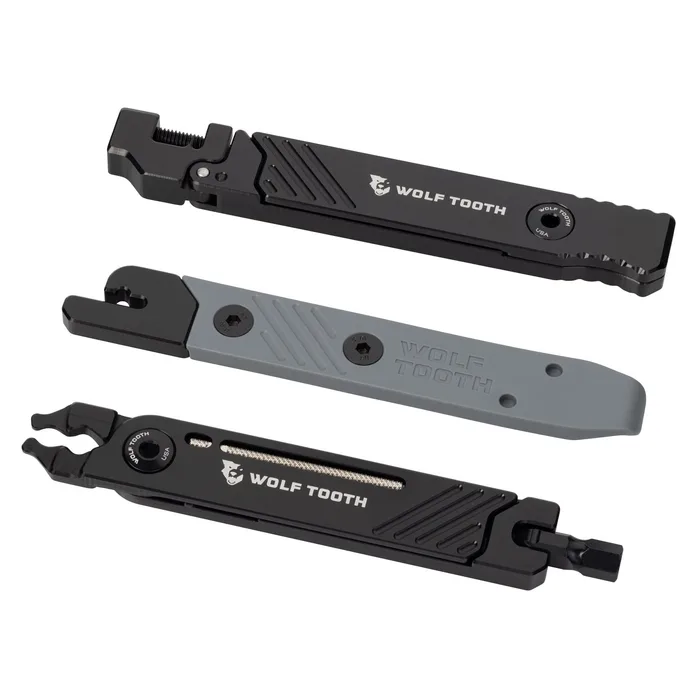
- Buy Wolf Tooth Components 8-Bit Kit One Three nesting tools that split the job properly, so the chainbreaker has a handle and the quick link has a home. Amazon
- Buy Topeak Mini PT30 The one-body tool that still gets the chain right, with a removable chain tool, a separate master link tool and somewhere to keep the link. Amazon
- It depends Fix It Sticks Multi-Tool Cycling Two steel sticks that lock into a T handle, and the one design here that can be turned into a torque-controlled tool. Amazon
- Skip Crankbrothers M20 Twenty functions and 203 g, with a chain tool Crankbrothers itself describes as chain-breaking only. Amazon
What actually matters
- Hex sizes - the fasteners you meet at the roadside cluster around 4, 5 and 6 mm, covering stem bolts, bar clamps, seatpost clamps, bottle cages and lever clamps. Anything below 3 mm is mostly derailleur limit screws, and 8 mm and 10 mm are pedal and crank territory you will rarely use on a ride.
- T25 Torx - disc rotor bolts and some stem and chainring hardware use T25, and SRAM's Zipp wheel manual specifies it directly for six bolt rotors at no more than 6.2 N-m. There is no hex substitute, so a tool without T25 has a hole in it that no amount of other bits fills.
- Chain tool construction - a chain tool has to push a hardened rivet out of a plate, which needs real force. Look for one that detaches from the body, has an L key or lever drive, or has enough length that you can wrap a hand around it rather than pinch it.
- Quick link provision - modern chains are joined by a master or quick link, and having a spare with you is what turns a broken chain into a ten minute stop. Some tools have built-in link storage or a compartment, and some offer nothing at all.
- Master link tool or pliers - fitting and removing a quick link by hand is possible but fiddly, and pliers or a dedicated slotted tool make it repeatable. This is a separate feature from the chain breaker and is often absent even on high function tools.
- Torque handling - component makers publish limits because carbon crushes and alloy threads strip. Either a published maximum torque per bit, which tells you where the tool itself gives up, or a real torque limiter that clicks and slips at a set value.
- Body material and weight - forged aluminium bodies with chrome vanadium or S2 steel bits are the common premium combination, while all-steel folding tools are cheaper and heavier. Weight differences of 30 to 90 g are typical across this category and are noticeable in a jersey pocket.
The specs, in plain English
Green flags vs red flags
Green flags
- T25 Torx is on the bit list alongside 4, 5 and 6 mm hex.
- There is a master link tool or pliers, not just a chain breaker.
- The tool has a named place for a spare quick link, such as a magnetic pocket or a sealed compartment.
- The maker publishes a maximum torque figure per bit, or sells a matched torque limiter.
- The body extends, detaches or forms a T handle so you can get leverage on a tight bolt.
Red flags
- A high function count with no T25 anywhere in the list.
- A chain tool described as chain-breaking only, with no master link function.
- No stated weight on the manufacturer's page.
- Tubeless plug tools listed as a feature with the plugs themselves not included.
- A short folding body sold on the strength of a long bit list, with nothing said about grip or leverage.
Who's who: the brands
- Wolf Tooth Components - Makes its 8-Bit tools in the USA and takes a modular approach, splitting pliers, chainbreaker and lever into separate nesting pieces.
- Topeak - Builds dense single-body tools with forged aluminium shells; the Mini PT30 fits a separate master link tool alongside the chain breaker.
- Fix It Sticks - Known for the two-stick T handle and for selling calibrated Newton-meter torque limiters that fit any standard quarter inch bit.
- Crankbrothers - Sells high function count folding steel tools, such as the M20 with an integrated tubeless plug tool and a mounted plug case.
- Silca - Pump and tool brand that also sells multitools.
How to read a listing without getting fooled
Ignore the headline number and read the tool list line by line. Tick off 4, 5 and 6 mm hex first, then T25, then Phillips, then anything else you know your bike actually uses. Next find the chain section and read it twice, because manufacturers are usually precise about the limits: a phrase like chain-breaking only, or a note that Campagnolo chains are excluded, tells you exactly what you are getting. Then look for the words master link, quick link or chain hook, and check whether there is storage for the link rather than just a tool to fit it. Check the stated weight and the stated body material, since a tool that does not publish a weight is often heavy. Finally read the included items and the compatibility notes at the bottom of the page, which is where you will find out that the plugs, the levers or the spare link are not in the box.
How much should you spend?
Budget tools generally give you a folded steel body and a decent hex range, and the compromises show up as missing T25, no chain tool at all, or a chain tool that is only good for opening a chain. Mid-range is where the category becomes genuinely useful: forged aluminium bodies, better bit steel, a chain tool that detaches or extends, and in the best cases a master link tool and somewhere to store the link. Premium buys you machining, published torque ratings, modular pieces that each do one job well, and torque limiters or measurement, plus the kind of finish that survives years in a wet saddle bag. Paying more for a higher function count on its own is the one upgrade that reliably gives you nothing, while paying more for a proper chain repair or for torque control is money that comes back the first time you need it.
Questions, answered
Where should I carry a multitool?
A saddle bag or frame bag is the usual answer, because a tool in a jersey pocket lands on your hip in a crash and a tool in a bottle cage rattles. Some tools ship with a neoprene sleeve, which stops the bits corroding and keeps the tool quiet. If your frame has a downtube storage hatch, a slim tool designed to nest is worth choosing for that reason alone.
How often should I check my multitool?
Look at it whenever you clean the bike, because a tool that lives in a wet bag corrodes quietly. Check that the pivot bolts are still tight, that the chain tool pin is straight and present, and that any spare quick link is still there and still the right speed for your chain. A missing chain tool pin is a common failure and is invisible until the moment you need it.
Do I need a different tool for a road bike and a mountain bike?
The core bits are the same, since both use 4, 5 and 6 mm hex and T25 rotor bolts. The differences are at the edges: mountain bikes make tubeless plug tools and a chain hook more valuable, while road and gravel bikes with carbon bars and posts make torque control more valuable. Chain speed matters too, so check that any chain tool covers the number of speeds you run.
Is a separate torque wrench still worth owning?
Yes, and it does a different job. A roadside limiter or beam gets you home safely at a known value, while a workshop torque wrench is what you use to set everything properly afterwards. The sensible pattern is to tighten just enough on the road to make the bike safe, ride conservatively, and reset the fastener to the manufacturer's figure at home.
Or jump to the head-to-head: Wolf Tooth Components 8-Bit Kit One vs Topeak Mini PT30.