Explained
Bike Grips, Explained
After reading, you'll understand why installed diameter is the number that matters, what lock-on really buys you, and how to fit a push-on grip without a fight.
In this guide
Grips are sold like accessories and work like components. Most listings lead with a colour chart and bury or omit the two numbers that decide whether the grip suits you: how thick it is and how it stays on the bar. The vocabulary does not help either, since lock-on, single clamp, durometer and installed diameter all get used without explanation. Once you know what each one is doing, the shortlist gets short fast.
The 30-second version
- Installed diameter is the comfort number, and most adult hands sit around 30mm to 33mm.
- Lock-on buys security, push-on buys damping, lower weight and grip shift compatibility.
- Silicone damps vibration, rubber survives abrasion, and cork is a wear item you replace.
- The end of the grip is where grips fail, so look for a reinforced closed end or included bar plugs.
- Isopropyl alcohol is the correct lubricant for push-on grips, because it evaporates and leaves nothing slippery behind.
The products this guide is about
Our verdict on each, with the full reasoning on the companion review.
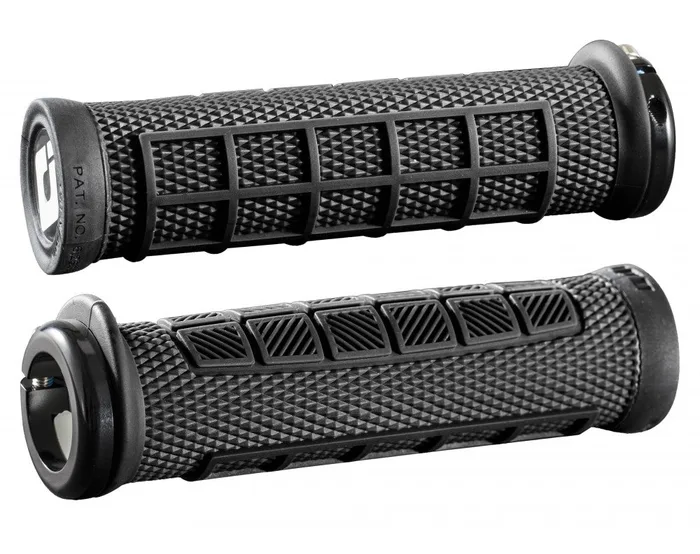
- Buy ODI Elite Pro Lock-On Grips A lock-on grip that solves rotation, blowout and glove traction in one part.
- Buy ESI Grips Chunky Grips Silicone foam that damps vibration, with the fullest spec sheet of any grip here.
- It depends Wolf Tooth Fat Paw Grips V2 A deliberately huge 36mm silicone foam grip for large hands and thick gloves.
- Skip Portland Design Works Lisbon Cork Grips Genuinely lovely natural cork, with no clamp and a side effect on bar width PDW is upfront about.
What actually matters
- Installed diameter - the outside diameter of the grip once it is on the bar, which is what your hand actually wraps. ESI Chunky is 32mm and Wolf Tooth Fat Paw V2 is 36mm, and that four millimetre gap is the difference between a comfortable grip and one that feels like a rolling pin.
- Lock-on system - an aluminium collar with a bolt that clamps the grip to the bar so it cannot rotate. Some designs use two collars and some, like ODI's v2.1, use a single clamp to free up more usable grip surface.
- Grip material - silicone damps high frequency vibration and does not harden with age, rubber resists abrasion and tearing, and cork is light and grippy but wears. Each is solving a different problem.
- Bar diameter - almost all flat and riser handlebars are 22.2mm at the grip area, often written as 22mm. Grips are built for that, and a drop bar is a different product entirely.
- End treatment - whether the grip has a reinforced closed end molded in, or an open end that needs a separate bar plug. An unplugged bar end is a genuine injury risk.
- Weight - a real consideration only at the extremes. A pair of ESI Chunky is 60 grams, while a lock-on grip with alloy collars can be nearer 100 grams and up depending on the design.
- Grip shift compatibility - twist shifters need a shorter grip and usually cannot clear a lock-on collar, which is why some grips call out grip shift use specifically.
The specs, in plain English
Green flags vs red flags
Green flags
- The listing states an installed diameter in millimetres.
- A weight is published for the pair, not for a single grip.
- Bar end plugs are stated as included, or the grip has a molded closed end.
- The maker names the material rather than calling it a proprietary compound and stopping there.
- Replacement collars and bolts are sold separately, which tells you the grip is meant to be kept.
Red flags
- The only listed specification is a colour range.
- A lock-on grip with no stated bolt size or torque figure.
- Photos that show the grip on a bar from one angle only, so you cannot see the ends.
- A soft, tacky compound with no durometer figure and no mention of abrasion.
- A push-on grip sold without bar plugs and without saying so.
Who's who: the brands
- ODI - The company that popularised the lock-on grip, and still the default in mountain biking and motocross.
- ESI Grips - Made silicone grips into a category, and publishes weights and diameters most brands leave off the box.
- Wolf Tooth - Minnesota component brand whose Fat Paw and Karv silicone foam grips bracket the thick and thin ends of the range.
- Portland Design Works - City and classic bike accessories, including cork grips made in Portugal and cork and rubber lock-ring designs.
- Lizard Skins - Long-running grip and bar tape maker known for patterned rubber compounds across mountain and road.
How to read a listing without getting fooled
Look for two numbers and one word. The numbers are installed diameter and length: diameter tells you whether the grip suits your hand, and length tells you whether it will fit between your shifter and the bar end without overhanging. The word is how it attaches, which will be lock-on, push-on or slip-on, and everything else follows from it. After that, check the ends, because a listing that mentions a reinforced closed end or included bar plugs has thought about the part that fails, and one that does not usually has not. Treat compound names as marketing unless a durometer figure or a material is attached. Finally, if you run grip shift or a bar-mounted dropper lever, check the stated length against what you have, since that is the constraint that eliminates most lock-on options.
How much should you spend?
Grips are a budget purchase in absolute terms and the cheapest fix for a real comfort problem, so the sensible move is to buy the right grip rather than the cheap one. Plain push-on silicone sits at the budget end and delivers the most vibration damping per unit spent. Lock-on rubber grips sit in the mid-range because you are paying for alloy collars, bolts and a reinforced end, and that is money well spent if you ride off road. Premium tier grips are usually buying you an unusual diameter, a specific foam compound, or replacement hardware sold separately under a repair programme, all of which are legitimate but none of which are necessary. The genuinely poor value is an expensive grip in the wrong diameter, which no amount of compound engineering will fix.
Questions, answered
How long do grips last?
It depends far more on material and storage than on mileage. Rubber grips harden and go shiny over a few seasons, particularly if the bike lives in sunlight, and silicone holds its feel much longer but scuffs. Cork wears steadily from day one. The practical signal is that when a grip stops feeling tacky in the wet, it has stopped doing its job, regardless of how it looks.
Can I reuse push-on grips if I take them off?
Usually yes, if you remove them carefully. The standard trick is to slide a thin screwdriver or a zip tie under the grip and squirt isopropyl alcohol or a little water down the gap, then twist the grip off rather than pulling. Cutting them off is faster and guarantees you will be buying a new pair. Clean the bar before refitting, since any residue stops the grip bonding by friction.
Do I need different grips for winter?
Not necessarily, but glove thickness changes the diameter that suits you. A grip that is right in summer can feel too fat in thick winter gloves, and the standard fix is either a thinner grip for cold months or a bigger one if you find the extra bulk helps against numbness. Wolf Tooth positions its 36mm Fat Paw specifically for riders with large or gloved hands, which is the same idea from the other direction.
Is there any reason to torque a lock-on collar properly?
Yes, and it is a genuine risk with carbon handlebars, where overtightening a clamp can crush the bar. Makers publish a figure for this: Wolf Tooth lists a maximum of 2.5 Nm for its Echo lock-on grips, tightened with a 3mm hex key. Undertightening is the other failure, and it shows up as a grip that creeps round under braking. Use a torque wrench if you own one.
Or jump to the head-to-head: ODI Elite Pro Lock-On Grips vs ESI Grips Chunky Grips.