Explained
Bike Fenders, Explained
After reading, you'll understand how to size fenders to your tires and frame, what hardware you need, and why a longer fender beats a wider one.
In this guide
Fenders look like a simple accessory and fit like a component. The two questions that decide everything are whether your frame has the mounting points the fender expects, and whether the fender's arc clears your tire with room for grit to pass. Get both right and a set of fenders lasts a decade in silence. Get either wrong and you get a rub, a rattle, and a project you abandon.
The 30-second version
- Length determines coverage, so the rear fender's length matters more than its width.
- Use the maker's stated tire limit, because a 55mm fender and a 45mm fender can clear very different tires.
- The hardware kit is the product, and a listing that itemises brackets and washers has thought about your frame.
- A front safety release is a safety feature, not a convenience, because a jammed front fender locks the wheel.
- Suspension forks need a different category, a short arch-mounted guard rather than a full-coverage fender.
The products this guide is about
Our verdict on each, with the full reasoning on the companion review.
- Buy Velo Orange 700c Smooth Fenders, 55mm Full-coverage alloy fenders with the most completely specified hardware kit here.
- Buy Portland Design Works Poncho Recycled Fenders, 700x45 Recycled polycarbonate full-coverage fenders with proper stays, mudflaps and a front safety release.
- It depends Mucky Nutz Face Fender The low-profile front guard that keeps trail spray out of your eyes and off your fork seals.
- Skip ROCKBROS Adjustable Bike Fenders Set A tool-free clip-on set whose listing publishes the dimensions of the box and almost nothing about the fenders.
What actually matters
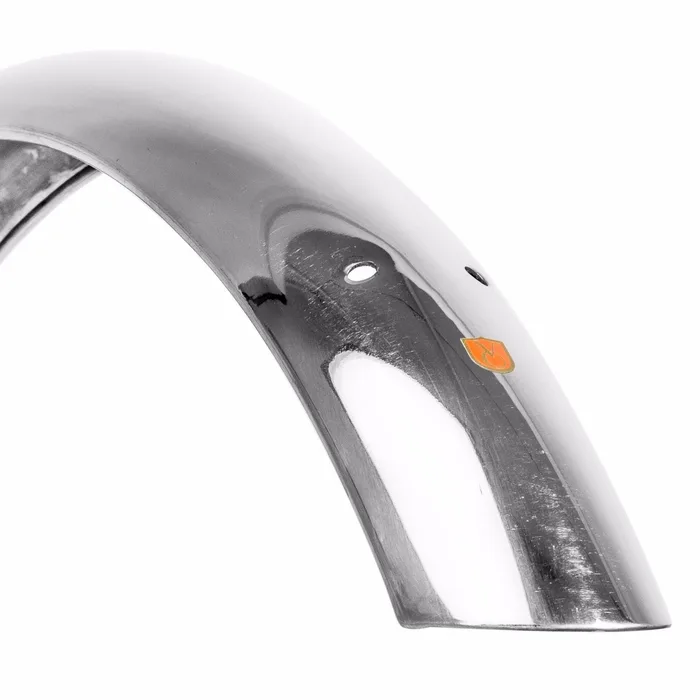
- Fender length - how far the fender wraps around the wheel. A long rear, such as Velo Orange's 120cm, reaches down toward the bottom bracket and keeps the drivetrain and your back dry; a short one sprays everything behind it.
- Stated tire clearance - the maximum tire width the maker rates the fender for, which accounts for the fender's arc as well as its width. Velo Orange rates its 55mm fenders to 45mm tires and PDW rates its 700x45 sets to 700x35mm.
- Mounting points - the eyelets at the dropouts, the fork crown and the brake bridge that a full-coverage fender attaches to. A frame without them needs adapter hardware or a different category of fender.
- Stays - the metal rods that hold the fender at a fixed distance from the tire. Thickness matters: PDW specifies 6mm stays, and thin wire stays are what make cheap fenders resonate.
- Safety release - a front mount designed to break away if debris jams between fender and tire, so the wheel keeps turning. It is the one genuine safety feature in the category.
- Mudflaps - the flexible extensions at the trailing end of each fender. They add coverage where it counts, below the fender line, and PDW supplies polypropylene ones.
- Material - alloy for looks and longevity at the cost of permanent dents, polycarbonate or recycled plastic for impact resistance and no maintenance.
The specs, in plain English
Green flags vs red flags
Green flags
- The listing states fender width, fender length and a maximum tire width.
- The hardware kit is itemised rather than described as everything you need.
- A front safety release is named as a feature.
- Stay thickness is specified, not just that stays are included.
- The maker sells additional fit hardware for frames without standard eyelets.
Red flags
- The only dimensions published are the package size and shipping weight.
- No maximum tire width is given for a fender sold by wheel size alone.
- Photographs show the fenders alone, with no view of the mounting hardware.
- Thin wire stays with no thickness quoted.
- Universal fit claimed for a full-coverage fender, which depends entirely on frame mounting points.
Who's who: the brands
- Velo Orange - Maryland brand focused on classic touring and city parts, selling polished and black alloy fenders in smooth, hammered and fluted patterns.
- Portland Design Works - Portland brand covering city and commuter accessories, with fenders in anodized aluminium and recycled polycarbonate and front safety release tabs.
- Mucky Nutz - UK maker of low-profile mountain bike guards, made from recycled plastic, whose Face Fender has been in production since 2009.
- SKS - German maker of long-running plastic and alloy fender systems widely fitted as original equipment on European city bikes.
- ROCKBROS - Value-focused accessory brand selling clamp-on adjustable fenders and a broad range of cycling parts.
How to read a listing without getting fooled
Work top down through three numbers before anything else: your tire width, the fender's stated maximum tire width, and the fender's length. If the listing gives you only the first two, you know how it fits but not how dry you will be, and if it gives you none of them you should move on. Then find the hardware list and read it as a compatibility statement, because a kit built for brazed-on eyelets assumes your frame has them and a kit that includes a fork crown daruma assumes your fork is drilled. Look for a sentence about frames that differ, since the good makers write one: Velo Orange says you may need one or two extra bits, and PDW asks you to note an order if your brake bridge has an eyelet. Finally, check the photos for the trailing ends, because mudflaps and their absence are usually visible even when nobody mentions them.
How much should you spend?
Fenders run from budget clip-ons to premium polished alloy sets, and the price differences track material and hardware rather than performance. The budget tier buys you a clip-on or a basic plastic set, which is the right choice only if your frame has no mounting points. The mid-range is where full-coverage plastic and polycarbonate sets sit, and it is the best value in the category, because you get the stays, brackets and mudflaps that make a fender quiet without paying for polish. The premium tier is alloy, hand-finished patterns and matched hardware, which is money spent on appearance and longevity rather than on staying dry. The false economy is a cheap full-coverage set with thin stays, which costs an afternoon of fitting and then rattles for the rest of its life.
Questions, answered
Will fenders slow me down?
Negligibly, and far less than the alternative of not riding. A full-coverage set adds a few hundred grams and a small amount of frontal area, which is not measurable against the comfort of a dry drivetrain and a dry back. The performance argument against fenders is really an aesthetic one. The practical argument for them is that a wet drivetrain wears far faster than a dry one, and chains and cassettes cost more than fenders.
Can I leave fenders on all year?
Yes, and most people who fit them properly do, because the fitting is the annoying part. Alloy fenders in particular are worth mounting once and forgetting. If you want the option of removing them, choose a set with quick-release stay hardware or a clip-on design and accept the reduction in coverage. Bear in mind that a fender remounted repeatedly is a fender whose bolts need checking more often.
Do I need a front fender, a rear fender, or both?
Both, if you can. The front fender keeps spray off your feet and your bottom bracket and stops water being thrown up into the frame; the rear keeps your back dry and protects anyone riding behind you. If you can only fit one, the rear does more for your comfort and the front does more for your bike. On a suspension mountain bike you will usually end up with a short front guard and either a shock guard or nothing at the rear.
How much clearance should there be between the fender and the tire?
Enough that wet grit passes through rather than packing, and even all the way round. Most makers design in roughly 10mm to 15mm at the closest point, which is why the stated maximum tire width is smaller than the fender's nominal width. Uneven clearance is the sign of a fender mounted before its stays were set neutral, and it is the usual cause of a rub that appears only when you hit a bump.
Or jump to the head-to-head: Velo Orange 700c Smooth Fenders, 55mm vs Portland Design Works Poncho Recycled Fenders, 700x45.