

Outdoors & Fitness
The Best Bike Degreasers: 4 Compared (and One to Skip)
We compared four bicycle drivetrain degreasers on delivery format, biodegradability, what each is safe to touch, published dwell times and how much each maker will state in writing.
The short version
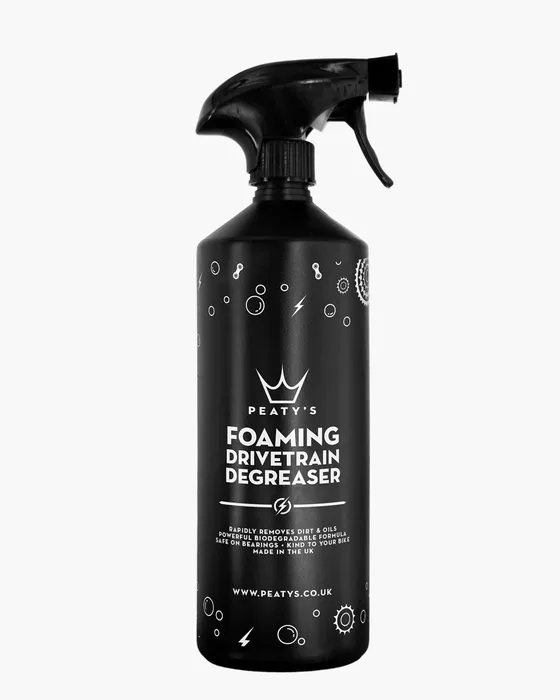
Peaty's Foaming Drivetrain Degreaser is the one to buy: a biodegradable high-strength foam that clings long enough to work, explicitly designed for regular use without stripping bearing greases, sold in 500ml, 1 litre and 5 litre with a published safety data sheet and a stated two-minute dwell. Pedro's Oranj Peelz is the value pick and the better deep-clean solvent, a citrus solvent and surfactant blend with deliberately low surface tension so it penetrates, biodegradable and water-soluble, sold in 16oz and a gallon. The Muc-Off Bio Degreaser is the convenient one, an aerosol that is carbon-fibre safe and works on metal, plastic, rubber and seals, though only the contents biodegrade and the can is a pressurised flammable aerosol. The Finish Line Citrus Degreaser is the one to skip, not because the formula is bad but because Finish Line publishes a single sentence about it: no biodegradability claim, no materials compatibility, no dilution ratio for the gallon, and nothing between an 18oz aerosol and a gallon jug. Best for: anyone whose cassette is black and who wants it clean without wrecking the bearings behind it.
Our picks at a glance
- Peaty's Foaming Drivetrain Degreaser - Buy. A clinging biodegradable foam with a stated dwell time and a published safety data sheet.
- Pedro's Oranj Peelz - Buy. A citrus solvent built to penetrate, biodegradable, and cheapest per use in the gallon.
- Muc-Off Bio Degreaser 500ml - It depends. The convenient aerosol, carbon safe and effective, in the least defensible packaging here.
- Finish Line Citrus Degreaser - Skip. A long-established citrus degreaser described in one sentence and sold in two sizes.
The verdict in 30 seconds
What mattered most
- Format
- Chemistry stated
- Sizes
- Biodegradable
- Safe on carbon
- Bearing grease claim
Degreaser is the one bike product where getting it wrong costs you more than the product. A solvent strong enough to dissolve waterproof chain lube is also strong enough to wash the grease out of a bottom bracket or pull the film off a set of brake pads, and the difference between a drivetrain degreaser and a general-purpose one is exactly that restraint. The other thing that separates these products is delivery. The same chemistry sold as an aerosol, a foaming trigger spray or a concentrate in a jug behaves differently at the cassette, costs differently per use and disposes of differently afterwards. We compared four, and the makers turn out to differ far more in what they will state than in what they claim.
A clinging biodegradable foam with a stated dwell time and a published safety data sheet.
Best for: Regular drivetrain maintenance on a bike whose bearings you would rather not repack.
- Foam increases contact time, so it stays on a vertical cassette face instead of running straight off onto the floor.
- Peaty's states it is designed for regular use without stripping precious bearing greases, the only maker here to address that directly.
- Published usage: spray, agitate with a brush, leave to soak for two minutes, rinse thoroughly, plus a downloadable safety data sheet and sizes from 500ml to 5 litres.
- A foam is slower to apply over a whole drivetrain than an aerosol blast.
- Peaty's does not publish the solvent chemistry, only that it is biodegradable and high strength.
- The 5 litre size needs your own trigger bottle to be usable.
- Two minutes of dwell means you cannot simply spray and rinse.
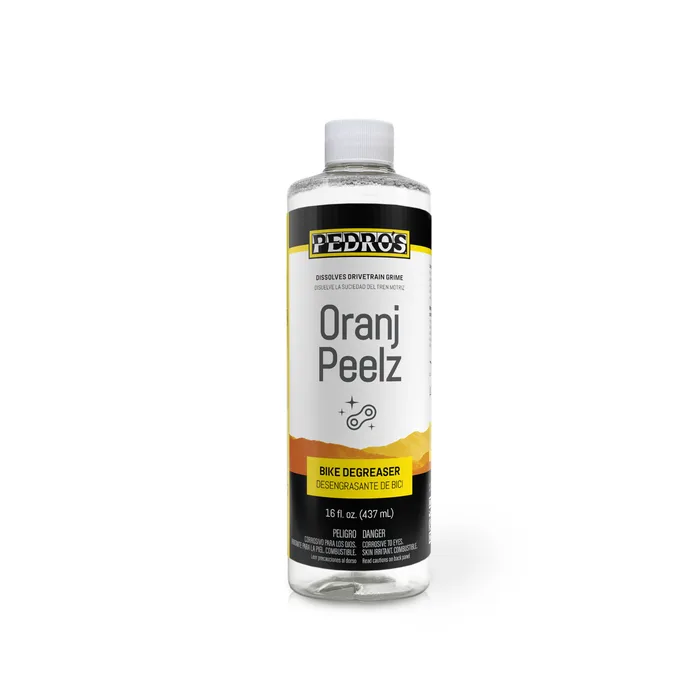
A citrus solvent built to penetrate, biodegradable, and cheapest per use in the gallon.
Best for: A deep clean on a neglected drivetrain, and anyone buying degreaser by the gallon.
- A citrus-based solvent and surfactant blend with deliberately low surface tension, so it wicks into chain rollers and cassette gaps rather than sitting on top.
- Biodegradable and water-soluble, so it rinses away and leaves surfaces residue-free.
- Sold as 16oz and as a 3.7 litre gallon, and Pedro's publishes step-by-step usage for brush application and for chain cleaner tools.
- A citrus solvent is strong enough to be worth keeping away from bearing seals and brake surfaces, and Pedro's does not publish a compatibility list.
- It is a liquid, not a foam, so it runs off vertical surfaces and needs a tray or a chain cleaner to avoid waste.
- No dilution ratio is published for the gallon, so you are guessing at concentration.
- The citrus smell is strong in an enclosed garage.
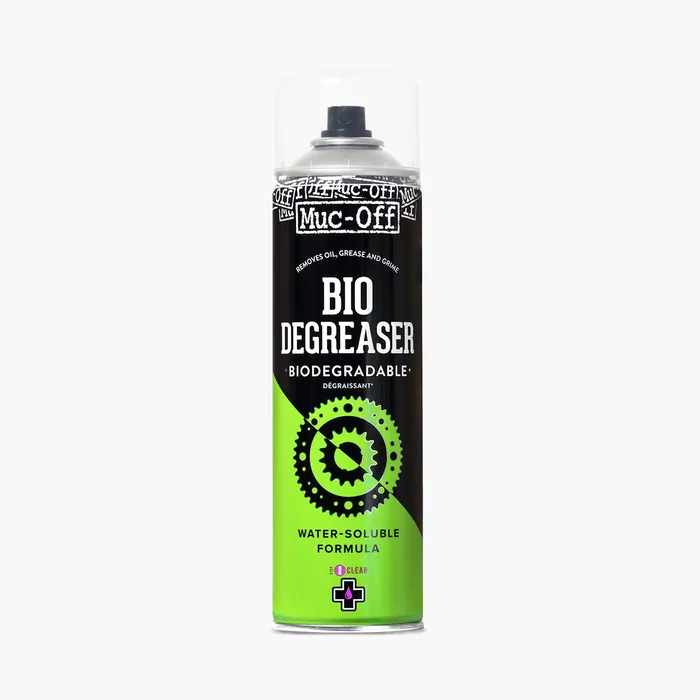
The convenient aerosol, carbon safe and effective, in the least defensible packaging here.
Best for: Quick, frequent drivetrain cleans where convenience beats cost per use.
- Water-soluble and safe on metal, plastic, rubber and seals, and Muc-Off states it is carbon fibre safe.
- Formulated to shift waterproof grease and chain lube residue, which is the build-up ordinary bike wash leaves behind.
- An aerosol reaches into a cassette and a derailleur cage faster and more evenly than a brush and a bottle.
- Only the contents are biodegradable, which Muc-Off states in a footnote; the pressurised can is not.
- Labelled extremely flammable aerosol and pressurised container, so storage and disposal are both constrained.
- 500ml of aerosol is the smallest quantity here and the most expensive way to buy this chemistry.
- No refill or concentrate version of this product is offered.
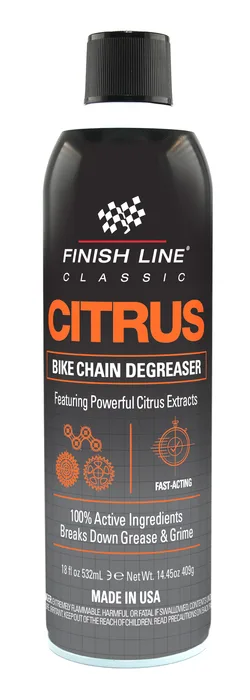
A long-established citrus degreaser described in one sentence and sold in two sizes.
Best for: A workshop that already knows how it handles this product and buys it by the gallon.
- Concentrated citrus extracts are a proven chemistry for dissolving drivetrain build-up, and the can states 100 percent active ingredients, meaning it is undiluted.
- A gallon jug is offered alongside the aerosol, which is the cheap way to buy degreaser.
- Made in the USA, printed on the can, which none of the other three states for its own product.
- Finish Line publishes one sentence about it online and nothing else: no biodegradability claim, no ingredients, no pH.
- No materials compatibility is stated, so nothing tells you whether it is safe on carbon, seals or brake surfaces.
- No dilution ratio is given for the gallon, and no dwell time or method is published.
- The 18 fl oz is an extremely flammable pressurised aerosol, and there is nothing between it and a full gallon.
| Criteria | Foaming Drivetrain Degreaser Top pick | Oranj Peelz | Bio Degreaser 500ml | Citrus Degreaser |
|---|---|---|---|---|
| Verdict | Buy it | Buy it | It depends | Skip it |
| Best for | Regular drivetrain maintenance on a bike whose bearings you would rather not repack. | A deep clean on a neglected drivetrain, and anyone buying degreaser by the gallon. | Quick, frequent drivetrain cleans where convenience beats cost per use. | A workshop that already knows how it handles this product and buys it by the gallon. |
| Price tier | $$ · mid-range | $ · budget | $$ · mid-range | $$ · mid-range |
| Format | Foaming trigger spray | Liquid, pour or brush on | Aerosol | Aerosol or gallon jug |
| Chemistry stated | Biodegradable, strength only | Citrus solvent and surfactant blend | Water-soluble, biodegradable contents | Concentrated citrus extracts |
| Sizes | 500ml, 1L, 5L | 473ml, 3.7L | 500ml | 18 fl oz, 1 gallon |
| Biodegradable | Yes, stated | Yes, stated | Contents only, can is not | Not stated |
| Safe on carbon | Not published for this product | Not published | Yes, stated | Not published |
| Bearing grease claim | Will not strip bearing greases | Not published | Safe on seals | Not published |
| Dwell time published | Two minutes | Not published | Not published | Not published |
| Safety data sheet | Published on the page | Not linked | Hazard warnings on page | Not linked |
Which one is right for you?
- Regular drivetrain maintenance on a bike whose bearings you would rather not repack. Buy it Peaty's Foaming Drivetrain Degreaser
- A deep clean on a neglected drivetrain, and anyone buying degreaser by the gallon. Buy it Pedro's Oranj Peelz
- Quick, frequent drivetrain cleans where convenience beats cost per use. It depends Muc-Off Bio Degreaser 500ml
- A workshop that already knows how it handles this product and buys it by the gallon. Skip it Finish Line Citrus Degreaser
How we judged the field
The first question about a degreaser is what it is allowed to touch. A drivetrain degreaser has to dissolve waterproof grease and cured chain lube while leaving bearing grease, seals, carbon fibre, anodising and brake surfaces alone, and those requirements pull against each other. So we looked for any statement about materials compatibility and about bearing grease, and treated silence as a real gap rather than a formality, because the consequence of getting it wrong is a repacked bottom bracket or a set of contaminated pads.
The second question is delivery, which decides both cost per use and how much of the product ends up on the floor. Aerosols reach everywhere and waste the least effort; foams waste the least product; liquids and gallons waste the least money. The third is what the maker publishes: biodegradability with the caveats spelled out, a dwell time, a method, a safety data sheet, and a size ladder that includes something between a small can and a gallon. On that last measure the four separated immediately, and the separation was not about price.
Peaty’s Foaming Drivetrain Degreaser is the one that reads like it was designed around the actual job. It is a high-strength biodegradable foam, and the foam is the point: Peaty’s says it increases contact time, which on a vertical cassette face is the difference between the product working and the product ending up on the driveway. The claim that matters most is the one nobody else makes, that it is designed for regular use without stripping precious bearing greases, which addresses the single way a degreaser damages a bike. The method is published too: spray it on, agitate with a brush, leave it for two minutes, rinse thoroughly with clean water. There is a downloadable safety data sheet on the page, and three sizes, from a 500ml trigger bottle up to 5 litres for a workshop. The gaps are that Peaty’s will not say what the solvent actually is beyond biodegradable and high strength, that the 5 litre needs your own bottle, and that a foam takes longer to apply than an aerosol. None of those is a reason to buy something else.
Pedro’s Oranj Peelz has been doing this for over twenty years and the description explains why it works rather than just asserting that it does. It is a citrus-based solvent and surfactant blend, and Pedro’s specifically calls out low surface tension as the mechanism: the liquid wicks into chain rollers and the gaps between cassette cogs instead of beading on the surface. It is biodegradable and water-soluble, rinses off, and leaves surfaces residue-free. Pedro’s also publishes usage instructions, including pouring it onto a brush or rag and scrubbing, and points you at its own brushes for the job. Sold as a 16oz bottle and a 3.7 litre gallon, it is the cheapest per clean of the four by a wide margin if you buy the big one. The reservations are the flip side of the strength: a solvent designed to penetrate is one you keep away from bearing seals, Pedro’s publishes no compatibility list to tell you where the line is, and there is no dilution ratio for the gallon. It is also a pour-on liquid, so without a tray or a chain cleaner tool most of it hits the floor.
Muc-Off’s Bio Degreaser is the convenient answer and the compromised one. As a product it is good: water-soluble, effective on built-up oil, grease and grime across metal, plastic, rubber and seals, explicitly carbon fibre safe, and formulated to handle waterproof grease and chain lube residue rather than just surface dirt. An aerosol gets into the back of a cassette and around a derailleur cage faster than anything you apply with a brush. The problem is the packaging and Muc-Off’s own footnote on it. The page carries an asterisk reading only contents are biodegradable, meaning the can is not, and the hazard text reads extremely flammable aerosol, pressurised container, may burst if heated. Muc-Off flags a Project Green credential for the product, defined as biodegradable, refillable or reusable, and this one qualifies only on the first of those three. There is no refill and no concentrate, and 500ml is both the smallest quantity in this comparison and the most expensive way to buy the chemistry.
Finish Line Citrus Degreaser is a skip on documentation rather than on formulation. The entire published description is one sentence saying that concentrated citrus extracts dissolve the toughest drivetrain build-up and decontaminate metal components, suited to pro workshops and everyday maintenance. That is all. There is no statement that it is biodegradable, no ingredient or solvent named, no pH, no materials compatibility, nothing about carbon or seals or brake pads, no dwell time, no method, no dilution guidance for the gallon and no safety data sheet linked. It is sold in an 18 fl oz aerosol and a 1 gallon jug with nothing in between, which forces a small purchase or a very large one. Finish Line is an established name and the chemistry is a well-understood one, but every other product here tells you more about what you are about to spray onto a frame, and two of them tell you considerably more for less money.
Peaty’s Foaming Drivetrain Degreaser vs Pedro’s Oranj Peelz: which should you buy?
Peaty’s against Pedro’s is a choice between control and strength. The Peaty’s foam does less per application, because the whole design is about staying put and working for two minutes rather than flushing everything off at once, and that restraint is the reason it can claim not to strip bearing greases. For a drivetrain you clean regularly, that is exactly right, and the published dwell time and safety data sheet mean you are not guessing.
Oranj Peelz is the stronger solvent and the better tool for a drivetrain that has been ignored. Low surface tension means it gets into the places a foam sits on top of, and on a chain that is genuinely gummed up that penetration is the difference between clean and nearly clean. It is also several times cheaper per use in the gallon. The cost is that Pedro’s does not tell you where to stop, so you supply the caution yourself: keep it off the hubs, keep it off the rotors, and rinse properly. Buy the Peaty’s if you clean the bike often and want a routine. Buy the Oranj Peelz if the cassette is black and you want it gone, or if you go through degreaser fast enough for the gallon to matter.
What to look for
- A bearing grease statement: the one way a degreaser really damages a bike is by getting past a seal, and only one maker here addresses it.
- Materials compatibility: carbon fibre, anodising, rubber seals and brake surfaces all have different tolerances, and a page that names none of them is telling you nothing.
- Delivery format: aerosol for speed, foam for clinging to vertical surfaces, liquid or concentrate for cost per use.
- A published method and dwell time: a degreaser that needs two minutes works differently from one meant to be rinsed immediately.
- What exactly is biodegradable: the contents, the packaging, or both, and read the footnote rather than the headline.
- A size between small and huge: an 18oz can and a gallon jug with nothing between them is a packaging decision, not a product range.
Our final take
Bike degreasers are mostly variations on two chemistries, so the decision comes down to delivery and to how much the maker is willing to tell you. Peaty’s Foaming Drivetrain Degreaser is the one to buy: it clings where you spray it, it publishes a method and a dwell time and a safety data sheet, and it is the only one that commits in writing to leaving your bearing grease alone. Pedro’s Oranj Peelz is the stronger, cheaper alternative and the better choice for a genuine rescue job, provided you supply the caution Pedro’s does not. The Muc-Off aerosol is genuinely convenient and genuinely carbon safe, and you should know that only its contents biodegrade. And a degreaser described in a single sentence, with no statement about what it is safe to touch, is one you are being asked to trust rather than to evaluate.
Questions, answered
Will degreaser ruin my bearings?
It can, and this is the real risk with the stronger formulas. Bottom brackets, hubs and pivot bearings are packed with grease behind seals, and a low-surface-tension solvent is designed to get past exactly that kind of barrier. The practical rules are to keep the spray aimed at the chain, cassette and chainrings rather than at hubs, to avoid blasting a pressure washer at a seal afterwards, and to prefer a product that addresses it directly. Peaty's is the only one of these four that states it is designed for regular use without stripping bearing greases.
Aerosol, foam or concentrate?
Aerosols are fastest and reach into a derailleur cage well, but they are the most expensive per use, they are pressurised and flammable, and the can is not recyclable in the same way a bottle is. Foaming sprays cling to vertical surfaces so more of what you spray does work, which is why Peaty's builds its dwell time around it. Concentrates and gallons are by far the cheapest per clean and the least wasteful, at the cost of needing your own bottle and your own judgement about dilution when the maker does not publish one.
Does biodegradable mean I can rinse it down the drain?
No. Biodegradable describes how the chemistry breaks down over time, not whether what you rinse off is clean. The runoff from a drivetrain clean carries dissolved chain lube, metal particles and road grime, and that is the part that should not go into a storm drain. Wash over ground that drains to a treatment system where you can, or catch the runoff in a tray. Note also Muc-Off's footnote on its aerosol: only the contents are biodegradable, not the can.
How often should I degrease a drivetrain?
Far less often than people think, if you are lubricating properly. A full degrease strips everything including the lube inside the chain rollers, and a chain relubricated from dry wears faster than one that was simply wiped and topped up. For most riders, wiping the chain after each ride and degreasing when the cassette is visibly black, the chain is gritty, or you are switching lube types is enough. Wet winter riding pushes that to every few weeks; dry summer riding much less.
Can I use car or household degreaser instead?
You can, and it is a common way to damage a bike. General-purpose and engine degreasers are formulated without any regard for carbon fibre, anodised finishes, rubber seals or brake pad contamination, and some are strongly alkaline enough to etch aluminium. Brake pads are the most expensive mistake, because a contaminated pad usually cannot be recovered and has to be replaced. A bike-specific degreaser costs more per litre and is formulated around all of those constraints.
Deciding between the top two? See our head-to-head: Peaty's Foaming Drivetrain Degreaser vs Pedro's Oranj Peelz.
More Outdoors & Fitness reviews
 The Best Bike Fenders: 4 Compared (and One to Skip)
  The Best Bike Floor Pumps: 4 Compared (and One to Skip)
  The Best Bike Frame Protection: 4 Compared (and One to Skip)
  The Best Bike Grips: 4 Compared (and One to Skip)
  The Best Bike Lights: 4 Compared (and One to Skip)
  The Best Bike Locks: 4 Compared (and One to Skip)