Explained
Bike Cleaning Brushes, Explained
After reading, you'll know which brushes a bike actually needs, how to keep drivetrain and frame brushes apart, and what a good product page should tell you.
In this guide
A bike cleaning set is not one product, it is three to five separate tools sold in one box, and the only honest way to evaluate it is one tool at a time. Once you know what each shape is for, the sets separate quickly into the ones designed around the jobs and the ones assembled around a price.
The 30-second version
- The drivetrain brush is the reason to buy a set, because a cassette is the one thing household brushes cannot clean.
- Keep drivetrain and frame brushes separate, since a contaminated brush can reach a brake rotor.
- Bristle stiffness should vary across the set, soft for paint, stiff for cogs and tyres.
- A degreaser brush saves product, by painting it onto the part rather than spraying past it.
- Handle material is a maintenance choice, wood if you dry them, plastic if you will not.
The products this guide is about
Our verdict on each, with the full reasoning on the companion review.
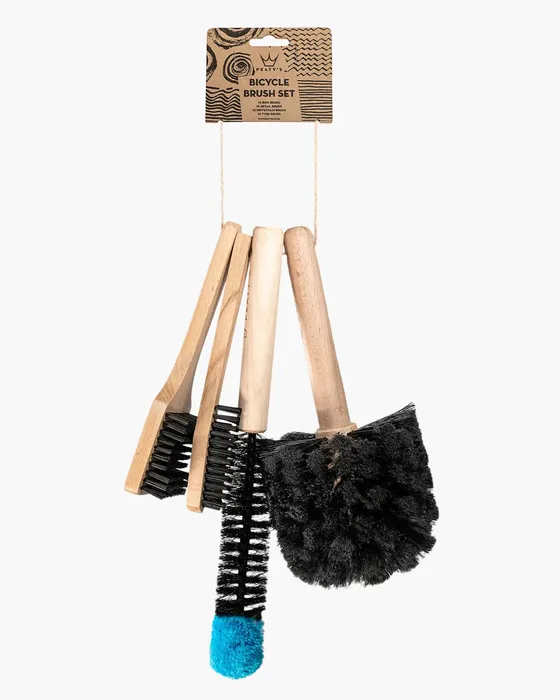
- Buy Peaty's Bicycle Brush Set Four brushes on sealed beech, each designed around a specific problem and explained in detail.
- Buy Pedro's Pro Brush Kit Four brushes with the bristles chosen per job, including the degreaser brush most sets leave out.
- It depends Muc-Off 5x Premium Brush Set The most brushes and the only storage bag, on handles that are entirely plastic.
- Skip Finish Line Mechanic Brush Set Five brushes, and Finish Line will not say which five.
What actually matters
- Drivetrain brush shape - angled heads, bristle channels and long inter-cog bristles are what separate a bike brush from a household one. Also look for a scraper or chisel end for jockey wheels.
- Soft frame brush - a large, low-stiffness head for covering the frame, fork and wheels without marking paint or matt finishes.
- Detail brush - a narrow brush for hubs, calipers, suspension mounts and fork crowns, where a full-size brush simply does not fit.
- Degreaser brush - long dense bristles that hold liquid so it can be painted onto a part. It uses far less product than spraying.
- Bristle material and stiffness - nylon is standard, and stiffness should be matched per brush rather than uniform across the set.
- Handle material - sealed wood, plastic, or plastic with rubberised zones to protect the finish if the handle contacts the frame.
- Storage - a bag or roll, which matters more than it sounds when the small brushes are the ones that go missing.
The specs, in plain English
Green flags vs red flags
Green flags
- Every brush in the set is listed and described individually.
- The drivetrain brush's shaping is explained, not just named.
- Bristle stiffness clearly varies by brush.
- Handle material is named.
- A storage bag or roll is included.
Red flags
- A piece count with no list of what the pieces are.
- One bristle type across every brush in the set.
- No drivetrain-specific brush at all.
- Compatibility quoted in drivetrain speeds that are several generations old.
- Bristle material described only as a compound or a blend.
Who's who: the brands
- Peaty's - UK brand that designed its brush range in-house on sealed beech handles, and publishes the reasoning behind each brush's shape.
- Pedro's - American bike tool maker whose Pro Brush Kit pairs a dual-ended drivetrain toothbrush with a dedicated degreaser application brush.
- Muc-Off - UK bike care brand with the widest brush range, including a claw brush with an integral mud scraper and a repositionable two-prong brush.
- Finish Line - American lubricant brand whose Grunge Brush is a long-standing drivetrain tool, though its brush set page publishes no contents list.
- Park Tool - The workshop tool standard, whose brush range is sold as individual pieces rather than sets and is specified by intended component.
How to read a listing without getting fooled
Read the set as a list of individual brushes, and if the page will not give you that list, stop there. For each brush, look for a shape claim rather than an adjective: an angled head, a bristle channel, stepped heights, a tapering cone, a scraper. Those describe a design decision, where soft, tough and premium do not. Check that stiffness varies across the set, because a set of five identical-feeling brushes is one brush sold five times. Look specifically for something that holds degreaser, since that is the piece most sets omit and the one that changes how much product you use. Then check handle material and decide honestly whether you will dry wooden handles. Finally see whether anything holds the set together, because the detail brush is always the one that disappears.
How much should you spend?
Brushes are cheap enough that the decision is about design rather than budget. The budget tier buys a genuinely good four-piece set from an established bike brand with a properly shaped drivetrain brush, and that is enough for most riders permanently. Mid-range buys either a five-piece set with a storage bag and a mud scraper, which is worth it if you ride off-road in winter, or a four-piece set on wooden handles with better-documented bristles. Above that you are buying individual workshop brushes, one component at a time, which is what a shop does because each brush gets replaced on its own schedule. What is never worth buying is a generic set with no contents list, because the only thing distinguishing a bike brush set from a bucket of household brushes is the shaping, and an undescribed set has not told you it has any.
Questions, answered
How do I keep brushes from wearing out?
Rinse them thoroughly the moment you finish, especially drivetrain brushes, because dried lube and grit stiffen the bristles into a solid mat and grit left in the base grinds the bristles off at the root. Shake them out, stand them bristles-down to drain rather than leaving them in a bucket, and let wooden handles dry properly before storing them. Peaty's says explicitly that caring for its brushes is important to achieve their life expectancy, which is the polite version of not leaving them soaking.
Can I put bike brushes in the dishwasher?
Not a good idea, and Muc-Off warns against boiling water and hot parts for its brushes specifically. Nylon bristles soften and take a permanent set at dishwasher temperatures, so a stiff drivetrain brush comes out limp. Wooden handles will also swell and eventually split their seal. Warm water, a squirt of degreaser for the drivetrain brushes and a thorough rinse does the job, and takes less time than loading the machine.
What brush do I use on disc rotors?
Ideally none of these. Rotors want a clean rag and a dedicated disc brake cleaner or isopropyl alcohol, not a brush that has touched lube. If a brush is necessary for a very dirty rotor, use one that has never been near the drivetrain and follow it with cleaner and a fresh rag. The risk is not scratching the rotor, which is steel; it is transferring a trace of oil onto it and then into the pads.
Is a chain cleaner tool a substitute for a drivetrain brush?
It replaces the brush for the chain and not for anything else. A clip-on chain cleaner runs the chain through brushes inside a reservoir, which is more effective and far less wasteful than brushing the chain by hand. It does nothing for the cassette, the chainrings, the derailleur cage or the jockey wheels, which is where a shaped drivetrain brush still earns its place. Most people who own a chain cleaner still use a brush for everything behind it.
Or jump to the head-to-head: Peaty's Bicycle Brush Set vs Pedro's Pro Brush Kit.