

Outdoors & Fitness
The Best Bike Cleaning Brushes: 4 Compared (and One to Skip)
We compared four bicycle cleaning brush sets on what is actually in the box, handle material, bristle design per brush, and how much each maker will describe rather than assert.
The short version
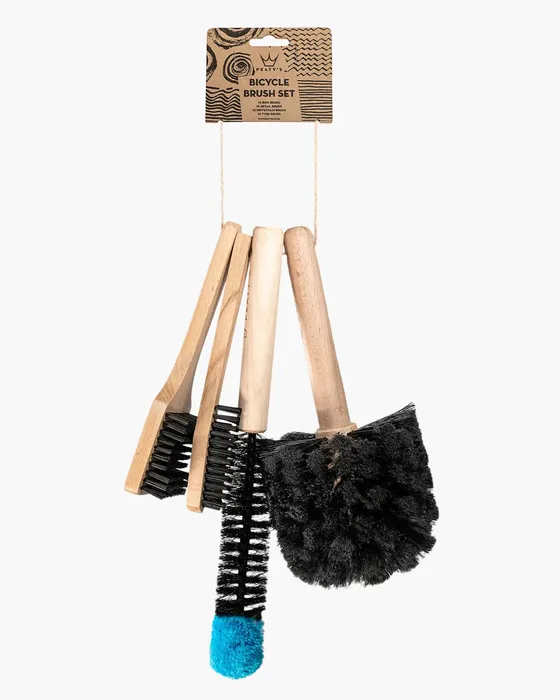
Peaty's Bicycle Brush Set is the one to buy: four brushes on sealed beech wood handles, each designed around a specific problem, including a drivetrain brush with an angled head that moves your hand away from the cassette, a stiffer central bristle channel for the chain to sit in, and a chisel-cut handle end for scraping jockey wheels. Pedro's Pro Brush Kit is the value pick and the better drivetrain set, with four brushes whose bristle diameter, length and density are chosen per job, including a genuine parts-cleaning brush for painting degreaser on. The Muc-Off 5x Premium Brush Set covers the most ground, with five brushes and a storage bag, though the handles are all plastic and the claw brush is still described as 10-speed compatible. The Finish Line Mechanic Brush Set is the one to skip, because Finish Line will not even tell you which five brushes are in it. Best for: anyone who has been cleaning a drivetrain with an old toothbrush and a washing-up brush.
Our picks at a glance
- Peaty's Bicycle Brush Set - Buy. Four brushes on sealed beech, each designed around a specific problem and explained in detail.
- Pedro's Pro Brush Kit - Buy. Four brushes with the bristles chosen per job, including the degreaser brush most sets leave out.
- Muc-Off 5x Premium Brush Set - It depends. The most brushes and the only storage bag, on handles that are entirely plastic.
- Finish Line Mechanic Brush Set - Skip. Five brushes, and Finish Line will not say which five.
The verdict in 30 seconds
What mattered most
- Brushes in the set
- Handle material
- Each brush described
- Drivetrain-specific shaping
- Degreaser application brush
- Mud scraper
Brushes are the part of bike cleaning that nobody researches and everybody ends up regretting. A set that looks identical to the next one on the shelf will differ in the things that matter: whether the drivetrain brush keeps your knuckles away from a spinning cassette, whether the soft brush is actually soft enough for a matt frame, whether the fine brush reaches a fork crown, and whether the handles survive a winter. The cheapest way to work out which is which is to read what each maker says about each individual brush in the set, because two of these four describe every bristle and two of them describe nothing at all.
Four brushes on sealed beech, each designed around a specific problem and explained in detail.
Best for: Anyone who cleans a bike often enough to care that the drivetrain brush is shaped properly.
- The Drivetrain Brush has an angled head that moves your hand away from a spinning cassette, a lower centre of stiffer bristles that forms a channel for the chain, softer longer outer bristles for the chain's sides, and a chisel-cut handle end for clearing jockey wheels.
- All four handles are sealed beech wood rather than plastic, and the packaging is 100 percent recycled cardboard with natural jute string.
- Each brush is specified: the Bog Brush has 360 degree flagged-end bristles, the Detail Brush uses crimped medium-density bristles made from post-consumer recycled material, the Tyre Brush has stepped-height stiff bristles running at 90 degrees to the handle.
- Four brushes rather than five, with no cone or bottle brush for reaching inside tight recesses.
- Wooden handles need drying and care, which Peaty's says outright, where plastic does not.
- No storage bag or roll is included.
- Peaty's publishes no bristle stiffness figures or brush dimensions, only descriptions.
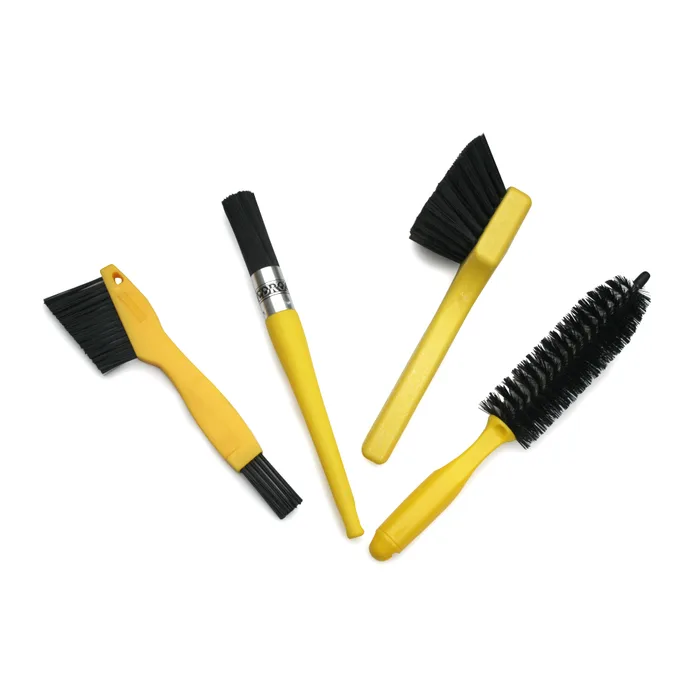
Four brushes with the bristles chosen per job, including the degreaser brush most sets leave out.
Best for: Drivetrain cleaning on a budget, especially if you use pour-on degreaser rather than a spray.
- The Toothbrush has two working ends: tapering bristles for chains, chainrings and cassette faces, and longer, stiffer, larger-diameter bristles at the other end to reach between cassette cogs.
- The Parts Cleaning Brush works like a paint brush, with long dense bristles that hold degreaser so you can paint it onto drivetrain parts instead of spraying it everywhere.
- Pedro's states that bristle diameter, length and density vary deliberately by brush, and publishes what each one is for, down to which of its cleaners each pairs with.
- All-plastic handles, with no material named.
- No dimensions, bristle materials or stiffness figures are published.
- No storage bag, and a cone brush and a toothbrush are awkward things to keep together.
- The large Frame and Wheel Brush has low-stiffness bristles, so it is a wash brush rather than a scrubber.
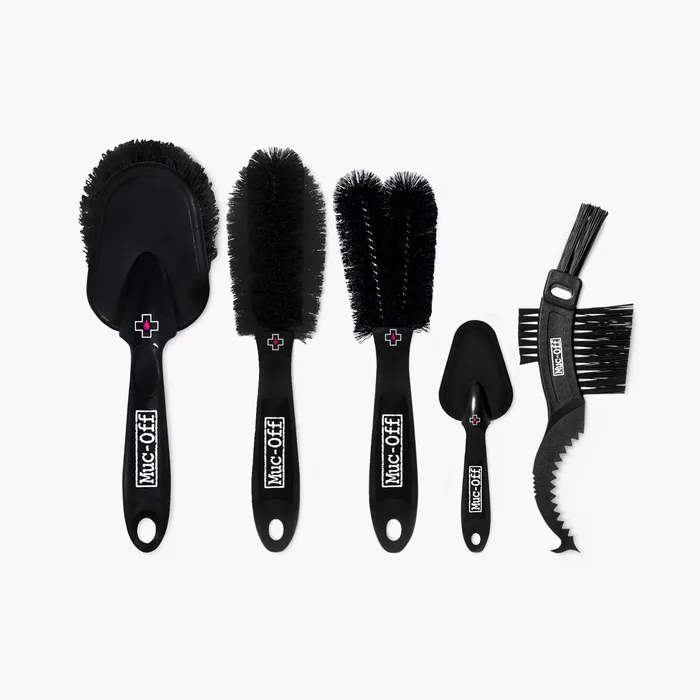
The most brushes and the only storage bag, on handles that are entirely plastic.
Best for: Muddy mountain bikes, where the mud scraper and the two-prong brush earn their place.
- Five brushes covering frame, detail, drivetrain, wheels and spokes, plus a Two Prong Brush whose twin heads reposition to reach shocks, linkages and pedals.
- The Claw Brush has triple heads with tough nylon bristles and an integral scraper for de-clogging mud, which no other set here includes.
- Rubberised impact zones on the handles to protect delicate finishes, an oversized soft brush head for covering large areas quickly, and a storage bag.
- The Claw Brush is still described as 10-speed compatible, which is a dated specification now that 12-speed cassettes are standard.
- All five handles are plastic, against a set of beech ones at similar money.
- The soft brush bristle material is given only as a sintered bristle compound, which is not a material.
- Muc-Off warns against use with boiling water or on hot parts, so the bristles have a real temperature limit.
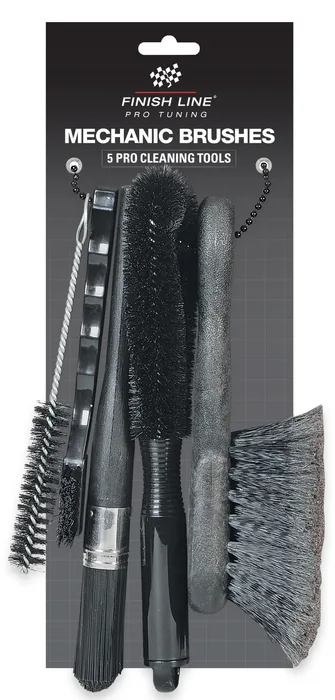
Five brushes, and Finish Line will not say which five.
Best for: A shop replacing worn brushes that already knows what is in the box.
- Five pieces is the same count as the largest set here.
- Finish Line positions it for bike shops as well as home mechanics, so it is built around shop use.
- It pairs with a lubricant and cleaner range you may already own.
- The product page never lists the five brushes, let alone what each is for.
- No handle material, no bristle material, no dimensions and no stiffness are published.
- There is no description of any drivetrain-specific shaping, which is the main reason to buy a bike brush set at all.
- Finish Line's own Grunge Brush page describes its horseshoe and long bristles in detail, which shows the information exists and simply is not given here.
| Criteria | Bicycle Brush Set Top pick | Pro Brush Kit | 5x Premium Brush Set | Mechanic Brush Set |
|---|---|---|---|---|
| Verdict | Buy it | Buy it | It depends | Skip it |
| Best for | Anyone who cleans a bike often enough to care that the drivetrain brush is shaped properly. | Drivetrain cleaning on a budget, especially if you use pour-on degreaser rather than a spray. | Muddy mountain bikes, where the mud scraper and the two-prong brush earn their place. | A shop replacing worn brushes that already knows what is in the box. |
| Price tier | $$ · mid-range | $ · budget | $$ · mid-range | $$ · mid-range |
| Brushes in the set | 4 | 4 | 5 | 5 |
| Handle material | Sealed beech wood | Plastic, not specified | Plastic with rubberised zones | Not published |
| Each brush described | Yes, in detail | Yes, in detail | Yes, in detail | No, not even listed |
| Drivetrain-specific shaping | Angled head, chain channel, chisel handle end | Dual-end toothbrush, inter-cog bristles | Claw brush with triple heads and scraper | Not published |
| Degreaser application brush | No | Yes, Parts Cleaning Brush | No | Not published |
| Mud scraper | No | No | Yes, integral to claw brush | Not published |
| Storage | None | None | Storage bag included | Not published |
| Packaging | Recycled cardboard and jute string | Not published | Not published | Retail card |
Which one is right for you?
- Anyone who cleans a bike often enough to care that the drivetrain brush is shaped properly. Buy it Peaty's Bicycle Brush Set
- Drivetrain cleaning on a budget, especially if you use pour-on degreaser rather than a spray. Buy it Pedro's Pro Brush Kit
- Muddy mountain bikes, where the mud scraper and the two-prong brush earn their place. It depends Muc-Off 5x Premium Brush Set
- A shop replacing worn brushes that already knows what is in the box. Skip it Finish Line Mechanic Brush Set
How we judged the field
A brush set is four or five separate products sold together, so we judged it as four or five separate products. For each one we asked what shape it is, what the bristles are like, what specific access problem it solves, and whether the maker says any of that. That last question turned out to be decisive, because two of these sets explain the design of every brush in them and one does not even list what is inside.
We weighted the drivetrain brush most heavily. It is the reason to buy a bike-specific set rather than a handful of hardware store brushes: the cassette is the hardest thing on a bike to clean, it is sharp, it spins, and the gaps between cogs are narrower every time the industry adds a speed. A set whose drivetrain brush is shaped for that job is worth more than a set with one extra piece. After that we looked at handle material and durability, at whether a degreaser-specific brush is included, and at how the set is packaged and stored, which sounds trivial until you are looking for the small brush in a shed.
Peaty’s Bicycle Brush Set is four brushes that were clearly designed rather than sourced, and Peaty’s says as much, describing the range as built from the ground up rather than an off-the-shelf plastic brush with a name on it. The Drivetrain Brush is the standout and the reasoning is published: an angled head so your hand is not next to a spinning cassette, a lower centre of stiffer bristles forming a channel for the chain to sit in while softer, longer outer bristles do the sides, and a chisel-cut handle end for scraping jockey wheels. The Bog Brush is the general-purpose one with 360 degree bristles so it does not clatter against the frame, and long flagged-end bristles that hold foam. The Detail Brush uses crimped medium-density bristles made from post-consumer recycled material. The Tyre Brush has stiff, stepped-height bristles set at 90 degrees to the handle so they wrap around the casing. All four handles are sealed beech, and the packaging is recycled cardboard and jute string. What you give up is a fifth brush, any kind of cone or recess brush, and a storage bag, and you take on the small obligation of drying wooden handles.
Pedro’s Pro Brush Kit is the same thinking at a lower price with a different fourth brush. The Toothbrush is the drivetrain tool and it is genuinely two brushes on one handle: tapering bristles at the front for the intricate surfaces of chains, chainrings and cassette faces, and at the other end longer, stiffer, larger-diameter bristles specifically to reach deep between cassette cogs. The Cone Brush tapers to small-diameter bristles so it pushes into recesses on frames, forks and wheels that nothing else reaches. The Parts Cleaning Brush is the one most sets omit and the one that saves money, a paint-brush-like tool with long dense bristles that hold degreaser so you can paint it onto a cassette rather than spraying most of it onto the floor. The large Frame and Wheel Brush covers the big areas with deliberately low-stiffness bristles. Pedro’s states that diameter, length and density vary by brush by design, and tells you which of its cleaners each brush pairs with. The gaps are material: no handle material named, no dimensions, no bristle composition, and nothing to store them in.
Muc-Off’s 5x Premium Brush Set is the broadest coverage here and the most conventional. The Soft Washing Brush has an oversized head for covering a frame quickly and what Muc-Off calls a sintered bristle compound for delicate finishes. The Detailing Brush handles sprockets, hubs, suspension mounts and fork crowns. The Claw Brush is the drivetrain tool, with triple heads of tough nylon and an integral scraper for de-clogging mud, which genuinely is something no other set here offers and which matters on a winter mountain bike. The Wheel and Component Brush is contoured for rims and spokes, and the Two Prong Brush has twin heads that reposition to get at spokes, discs, shocks, cranks, linkages and pedals. All of it comes in a storage bag, and the handles carry rubberised impact zones to protect finishes. Two things hold it back. Every handle is plastic, where a similarly priced set gives you beech. And the Claw Brush is still described as 10-speed compatible, a claim that dates the product at a time when 12-speed is the default and cog spacing has narrowed since. Muc-Off also warns against boiling water and hot parts, so the bristles have a temperature ceiling.
Finish Line’s Mechanic Brush Set is a skip for a simple reason: the page does not say what is in it. The description runs to two sentences, saying the set of five unique brushes is essential for every bike shop and DIY mechanic and pairs with Finish Line wash formulas. It never names the five brushes, never says what any of them is for, never gives a handle or bristle material, and never mentions drivetrain shaping, which is the entire point of buying a bike-specific set. What makes this look like a choice rather than an oversight is Finish Line’s own Grunge Brush page, which describes that product’s dual heads precisely, horseshoe bristles for chains and jockey wheels and long bristles for cassettes and derailleurs. The information exists inside the company. It simply is not on the page for the set, and at this price two competitors describe every brush they sell you.
Peaty’s Bicycle Brush Set vs Pedro’s Pro Brush Kit: which should you buy?
Peaty’s against Pedro’s is close and the difference is what the fourth brush does. Peaty’s spends it on a tyre brush with stepped bristles and gives you sealed beech handles, plastic-free packaging and the best-shaped drivetrain brush of the group, with an angled head that keeps your knuckles off the cassette and a chisel handle end for jockey wheels. It is the more considered set and the more pleasant one to own.
Pedro’s spends its fourth brush on a Parts Cleaning Brush for applying degreaser, and that changes how you clean rather than just what you clean with, because painting degreaser onto a cassette uses a fraction of what spraying does. Its Toothbrush is also a genuinely clever two-ended tool, with bristles at the far end sized specifically to reach between cogs. It costs less and it comes on plastic handles you can abandon in a bucket without guilt. Buy the Peaty’s if you want the better set. Buy the Pedro’s if you use pour-on degreaser, or if you know your brushes will be left wet.
What to look for
- A properly shaped drivetrain brush: an angled head, a bristle channel for the chain, or long bristles sized to reach between cogs. This is the reason to buy a bike set.
- A soft brush large enough for the frame: low-stiffness bristles and an oversized head, kept strictly separate from the drivetrain brushes.
- A brush that holds degreaser: long dense bristles let you paint product onto a part instead of spraying past it, which pays for itself.
- Handle material, stated: sealed wood lasts if you dry it, plastic survives neglect, and an unnamed material tells you nothing.
- A mud scraper, if you ride off-road: an integral scraper on the drivetrain brush saves a lot of time in winter.
- Each brush described individually: a set whose maker will not list its contents is asking you to buy on the logo.
Our final take
Brush sets are judged one brush at a time, and the makers who understand that write it down. Peaty’s Bicycle Brush Set is the one to buy: four brushes on sealed beech, each designed around a specific annoyance, with the best drivetrain brush of the four and packaging that leaves nothing plastic behind. Pedro’s Pro Brush Kit costs less, thinks just as hard about the drivetrain, and includes the degreaser brush the others leave out. The Muc-Off set is the widest coverage and the right answer for a muddy mountain bike thanks to its scraper and its two-prong brush, if you can live with plastic handles and a claw brush whose specification has not been updated in several drivetrain generations. And a five-piece set whose maker will not list the five pieces is not a set, it is a gamble.
Questions, answered
Why not just use a household brush and an old toothbrush?
You can, and for the frame it is genuinely fine. Where it stops working is the drivetrain. A household brush is too wide to get between cassette cogs, an old toothbrush is too short to reach the inner ones and puts your knuckles right next to the teeth, and neither has bristles stiff enough to shift cured lube without a lot of scrubbing. That is the specific problem the shaped drivetrain brushes in these sets are solving, and it is the one part of the set worth paying for.
How many brushes do I actually need?
Three covers almost everything: a large soft brush for the frame and wheels, a stiff shaped brush for the cassette and chainrings, and a small detail brush for hubs, calipers and fork crowns. A fourth that holds degreaser, like Pedro's Parts Cleaning Brush, saves a surprising amount of product because you paint it on rather than spraying past the part. Anything beyond that, including cone brushes and two-prong brushes, is about specific suspension and linkage access rather than general cleaning.
Do I need separate brushes for degreaser and soap?
Yes, and this is the mistake that ruins good brushes. A brush used on the drivetrain picks up dissolved chain lube and metal paste, and using it afterwards on the frame smears that onto paint and, far worse, potentially onto brake rotors. Keep one set for drivetrain and one for everything else, mark them, and never let a drivetrain brush near a disc rotor. Most of these sets separate naturally into a soft frame brush and stiff drivetrain brushes, so the discipline costs nothing.
Wooden or plastic handles?
Plastic is maintenance-free and survives being left wet, which is how most brushes die. Wood feels better, is less waste at the end of its life and is what Peaty's uses across its range on sealed beech, but Peaty's also says outright that caring for your brushes matters for their life expectancy, and what that means in practice is not leaving them in a bucket of water. If you are honest about putting brushes away wet, buy plastic.
Will stiff bristles scratch my frame?
Stiff nylon on a gritty frame can mark clear coat and will certainly mark matt finishes, which is why every one of these sets includes a large soft brush and reserves stiff bristles for the drivetrain and tyres. The real damage comes from grit trapped in the bristles rather than the bristles themselves, so rinse the frame first to carry loose dirt off, rinse the brush during the wash, and keep the stiff brushes below the chainstay where the finish matters less.
Deciding between the top two? See our head-to-head: Peaty's Bicycle Brush Set vs Pedro's Pro Brush Kit.
More Outdoors & Fitness reviews
 The Best GPS Bike Computers: 4 Compared (and One to Skip)
  The Best Bike Degreasers: 4 Compared (and One to Skip)
  The Best Bike Fenders: 4 Compared (and One to Skip)
  The Best Bike Floor Pumps: 4 Compared (and One to Skip)
  The Best Bike Frame Protection: 4 Compared (and One to Skip)
  The Best Bike Grips: 4 Compared (and One to Skip)