

Cycling
The Best GPS Bike Computers: 4 Compared (and One to Skip)
We compared four current cycling head units on maps, battery, screen and real-world reliability to find which are worth mounting.
The short version
The Garmin Edge 1050 is the most capable GPS bike computer you can buy, with a 3.5-inch screen, strong maps and deep training tools, but it's the priciest and its stated 20 hours trails some cheaper Edges. The Wahoo ELEMNT ROAM 3 is the value champion: simple app-led setup, a glove-friendly touchscreen, up to 25 hours of battery and reliable navigation. The Hammerhead Karoo has a smartphone-quality display and great SRAM AXS integration, but it publishes little hardware detail and its training platform is less established, so it's a conditional pick. The Wahoo ELEMNT ACE is big, expensive and built around a wind sensor most riders won't miss, making it the one to skip. Best for: most riders should buy the ROAM 3, and reach for the Edge 1050 only if they want the absolute maximum.
Our picks at a glance
- Garmin Edge 1050 - Buy. The most capable do-everything head unit, if your budget and cockpit can take it.
- Wahoo ELEMNT ROAM 3 - Buy. The no-drama navigator: dependable maps, long battery and a simple app-led setup.
- Hammerhead Karoo - It depends. The best-looking screen in the game, with a few compromises you should go in knowing.
- Wahoo ELEMNT ACE - Skip. A big, pricey flagship whose headline wind sensor doesn't earn its size for most riders.
The verdict in 30 seconds
What mattered most
- Display & readability
- Navigation & maps
- Battery life (maker stated)
- Training & analytics
- Ecosystem & sensor support
- Ease of use
A good bike computer earns its handlebar space with dependable maps, honest battery life and a screen you can read at a glance in full sun. We weighed the four head units most riders actually cross-shop in 2026. Two are easy recommendations, one is a genuine "it depends," and one big-name flagship is hard to justify for almost anyone.
The most capable do-everything head unit, if your budget and cockpit can take it.
Best for: Riders who want the single most powerful unit and are already invested in Garmin's ecosystem.
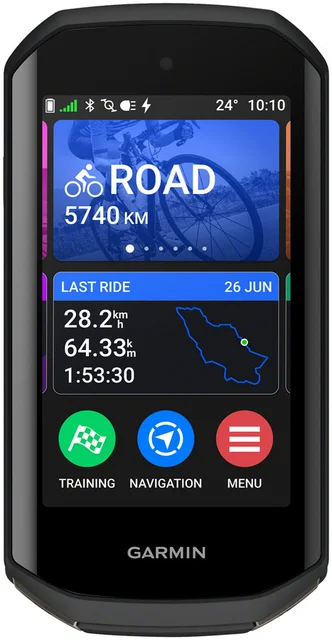
- Vivid 3.5-inch colour touchscreen, at 480 x 800 pixels
- Best-in-class maps, rerouting and the deepest training and ride analytics
- Huge ecosystem: sensors, group ride tracking, contactless pay and a built-in speaker bell
- Priciest of the group by a clear margin
- Garmin rates it at up to 20 hours in demanding use, less than some of its cheaper Edge models such as the Edge 840 at up to 26 hours, and the feature depth can overwhelm
Own the Garmin Edge 1050? Tell us how it held up.
Thanks. Counted, and shown once enough owners have weighed in.
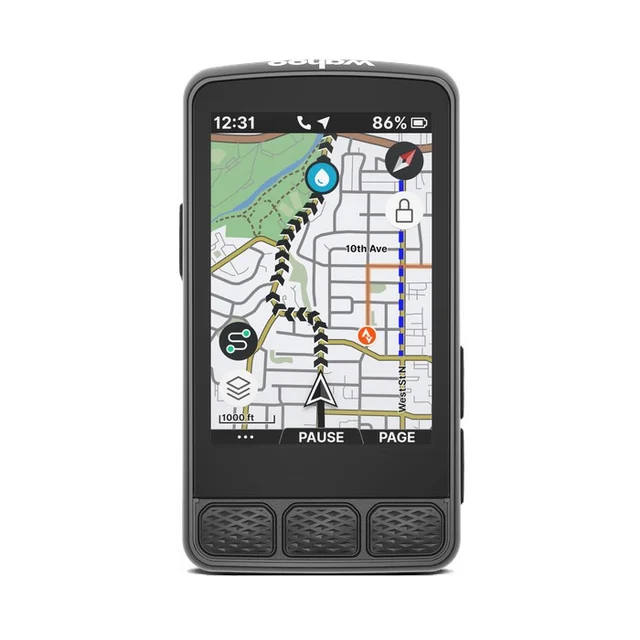
The no-drama navigator: dependable maps, long battery and a simple app-led setup.
Best for: Riders who prioritize reliable navigation and a fuss-free experience over deep analytics.
- Glove-friendly 2.8-inch touchscreen that Wahoo says keeps you in command in all conditions
- Phone-app-led setup and a Ready-To-Ride dashboard built for simplicity
- Up to 25 hours of stated battery life, plus turn-by-turn maps, audible turn alerts and LED navigation cues
- Its 2.8-inch screen is smaller than the Edge 1050's 3.5 inches
- Training and analytics are lighter than Garmin's for data-focused riders
Own the Wahoo ELEMNT ROAM 3? Tell us how it held up.
Thanks. Counted, and shown once enough owners have weighed in.
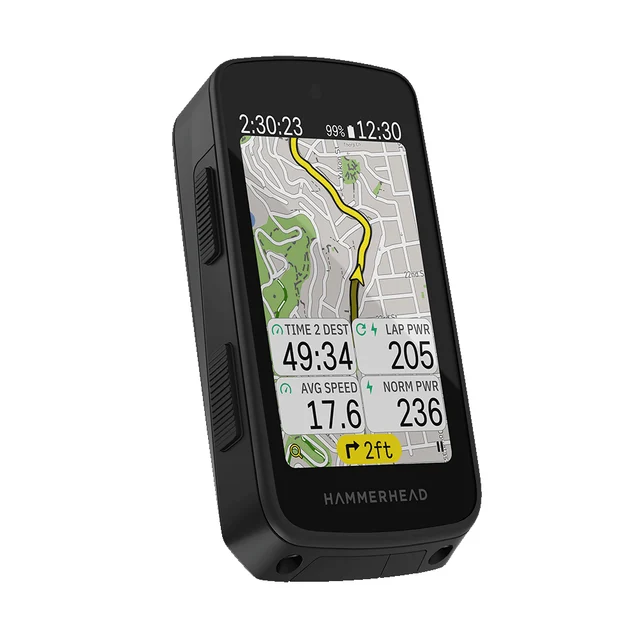
The best-looking screen in the game, with a few compromises you should go in knowing.
Best for: Display-obsessed riders on SRAM AXS drivetrains who value looks and integration over a mature training platform.
- Smartphone-quality Gorilla Glass touchscreen, backed by physical buttons for gloves
- Tight SRAM AXS integration and regular software updates
- Hammerhead quotes 35+ hours of battery life when you customise the ride settings
- Hammerhead does not publish a weight or screen size on its product page
- Now sold through SRAM, and its training platform is less established than Garmin's
Own the Hammerhead Karoo? Tell us how it held up.
Thanks. Counted, and shown once enough owners have weighed in.
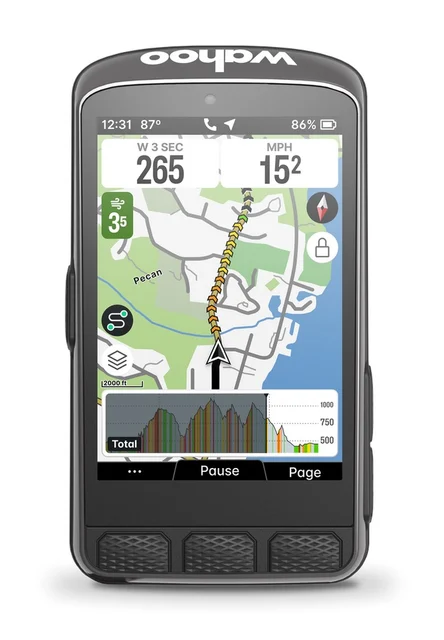
A big, pricey flagship whose headline wind sensor doesn't earn its size for most riders.
Best for: Data-obsessed riders who specifically want integrated wind readings and accept the size, weight and price to get them.
- 3.8-inch touchscreen, the largest here, with the familiar Wahoo interface
- Integrated wind sensor measures airspeed, and Wahoo rates the battery at up to 30 hours
- At a stated 208g and 126 x 71mm it is the biggest and heaviest unit here, and it dominates a small cockpit
- Wind data is a niche metric that many riders will rarely use
Own the Wahoo ELEMNT ACE? Tell us how it held up.
Thanks. Counted, and shown once enough owners have weighed in.
| Criteria | Garmin Edge 1050 Top pick Buy it Buy | Wahoo ELEMNT ROAM 3 Buy it Buy | Hammerhead Karoo It depends Buy | Wahoo ELEMNT ACE Skip it Buy |
|---|---|---|---|---|
| Best for | Riders who want the single most powerful unit and are already invested in Garmin's ecosystem. | Riders who prioritize reliable navigation and a fuss-free experience over deep analytics. | Display-obsessed riders on SRAM AXS drivetrains who value looks and integration over a mature training platform. | Data-obsessed riders who specifically want integrated wind readings and accept the size, weight and price to get them. |
| Price tier | $$$$ · flagship | $$$ · premium | $$$ · premium | $$$ · premium |
| Display & readability | 3.5" color touchscreen | 2.8" color touchscreen, glove-friendly | Gorilla Glass touchscreen plus buttons | 3.8" touchscreen, largest here |
| Navigation & maps | Excellent maps, fast rerouting | Reliable turn-by-turn, LED cues | Beautiful maps, strong routing | Full maps |
| Battery life (maker stated) | Up to 20h demanding use, 60h saver mode | Up to 25h | 35+ hours with customised settings | Up to 30h |
| Training & analytics | Deepest, class-leading | Solid but lighter | Good, still-growing platform | Good, plus wind data |
| Ecosystem & sensor support | Vast, mature ecosystem | Broad ANT+ and Bluetooth | Strong SRAM AXS integration | Broad, plus built-in wind sensor |
| Ease of use | Powerful but complex | Simplest, app-led setup | App-like and intuitive | Familiar Wahoo flow |
| Size & mounting footprint | Large but manageable | Mid-size | Weight not published | Biggest and heaviest, 208g |
| Price tier | $$$$ · flagship | $$$ · premium | $$$ · premium | $$$ · premium |
Which one is right for you?
- Riders who want the single most powerful unit and are already invested in Garmin's ecosystem. Buy it Garmin Edge 1050
- Riders who prioritize reliable navigation and a fuss-free experience over deep analytics. Buy it Wahoo ELEMNT ROAM 3
- Display-obsessed riders on SRAM AXS drivetrains who value looks and integration over a mature training platform. It depends Hammerhead Karoo
- Data-obsessed riders who specifically want integrated wind readings and accept the size, weight and price to get them. Skip it Wahoo ELEMNT ACE
How we judged the field
We don’t run our own lab. Instead, we synthesize independent testing, expert hands-on reviews and aggregated owner reports to see where the consensus lands and, just as important, where it splits. For GPS bike computers, a handful of things separate a unit you love from one you tolerate: how readable the screen is in harsh sunlight, how good the maps and rerouting are, how honest the battery life is on a real all-day ride, how painless the setup and daily interface feel, and whether it plays nicely with the sensors and drivetrain you already own. We weighted real-world reliability heavily, because a head unit that reboots mid-ride or drains faster than promised undermines everything else. Price mattered too, but only in context: the most expensive option can still be the right one, and the cheapest isn’t automatically a bargain.
Garmin Edge 1050
Buy itThe Edge 1050 is the unit to beat. Its vivid 3.5-inch colour touchscreen runs at 480 x 800 pixels. Underneath is Garmin’s mature mapping and rerouting, the deepest training and analytics suite here, and an ecosystem that spans sensors, group ride tracking, contactless payment and even a genuinely useful built-in speaker that works as a bell and for alerts. The trade-offs are real but predictable: it’s the most expensive option, its stated 20 hours in demanding use trails some of Garmin’s cheaper Edge models, such as the Edge 840 at up to 26 hours, and the sheer depth of features can feel like a lot if you just want speed, distance and directions. For riders who want maximum capability and are already living in Garmin’s world, it’s an easy recommendation.
Wahoo ELEMNT ROAM 3
Buy itThe ROAM 3 wins on the things you feel every single ride. The phone-app-led setup and Ready-To-Ride dashboard keep things simple, Wahoo describes its 2.8-inch touchscreen as glove-friendly in all conditions, and it is rated at up to 25 hours of battery. Navigation is clear and dependable, with on-device maps, sensible rerouting, audible turn alerts and LED cues along the top edge that nudge you through turns without staring at the screen. It gives up some ground to the Edge 1050 on screen size and on deep analytics, so hardcore data riders may want more. But for the large majority who want reliable maps and a fuss-free experience for less money, the ROAM 3 is the smart pick.
Hammerhead Karoo
It dependsThe Karoo’s selling point is its screen: a smartphone-quality Gorilla Glass touchscreen that makes maps a pleasure to read, backed by physical buttons for gloved hands and regular software updates. If you ride a SRAM AXS drivetrain, its integration is the tightest of the bunch, which makes sense now that it lives under the SRAM umbrella. The catch is a set of compromises you should accept up front: Hammerhead publishes little hardware detail such as weight or screen size, its 35+ hour battery figure depends on customised settings, and its training platform is less established than Garmin’s. Buy it if the display and AXS integration are what you care about most; look elsewhere if you want the most proven training platform.
Wahoo ELEMNT ACE
Skip itThe ACE is Wahoo’s big-screen flagship, and its headline act is an integrated air-speed sensor that measures wind. It’s a real innovation, the 3.8-inch touchscreen is the largest here, and Wahoo rates the battery at up to 30 hours. The problem is the value equation. At a stated 208g it is the largest and heaviest unit here, it dominates a compact cockpit, and it commands a premium, yet wind and drafting data is a niche metric most riders will rarely act on. For less money, the ROAM 3 does the core job in a smaller package. Unless wind data is genuinely central to your training, this is the one to pass on.
Sources
Specs in this review come from these pages.
Garmin Edge 1050 vs Wahoo ELEMNT ROAM 3: which should you buy?
This is the decision most shoppers actually face. The Edge 1050 is the more capable device in almost every technical sense: a better screen, deeper analytics, a broader ecosystem and more features than you’ll likely ever use. The ROAM 3 counters with the things that shape the day-to-day experience: it’s noticeably cheaper, simpler to set up and live with, rated for longer battery life (up to 25 hours against 20 in demanding use), and smaller on the bars. If you’re a data-driven rider who wants every metric and the sharpest maps, and the price doesn’t scare you, get the Edge 1050. If you mainly want to get on your bike, follow a route reliably and not think about your computer, the ROAM 3 will make you happier for less. Most riders fall into the second camp, which is why the ROAM 3 is our runner-up but the more broadly sensible buy.
What to look for
- Sunlight readability: a screen that washes out in bright light makes every other feature harder to use.
- Honest battery life: match a unit’s real-world endurance to your longest rides, not the marketing number.
- Buttons vs touch: touch is faster for maps; buttons are more reliable in gloves, rain and rough terrain.
- Maps and rerouting: confirm it has full on-device maps and reroutes quickly when you go off course.
- Sensor and drivetrain compatibility: check ANT+/Bluetooth support and any special integration for SRAM AXS or Shimano Di2.
- Size and mounting: make sure the unit fits your cockpit and your handlebar mount without crowding other gear.
- Ecosystem lock-in: factor in the app, subscription-free features and how well it fits the platform you already use.
Our final take
There’s no single winner for everyone, but there is a clear pattern. The Garmin Edge 1050 is the most capable GPS bike computer you can buy and the right call if you want the absolute best and will use its depth. For most riders, though, the Wahoo ELEMNT ROAM 3 delivers the experience that matters day to day (reliable navigation, long battery and effortless setup) for meaningfully less. The Hammerhead Karoo is a stunning-screened, conditional choice best reserved for SRAM AXS riders who prize the display. And the Wahoo ELEMNT ACE, for all its clever wind sensing, is the one to skip: too big, too pricey and built around a feature most riders simply won’t miss.
Questions, answered
Is a dedicated bike computer better than using my phone or a running watch?
For serious riding, yes. A dedicated head unit gives you a sunlight-readable screen, far longer battery life, glove-friendly controls and secure handlebar mounting that a phone can't match, plus cycling-specific maps and rerouting. A GPS running watch overlaps on fitness data but has a tiny screen and weak on-bike navigation, so it's a poor substitute if maps matter to you.
Do I need touchscreen, or are buttons better?
It's a genuine preference, and all four units here have touchscreens. Touch is faster for panning maps and scrolling menus. Physical buttons, which Hammerhead highlights on the Karoo, are more reliable with full-finger gloves, in rain, or on rough terrain where a bouncing thumb can mis-tap. If you ride in wet or cold conditions a lot, check that the unit you choose also has usable buttons.
How important is battery life?
It depends on your rides. For daily commutes and two-hour spins, every unit here has plenty. On the makers' own figures, the Edge 1050 is rated at up to 20 hours in demanding use and 60 in saver mode, the ROAM 3 at up to 25, the ACE at up to 30, and the Karoo at 35+ with customised settings. Real-world life varies with brightness, GPS mode and sensors, so for ultra-distance events plan for a top-up whichever you choose.
Will these work with my existing sensors and drivetrain?
Generally yes. All four support standard ANT+ and Bluetooth sensors, so your power meter, heart-rate strap and speed/cadence sensors should pair with any of them. If you run a SRAM AXS electronic drivetrain, the Hammerhead Karoo offers the tightest integration, though Garmin also connects to select electronic shifting systems.
Is the Wahoo ELEMNT ACE's wind sensor worth it?
For most riders, no. It's a clever, novel feature, but wind and drafting data is something most riders will rarely act on, and you pay for it in the largest and heaviest unit here. Unless integrated wind data is genuinely important to your training, your money goes further on the ROAM 3 or Edge 1050.
Deciding between the top two? See our head-to-head: Garmin Edge 1050 vs Wahoo ELEMNT ROAM 3.
More in Cycling
GPS Bike Computers, Explained Plain-English guide → Garmin Edge 1050 vs Wahoo ELEMNT ROAM 3 Head-to-head →  The Best Bike Degreasers: 4 Compared (and One to Skip)
  The Best Bike Fenders: 4 Compared (and One to Skip)
  The Best Bike Floor Pumps: 4 Compared (and One to Skip)
  The Best Bike Frame Protection: 4 Compared (and One to Skip)