

Outdoors & Fitness
The Best Bike Bottle Cages: 4 Compared (and One to Skip)
These four span 28 to 48 grams. A full large bottle is about 750 grams, so the weight spread is a rounding error and the useful specs are adjustment and bottle fit.
The short version
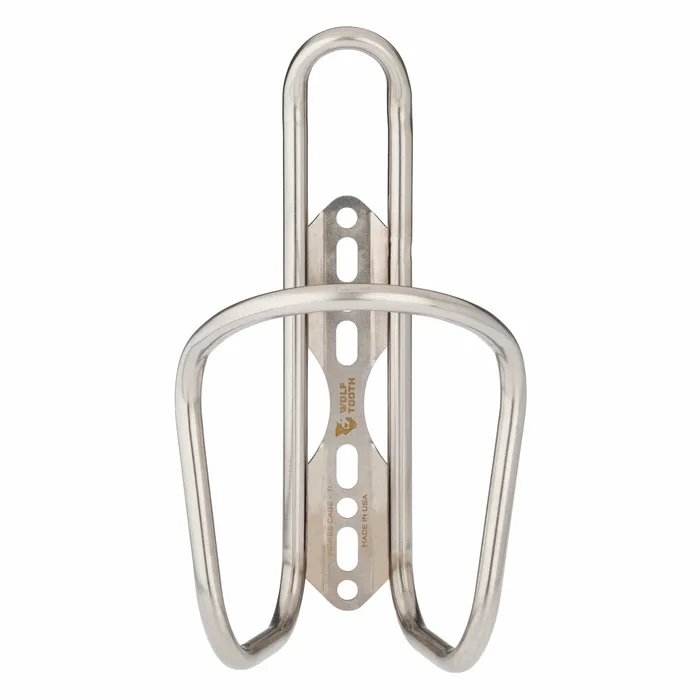
The Wolf Tooth Morse Cage Ti is the pick for awkward frames: a stated 33 grams of hand-bent titanium on a base plate offering four mounting positions and up to 32mm of vertical adjustment, which is what gets a bottle into a small front triangle. The Lezyne Matrix Team Cage is the value choice at a stated 36 grams, with side-loading from either the left or the right, so it works where a seat tube or a frame bag blocks a straight pull. The King Cage Iris suits one specific problem: at 48 grams of 304 stainless it is the heaviest here, and it is the only one that publishes the bottle it accepts, fitting metal bottles up to a 2.9 inch base. Skip the Arundel Mandible for most riders, because carbon saves you 5 grams against titanium and gives up the one thing a metal cage offers, which is a grip you can adjust. Best for: buying on where the cage fits rather than on what it weighs.
Our picks at a glance
- Wolf Tooth Morse Cage Ti - Buy. Hand-bent titanium at a stated 33 grams on a base plate that slides the bottle up to 32mm up or down the frame.
- Lezyne Matrix Team Cage - Buy. A stated 36 grams of one-piece composite that loads from either side, at a fraction of what the metal cages cost.
- King Cage Iris Stainless Steel - It depends. The heaviest cage here and the only one that tells you which bottles it will actually hold.
- Arundel Mandible - Skip. The lightest cage in the comparison at a stated 28 grams, which buys you five grams over titanium and costs you the ability to adjust the grip.
The verdict in 30 seconds
What mattered most
- Stated weight
- Material
- Published mounting adjustment
- Side loading
- Published bottle compatibility
- Grip adjustable by hand
Bottle cages are sold on weight, which is close to the least useful thing about them. The whole field here fits inside 20 grams, and a full 750ml bottle weighs roughly 750. What actually varies is where the cage can sit on your frame, how hard it grips, and whether it will hold the fat insulated bottle you already own. Three of these four publish an adjustment figure, and one publishes the bottle dimension it will accept, which turns out to be the spec most people needed.
Hand-bent titanium at a stated 33 grams on a base plate that slides the bottle up to 32mm up or down the frame.
Best for: Small frames, full-suspension bikes and anywhere a frame bag or a shock fights the bottle for space.
- Wolf Tooth states a total weight of 33 grams for hand-bent hollow titanium tubing.
- The base plate offers four mounting positions, giving up to 32mm of vertical bottle adjustment on the same pair of bosses.
- Each position pairs a round hole with a slot so the cage cannot rotate once tightened.
- Fits any frame with standard bottle bosses at 64mm spacing.
- Titanium tube can be eased or closed slightly by hand to tune retention, which a moulded cage cannot.
- Among the most expensive cages here for a part that holds a water bottle.
- The base plate adds a component and two more surfaces to keep clean.
- Titanium in a bare finish scuffs and discolours where the bottle rubs.
- Adjustment is vertical only, so it does not help with fore and aft clearance.
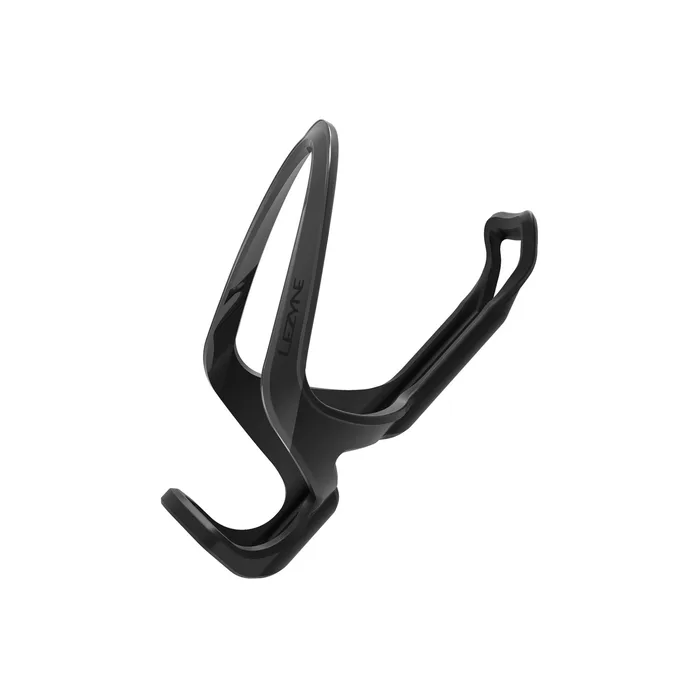
A stated 36 grams of one-piece composite that loads from either side, at a fraction of what the metal cages cost.
Best for: Most riders on most frames, and anyone who needs to pull the bottle out sideways.
- Lezyne states 36 grams, within 8 grams of the titanium cages here.
- Side-loading from the left or the right, which is what makes a bottle usable in a cramped front triangle.
- One-piece composite construction with nothing to come loose.
- Compatible with any frame carrying standard bottle mounts.
- Ten colour options, which matters more to buyers than the spec sheet suggests.
- Composite grip is set at moulding and cannot be adjusted if your bottle is loose or tight.
- No published mounting adjustment, so the bottle sits where the bosses put it.
- Plastic cages can whiten or crack at the arms after years of flexing.
- No published bottle diameter limit, so wide insulated bottles are a gamble.
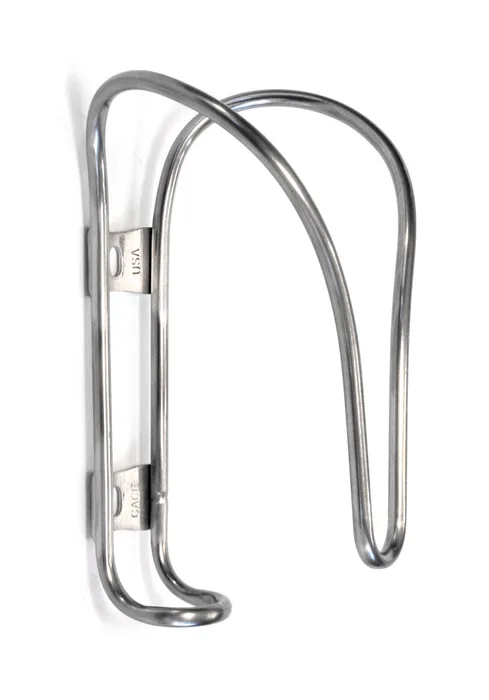
The heaviest cage here and the only one that tells you which bottles it will actually hold.
Best for: Anyone carrying an insulated metal bottle, and riders on rough surfaces who want the most retention.
- King Cage states 48 grams of 304 stainless steel tubing.
- The only cage here publishing a bottle dimension: it accommodates metal bottles with a base up to 2.9 inches, naming Klean Kanteen and Hydro Flask.
- Stainless will not leave black marks on a bottle the way some finishes do.
- Deliberately a slightly tighter fit than a standard cage, which King Cage frames as extra security on a down tube.
- Precision-machined in Durango, Colorado, and stainless tube can be tuned by hand.
- 48 grams is 20 more than the carbon cage, though that is still a fraction of a mouthful of water.
- A tighter-than-standard fit is harder to use one-handed at speed until it beds in.
- Only the lower mounting hole position is published, at 30mm from the bottom of the cage, with no adjustment range.
- Bare stainless shows scratches where an insulated bottle grinds against it.
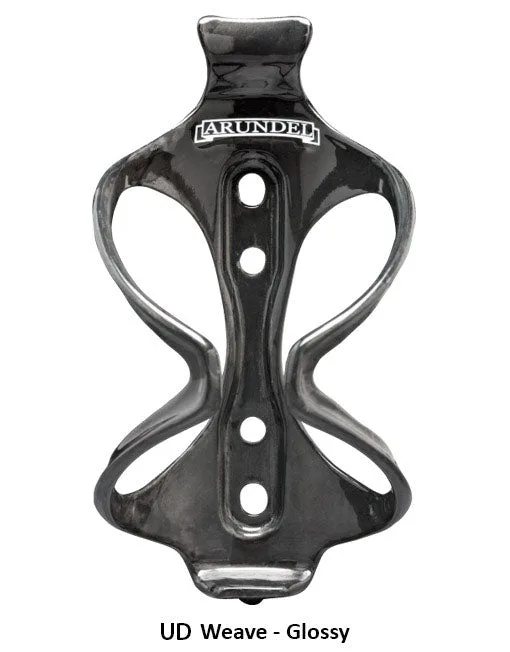
The lightest cage in the comparison at a stated 28 grams, which buys you five grams over titanium and costs you the ability to adjust the grip.
Best for: Racers already counting grams elsewhere who use one consistent bottle and never change it.
- Arundel states 28 grams, the lightest figure here.
- Unidirectional carbon weave with arms shaped to add stiffness without adding material.
- A second set of mounting holes 20mm lower gives extra clearance from the top tube.
- Arundel describes the grip as the strongest in its range, aimed at keeping bottles in over rough ground.
- Saves 5 grams against the titanium cages and 8 against the composite one, on a part that carries 750 grams of water.
- Carbon retention is fixed at moulding, so a bottle that is loose or too tight stays that way.
- A stiff carbon cage scuffs plastic bottles more readily than a tubular metal one.
- No published bottle diameter, and a rigid tight cage is the worst case for a wide insulated bottle.
| Criteria | Morse Cage Ti | Matrix Team Cage | Iris Stainless Steel | Mandible |
|---|---|---|---|---|
| Verdict | Buy it | Buy it | It depends | Skip it |
| Best for | Small frames, full-suspension bikes and anywhere a frame bag or a shock fights the bottle for space. | Most riders on most frames, and anyone who needs to pull the bottle out sideways. | Anyone carrying an insulated metal bottle, and riders on rough surfaces who want the most retention. | Racers already counting grams elsewhere who use one consistent bottle and never change it. |
| Price tier | $$$ · premium | $ · budget | $$ · mid-range | $$$ · premium |
| Stated weight | 33 g | 36 g | 48 g | 28 g |
| Material | Hand-bent hollow titanium tubing | One-piece composite matrix | 304 stainless steel tubing | Unidirectional carbon weave |
| Published mounting adjustment | Up to 32mm vertical, four base-plate positions | None published | None published; lower hole 30mm from cage base | Second hole set 20mm lower |
| Side loading | Not published | Yes, left or right | Not published | Not published |
| Published bottle compatibility | Not published | Not published | Metal bottles up to a 2.9 in base | Not published |
| Grip adjustable by hand | Yes, metal tube | No, moulded | Yes, metal tube | No, moulded carbon |
| Stated origin | Not published | Not published | Machined in Durango, Colorado | Not published |
| Fits standard 64mm bosses | Yes, stated | Yes, stated | Yes | Yes |
Which one is right for you?
- Small frames, full-suspension bikes and anywhere a frame bag or a shock fights the bottle for space. Buy it Wolf Tooth Morse Cage Ti
- Most riders on most frames, and anyone who needs to pull the bottle out sideways. Buy it Lezyne Matrix Team Cage
- Anyone carrying an insulated metal bottle, and riders on rough surfaces who want the most retention. It depends King Cage Iris Stainless Steel
- Racers already counting grams elsewhere who use one consistent bottle and never change it. Skip it Arundel Mandible
How we judged the field
Five things decide a bottle cage and the one on the packaging is the least important. Weight comes first only because it is what gets advertised, and the useful thing to know is the size of the spread: 28 grams to 48 across this field, against a full bottle at roughly 750. The second is mounting adjustment, which is whether the cage can move the bottle relative to the frame’s bosses, and it is the difference between a bottle you can extract and one you cannot. The third is loading direction, because a seat tube cage in a small frame often cannot be pulled straight up. The fourth is bottle compatibility, which almost nobody publishes and which decides whether your insulated flask fits. The fifth is whether the grip can be adjusted afterwards.
The field splits on material in a way that maps neatly onto that last point. Tubular metal cages, in titanium or stainless, can be eased open or closed by hand to suit a particular bottle. Moulded cages, whether a composite like Lezyne’s or a carbon layup like Arundel’s, have their retention fixed when they are made. That is not a knock on moulding, which buys a one-piece part with no fasteners and, in Lezyne’s case, side loading that the metal cages here do not offer. It does mean the question of what bottle you actually use should be settled before you buy, not after. So we took two metal cages and two moulded ones, and read what each maker was willing to put a number against.
Wolf Tooth Morse Cage Ti - buy
The Morse Cage Ti is the one we would buy for a difficult frame, and it earns that with a feature the others do not have. Wolf Tooth states 33 grams for hand-bent hollow titanium tubing, which puts it in the middle of this field on weight and at the top on usefulness. The base plate is the point: named for a dot-dash mounting pattern, it offers four positions that align with standard bosses and deliver up to 32mm of vertical bottle adjustment. Each position pairs a round hole with a slot, so once tightened the cage cannot rotate. If you have ever failed to get a bottle out of a small front triangle, or fought a frame bag for the same space, 32mm is the difference between carrying water and not. It fits any frame with the standard 64mm bolt spacing. The costs are price, a base plate that is another part to keep clean, and a bare titanium finish that marks where the bottle rubs. Adjustment is vertical only.
Lezyne Matrix Team Cage - buy
The Matrix Team Cage is the sensible default and by some distance the cheapest thing here. Lezyne states 36 grams, which puts a one-piece composite cage within 8 grams of titanium and makes the premium materials harder to justify on weight alone. The feature that matters is side loading from either the left or the right, which solves the same problem as Wolf Tooth’s base plate by a different route: if the bottle cannot come straight up because a top tube or a frame bag is in the way, it comes out sideways instead. It is one piece, so there is nothing to work loose, it fits any standard mount, and it comes in ten colours, which is a bigger factor in this category than any spec sheet admits. What you give up is adjustability. The grip is set at moulding, so a bottle that rattles will keep rattling, and plastic cage arms can whiten and crack after enough seasons of flexing. There is also no published bottle diameter.
King Cage Iris Stainless Steel - it depends
The Iris is the heaviest cage here and the only one that answers the question people actually arrive with. King Cage states 48 grams of 304 stainless tubing, and then does something rare: it publishes what the cage will hold, naming metal bottles with a base up to 2.9 inches and calling out Klean Kanteen and Hydro Flask by name. If you carry an insulated bottle, that single sentence is worth more than every weight figure on this page. Stainless also will not leave black marks on a bottle, and King Cage deliberately makes the Iris a slightly tighter fit than standard, framed as extra security on a down tube. It is machined in Durango, Colorado. The trade-offs are real but small: 48 grams is 20 more than the carbon cage, a tight cage takes a while to become easy one-handed, and the only mounting figure published is the 30mm from the lower hole to the bottom of the cage, with no adjustment range at all.
Arundel Mandible - skip
The Mandible is a beautifully made cage that we would not tell most people to buy, and the reason is what the weight saving costs. Arundel states 28 grams, genuinely the lightest here, in unidirectional carbon weave with arms shaped to add stiffness without material, and it offers a second set of mounting holes 20mm lower for top tube clearance. Arundel says the grip is the strongest in its range. Now the arithmetic: 28 grams against the Wolf Tooth’s 33 saves 5 grams, and against the Lezyne’s 36 saves 8, on a bracket that holds 750 grams of water. That is the entire benefit. The cost is that carbon retention is fixed forever. A metal cage that grips your bottle too loosely can be closed up by hand in ten seconds; a carbon one cannot, and trying damages it. A stiff carbon cage is also harder on plastic bottles, and with no published bottle dimension, a wide insulated flask is the worst thing you can present it with.
Wolf Tooth Morse Cage Ti vs Lezyne Matrix Team Cage: which should you buy?
The Morse Cage Ti and the Matrix Team Cage are the two worth choosing between, and they solve the same problem from opposite ends of the price list. Both are answers to a bottle you cannot get out. Wolf Tooth moves the bottle, giving up to 32mm of vertical adjustment so it sits where there is room. Lezyne changes how you extract it, loading from the left or the right so a blocked vertical path stops mattering. On a small frame or a full-suspension bike, the Wolf Tooth is the more complete fix because it also helps with a shock or a frame bag in the way.
Everywhere else, the Lezyne is very hard to argue with. It is within 3 grams of the titanium cage, costs a small fraction as much, has nothing to come loose, and comes in enough colours to match a bike properly. Spend the difference on the Wolf Tooth when your frame is genuinely tight, when you want to be able to fine-tune the grip by hand, or when you are running a cage under the down tube where retention matters most. Buy the Lezyne for everything else and do not feel short-changed, because at these weights nobody can tell the difference on the road.
What to look for
- Put the weight figure in context: the whole field here spans 20 grams, and a full large bottle is about 750.
- Look for a published adjustment range: 32mm of vertical movement or 21mm fore and aft is what makes a bottle usable in a tight frame.
- Check whether it side-loads, and from which side: the seat tube bottle is usually the one that will not come straight out.
- Find a bottle dimension if you use an insulated flask: almost no maker publishes one, and a 2.9 inch base is the figure to look for.
- Prefer metal tube if you switch bottles: titanium and stainless can be eased open or closed by hand, and moulded cages cannot.
- Check the bolt spacing: 64mm is standard, and a cage that states it is telling you it will fit.
Our final take
This is a category where the advertised number and the useful number are different things. Every cage here weighs less than a mouthful of water, so the 20 gram spread between the lightest and the heaviest is not a reason to choose anything. What is worth choosing on is whether the cage puts the bottle where your frame has room, whether you can get it out sideways when it does not, and whether it will hold the bottle you already own. Wolf Tooth’s Morse answers the first with 32mm of adjustment. Lezyne’s Matrix Team answers the second for a fraction of the money. King Cage answers the third, which is the question most people should have asked first. And 28 grams of carbon answers none of them.
Questions, answered
Does bottle cage weight actually matter?
Barely, and the arithmetic makes that obvious. The lightest cage here is 28 grams and the heaviest is 48, a spread of 20 grams. A large water bottle holds 750ml, which weighs about 750 grams when full. So the entire difference between the lightest and heaviest cage in this comparison is under three percent of what you put in it, and it disappears the moment you take one mouthful. If you want to save weight on a bike, the bottle you fill and the tools you carry are far bigger levers than the bracket holding them.
Why would I need mounting adjustment?
Because frames are not designed around bottles. Small frames, full-suspension bikes and anything carrying a frame bag routinely leave too little room to get a bottle in and out of a fixed cage. Wolf Tooth's base plate gives up to 32mm of vertical movement on the same bosses, Arundel offers a second hole set 20mm lower for top tube clearance, and SILCA's titanium cage publishes 21mm of fore and aft adjustment. Any of those can turn a bottle position from unusable into fine, and none of it shows up in a weight comparison.
Will my insulated bottle fit?
Check the cage's published bottle dimension, and note that most cages do not have one. King Cage is the exception here, stating that the Iris accepts metal bottles with a base up to 2.9 inches and naming Klean Kanteen and Hydro Flask specifically. Standard cycling bottles are around 2.9 inches at the base too, which is why they fit everything. Wide insulated bottles are the ones that do not, and a rigid carbon cage is the least forgiving place to find that out.
Can I adjust how tightly a cage holds a bottle?
On a metal tube cage, yes, within reason. Titanium and stainless tubing can be eased slightly open or closed by hand to suit a particular bottle, which is a large part of why tubular metal cages have stayed popular. Moulded cages, whether composite or carbon, have their retention set when they are made, and attempting to bend carbon damages it rather than adjusting it. If you switch between bottle types often, that adjustability is worth more than a few grams.
Where should the cage go on the frame?
Down tube first if you only run one, because it keeps the weight low and central and is the easiest to reach on the move. The seat tube position is the second bottle and is often tighter, which is where side-loading cages earn their place. Under the down tube is for extra capacity on gravel and touring bikes, and it is where retention matters most because the bottle is inverted and taking the worst of the road spray, which is why SILCA specifically describes its titanium cage as suited to that position.
Deciding between the top two? See our head-to-head: Wolf Tooth Morse Cage Ti vs Lezyne Matrix Team Cage.
More Outdoors & Fitness reviews
 The Best Bike Chain Lubes: 4 Compared (and One to Skip)
  The Best GPS Bike Computers: 4 Compared (and One to Skip)
  The Best Bike Floor Pumps: 4 Compared (and One to Skip)
  The Best Bike Lights: 4 Compared (and One to Skip)
  The Best Bike Locks: 4 Compared (and One to Skip)
  The Best Bike Multitools: 4 Compared (and One to Skip)