Explained
Bike Bells, Explained
After reading, you'll know how to measure your bar, which diameters are standard, and what actually makes a bell carry.
In this guide
Bells are the cheapest safety part on a bike and the one most often bought twice, because handlebars come in several diameters and the same bar changes diameter along its length. Sort the measurement out first and the rest of the decision is about tone, where it mounts and whether your thumb can reach it. The category also has a quiet oddity: essentially nobody publishes how loud their bell is, so loudness has to be judged from what the dome is made of and how big it is.
The 30-second version
- Bar diameter is the deciding spec, and it changes along the bar, so measure where the bell will actually clamp.
- 22.2mm and 31.8mm are the two you meet most, the first at grips and drop bar tops, the second at the stem clamp area.
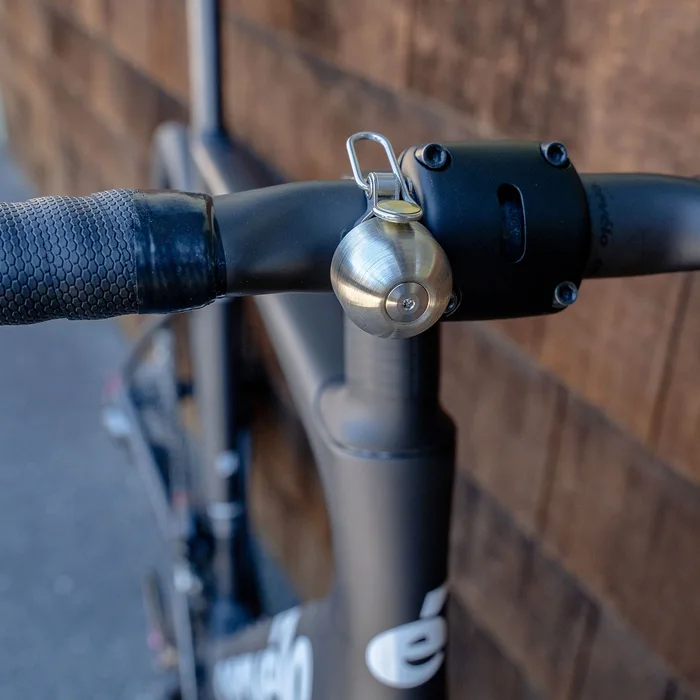
- Solid brass is what rings, so a brass-finished alloy dome is a different product from a solid brass one.
- Nobody publishes decibels, which means dome size and material are the only comparable evidence of loudness.
- Mount it where your thumb already is, because a bell that needs a hand move will not get used in traffic.
The products this guide is about
Our verdict on each, with the full reasoning on the companion review.
- Buy Spurcycle Original Bell The widest published fit range here, 22 to 36mm with both bands in the box, on a brass dome that is the point of the whole thing.
- Buy Knog Oi Classic Bike Bell A bell that wraps around the bar instead of sitting on top of it, sold in two clearly stated size ranges with the shims and the hex key included.
- It depends Portland Design Works King of Ding II A solid brass bell on a proper alloy band at the lowest price here, with a fit range that stops at 25.4mm.
- Skip Lezyne Classic Brass Bell A handsome brass bell on a machined base, sold in sizes called Small and Medium with no millimetre range published anywhere.
What actually matters
- Handlebar diameter - the outside diameter at the mounting point. The single spec that determines fit, and the one some makers omit entirely in favour of words like Small and Medium.
- Mount type - a rigid band clamp, a wrap-around clamp with shims, or an elastic O-ring. Bands hold position best; O-rings fit more shapes and twist more easily.
- Dome material - solid brass, plated brass, or aluminium. Solid brass gives the long, carrying ring most people are buying; a finish over another metal does not.
- Dome size - how much metal is vibrating. Larger domes generally carry further, and a published dimension is more useful than any adjective on the page.
- Striker action - a thumb lever, a flick striker, or a wrap-around trigger. What matters is whether you can operate it from the hand position you ride in.
- Cockpit clearance - whether the bell stands proud of the bar and fouls a lever hood, bar bag, light or computer mount. Wrap-around designs clear more.
- What is in the box - shims, alternative bands and the hex key. A bell needing a tool you do not own is not fitted on the day it arrives.
The specs, in plain English
Green flags vs red flags
Green flags
- A millimetre fit range printed on the product page.
- More than one band or a set of shims included, so one bell covers several diameters.
- The dome material stated as solid brass rather than described as brass-coloured.
- A published dome dimension or weight.
- The required tool named, and ideally supplied.
Red flags
- Sizes given only as words, with no diameters anywhere.
- No mention of what the dome is made from.
- A loudness claim with no number and no dimension behind it.
- A rigid clamp sold for carbon bars with no torque guidance.
- No indication of what is in the box, on a product that needs a hex key to fit.
Who's who: the brands
- Spurcycle - Small US maker of one very well engineered bell, notable for publishing a wide fit range and supplying both band sizes in the box.
- Knog - Australian design house whose wrap-around Oi bells state two clear size bands and include shims and a hex key.
- Portland Design Works - Makes traditional solid brass domes on alloy bands at accessible prices, with the mount range stated on the page.
- Lezyne - Machined alloy bases with polished brass domes, mounted with O-rings, sold in named sizes rather than by diameter.
How to read a listing without getting fooled
Find the fit range before anything else and check it against a measurement rather than a memory, because handlebars are not one size and the same bar is not one size along its length. If a page gives only words for sizing, treat that as the most important gap, not a detail. Next look at what the dome is made of and whether a dimension is given, since those two facts are the only comparable evidence of how it will sound in a category where nobody publishes decibels. Then read the box contents for shims, spare bands and the hex key. Finally, look at the photographs from the side and ask whether the bell stands proud enough to argue with your lever hoods, your bar bag or your light mount, because that is what decides whether it stays on the bike.
How much should you spend?
Budget bells are stamped or plated domes on simple bands, and plenty of them work fine on a bike that lives outside and gets replaced. The mid-range buys a solid brass dome, a clamp that states its range, and usually the shims or the tool you need to fit it properly. The premium tier is paying for machining, finish and fit coverage: a wider published range with more than one band supplied, a dome dimension on the page, and materials chosen for tone rather than cost. Because the most common failure in this category is a bell that does not fit rather than one that does not ring, the range a maker publishes is worth more of your money than the finish is.
Questions, answered
Can I fit a bell if my bars are full of cables and a computer mount?
Usually, but the design matters. A wrap-around bell sits in the same plane as the bar and clears hoods and mounts better than a traditional dome standing proud. If space is very tight, look for a bell that mounts under the bar or one built into a bar end. Test the position with the bell held in place before you tighten anything.
Why does my bell sound dull?
Something is touching the dome. The usual culprits are an over-tightened mount, a cable pressing against it, or the striker resting on the dome instead of springing clear. Back the clamp off slightly, check the clearance all the way round, and make sure nothing rests on it at the fitted position. A dome only rings if it is free to vibrate.
Is a bell a legal requirement?
It depends entirely on where you ride, and rules vary by country and sometimes by city or by path. Some places require an audible warning device on any bicycle, others require it only on shared paths, and others not at all. Check your local regulations rather than assuming, since the requirement is usually specific about an audible device rather than about a bell as such.
Should I get a bell or an electronic horn?
A bell for shared paths and a horn for traffic, if you must choose. Bells are quiet enough to be polite and their tone carries well at walking distance, which is what you need behind a pedestrian. Electronic horns are far louder and read as aggressive on a path, which is why the loud ones are marketed for road use. Many riders who ride both carry both.
Or jump to the head-to-head: Spurcycle Original Bell vs Knog Oi Classic Bike Bell.