

Outdoors & Fitness
The Best Tubeless Sealants: 4 Compared (and One to Skip)
We compared four tubeless tire sealants on the size of hole each maker claims to seal, how long it stays liquid, cold weather behaviour and whether you can inject it through a valve.
The short version
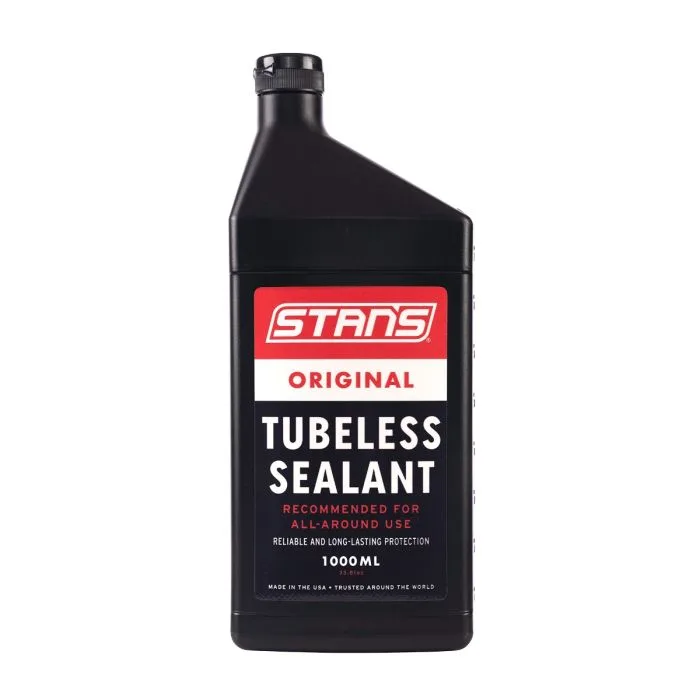
Stan's Original Tubeless Sealant is the one to buy if you want a single bottle that handles road, gravel and mountain tires without thinking about it. Stan's publishes the numbers most makers leave out: punctures up to 6.5mm, liquid for 2 to 7 months, anti-freeze agents rated to -20F, and a dosing chart covering everything from a 700c x 28mm road tire to a 26 x 5 fat tire. Orange Seal Endurance is the pick if topping up is the part you hate, since it is formulated to go two to three times longer between refills and the injector bottle comes with a dipstick so you can check without unseating a bead. SILCA Ultimate is a genuinely good sealant aimed at a narrower rider: carbon fibre strands, ammonia free so it is safe on cotton casings, 6 months plus, but the injector is sold separately and it will not go through Reserve valves. Caffelatex is the one to skip for most tubeless riders, because Effetto Mariposa's own figures put it at 5mm off-road and only 3mm on road tubeless, well under the rest of this field. Best for: riders who want one bottle that covers every bike in the garage.
Our picks at a glance
- Stan's NoTubes Original Tubeless Sealant - Buy. The sealant everything else gets compared to, and the one that publishes the most numbers.
- Orange Seal Endurance Tubeless Tire Sealant - Buy. Same sealing claim as the standard formula, built to go two to three times longer between top-offs.
- SILCA Ultimate Tubeless Sealant - It depends. Carbon fibre strands in a foaming latex carrier, ammonia free, with two setup restrictions worth knowing first.
- Effetto Mariposa Caffelatex Tire Sealant - Skip. Good chemistry and real versatility, but Effetto Mariposa's own sealing figures are the smallest in this group.
The verdict in 30 seconds
What mattered most
- Largest puncture claimed
- Stated time liquid in the tire
- Low temperature claim
- Injects through the valve
- Latex base and ammonia
- What does the sealing
Tubeless sealant is the cheapest part of a tubeless setup and the part that decides whether the whole thing works. Every bottle looks the same on a shop shelf, and the marketing language is close to interchangeable, so buyers end up choosing on brand recognition. The specs that actually differ are published, though not always on the product page you land on first. We pulled the maker's own claims for four widely sold sealants and lined them up: biggest hole sealed, months liquid in the tire, low temperature rating, and whether the stuff will go through a Presta valve core or has to be poured over the bead.
The sealant everything else gets compared to, and the one that publishes the most numbers.
Best for: Anyone running more than one type of tubeless bike who wants a single bottle and a printed volume chart.
- Stan's states a 6.5mm maximum puncture size, which is at the top of this group.
- Anti-freezing agents are rated for use down to -20F, the lowest published figure here.
- A full dosing chart covers tire sizes from 700c x 28mm to 26 x 5, so you are not guessing at volume.
- Stan's puts the liquid life at 2 to 7 months, a wide band that shifts with how dry your climate is.
- Stan's notes arid conditions need more frequent level checks, which means a seasonal habit rather than set and forget.
- The injector is a separate purchase unless you buy a 60ml or 125ml bottle.
- Stan's does not publish the latex type or whether the formula contains ammonia.
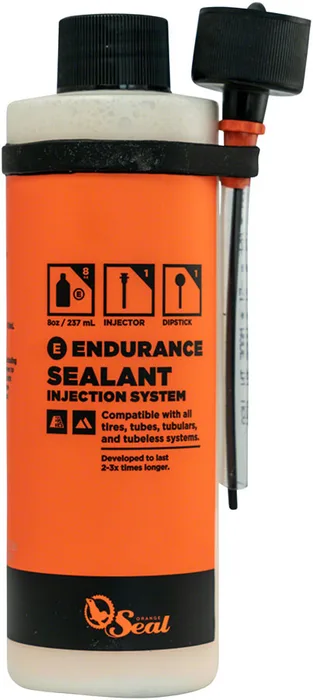
Same sealing claim as the standard formula, built to go two to three times longer between top-offs.
Best for: Riders who ride year round and would rather buy once and check the level twice a season.
- Orange Seal states the Endurance formula lasts two to three times longer than its standard sealant.
- The stated sealing limit is punctures up to a quarter of an inch, in line with the strongest claims here.
- The 4oz and 8oz injector bottles ship with a dipstick, so you can check the level without breaking a bead.
- Orange Seal does not publish a low temperature figure, only that it performs across varying temperatures and altitudes.
- The latex type and whether the formula contains ammonia are not stated.
- Refill bottles come without the applicator, so the first purchase has to be an injector bottle.
- Longevity is given as a multiple of the standard formula rather than a number of months.
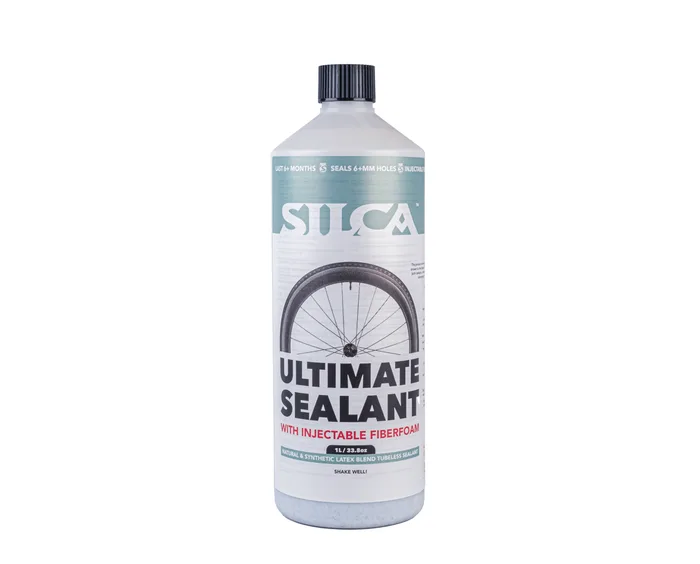
Carbon fibre strands in a foaming latex carrier, ammonia free, with two setup restrictions worth knowing first.
Best for: Road and gravel riders on cotton or thin casings who already own an injector and are not on Reserve wheels.
- SILCA states it seals 6mm and larger punctures and stays liquid 6 months and up.
- It is ammonia free, which SILCA states makes it safe to use on cotton tire casings.
- SILCA publishes a tested low temperature sealing figure of -15C, which is 5F.
- The injector is sold separately, so the cheapest bottle is not the whole cost.
- SILCA states it is not injectable in Reserve valves, which rules out some wheelsets.
- SILCA says it must not be mixed with the previous Ultimate formula or its replenisher, so a top-up means knowing which bottle is already in there.
- It is the most expensive per millilitre of the four and the value is in the fibre content, not in volume.
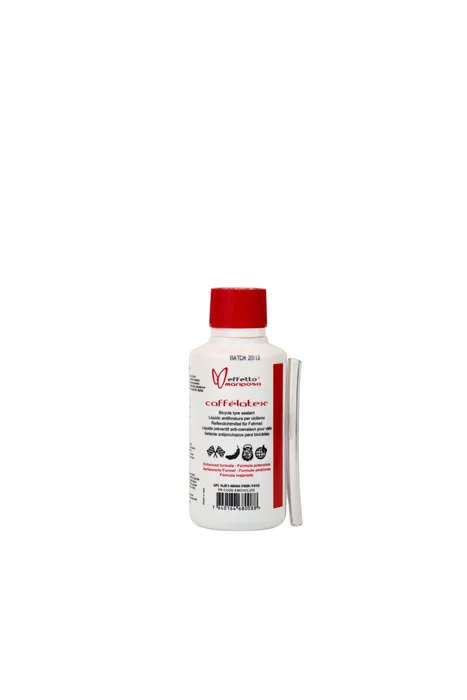
Good chemistry and real versatility, but Effetto Mariposa's own sealing figures are the smallest in this group.
Best for: Riders running latex tubulars or latex inner tubes, where the tubeless field mostly does not compete.
- It is one of the few sealants rated by its maker for inner tubes and tubulars as well as tubeless.
- Effetto Mariposa states it contains no ammonia and uses synthetic latex, so it avoids natural latex allergy issues.
- The foaming behaviour is meant to spread it across the whole inside of the tire rather than pooling at the bottom.
- Effetto Mariposa states it repairs punctures up to 5mm off-road and only 3mm on road tubeless, below every other sealant here.
- No liquid life in months is published, so there is no guidance on when to refresh.
- No low temperature figure is published either.
- It is not rated for TPU inner tubes, which is where a lot of riders have moved.
| Criteria | Original Tubeless Sealant Top pick | Endurance Tubeless Tire Sealant | Ultimate Tubeless Sealant | Caffelatex Tire Sealant |
|---|---|---|---|---|
| Verdict | Buy it | Buy it | It depends | Skip it |
| Best for | Anyone running more than one type of tubeless bike who wants a single bottle and a printed volume chart. | Riders who ride year round and would rather buy once and check the level twice a season. | Road and gravel riders on cotton or thin casings who already own an injector and are not on Reserve wheels. | Riders running latex tubulars or latex inner tubes, where the tubeless field mostly does not compete. |
| Price tier | $ · budget | $ · mid-range | $$ · premium | $ · mid-range |
| Largest puncture claimed | Up to 6.5mm | Up to 1/4 inch | 6mm and larger | 5mm off-road, 3mm road |
| Stated time liquid in the tire | 2 to 7 months | Two to three times the standard formula | 6 months and up | Not published |
| Low temperature claim | Anti-freeze agents to -20F | Varying temperatures, no figure | Tested sealing to -15C (5F) | Not published |
| Injects through the valve | Yes, with the maker's injector | Yes, injector bottle included | Yes, injector separate, not Reserve valves | Yes, with the maker's syringe |
| Latex base and ammonia | Not published | Not published | Natural and synthetic blend, ammonia free | Synthetic, ammonia free |
| What does the sealing | Sealing crystals | Not published | Carbon fibre strands in a foaming carrier | Silicate particles under 2 microns |
| Bottle sizes | 60ml to 1000ml, plus a 4500ml jug | 4oz to 32oz | 65ml, 500ml, 1L | 250ml and 1000ml |
| Rated for tubes and tubulars | Not stated | Not stated | Not stated | Yes, latex and butyl tubes and tubulars, not TPU |
Which one is right for you?
- Anyone running more than one type of tubeless bike who wants a single bottle and a printed volume chart. Buy it Stan's NoTubes Original Tubeless Sealant
- Riders who ride year round and would rather buy once and check the level twice a season. Buy it Orange Seal Endurance Tubeless Tire Sealant
- Road and gravel riders on cotton or thin casings who already own an injector and are not on Reserve wheels. It depends SILCA Ultimate Tubeless Sealant
- Riders running latex tubulars or latex inner tubes, where the tubeless field mostly does not compete. Skip it Effetto Mariposa Caffelatex Tire Sealant
How we judged the field
Five things separate one bottle of sealant from another, and only one of them is how well it seals. The first is the largest hole the maker will commit to in writing, because that is the difference between riding home and walking. The second is how long the stuff stays liquid, since a dried tire is an unprotected tire and nobody checks as often as they mean to. The third is temperature behaviour, both the freezing point of the carrier and whether the maker has tested sealing in the cold at all. The fourth is installation: sealant that goes through a removable valve core is a two minute top-up, while sealant that has to go over the bead is a workshop job. The fifth is what is actually suspended in the liquid, because crystals, carbon fibre and silicate particles plug holes in different ways and at different sizes.
The field splits cleanly along the injection line. Stan’s Original, Orange Seal Endurance, SILCA Ultimate and Caffelatex all go through a valve, which is why they are here, and products like Stan’s Race Day, which the maker states must be poured directly into the tire over the bead, sit outside what most riders want. Within the injectable group the split is between all-rounders and specialists. Stan’s and Orange Seal are aimed at every tubeless bike; SILCA is aimed at a rider with cotton casings and an injector already on the bench; Caffelatex is aimed at someone still running tubulars or latex tubes. We chose one from each position and kept the numbers to what the makers publish themselves.
Stan’s Original is the oldest product here and still the most thoroughly documented. Stan’s states it seals punctures up to 6.5mm, stays liquid for 2 to 7 months, and carries anti-freezing agents rated for use down to -20F, which is the lowest published cold figure of the four. It is compatible with all tubeless road, gravel and mountain tires, and one litre is stated to do up to sixteen tires. The dosing chart is the quiet advantage: sixteen rows running from 700c x 28mm at 50ml through 29 x 2.4 at 110ml to 26 x 5 at 230ml, which removes the guesswork that causes most weeping beads. The gaps are real, though. Stan’s does not publish the latex type or whether the formula contains ammonia, and the 2 to 7 month band is wide enough that you have to find your own number by checking. Stan’s is upfront that arid conditions need more frequent monitoring. For a household with a road bike, a gravel bike and a trail bike, this is the one bottle that covers all three.
Orange Seal Endurance takes the same sealing claim as the company’s standard formula, punctures up to a quarter of an inch, and reformulates for longevity, stating it lasts two to three times longer between top-offs. That is the whole pitch, and it is a good one, because the most common tubeless failure is not a puncture the sealant could not handle but a tire that had dried out weeks earlier. The 4oz and 8oz injector bottles ship with a dipstick, so checking the level is a thirty second job through the valve rather than an unseated bead and a paper towel. What Orange Seal does not do is put numbers on much else. There is no published low temperature figure, only that it performs under varying temperatures and altitudes, and no statement of latex type or ammonia content. The longevity claim itself is a multiple rather than a month count. Buy the injector bottle first and refills after, since the refill bottles come without the applicator.
SILCA Ultimate is the most specific product here and the one with the most conditions attached. SILCA publishes a proper spec list: seals 6mm and larger punctures, lasts 6 months and up, a proprietary natural and synthetic latex blend with optimised carbon fibre strands, foaming agents to carry those strands to the hole, tested sealing down to -15C which is 5F, and ammonia free so it is safe on cotton casings. That combination is genuinely useful if you ride supple cotton or thin casing tires, where ammonia is a live concern and hole size at pressure matters. Two restrictions decide whether it is right for you. The injector is sold separately, and SILCA states the sealant is not injectable in Reserve valves, so a Reserve wheelset means pouring over the bead. SILCA also says it must not be mixed with the previous Ultimate formula or its replenisher, so a top-up on an unknown tire means starting clean. Right sealant, narrow rider.
Caffelatex has a following for good reasons that are not about tubeless. Effetto Mariposa states it works in tubeless, tubular and latex or butyl inner tube applications, contains no ammonia, uses synthetic latex so it avoids natural latex allergy issues, and foams as the wheel turns so it coats the whole inside of the casing rather than pooling. The sealing mechanism is a blend of liquid synthetic polymers plus silicate particles under 2 microns, which the company says slows the sealant through the hole and gives it more time to close. The problem for a tubeless buyer is the number at the end of that explanation. Effetto Mariposa states repairs up to 5mm on off-road tubeless tyres and 3mm on road tubeless, against 6.5mm from Stan’s, a quarter inch from Orange Seal and 6mm plus from SILCA. It is also not rated for TPU tubes. If you are running tubulars or latex tubes, this is a reasonable buy. For a standard tubeless setup, the field seals bigger holes.
Stan’s NoTubes Original Tubeless Sealant vs Orange Seal Endurance Tubeless Tire Sealant: which should you buy?
Stan’s Original and Orange Seal Endurance are close enough that the choice comes down to which chore you dislike more. Stan’s gives you the bigger published sealing figure at 6.5mm, a real cold weather number at -20F, and a dosing chart detailed enough to set up a fat bike and a road bike from the same page. Orange Seal matches the sealing claim in practice, a quarter of an inch being 6.35mm, and spends its engineering on staying wet, stating two to three times the life of its standard formula and putting a dipstick in the box so you will actually check.
Pick Stan’s if you own several kinds of tubeless bike, if you ride in genuine cold, or if you want a maker that publishes specifics. Pick Orange Seal Endurance if you have one or two bikes, ride them steadily, and know from experience that you are the kind of rider who discovers a dry tire in a car park. One more practical point: Stan’s sells in 60ml and 125ml bottles that are sized to install straight through the valve, while Orange Seal’s approach is the reusable injector bottle plus cheaper refills. If you top up four or more tires a season, the refill route costs less over a year.
What to look for
- Published hole size: a maker that will state a millimetre figure has tested it, and a maker that only says “seals large punctures” has told you nothing you can compare.
- A months figure, not a vibe: Stan’s says 2 to 7 months and SILCA says 6 months and up, while some makers give a multiple of their own other product or nothing at all.
- Valve injectability: sealant you can push through a removable valve core turns a top-up into a two minute job, and some products, including Stan’s Race Day, must be poured over the bead instead.
- Whether the injector is included: Orange Seal’s injector bottles include one and SILCA’s does not, which changes what the first purchase really costs.
- Ammonia content if you run cotton casings: SILCA and Effetto Mariposa both state their formulas are ammonia free, and the other two do not address it either way.
- A dosing chart for your exact tire: volume is set by tire size, and the makers that publish a full table save you the guess that causes most slow bead leaks.
Our final take
Sealant is the one tubeless component where the cheap option is also the most documented. Stan’s Original publishes a bigger sealing figure than most, a colder freeze rating than any of the others here, and a dosing chart that covers every tire you are likely to own, which is why it stays the default recommendation. Orange Seal Endurance is the upgrade that addresses the failure everyone actually has, a tire that quietly dried out, and it hands you a dipstick so you will notice. SILCA Ultimate is the right answer for cotton casings and an injector you already own, with two setup restrictions to read first. Caffelatex is a fine product aimed at tubulars and latex tubes, and a small seal rating for a tubeless tire.
Questions, answered
How much sealant does a tire actually need?
It scales with tire volume, not with wheel size, and the makers publish charts. Stan's lists 50ml for a 700c x 28mm road tire, 110ml for a 29 x 2.4 mountain tire and 230ml for a 26 x 5 fat tire. Going under the recommendation is the most common reason a tubeless setup weeps at the bead for days. Going well over adds rotating weight and can slosh audibly at low speed. If you only remember one rule, a road tire wants roughly a shot glass and a trail tire wants roughly a mug.
Can I mix two brands of sealant in the same tire?
Treat it as a bad idea unless the maker says otherwise, and note that SILCA explicitly says not to mix its Ultimate sealant with the previous version of its own sealant or that version's replenisher. Different products use different latex chemistry and different suspended solids, and the failure mode is not a leak but a rubbery mass that stops circulating. If you are switching brands, the clean route is to unseat one bead, wipe out what is in there and start fresh. That is also the moment to check the tire casing for old plugs and cuts.
Why does sealant dry out faster in some places than others?
The liquid carrier evaporates through the tire casing, and how fast depends on humidity, temperature and how porous the casing is. Stan's states its Original formula stays liquid 2 to 7 months and specifically notes that arid conditions call for more frequent monitoring, which is the honest version of a spec most makers round off. Thin, supple casings breathe more than thick downhill casings. If you live somewhere dry and hot, plan on checking levels at the short end of whatever range the maker gives.
Does sealant work with CO2 inflators?
Some sealants are specifically stated to be CO2 compatible and some say nothing at all, which is the distinction to look for on a trailside repair. Peaty's, for example, lists CO2 compatibility as a product feature on its Holeshot Biofibre sealant. The concern with latex sealants has always been that a blast of very cold CO2 can shock the latex out of suspension. If you carry CO2 rather than a pump, buy a sealant whose maker states compatibility rather than assuming it.
What is the deal with ammonia in sealant, and should I care?
Ammonia is used to keep natural latex from coagulating in the bottle, and it is also what makes some sealants smell sharp when you open them. It matters most if you run cotton or other natural fibre casings, where SILCA specifically says its ammonia free formula is safe to use. It can also be a factor with some rim and valve materials over long exposure. For a standard nylon casing tubeless tire on an alloy or carbon rim, it is not something most riders need to weigh.
Deciding between the top two? See our head-to-head: Stan's NoTubes Original Tubeless Sealant vs Orange Seal Endurance Tubeless Tire Sealant.
More Outdoors & Fitness reviews
 The Best Tubeless Valves: 4 Compared (and One to Skip)
  The Best Via Ferrata Sets: 4 Compared (and One to Skip)
  The Best Adjustable Weight Benches: 4 Compared (and One to Skip)
  The Best Weighted Vests: 4 Compared (and One to Skip)
  The Best Auto-Darkening Welding Helmets: 4 Compared (and One to Skip)
  The Best Wheelbarrows & Garden Carts: 4 Compared (and One to Skip)