Explained
Toy Storage Organizers, Explained
After reading, you'll understand what a toy storage listing is telling you, which numbers matter, and which safety features are real versus decorative.
In this guide
First-time buyers usually shop this category on looks and bin count, then discover two things the hard way. The first is that a container a child cannot open, see into, or put back becomes an adult's job forever. The second is that almost every unit is made of the same engineered wood, so the differences that matter are height, load rating, and hardware. The vocabulary on the listings is doing more work than it looks like.
The 30-second version
- Height beats capacity, because a unit a child can reach flat-footed is a unit they will not climb.
- Most frames are engineered wood, so a listing that says solid pine or birch plywood is telling you something real.
- A published load number is a signal, not because the number is high but because the brand measured and disclosed it.
- Lids are the one genuine hazard, and CPSC's guidance is that open chests and bins with no lid do not present the falling-lid risk.
- Anchoring is your job here, since the federal tip-over rule covers clothing storage units rather than toy furniture.
The products this guide is about
Our verdict on each, with the full reasoning on the companion review.
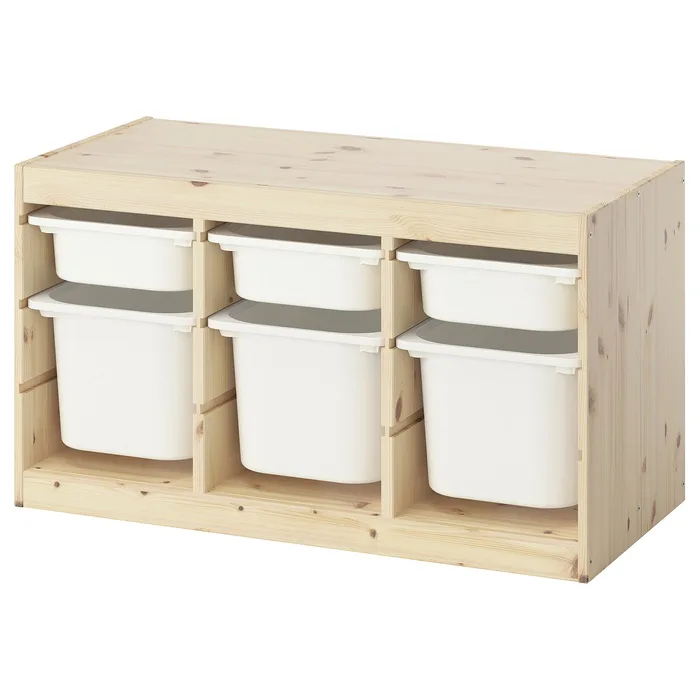
- Buy IKEA TROFAST storage combination with boxes, light white stained pine/white, 36 5/8x17 3/8x20 1/2" A low solid pine rail frame with six polypropylene bins that slide out on repositionable grooves, so a toddler can reach every toy without climbing. Amazon
- Buy Humble Crew Inspire Grey and White 12-Bin Toy Organizer (WO589) Twelve tilted plastic bins on an engineered wood frame with steel rods, short and wide rather than tall and narrow. Amazon
- It depends Costway 5-Cube Wooden Kids Toy Storage Organizer with Anti-Tipping Kits (JZ10144) A 30 inch tall cubby unit, three open squares over two deep scoop-front bins, sold with the load numbers and anti-tip brackets that many brands in this category leave out. Amazon
- Skip Delta Children MySize Deluxe Toy Box (TB83460GN) A conventional lidded chest with a slow-close safety hinge, which fixes pinched fingers but not the deeper problem with lidded chests. Amazon
What actually matters
- Reach height - the distance from the floor to the top surface decides whether a child climbs. If they can get the top item standing flat on the floor, the unit has no reason to be climbed and tipping becomes much less of a concern.
- Bin granularity - the number of separate containers is what turns cleanup from dumping into sorting. Eight bins a child can name usually beats one big box, because retrieval and return both work on categories.
- Frame material - solid wood and plywood generally hold fasteners better through years of sideways force than particleboard and MDF, which tolerate far less re-assembly. It strongly affects whether the unit survives a second child.
- Load rating - pounds per shelf or per level tells you whether the unit can carry wooden blocks and magnetic tiles or only stuffed animals. Brands that publish it have tested it, which is itself a quality signal.
- Anchoring hardware - many units that need a wall attachment include a bracket but not the wall screws and plugs, because the right fixing depends on drywall, plaster, or masonry. Check what is in the box and buy the rest.
- Lid mechanism - if there is a hinged lid, the only acceptable version is one whose support holds it open in any position you place it, and that support needs re-checking over time as it loosens.
- Bin material and rigidity - rigid plastic bins slide back into rails without adult help, while fabric bins sag and need reshaping. That difference decides whether a child can complete cleanup alone.
The specs, in plain English
Green flags vs red flags
Green flags
- The listing names the frame material specifically, such as solid pine or birch plywood, rather than saying 'wood'.
- A load rating is published in pounds per shelf or per level.
- Assembled dimensions are given, not just carton dimensions.
- The unit is short and wide rather than tall and narrow, and the top is within a child's flat-footed reach.
- Anchoring hardware is described explicitly, including what is and is not in the box.
Red flags
- A hinged lid with no description of a lid support that holds any position.
- No assembled dimensions anywhere on the manufacturer's page.
- Bin count is advertised prominently but bin dimensions are not given.
- The listing leans on lifestyle photos and colorways with no material or capacity spec at all.
- A tall unit marketed for toddlers with no mention of anchoring.
Who's who: the brands
- IKEA - Publishes materials and dimensions on its product pages, and its TROFAST rail-and-bin system is a common reference point for kids' bin storage, though we found no load rating published for TROFAST itself.
- Humble Crew (Tot Tutors) - Focused specifically on kids' bin organizers at low prices, and publishes a per-level load figure on the Inspire organizer.
- Delta Children - A large nursery and kids' furniture brand whose toy storage runs to lidded chests and multi-bin organizers in engineered wood, some of which are GREENGUARD Gold certified.
- Costway - A high-volume online furniture seller whose cube organizer listing carries a spec table with per-cube and top-panel load limits, and whose unit ships with anti-tipping brackets.
- ECR4Kids - Sells classroom-grade birch plywood cubby cabinets and scoop-front bins, built heavier than home lines and priced accordingly.
- Sauder - A long-established ready-to-assemble furniture maker whose kids' and home storage pieces are flat-pack engineered wood in conventional shapes.
How to read a listing without getting fooled
Start at the bottom of the listing, not the top. Find the assembled dimensions and compare the height to your child, then find the frame material and see whether the brand named a species or hid behind the word wood. Next look for a load figure; if there is none, assume the unit is meant for light toys and plan accordingly. Then read what is actually in the box, since bin count, insert count, and anchoring hardware are the three things listings most often imply without stating. Finally, if there is a lid, read the exact hardware wording: a slow-close hinge and a lid support that holds any position are different claims, and only the second one addresses the hazard CPSC writes about.
How much should you spend?
Budget tier buys you a bin organizer or a small cube shelf in engineered wood, usually with bins included on the organizer and bare compartments on the shelf, and it is genuinely enough for a young child's room. Mid-range buys either a bigger rail-frame system with a solid wood frame and a set of deep bins, or a nicely finished lidded chest, and the rail frame is the better use of the money. Premium tier in this category means classroom-grade birch plywood cabinets on casters, built to survive a room full of children rather than one, which is overkill at home unless you run a daycare or expect several kids through the same piece. The most common mistake is spending mid-range money on a finish rather than a frame; the second most common is buying a cubby shelf at budget prices and then discovering the bins cost as much again.
Questions, answered
Should I label bins if my child cannot read yet?
Yes, with pictures. A photo or simple drawing of the contents taped to the front of each bin does the same job as a word label and lets a three-year-old put things back in the right place. It also makes the system survive other people, since a babysitter or grandparent can tidy correctly without asking. Rotate the labels when the toy mix changes rather than letting them go stale.
How many bins is the right number?
Fewer than the listing suggests. A child can reliably manage as many categories as they can name, which is usually four to eight for a preschooler, so a twelve-bin unit often works best with several bins holding the same broad category. Too many narrow categories means toys get put anywhere, which defeats the sorting. Start broad and split a category only when a bin overflows.
Is a rolling cart a reasonable alternative?
For a subset of toys, yes. A cart works well for art supplies, small building sets, or anything used at a table, because it brings the materials to the activity and rolls away afterwards. It is a poor primary toy store, since the trays are shallow and the whole thing tips more easily than a floor-standing unit when a child leans on it. Treat it as a supplement to a main unit rather than a replacement.
What do I do with the toy chest I already own?
Check the lid first. If the lid falls freely when you let go of it, CPSC's guidance is to remove the lid entirely, or to fit a support that will hold the lid open in any position you place it. Once a support is installed, re-check it periodically because some supports loosen and need adjusting. If you keep the chest, it is still a poor sorting system, so consider using it for bulky low-frequency items and putting daily toys somewhere a child can see them.
Or jump to the head-to-head: IKEA TROFAST storage combination with boxes, light white stained pine/white, 36 5/8x17 3/8x20 1/2" vs Humble Crew Inspire Grey and White 12-Bin Toy Organizer (WO589).