Explained
Baby Activity Centers, Explained
After reading, you'll understand what separates a stationary activity center from an infant walker, which limits on a spec sheet actually govern how long you can use one, and how to spot a listing that is hiding the numbers.
In this guide
First-time buyers get tripped up by the shelf, not by the specs. Jumpers, saucers, entertainers and walkers sit side by side under signs that say activity center, and the boxes all promise the same developmental benefits. But one of those four rolls across the floor with the baby in it, and that single difference is the reason there is a federal standard, an American Academy of Pediatrics position and an outright Canadian ban attached to this category. The second thing that trips people up is limits: two models from the same brand will not have the same numbers, and some listings simply do not publish them.
The 30-second version
- Stationary and wheeled are different products, and only the wheeled sit-in kind is what the safety warnings are about.
- Head control is the real gate, so a baby who cannot hold their head up unassisted is not ready regardless of what the age range says.
- Weight is not the limit that ends it, because height, climbing out and standing flat footed usually arrive first.
- Three height positions is the working standard, and anything with fewer shortens the useful life of the purchase.
- These are short-stint devices, and the WHO's under-1 guidance about not being restrained for more than an hour at a time is a sensible frame for how to use them.
The products this guide is about
Our verdict on each, with the full reasoning on the companion review.
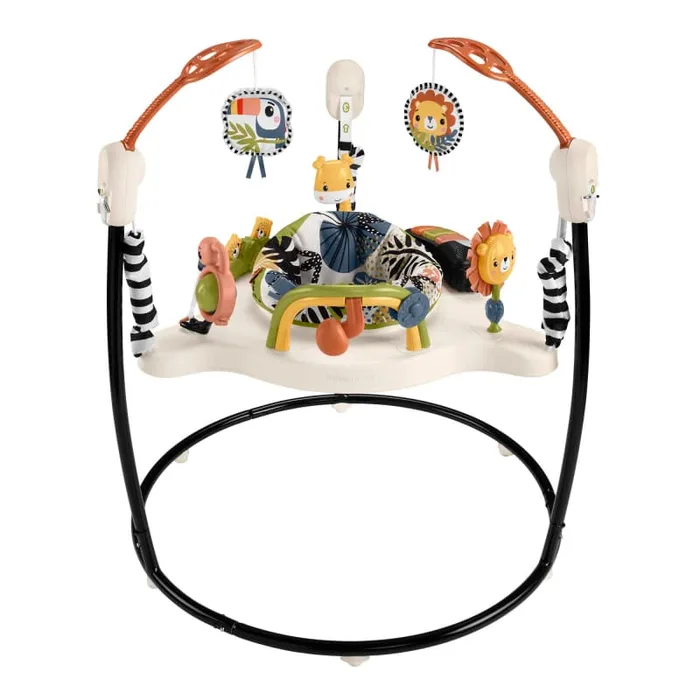
- Buy Fisher-Price Palm Paradise Jumperoo A freestanding jumper that answers every bounce with lights and music, on a frame with three height settings and a seat that spins the whole way around.
- Buy Evenflo ExerSaucer Polar Playground Activity Center A compact bouncing saucer with a spinning seat and the most specific stop-use guidance we found on any listing in this category.
- It depends Bright Starts Pop 'N Jump Portable Activity Jumper (Sweet Treats) A folding, canopy-equipped jumper built for the backyard and the grandparents' house rather than for daily living room duty. Amazon
- Skip Delta Children Jeep Classic Wrangler 3-in-1 Grow With Me Walker A carefully built, JPMA certified sit-in walker that we still would not buy, because the whole product class is the one paediatricians have asked to have taken off the market. Amazon
What actually matters
- Stationary base - the base stays where you put it and the baby bounces, spins and reaches in place. This is the entire safety distinction between an activity center and an infant walker, and it is the first thing to confirm on any listing.
- Head control requirement - these units are meant for a baby who can hold their head upright without help. Fisher-Price and Evenflo both state it on the product page, and it matters more than the printed age range.
- Height limit - the most commonly omitted spec and often the one that actually ends use. Evenflo publishes a 30 inch cutoff for the ExerSaucer line; Fisher-Price publishes none for the Palm Paradise Jumperoo.
- Height positions - the number of seat heights the frame offers, which decides whether the unit fits a 5 month old and a 10 month old or only one of them. Three is standard across the models we checked.
- Seat rotation - a seat that spins 360 degrees puts every toy in reach and lets a baby change what they are looking at without help. A fixed seat means a bored baby needs an adult to turn them.
- Cleaning path - whether the seat pad comes off and machine washes, and whether the toys detach or have to be wiped in place. This is the difference between a device you can hand down and one you throw out.
- Assembled footprint - measure the standing dimensions, not the box. Sizes vary a lot between models, and a folding jumper can still be over 40 inches tall.
The specs, in plain English
Green flags vs red flags
Green flags
- The listing states a head control requirement in words, not just an age in months.
- Both a weight limit and a height limit appear, with numbers.
- There is a written stop-use list covering climbing out and standing flat footed, not only a maximum weight.
- Three or more height positions, with the count published rather than described as adjustable.
- The seat pad is described as removable and machine washable, and the assembled dimensions are given.
Red flags
- The base has wheels and the baby sits inside it while it rolls.
- No height limit is published anywhere on the page, and the age range is the only guidance offered.
- Different numbers appear in the marketing copy and the spec table on the same listing.
- The seat pad is wipe-clean only, or the toys are all fixed to the frame.
- Specs are quoted from a different model in the same line, or the listing reuses a sibling product's limits.
Who's who: the brands
- Fisher-Price - Owns the Jumperoo name and the lights-and-music jumper format, and its listings state the head control and climb-out rule clearly even when the height limit is missing.
- Evenflo - Makes the ExerSaucer line and publishes detailed stop-use criteria, including the 30 inch height cutoff and the flat-footed test.
- Bright Starts - Part of Kids2, best known for the folding Pop 'N Jump portables with canopies, aimed at travel and outdoor use rather than daily living room duty.
- Baby Einstein - Also a Kids2 brand, focused on music and discovery themed jumpers and multi-stage centers that convert as the child grows.
- Delta Children - A furniture-first brand whose baby gear includes licensed Jeep sit-in and push-behind walkers, JPMA certified but in a category paediatricians advise against.
How to read a listing without getting fooled
Start at the bottom of the listing, not the top. The marketing block sells the theme; the product details table is where the limits live, and when the two disagree, as they do on the Jeep walker's height figure, trust the table and treat the disagreement as a mark against the listing. Look for four numbers in particular: maximum weight, maximum height, the number of height positions, and the assembled dimensions. Then look for two sentences: the milestone the child must have reached to start, and the list of signs that they should stop. If the height limit and the stop-use list are both absent, you are buying without knowing how many months you get. Finally, check that the specs belong to the exact model and colourway you are ordering, because brands run several units under one family name with different limits.
How much should you spend?
This is a category where the budget tier is genuinely competent. A budget saucer or portable jumper will still give you three height positions, a published weight limit and a washable seat pad, which is most of what matters. Mid-range tends to buy you a bigger toy ring, more sound features and a spinning seat, which is worth it if the device is going to be in daily use for months rather than occasional use. Premium in this category mostly buys convertibility, meaning a center that becomes a toddler play table later, and that only pays off if you are confident you will still want the footprint in eighteen months. Given how short the usable window is, spending mid-range and putting the difference toward a play yard is a reasonable call.
Questions, answered
Are wheeled baby walkers actually illegal to sell in the US?
No, they are regulated rather than banned. 16 CFR Part 1216 establishes a mandatory consumer product safety standard for infant walkers and requires each one to comply with ASTM F977, so walkers sold in the US must meet that standard. Canada took the other route: item 3 of Schedule 2 of the Canada Consumer Product Safety Act covers wheeled baby walkers, and section 5 of that Act bars anyone from manufacturing, importing, advertising or selling a Schedule 2 product. The American Academy of Pediatrics has called for a ban on the manufacture and sale of baby walkers with wheels in the US as well.
What are the alternatives if I skip the walker?
The American Academy of Pediatrics points to three: stationary activity centers, which are walkers without wheels and often have seats that rotate and bounce; play yards or playpens, which give a safe enclosed space to sit, crawl and pull up in; and high chairs, for older infants who can sit well and want to play with toys at a surface. All three keep the baby in one place, which is the actual safety mechanism. Floor time in a childproofed space remains the thing none of these devices replace.
Does an activity center help a baby learn to walk?
Manufacturers describe these products as strengthening gross motor skills and engaging the developing senses, and Fisher-Price and Evenflo both word it that way. That is not the same as teaching walking, and none of the listings we read claims it is. Time spent bearing weight in a supported seat is different from time spent on the floor pushing up, rolling and cruising along furniture. Treat the device as entertainment that happens to involve movement, and ask your pediatrician if you have questions about your child's motor development.
How much floor space do I actually need?
More than people expect, and the folded size is misleading. The Evenflo Polar Playground sits on a base 27 inches across and is 29.5 inches tall. The Bright Starts Pop 'N Jump packs into a bag, but its listed dimensions are 40.16 inches tall and 33.07 inches long. Measure the corner you intend to sacrifice, and remember you also need clearance all the way around so the baby cannot reach a shelf, a cord or a table edge.
Or jump to the head-to-head: Fisher-Price Palm Paradise Jumperoo vs Evenflo ExerSaucer Polar Playground Activity Center.