Explained
Baby Bathtubs, Explained
After reading this you will be able to look at any baby bathtub listing and predict how it will behave after six months of real use, not just on day one.
In this guide
Baby bathtubs all look much the same on a shelf, so most people choose on price, colour or the number of stages printed on the box. Six months later the differences are obvious, and they are almost never about stages: they are about whether water can get out of the thing and whether it can dry. This guide decodes the terms you will see in listings so you can tell a design that ages well from one that turns into a chore.
The 30-second version
- Count the soft parts before anything else. Every mesh sling, foam wedge and plush petal is a place water hides, and mould in those parts is one of the most common long-run owner complaints in this category.
- Find the drain plug on the photos. A plug in the side wall or the middle of the floor empties under gravity, while a plug set into the underside means lifting a full tub before it will drain at all.
- Newborn support and sitting support are different jobs. Tubs that promise both usually compromise both, so decide whether you want one purchase that is adequate at each stage or two that are good at one stage each.
- Storage is a hygiene spec, not a convenience spec. A tub that folds flat or hangs from a hook gets air on both faces and dries, while one that sits on a bathroom floor stays damp along whatever edge touches the tile.
- No feature makes bathing hands-free. Contoured supports, textured bases, crotch posts and bath seats reduce slipping, and none of them substitute for an adult with hands on the baby for the whole bath.
The products this guide is about
Our verdict on each, with the full reasoning on the companion review.
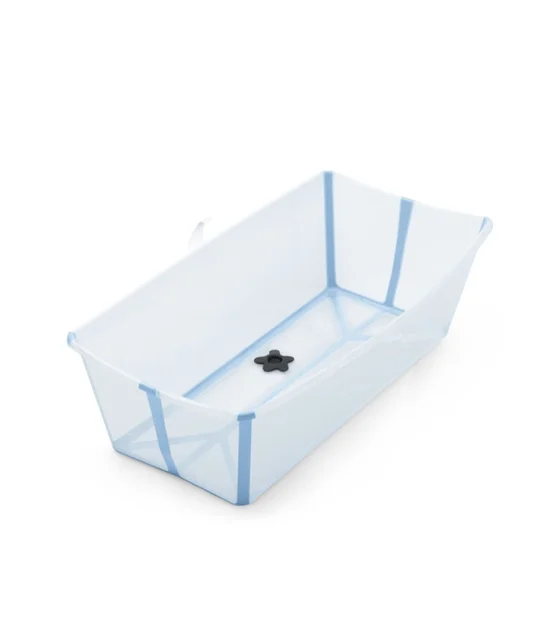
- Buy Stokke Flexi Bath X-Large A folding hard-plastic tub with no fabric anywhere, a large centre drain and enough length to carry a child well past the toddler stage. Amazon
- Buy Angelcare Soft Touch Baby Bath Support A one-piece moulded support with a quick-drying mesh deck that holds a newborn at an angle in the big tub or a sink, and dries faster than anything else here. Amazon
- It depends Skip Hop Moby Smart Sling 3-Stage Tub A likeable three-stage whale tub with a genuinely good hanging hook, undermined by a mesh sling that owners report going mouldy on the underside. Amazon
- Skip Fisher-Price Baby to Toddler Bath 4-in-1 Sling 'n Seat Tub Cheap and everywhere, but the drain plug sits underneath the tub and the sling plus seat insert give mould two places to settle. Amazon
What actually matters
- Soft parts count. Zero soft parts is best, one is manageable if you will genuinely unclip and hang it after every bath, and two (a sling plus a seat pad) is a daily chore most people abandon within weeks. Slings with a sewn or bound edge are the worst offenders because the binding holds water where nobody looks.
- Drain position and size. This is the spec buyers ignore at purchase and complain about constantly afterwards. A large plug in the centre of the floor or low in a side wall empties fast on a flat surface. A small plug, a narrow spout or a plug moulded into the base all mean slow draining or lifting a heavy tub of warm water.
- Drying design. Look for a shape that can stand on its edge, fold flat or hang, and for smooth interior surfaces with as few crevices, moulded ridges and blind wells as possible. Hinges, plug recesses and rim channels are where mould appears on otherwise good tubs.
- Real stage coverage. Marketing counts stages, your baby counts weeks. A newborn-only support is finished around the time your baby sits unaided. A convertible tub typically runs to somewhere in the second year. An extra-large folding tub can stay useful into preschool.
- Weight limit rather than age range. Age ranges are advertising copy. The stated weight ceiling is the number that actually ends the product's life, and on some cheap convertibles that ceiling arrives well before the advertised final stage.
- Where it will be used and stored. Sink insert, inside the adult bath, on a worktop, on the floor. Each implies a different size, a different drainage behaviour and a different amount of bending. Measure your sink or bath before you buy anything described as compact.
- Temperature cue. A colour-changing plug, a thermometer well or a heat-indicating patch is cheap insurance against water that felt fine to an adult wrist but is too warm for a newborn.
The specs, in plain English
Green flags vs red flags
Green flags
- No fabric or foam anywhere on the product, so there is nothing to unclip, wring out or machine wash
- A large plug in the centre of the floor or low in a side wall, ideally one you can operate without lifting the tub
- A hanging hook, a flat fold or a shape that stands stably on its edge, so drying is a five-second habit rather than a project
- A smooth interior with few moulded ridges, and a rim without deep channels along its underside
- A stated weight limit, not just an age range, and a size that plausibly matches the final stage claimed
- A colour-changing plug or another temperature cue you cannot forget to check
Red flags
- Two or more soft parts, typically a mesh sling plus a padded seat insert, both of which have to come out and dry after every bath
- A drain plug moulded into the base, which will not empty the tub while it is sitting on a floor or worktop
- Thick plush or foam padding, especially on flower-style sink inserts, which needs machine washing to stay fresh and holds water for a long time
- Marketing that leans on stage counts or years of use while the weight ceiling tells a shorter story
- Any language implying a base, seat, harness or contour lets you step away, look away or multitask
- Inflatable seams and glued joints, which are effectively sealed places for water and residue to sit where you cannot clean them
Who's who: the brands
- Stokke - Scandinavian nursery brand best known in this category for a foldable baby bath, sold at a premium and in more than one size.
- Angelcare - Baby monitor and bath brand whose one-piece mesh bath supports are the low-cost, fast-drying answer to the newborn stage.
- Skip Hop - Design-led nursery accessories brand; its multi-stage tubs are well thought out on storage and shell shape, with slings that owners frequently report going mouldy.
- Fisher-Price - Mass-market baby brand behind the cheap multi-stage tubs stocked almost everywhere, generally strong on price and availability and weak on drainage and soft-part count.
- OXO Tot - Housewares brand applying its usual ergonomic approach to sink-to-tub convertibles, typically with more thought given to draining and cleaning than the category average.
- Boon and Frida Baby - Two modern parenting brands with compact and convertible plastic tubs that show up constantly in comparisons, sitting between the budget and premium tiers.
How to read a listing without getting fooled
Start by ignoring the headline, because "4-in-1" and "grows with baby" tell you nothing about how the product ages. Instead, scroll to the photos and find three things. First, count every piece of fabric, mesh or foam in the pictures; that number is your daily maintenance load. Second, locate the drain plug and work out whether gravity can empty the tub where you plan to use it, or whether the plug sits in the base and you will be lifting warm water. Third, look at how it is stored in the lifestyle shots: hanging on a hook or folded flat is a good sign, sitting on a bathroom floor is not. Then check the specification list for a weight limit rather than an age range, since the weight ceiling is what actually ends the product's life. In owner reports, filter for the six-month and one-year comments rather than the first-week ones, and search the reviews for the words mould, drain and dry; those three words surface many of the long-run complaints in this category. Finally, discount any listing that describes a base, seat, contour or restraint in language suggesting you can take your hands off, because that is a marketing claim no product can support.
How much should you spend?
This is a category where spending more buys you fewer problems rather than more features, but only up to a point. At the bottom of the market you can buy a simple moulded bath support or a plain plastic tub for very little, and if the support has an open mesh deck and no pad it may genuinely be the best-performing thing you could have bought for the newborn months. The mid tier is where the money often goes wrong: it typically pays for stage counts, character shapes and inserts, which means more soft parts and more cleaning rather than better design. The premium end is worth it for one specific reason, which is subtraction: a tub that removes fabric and foam entirely, drains through a large well-placed plug and folds flat to dry tends to stay pleasant to own for longer, and an extra-large version can spread that cost over the whole run from newborn to preschooler instead of a few months. So the value sweet spot is either very cheap and single-purpose, or premium and genuinely convertible, and the least rewarding place to spend is the middle. Buying a cheap newborn support now and a bigger tub later is a defensible plan and often costs less overall than replacing a mouldy tub twice.
Questions, answered
Why do baby bathtubs go mouldy, and can I prevent it?
Mould needs water, warmth and a trace of organic food, and baby wash residue supplies the last one. Anything that holds water out of sight will bloom eventually: a mesh sling with a sewn binding, a foam pad, an inflatable seam, a hinge, a rim channel or a plug well. The fix is structural rather than chemical. Prefer designs with no soft parts, empty and rinse straight after the bath, then hang the tub or stand it on its edge somewhere with air moving. If the product has a sling, treat it as a consumable and plan to replace it when it stains.
Do I actually need a baby bathtub?
No. Plenty of families bathe a newborn in a clean sink or in the adult bath with a simple support, and some skip a dedicated tub entirely. What a tub buys you is a comfortable back, far less water heated, and a defined edge to lean against. Choose based on your bathroom, your sink size and where the thing will be stored, not on the number of stages printed on the box.
Are convertible tubs that cover newborn through toddler worth it?
Sometimes, but read the design rather than the claim. Most convertibles handle the newborn stage with a clip-in sling and the sitting stage with a padded insert, which means two soft parts to remove and dry daily and a shell that is a compromise size at both ends. The convertibles that work are the ones where the shell alone is big enough to be useful later and the stage adaptation does not add fabric. Check the weight limit too, because the final stage is often shorter than the marketing implies.
Is a bath seat safe once my baby can sit up?
A bath seat is a bathing aid, not a safety device, and regulators are unusually direct about it. Babies slip through the leg openings, tip seats over and climb out, and the documented pattern in drowning cases is that the seat made an adult comfortable enough to step away. Suction cups also grip poorly on textured tub floors. If you use one, use it exactly as you would use nothing at all: within arm's reach, hands on, the whole time.
How long will we really use one?
A newborn-only support is finished around the time your baby sits unaided, which is often near six months. A multi-stage tub usually lasts until your child would rather splash in the family bath, which for many families is somewhere in the second year. Extra-large folding tubs stretch furthest because they stay big enough to be useful for rinsing or paddling with a preschooler.
Does any tub feature let me leave the room for a second?
No, and this is the one point worth being blunt about. Babies can drown in very little water and very quickly, and no contoured base, crotch post, textured surface, seat bar or non-slip foot changes that. Infant bath tubs sold in the US fall under a mandatory federal safety standard aimed at drowning and collapse hazards, and even that standard assumes constant hands-on adult supervision. Get the towel, the jug and the clean nappy within reach before the water goes in, take the baby out before you answer the door or the phone, and keep a hand on your baby until they are out of the water.
Or jump to the head-to-head: Stokke Flexi Bath X-Large vs Angelcare Soft Touch Baby Bath Support.