

Baby & Family
The Best Toy Storage Organizers: 4 Compared (and One to Skip)
We compared four common ways to store toys on the things you can actually verify: frame material, published load limits, what storage comes in the box, and how each one handles the two real hazards in this category, tip-over and falling lids.
The short version
The IKEA TROFAST storage combination in light white stained pine is our overall pick: a solid pine rail frame, six deep pull-out bins, and a 20 1/2 inch height that puts every toy in a preschooler's reach. The Humble Crew Inspire 12-Bin Toy Organizer is the value pick, with twelve bins in two sizes and a published 20 pound per level limit, which many brands do not disclose. The Costway 5-Cube Wooden Kids Toy Storage Organizer is the depends pick: it publishes detailed numbers, 22 pounds per cube and 110 pounds on top, and ships two anti-tip brackets, but it is MDF and gives you only five fixed compartments. Skip the Delta Children MySize Deluxe Toy Box, and lidded chests in general: the slow-close hinge is genuine, but CPSC's own guidance is that chests with no lid avoid the falling-lid risk entirely, and a single deep compartment is the worst layout for finding anything. Anchoring matters more than brand here, because no federal tip-over rule covers toy furniture. Buy for reach and sightlines first, finish second. Best for: parents who want a child to actually put toys away without help.
Our picks at a glance
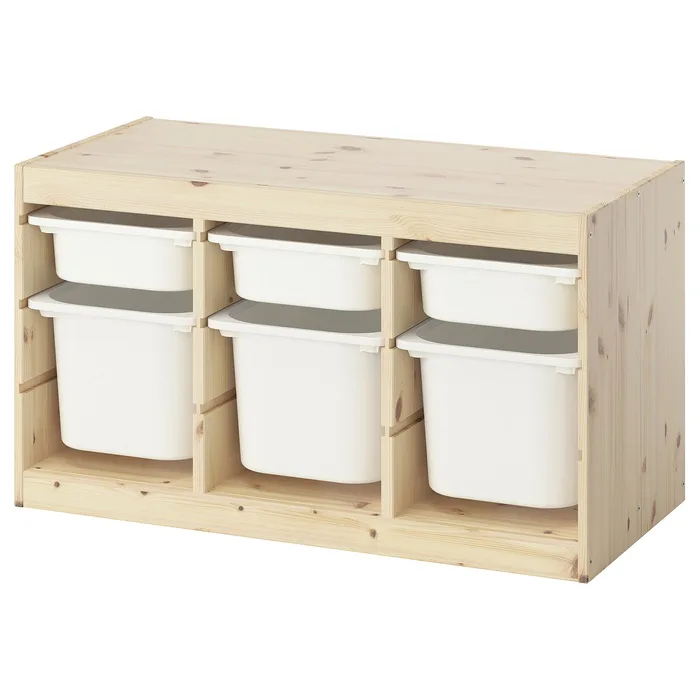
- IKEA TROFAST storage combination with boxes, light white stained pine/white, 36 5/8x17 3/8x20 1/2" - Buy. A low solid pine rail frame with six polypropylene bins that slide out on repositionable grooves, so a toddler can reach every toy without climbing.
- Humble Crew Inspire Grey and White 12-Bin Toy Organizer (WO589) - Buy. Twelve tilted plastic bins on an engineered wood frame with steel rods, short and wide rather than tall and narrow.
- Costway 5-Cube Wooden Kids Toy Storage Organizer with Anti-Tipping Kits (JZ10144) - It depends. A 30 inch tall cubby unit, three open squares over two deep scoop-front bins, sold with the load numbers and anti-tip brackets that many brands in this category leave out.
- Delta Children MySize Deluxe Toy Box (TB83460GN) - Skip. A conventional lidded chest with a slow-close safety hinge, which fixes pinched fingers but not the deeper problem with lidded chests.
The verdict in 30 seconds
What mattered most
- Type
- Frame material (as listed)
- Listed size (W x D x H)
- Storage included
- Published load limit
- Anchoring hardware
Toy storage looks like a decor problem and is really a reach problem. If a child cannot see what is in a container and cannot get it out and put it back alone, the container becomes a pile and you become the librarian. The field splits into four shapes: open rail frames with pull-out bins, tiered bin organizers, open cubby shelving with fixed compartments, and lidded chests. We picked one of each so you can compare the shapes, not just the finishes.
A low solid pine rail frame with six polypropylene bins that slide out on repositionable grooves, so a toddler can reach every toy without climbing.
Best for: Toddler and preschool rooms where the goal is a child fetching and putting away toys without an adult.
- IKEA lists the frame as solid pine with a tinted clear acrylic lacquer, not particleboard.
- The combination includes six boxes in two depths, three at 16 1/2 by 11 3/4 by 9 inches and three at 16 1/2 by 11 3/4 by 4 inches, and the grooves let you move them.
- At 20 1/2 inches tall the whole unit sits below a preschooler's shoulder, so there is nothing to climb and nothing to pull over.
- We found no load rating published for the frame or the boxes, so how much weight to put in a bin is a judgment call.
- The frame and the two box sizes are listed as separate article numbers (203.086.97, 405.821.00, 505.820.72), so this is a flat pack with real assembly.
- The boxes have no lids, labels, or windows, so a sorting system only works if you add your own labels.
- Changing the bin mix means another order, since the combination ships with a fixed set of six.
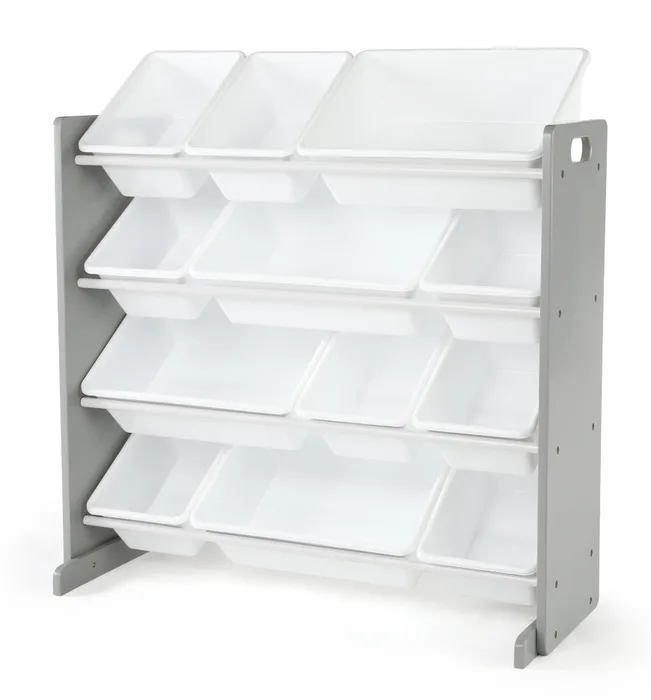
Twelve tilted plastic bins on an engineered wood frame with steel rods, short and wide rather than tall and narrow.
Best for: Playrooms and shared bedrooms where sorting toys into many small categories matters more than heirloom construction.
- Humble Crew publishes a load figure, 20 pounds per level, which many brands in this category leave off the listing.
- Twelve bins in two sizes, eight at 12 by 9 by 6 inches and four at 16 by 12 by 6 inches, give a child enough separate categories to sort rather than dump.
- The listed footprint is 34 inches wide by 11 inches deep, 16 inches with the stabilizing braces, and 31 inches tall, so it is stable by shape rather than by strap.
- The frame is engineered wood with steel shelving rods, so it flexes under a leaning child and the joints do not enjoy being taken apart twice.
- Humble Crew lists stabilizing braces but does not list a wall anchor strap, so anchoring hardware is on you.
- 20 pounds per level disappears quickly under hardwood blocks, die-cast cars, or a bin of magnetic tiles.
- Bins sit loose in the rods, so a child can lift one out and upend it, which is both the feature and the mess.
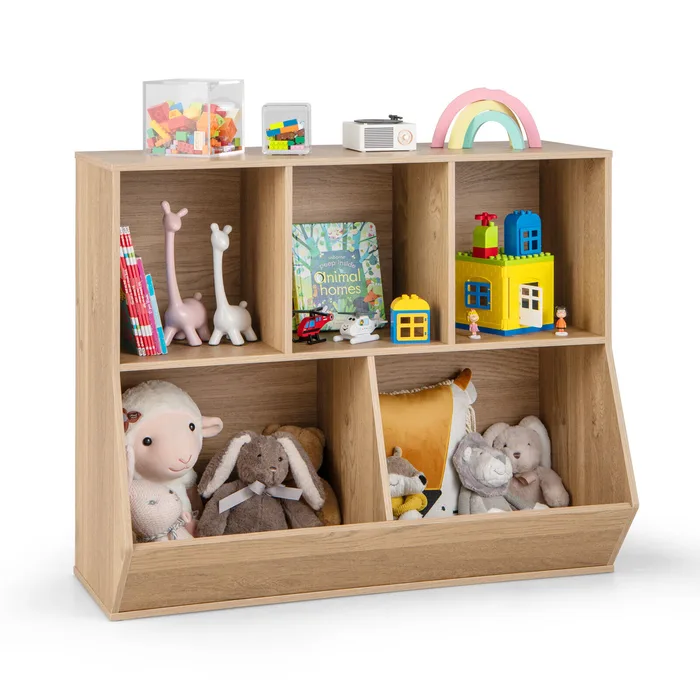
A 30 inch tall cubby unit, three open squares over two deep scoop-front bins, sold with the load numbers and anti-tip brackets that many brands in this category leave out.
Best for: Families who want published load figures and anchoring hardware in the carton, and who are happy with five fixed compartments instead of a dozen bins.
- Costway prints numbers many brands in this category leave out: 22 pounds per cube and 110 pounds on the top panel, in the spec table rather than in marketing copy.
- Two steel anti-tip brackets are in the box, and fixing them to the wall is the last numbered step of the assembly manual, so anchoring is part of the build rather than an afterthought.
- The two lower cubes are 17 by 11 by 15 1/2 inches with 6 inch front barriers, so bulky loose toys stay contained without buying a single bin.
- At 35 1/2 by 16 by 30 inches it is low enough that a preschooler reaches the top surface, and the spec table gives every interior opening so you can check what fits before ordering.
- The frame is MDF and engineered wood, so this is a several-year piece rather than a hand-me-down, and it will not survive being dragged between rooms or taken apart twice.
- Five compartments is coarse sorting next to a twelve-bin organizer, and the three upper squares read as clutter until you add 11 inch cube bins, which are not included.
- Costway lists no ASTM, CPSC, or GREENGUARD certification on the product page, and the spec table carries a California Proposition 65 warning.
- Two brackets is thin coverage for a 35 1/2 inch wide unit, and the manual leaves the wall fixing itself, expansion screws into whatever your wall is made of, to you.
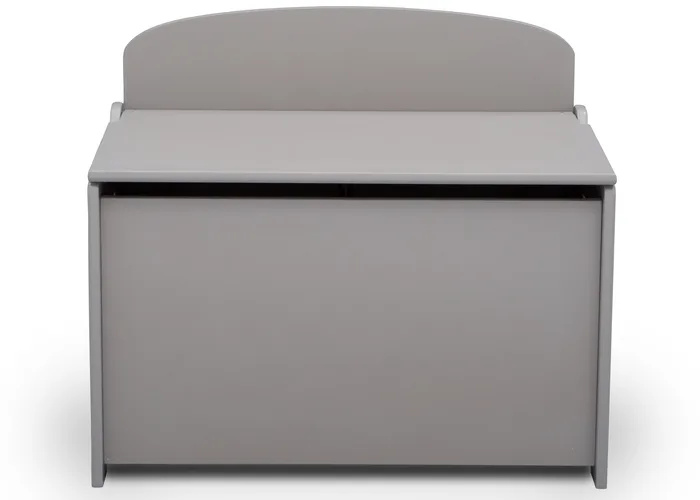
A conventional lidded chest with a slow-close safety hinge, which fixes pinched fingers but not the deeper problem with lidded chests.
Best for: Someone who specifically wants a bench-height lidded chest for bulky items and accepts a dig-through-the-pile system.
- The slow-close lid with safety hinge is real and is the direction CPSC points parents who insist on a vertically opening lid.
- It is GREENGUARD Gold certified, which Delta describes as screening for more than 10,000 chemicals and VOCs, and that is more disclosure than most toy furniture offers.
- Cut-out handles on both sides make it easy for one adult to move between rooms.
- One deep compartment is the worst possible layout for retrieval: everything lands in a heap and the child digs instead of choosing.
- CPSC guidance is blunt that open chests and bins with no lids, or chests with lightweight removable lids, do not present the falling-lid risk at all.
- We could not confirm a manufacturer age recommendation on the product page, so check it before buying for a toddler.
- We could not find assembled dimensions or a weight capacity on the product page, so check fit and limits before buying.
| Criteria | TROFAST storage combination with boxes, light white stained pine/white, 36 5/8x17 3/8x20 1/2" Top pick | Inspire Grey and White 12-Bin Toy Organizer (WO589) | 5-Cube Wooden Kids Toy Storage Organizer with Anti-Tipping Kits (JZ10144) | MySize Deluxe Toy Box (TB83460GN) |
|---|---|---|---|---|
| Verdict | Buy it | Buy it | It depends | Skip it |
| Best for | Toddler and preschool rooms where the goal is a child fetching and putting away toys without an adult. | Playrooms and shared bedrooms where sorting toys into many small categories matters more than heirloom construction. | Families who want published load figures and anchoring hardware in the carton, and who are happy with five fixed compartments instead of a dozen bins. | Someone who specifically wants a bench-height lidded chest for bulky items and accepts a dig-through-the-pile system. |
| Price tier | $$ · mid-range | $ · budget | $ · budget | $$ · mid-range |
| Type | Open rail frame, pull-out bins | Tiered open bins on a rod frame | Open cubby shelf, 3 squares over 2 deep bins | Lidded chest, one compartment |
| Frame material (as listed) | Solid pine, tinted clear acrylic lacquer | Engineered wood with steel shelving rods | MDF and engineered wood | Engineered wood with scratch-resistant finish |
| Listed size (W x D x H) | 36 5/8 x 17 3/8 x 20 1/2 in | 34 x 11 in (16 in with braces) x 31 in | 35 1/2 x 16 x 30 in | Not confirmed on product page |
| Storage included | 6 boxes: 3 deep, 3 shallow | 12 bins: 8 standard, 4 large | 5 fixed cubbies: 3 shallow, 2 deep with 6 in barriers | One open compartment under the lid |
| Published load limit | Not published | 20 lb per level | 22 lb per cube, 110 lb on top | Not published |
| Anchoring hardware | Not listed for this low frame | Stabilizing braces; no wall strap listed | 2 anti-tip brackets included; wall fixings not specified | Not listed |
| Lid | None | None | None | Slow-close lid with safety hinge |
| Certifications the brand lists | None listed on the product page | ASTM International, CPSC certified, non-toxic paints and glue, formaldehyde compliant | None listed; page carries a California Proposition 65 warning | GREENGUARD Gold |
Which one is right for you?
- Toddler and preschool rooms where the goal is a child fetching and putting away toys without an adult. Buy it IKEA TROFAST storage combination with boxes, light white stained pine/white, 36 5/8x17 3/8x20 1/2"
- Playrooms and shared bedrooms where sorting toys into many small categories matters more than heirloom construction. Buy it Humble Crew Inspire Grey and White 12-Bin Toy Organizer (WO589)
- Families who want published load figures and anchoring hardware in the carton, and who are happy with five fixed compartments instead of a dozen bins. It depends Costway 5-Cube Wooden Kids Toy Storage Organizer with Anti-Tipping Kits (JZ10144)
- Someone who specifically wants a bench-height lidded chest for bulky items and accepts a dig-through-the-pile system. Skip it Delta Children MySize Deluxe Toy Box (TB83460GN)
How we judged the field
Five things decide whether toy storage works. Reach comes first: a container a child cannot see into and cannot lift out alone is a container an adult empties. Second is granularity, because one big space produces a heap and eight small spaces produce categories, and categories are what make a child able to clean up. Third is frame construction, since almost everything in this category is engineered wood and the exceptions are worth paying attention to. Fourth is published limits, because a brand that prints a load figure has measured something, and a brand that prints nothing is asking you to guess. Fifth is the safety story, which in this category is narrow and specific: tip-over for anything tall, and falling lids for anything with a hinged top.
The field sorts into four shapes. Rail frames with deep pull-out bins are the most durable and the most flexible, because the bin depth and position can change as the toys change. Tiered bin organizers are the cheapest way to get many small categories at a child’s height, at the cost of frame rigidity. Open cubby shelving is the middle path: fixed compartments at child height, sometimes with a deep scoop-front bin or two built in, but the shallow squares still read as a shelf until you put containers in them. Lidded chests are the oldest shape and the one we would not choose, for reasons that are about retrieval as much as safety. We picked one representative of each so the comparison is between formats, not between finishes.
IKEA TROFAST storage combination with boxes, light white stained pine/white, 36 5/8x17 3/8x20 1/2”
Buy itThe TROFAST combination is the version of this system worth buying, because IKEA lists this frame as solid pine. Solid pine matters here for an unglamorous reason: the frame is a set of grooved rails that take repeated sideways force every time a child yanks a bin out at an angle, and pine holds a screw through that abuse in a way particleboard does not. The combination includes six boxes, three deep at 16 1/2 by 11 3/4 by 9 inches and three shallow at 16 1/2 by 11 3/4 by 4 inches, and the grooves let you slide them anywhere on the frame or swap in a shelf. The 20 1/2 inch height is the quiet win: it is low enough that a preschooler reaches every bin flat-footed, which is a better answer to tipping than a strap. We found no load rating from IKEA, and assembly is a genuine flat-pack session. For a toddler or preschool room where the child does the fetching and the putting away, this is the one.
Humble Crew Inspire Grey and White 12-Bin Toy Organizer (WO589)
Buy itThe Humble Crew Inspire is the cheapest honest way to get twelve separate places for toys at a height a child can work. Eight standard bins at 12 by 9 by 6 inches and four large bins at 16 by 12 by 6 inches is enough granularity that a four-year-old can sort blocks from cars from small figures instead of sweeping everything into one hole. Humble Crew also publishes what many competitors omit: 20 pounds per level, which is both useful and sobering once you weigh a bin of hardwood blocks. The frame is engineered wood with steel shelving rods, and it behaves that way, flexing under a leaning child and losing some rigidity if you ever take it apart and rebuild it. The listing mentions stabilizing braces that push the depth from 11 to 16 inches but does not list a wall anchor strap, so anchoring is on you. The trade-off is plain: more categories and less money in exchange for a frame that will not be handed down. For a playroom or a shared bedroom, that is often the right trade.
Costway 5-Cube Wooden Kids Toy Storage Organizer with Anti-Tipping Kits (JZ10144)
It dependsThe Costway 5-Cube organizer is the best-documented unit in this comparison and still only a depends, which is a useful thing to sit with. Costway prints 22 pounds per cube and 110 pounds on the top panel in a plain spec table, gives the interior size of every opening, three upper squares at 11 by 11 by 13 inches and two lower cubes at 17 by 11 by 15 1/2 inches with 6 inch front barriers, and puts two steel anti-tip brackets in the carton with wall fixing as the final numbered step of the assembly manual. Set against IKEA, where we found no load rating for TROFAST, that is a real advantage, and it is the kind of disclosure that should be the floor in a category sold to parents. What it does not fix is the frame and the format. The construction is MDF and engineered wood, so this is a several-year piece that will not enjoy being dragged between rooms or rebuilt twice, and the product page lists no ASTM, CPSC, or GREENGUARD certification while carrying a California Proposition 65 warning. Five compartments is coarse sorting compared with a twelve-bin organizer: the two deep cubes genuinely hold loose stuffed animals and bulky toys without any bin at all, but the three shallow squares look like clutter until you add 11 inch cube bins, which cost extra. At 30 inches tall with a 35 1/2 inch top surface, the top also becomes a shelf whether you intend it to or not, which is exactly why the brackets are in the box. Buy it if published numbers and included anchoring hardware are what you were missing, and accept that you are buying MDF to get them.
Delta Children MySize Deluxe Toy Box (TB83460GN)
Skip itThe Delta Children MySize Deluxe Toy Box is well made for what it is, and what it is remains the wrong shape. The slow-close lid with safety hinge is genuine, and it is the direction CPSC points parents who insist on a vertically opening lid. GREENGUARD Gold certification is real disclosure that many competitors skip. But the format defeats the purpose: one deep compartment means everything lands in a heap, a child digs to the bottom for the thing they want, and cleanup means sweeping toys in rather than sorting them. CPSC’s own consumer guidance is explicit that open chests and bins with no lids, or chests with lightweight removable lids, do not present the falling-lid risk at all, which is a strange thing to read on the way to buying a lid. We could not confirm an age recommendation, assembled dimensions, or a weight capacity on the product page, so check those before buying. For a bench-height box of bulky things, fine. As the room’s main toy storage, no.
Sources
Specs in this review come from these pages.
- U.S. Consumer Product Safety Commission, CPSC Warns Consumers of Dangers with Toy Chest Lids (Publication 5099) (cpsc.gov)
- 16 CFR Part 1250, Safety Standard for Toys (requires ASTM F963-23) (ecfr.gov)
- 16 CFR Part 1261, Safety Standard for Clothing Storage Units (ecfr.gov)
- CPSC, Product Instability or Tip-Over Injuries and Fatalities Associated with Televisions, Furniture, and Appliances: 2023 Report (cpsc.gov)
- ASTM International, F834 Standard Consumer Safety Specification for Toy Chests (Withdrawn 2016) (store.astm.org)
- Costway, 5-Cube Wooden Kids Toy Storage Organizer product page (load capacity and anti-tipping specifications) (costway.com)
- Costway, assembly and safety manual for item 73526894 (anti-tip bracket installation) (cdn1.costway.com)
IKEA TROFAST storage combination with boxes, light white stained pine/white, 36 5/8x17 3/8x20 1/2” vs Humble Crew Inspire Grey and White 12-Bin Toy Organizer (WO589): which should you buy?
TROFAST and the Humble Crew organizer solve the same problem from opposite ends. TROFAST buys durability: a solid pine frame, deep bins that slide on repositionable grooves, and a 20 1/2 inch height that makes climbing pointless. Humble Crew buys granularity: twelve bins in two sizes for less money, at 31 inches tall and 34 inches wide, on an engineered wood frame with steel rods. If your child is two or three and you want them working the storage themselves, TROFAST’s height and bin depth win. If your child is four or five and the problem is that twenty categories of small toys are living in three containers, the Humble Crew gives you more sorting for less.
The deciding question is how long you expect the piece to last. TROFAST’s solid pine frame should hold up better to repeated rebuilds; the Humble Crew frame is a several-year purchase that ages by loosening. The other deciding question is weight, and here both of our buy picks are beaten on paperwork. Humble Crew publishes 20 pounds per level, which a bin of wooden blocks or magnetic tiles reaches fast; we found no figure for TROFAST, so you are estimating. The Costway cubby unit prints both a per-cube figure and a top-panel figure, which is the disclosure we would like from everyone, and it still loses to TROFAST on frame material and to Humble Crew on how many categories you get. Whichever you choose, put the heaviest bins on the bottom row and label the fronts, because a child who can read a picture label puts toys back in the right place and a child who cannot puts them anywhere.
What to look for
- Reach before capacity: if the top of the unit is above your child’s shoulder standing flat on the floor, they will climb it, so pick the shorter unit even when it holds less.
- A published load figure: a brand that prints pounds per shelf or per level has tested something, and a listing with no numbers is asking you to guess how much a bin of blocks weighs.
- Frame material named in plain words: solid pine, birch plywood, and particleboard behave completely differently under a child yanking bins sideways, and the spec sheet usually says which one you are getting.
- Anchoring hardware you can identify: wall brackets in the box are common, wall screws and plugs almost never are, so read the fine print and buy fixings suited to your wall.
- No hinged lid, or a support that holds it anywhere: CPSC’s guidance is that no lid, a lightweight removable lid, or a sliding panel avoids the falling-lid hazard, and a vertically opening lid needs a support you test yourself.
- Bins that a small child can reseat: rigid plastic that drops back into a rail beats fabric that sags, because storage a child cannot re-load alone quietly becomes an adult chore.
Our final take
Buy for how a child uses a room, not how the room photographs. The TROFAST combination gets it right by being low, by giving six deep bins that slide out and go back, and by using solid pine where many others in this category use engineered wood. The Humble Crew organizer is the honest budget answer if what you need is more separate categories rather than a frame that lasts a decade. The Costway cubby unit is worth it if what you were missing is published load figures and anti-tip brackets in the box, and you can live with MDF and five compartments. And the lidded chest, however nicely finished, buys you a heap you have to dig through, plus a hazard that CPSC tells you how to avoid entirely: skip the lid.
Questions, answered
Are lidded toy chests actually dangerous?
The hazard is specific and well documented. CPSC has published that children have died when lids of containers used for toy storage fell on their heads or necks, and that there have been incidents of permanent brain damage. Its guidance says the incidents typically happened when a child used the chest to pull up and the lid fell from the open position, or when a small child tried to open the lid alone. CPSC's recommendation is that open chests and bins with no lid, chests with lightweight removable lids, and chests with sliding doors or panels do not present the falling-lid risk. If you keep a vertically opening lid, it should have a support that holds the lid open in any position it is placed, and you should test that support yourself and re-check it over time.
Do toy organizers have to meet a federal tip-over standard?
Not the way dressers do. The federal tip-over rule, 16 CFR Part 1261, applies to clothing storage units, which it defines as free-standing furniture intended for the storage of clothing typical of bedroom furniture, and it took effect for units manufactured after September 1, 2023. A toy organizer or open cube shelf is generally outside that definition, so nothing forces it to pass the stability test that a dresser must pass. That is why anchoring is your job here rather than the manufacturer's. Treat any unit tall enough for a child to climb as an anchoring project regardless of what the box says.
Which standard covers toy chests?
Toy chest requirements now live inside ASTM F963, the toy safety standard. The separate toy chest standard, ASTM F834, was withdrawn in 2016, and its requirements were folded back into F963 as its toy chest section. F963 is not merely voluntary in the United States: 16 CFR 1250.2 requires that each toy comply with all applicable provisions of ASTM F963-23. So a product genuinely marketed and sold as a toy chest is expected to meet lid and closure requirements. That does not make a lidded chest a good organizer, only a regulated one.
How tall is too tall for a kid's room?
There is no legal answer, so use the child rather than a number. If your child can reach the top shelf standing flat on the floor, they have no reason to climb; if they cannot, they will. Height also changes the math on tipping, because a taller, narrower unit reaches its tipping point with less force. CPSC's 2023 tip-over report estimated an annual average of 17,800 emergency department treated tip-over injuries between 2020 and 2022, with 7,800 of those, 44 percent, to children under 18. Short and wide is a design choice that removes the problem instead of managing it.
Are plastic bins better than fabric bins?
For toys, usually yes. Rigid plastic holds its shape when a child yanks it out and slides back into a rail or rod without needing an adult to reshape it. Fabric bins collapse, sag when loaded, and are harder for small hands to reseat, which quietly turns cleanup into an adult job. Fabric wins on softness and on looking less like a classroom, and it is easier to wash. If you go fabric, pick bins with rigid inserts or a stiff base and accept that they will need replacing sooner.
Deciding between the top two? See our head-to-head: IKEA TROFAST storage combination with boxes, light white stained pine/white, 36 5/8x17 3/8x20 1/2" vs Humble Crew Inspire Grey and White 12-Bin Toy Organizer (WO589).
More Baby & Family reviews
 The Best Train Sets: 4 Compared (and One to Skip)
  The Best Travel Strollers: 4 Compared (and One to Skip)
  Best Video Baby Monitors: What Actually Earns a Spot in the Nursery (and One to Skip)
  The Best Weighted Stuffed Animals: 4 Compared (and One to Skip)
  The Best White Noise Machines for Sleep (and One We'd Skip)
  The Best Booster Car Seats: 4 Compared (and One to Skip)