Explained
Toddler Tricycles, Explained
After reading, you'll understand which numbers on a toddler trike listing predict whether your child will actually ride it, and which ones are decoration.
In this guide
First-time buyers get tripped up by the stage count. A trike advertised as 4-in-1 or 5-in-1 sounds like four products for the price of one, but the stages are often just accessories coming off in sequence, and the trike underneath never changes. Meanwhile the specs that decide whether the thing gets ridden, its own weight and whether the seat can be moved to fit your child's legs, are frequently missing from the page entirely. The other common surprise is discovering that a balance bike, which looks like less product for more money, may be the better answer.
The 30-second version
- Stage counts are marketing, so read what each stage removes rather than counting how many there are.
- The trike's own weight is the hidden spec, because leg strength at this age is small and a heavy trike simply does not move.
- An age range without a weight limit is half a spec, and the weight limit is usually the one that ends the trike's useful life first.
- Inseam beats age every time, which is why the makers who publish inseam ranges are telling you something the others are not.
- A balance bike is a different product, not a cheaper trike, so compare them on what you want to happen next year rather than on price.
The products this guide is about
Our verdict on each, with the full reasoning on the companion review.
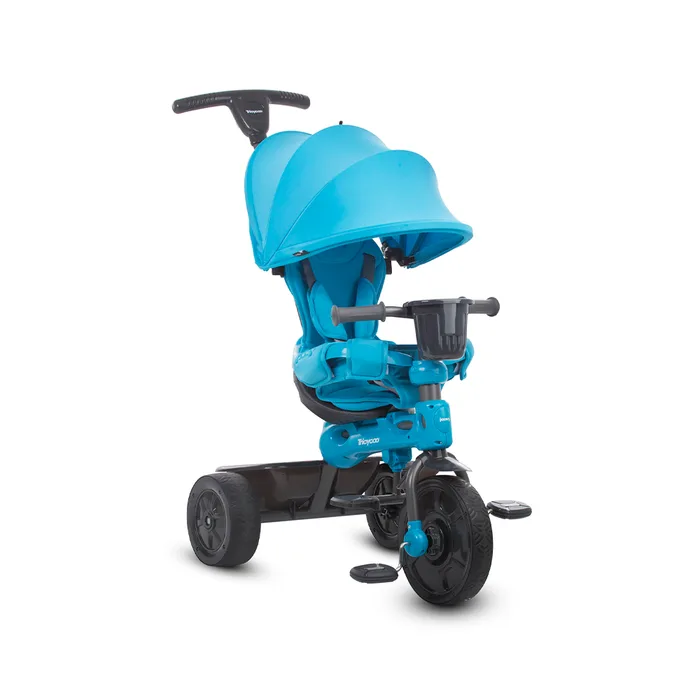
- Buy Joovy Tricycoo 4.1 The convertible trike with the most usable published numbers and the lightest frame of the trikes here. Amazon
- Buy Radio Flyer 4-in-1 Stroll 'N Trike The value convertible: the highest stated rider weight limit of the trikes here and the longest listed age range, with a thinner spec sheet. Amazon
- It depends Strider 12 Sport Balance Bike Not a trike at all, and for teaching a child to ride that is the point. Amazon
- Skip Schwinn Roadster Tricycle 12in A handsome all-steel retro trike sold without the three numbers a parent most needs. Amazon
What actually matters
- Assembled weight - This is how much the trike weighs empty, and it is the single best predictor of whether a toddler can move it under their own power. It also decides whether you will happily carry it back to the car or start leaving it at home.
- Rider weight limit - The maximum load the maker rates the frame and seat for, stated separately from the age range. Children hit weight limits at very different ages, so this number, not the age band, usually tells you when the trike is done.
- Seat adjustability - A seat that slides fore and aft or moves up and down is what keeps the pedals reachable as legs grow. Without it the trike fits properly for one short window and is wrong on both sides of it.
- Parent handle height - The push handle is what makes a trike useful before a child can pedal, and its height determines whether the adult walks upright or hunched. Removable handles matter too, because a child riding solo does not want one behind them.
- Wheel and tire material - Foam, rubber and hard plastic behave very differently on grass, gravel and pavement, affecting grip, noise and how much bump the child feels. Many trike pages say nothing about material, which is itself worth noticing.
- Restraint type - Harnesses matter only in the earliest stages, when a child cannot reliably hold themselves upright. A three-point harness covers the waist and crotch, a five-point adds shoulders, and a removable safety guard is a separate bar rather than a strap.
- Pedal engagement - Some trikes let you disconnect or lock the pedals so they do not spin while you push, and some use a fixed crank where the pedals always turn with the wheel. This changes both comfort and how safe the pushing phase feels.
The specs, in plain English
Green flags vs red flags
Green flags
- The page publishes an assembled weight for the product itself, not just carton dimensions.
- There is a rider weight limit stated alongside the age range.
- Fit is given as an inseam or seat height range rather than only as an overall box size.
- The seat adjusts and the maker says how, whether it slides fore and aft or changes height.
- The push handle is described as height-adjustable and removable rather than simply present.
Red flags
- No age range, no weight limit and no product weight anywhere on the manufacturer's own page.
- A high stage count with no explanation of what changes between stages.
- Wheel and tire material left unstated when the listing is otherwise detailed.
- A stated age range that starts well below the age at which the harness or safety guard is described as usable.
- Replacement parts are not offered anywhere on the maker's site, which matters for a product that gets dragged over kerbs.
Who's who: the brands
- Radio Flyer - The default American trike brand, with a wide range from classic steel trikes through four-stage stroller trikes and balance bikes, generally at accessible prices.
- Joovy - A juvenile gear maker whose Tricycoo line focuses on multi-stage convertible trikes with parent-oriented controls like pedal locks and rear brakes.
- Strider - A balance-bike specialist that publishes unusually detailed fit data and builds very light bikes aimed at getting children onto two wheels early.
- Schwinn - A long-established bicycle brand whose kids' range includes retro-styled steel trikes sold largely on classic looks and heritage.
- Doona - Known for the Liki Trike, a compact folding stroller-trike aimed at families who need something that packs down small for travel and city use.
How to read a listing without getting fooled
Start at the bottom of the listing, not the top. Skip the stage count and the lifestyle photos and find the spec block, then look for three things in order: assembled weight, rider weight limit, and any fit measurement more specific than the overall box dimensions. If all three are there, the maker expects you to size the product and you can compare it fairly against a rival. If the block only gives you length, width and height, you are being sold a silhouette. Next, read the feature bullets for what is removable rather than what is included, because that is where the real stage progression lives, and check whether the words brake, pedal lock and adjustable appear anywhere. Finally, look at whether the site sells replacement parts. A trike lives outdoors and gets crashed into kerbs, and a maker who stocks spare wheels and pedals is telling you something about how long they expect the product to last.
How much should you spend?
Budget trikes cover the basic convertible formula: a push handle, a canopy, a harness and a seat that adjusts, often with unstated wheel material and no brake. That is enough for most families, and the Radio Flyer 4-in-1 sits squarely in that band. Moving to the mid-range buys refinement rather than a different product: a lighter frame, a pedal lock, a rear brake, a better canopy and more thought about how the handle and seat adjust, which is where the Joovy Tricycoo 4.1 and most quality balance bikes live. The premium tier is mostly about packability and materials, folding travel trikes with aluminium profiles and five-point harnesses aimed at families who fly or take transit. Spending more does not buy more months of use, since the weight limit sets that. It buys a nicer experience during the months you have.
Questions, answered
What does 4-in-1 or 5-in-1 actually mean?
It is a count of configurations, not of products. The maker starts with everything attached, a canopy, a harness or safety guard, footrests and a parent push handle, and each stage removes one layer as the child grows. Two trikes with identical hardware can be marketed as 3-in-1 and 5-in-1 depending on how finely the maker slices the sequence. Read what each stage adds or removes and ignore the number.
Are foam tires worse than rubber ones?
They are different rather than strictly worse. Solid foam tires cannot puncture, never need pumping and are much lighter, which is why they are common on toddler products. Inflated rubber tires grip better on loose surfaces and absorb more of a bumpy path, which you notice on gravel or grass rather than on a smooth pavement. For a trike used mostly on sidewalks, foam is a sensible default.
How long will a trike actually last before they outgrow it?
The rider weight limit usually ends it before the age range does. Convertible trikes in this comparison are rated between 44 and 49 pounds, and children reach those weights at quite different ages. A seat that adjusts extends the useful window at the top end, since the constraint is often reach to the pedals rather than the frame. Buy on the weight limit and the seat range, not on the highest age printed on the box.
Do I need to worry about safety certification?
Toys sold in the US must comply with all applicable provisions of ASTM F963-23 under 16 CFR 1250.2, so compliance is a legal baseline rather than a feature a brand competes on. That is why you rarely see the standard quoted on a product page, and why its absence from a listing is not by itself a warning sign. What is worth checking is that the product comes from an identifiable brand with a real support page, a warranty and replacement parts, since those are the things you will need if something breaks.
Or jump to the head-to-head: Joovy Tricycoo 4.1 vs Radio Flyer 4-in-1 Stroll 'N Trike.