Explained
Toddler Utensils, Explained
After reading, you'll understand what a toddler utensil is actually made of, which safety phrases refer to a real standard, and how to read a care line before you buy.
In this guide
First-time buyers usually shop this category on pictures and colours, then discover three months later that the soft tip has a bite out of it or that the set cannot go in the dishwasher. The wording on these pages is where the useful information hides, and it is inconsistent between brands and sometimes inside a single listing. A few phrases look like certifications and are not. A few genuinely name a regulation you can look up. Knowing which is which takes about five minutes and saves you buying the same set twice.
The 30-second version
- Head material decides lifespan, so if a toddler already has molars, a stainless head will outlive a silicone one by a wide margin.
- Non-toxic is not a certification, it is an unregulated marketing adjective, and a page that leans on it usually has nothing more specific to offer.
- Dishwasher safe does not mean sterilizer safe, and several brands explicitly forbid boiling and steam while allowing a top rack wash.
- Short handles are the design choice that matters, because they suit a fist grip and keep the far end of the utensil from reaching deep into a mouth.
- Mess reduction is not a real product category, so a set sold mainly on that promise is asking you to pay for something no utensil can deliver.
The products this guide is about
Our verdict on each, with the full reasoning on the companion review.
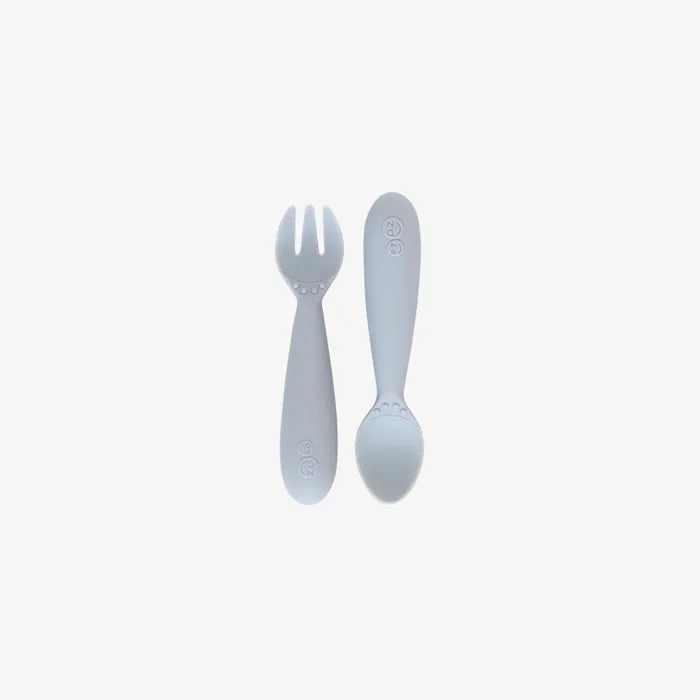
- Buy ezpz Mini Utensils A fork and spoon with stiff nylon heads and a fist-sized silicone handle, aimed at the year when a toddler is finally strong enough to load a utensil. Amazon
- Buy Bumkins Spoon + Fork Set Stainless steel heads on textured silicone handles, sized for toddlers and cheap enough to buy two sets. Amazon
- It depends Avanchy Baby Spoons Regular Scoop, Bamboo & Silicone A wide silicone bowl on a short bamboo handle, gentle on gums and strictly handwash. Amazon
- Skip Munchkin Raise Toddler Fork & Spoon Set A cheap matched pair whose headline feature is a base that keeps the tips off the table, with almost no materials disclosure behind it. Amazon
What actually matters
- Head material - This is the single biggest determinant of how long a set survives and how well it picks food up. Silicone is soft and gets chewed, nylon is stiffer and holds a shape, stainless steel is the durable option and the one most brands reserve for older toddlers.
- Handle length - A published length lets you judge both reach and how far the utensil can travel toward the back of a mouth. Brands that publish it are usually the ones that thought about it.
- Grip diameter - Toddlers hold a utensil in a closed fist, not between finger and thumb, so a fat, round handle is easier to control than a slim adult-shaped one. Some listings publish the handle width at the end and in the middle, which is the number you want.
- Stated age range - The age on the box is the maker's claim about what the design can do, not a rule. A set rated 18 months and up is telling you it was not designed for a six month old's mouth or grip.
- Named compliance - A page that cites third party lab testing against specific US CPSC rules, or names LFGB grade silicone, gives you something to verify. A page that says only BPA-free gives you one narrow claim.
- Care limits - Dishwasher, microwave, boiling and steam sterilizing are four different heat exposures with different answers per product. Read all four before assuming your usual cleaning routine applies.
- Choke guard - Some starter utensils add a wide collar or barrier partway down the handle, intended to stop the utensil going too far into the mouth. None of the four sets compared here advertises one, so if that feature matters to you, check the listing specifically rather than assuming.
The specs, in plain English
Green flags vs red flags
Green flags
- The page states head material and handle material separately, rather than describing the whole set as one material.
- Published dimensions, ideally overall length plus handle width at the end and in the middle.
- Named compliance testing, such as third party labs testing to specific US CPSC rules, or LFGB grade silicone.
- A care line that addresses dishwasher, microwave, boiling and sterilizing as separate questions.
- A stated age range that matches the design, with a clear next step in the brand's own range for older children.
Red flags
- Non-toxic used as if it were a certification, with no standard, test or regulation named anywhere.
- BPA-free as the only chemical statement on the page.
- Chew-proof or bite-proof claims on a silicone tip, which no maker in this category backs with a test.
- Antimicrobial or antibacterial material claims with no test method or standard cited.
- Materials copy that contradicts itself, such as calling a set 100 percent silicone when the heads are visibly metal.
Who's who: the brands
- ezpz - Builds a staged line of feeding utensils, starting with the Tiny Spoons and moving up to the Mini Utensils at twelve months.
- Bumkins - Feeding brand with silicone and stainless gear that states its third party testing on the product page.
- Avanchy - Focuses on bamboo and stainless steel with silicone tips, marketed on sustainability, with several patented utensil shapes.
- Munchkin - Mass-market baby range that includes feeding gear, with the Raise set listing little beyond BPA-free.
- OXO Tot - A kids line from a housewares brand, known for chunky ergonomic handles.
How to read a listing without getting fooled
Start at the bottom of the listing rather than the top. Find the materials line and check whether it names the head and the handle separately, because a set with a metal head and a silicone grip should say both. Then look for dimensions, since a published length and handle width tells you more about whether a small hand can use the thing than any amount of ergonomic copy. Next read the care instructions as four separate permissions: dishwasher, microwave, boiling, sterilizing. Finally, scan the safety claims and sort them into two piles, one for phrases that reference something checkable, such as a named regulation or a third party lab, and one for adjectives. If the second pile is bigger than the first, you are buying on trust.
How much should you spend?
This is a cheap category, which is worth remembering before you talk yourself into a premium set. Budget tier gets you a matched fork and spoon from a mass-market brand, and at that level the quality varies less than the disclosure does, so choose the budget set that publishes the most. Mid-range buys either a specialist design aimed at one developmental stage or a natural-material set such as bamboo with silicone, and the extra generally goes on shape and thought rather than materials cost. Premium in this category usually means a multi-stage bundle or a gift set of several pieces, which is fine as a present but rarely better value than buying the one stage you need now. Since even the good sets get chewed, lost and left at nursery, buying two budget sets often beats buying one expensive one.
Questions, answered
What does LFGB grade silicone actually mean?
LFGB is the German food and feed code, the Lebensmittel- und Futtermittelgesetzbuch, which sets the rules for food contact materials sold in Germany. When a brand says LFGB grade silicone it is claiming the material was tested to that framework, which is generally considered stricter than a bare US food contact claim. It is a genuine reference you can look up, which puts it in a different class from an adjective. It still refers to the material rather than certifying the finished product.
Is non-toxic a certification?
No. Non-toxic has no fixed legal definition on consumer goods in this category, and no body issues a non-toxic certificate for a toddler spoon. It is worth something only when the same page also names what was actually tested, such as lead, phthalates, BPA, BPS and cadmium, and who did the testing. If non-toxic is the strongest claim on the page, treat it as marketing. Look instead for a named regulation, a named standard or a third party lab.
What is a choke guard on a toddler utensil?
It is a wide collar or barrier set partway along the handle, meant to stop the utensil travelling too far into a child's mouth. It is a design feature rather than a regulated safety category, so its presence is not certified by anyone. A short handle achieves something similar by simply not being long enough to reach far. If this matters to you, check the listing and photos directly, and remember that supervision during meals is the thing that actually does the work.
Can a toddler skip training utensils and use a small metal fork?
Plenty of families do, and it mostly comes down to grip and geometry rather than the metal itself. A scaled-down adult fork usually has a long, slim handle designed for a finger and thumb hold, which is harder for a toddler who grips with a whole fist. Toddler forks are made short and thick with blunted, inward-bent outer tines for exactly that reason. If you do use adult cutlery, pick the shortest, fattest handle in the drawer and supervise as you would with any pointed utensil.
Or jump to the head-to-head: ezpz Mini Utensils vs Bumkins Spoon + Fork Set.